New Synagogue Berlin (Neue Synagoge): A Complete Visitor Guide
The New Synagogue Berlin on Oranienburger Straße is one of the city's most architecturally arresting buildings and a place of profound historical weight. Once the largest synagogue in Germany, it was damaged during the November 1938 pogroms, nearly destroyed in World War II, and painstakingly reconstructed over decades. Today the building houses the Centrum Judaicum, a museum and memorial dedicated to Berlin's Jewish history.
Quick Facts
- Location
- Oranienburger Straße 28–30, 10117 Berlin (Mitte)
- Getting There
- S-Bahn Oranienburger Straße (S1, S2, S25, S26) — 2-min walk; U-Bahn Oranienburger Tor (U6) — 5-min walk
- Time Needed
- 1–2 hours for the exhibition and dome; 30 minutes if visiting only the exterior and courtyard
- Cost
- Standard €7 / Reduced €4.50 / Family €20 (museum areas; verify current prices on-site)
- Best for
- History enthusiasts, architecture lovers, those tracing Jewish heritage in Berlin
- Official website
- centrumjudaicum.de
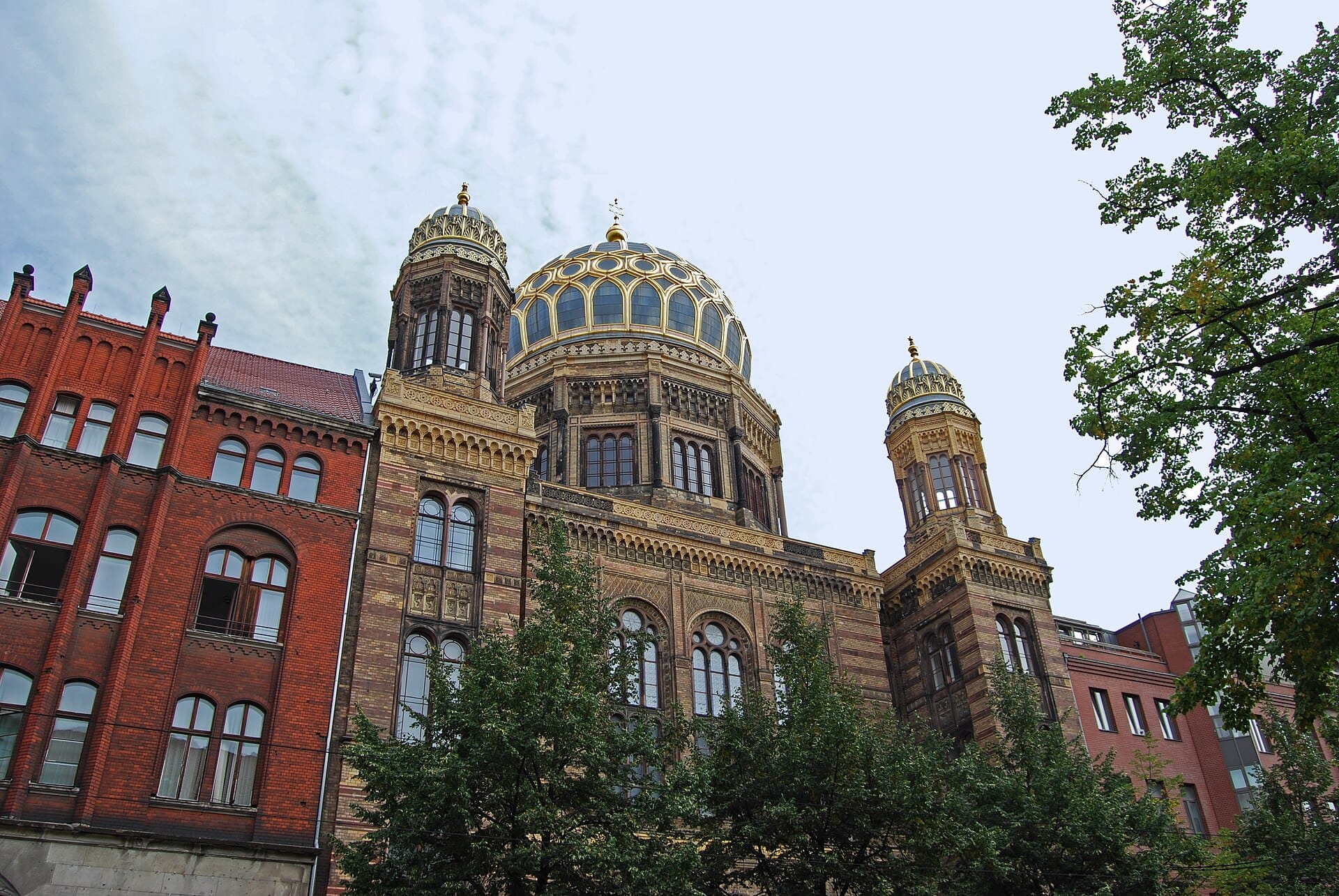
First Impressions: What You See Before You Even Enter
The New Synagogue Berlin announces itself well before you reach the entrance. The golden dome rises above the roofline of Oranienburger Straße with an almost theatrical confidence, its Moorish-revival façade of yellow and red brick, gilded ornamental metalwork, and horseshoe arches standing in sharp contrast to the quieter residential streetscape around it. In morning light, the dome catches the sun at an angle that makes it shimmer. By late afternoon, the brickwork deepens to a warm amber. At night, discreet floodlighting gives the whole structure a composed, ceremonial quality.
The façade alone is worth the walk from the S-Bahn station, which is no more than two minutes away. Most visitors stop for photographs before entering, and there is good reason to: the scale of the building only becomes fully apparent once you step back to the far side of the street. What is harder to read from the outside is the fact that the interior behind this façade is largely a reconstruction. The original building was far more vast than what survives today, and understanding that gap is central to understanding the site.
ℹ️ Good to know
Security screening is in place at the entrance. Bags are checked and you will pass through a metal detector. This is standard for Jewish institutions in Berlin and adds only a few minutes to entry.
History: From Grand Opening to Near-Total Destruction
The Neue Synagoge was dedicated on 5 September 1866, at the Jewish New Year, in a ceremony attended by Prussian Prime Minister Otto von Bismarck. At the time of its opening, it was the largest synagogue in Germany, with approximately 3,200 seats. The architect Eduard Knoblauch designed it in the Moorish Revival style, a deliberate choice that combined the visual language of Sephardic synagogues with cutting-edge 19th-century iron construction. The main dome stood more than 50 metres high and was recognized internationally for its engineering as much as its aesthetics.
During the November 1938 pogroms, known in German as Kristallnacht, the building was attacked and set on fire. The local police commander, Wilhelm Krützfeld, is documented to have intervened to protect the structure, citing its status as a listed historical monument. The fire was extinguished. The synagogue survived that night, though badly damaged. What ultimately destroyed much of the building was Allied bombing in 1943, which collapsed the main prayer hall and the central dome. The ruin stood for years. In 1958, the East German authorities demolished the remaining damaged sections of the nave, leaving only the front section and the reconstructed dome visible today.
Reconstruction of the surviving portions began in 1988, still during the East German period. The restored building was formally transferred to the Stiftung Neue Synagoge Berlin – Centrum Judaicum on 16 December 1994 and reopened to the public on 7 May 1995 with the exhibition "Tuet auf die Pforten" ("Open the gates"). What visitors see today is an honest reconstruction: the dome and front sections have been restored in detail, but the former main hall is gone. In its place, a courtyard and a clear explanation of what once stood there.
For a broader understanding of the sites and events connected to Jewish history in Berlin, the Jewish Museum Berlin in Kreuzberg offers one of the most architecturally and intellectually rigorous explorations of the subject anywhere in the city.
Tickets & tours
Hand-picked options from our booking partner. Prices are indicative; availability and final rates are confirmed when you complete your booking.
Berlin highlights tour with Neue Nationalgalerie Ticket
From 27 €Instant confirmationSelf-guided audio tour of Berlin with Neues Museum access
From 30 €Instant confirmationNeue Nationalgalerie Berlin entrance ticket
From 14 €Instant confirmationSkip-the-line ticket for Gemaldegalerie Berlin
From 14 €Instant confirmation
The Centrum Judaicum Exhibition: What You Actually See Inside
The museum occupies the restored front section of the building. The permanent exhibition, titled "Tuet auf die Pforten" ("Open the gates"), traces the history of the synagogue itself and the Jewish community of Berlin from the 17th century through the Nazi period and into the postwar decades. It is presented across multiple rooms and levels, with original artefacts, archival photographs, architectural fragments, and documentary panels. The exhibition is available in German and English.
One of the most affecting elements is the way the exhibition handles absence. Plans, scale models, and photographs show what the full building looked like before its destruction. Standing in the relatively modest rooms of the surviving front section while looking at images of the vast nave that once extended behind makes the losses tangible in a way that text alone cannot. Several fragments from the original interior are displayed, including decorative elements and liturgical objects.
Almost all exhibition spaces are accessible to wheelchair users, and an accessible restroom is available on-site. The rooms are relatively compact and well-lit. Visitors with limited mobility can cover the majority of the exhibition without significant difficulty.
💡 Local tip
The climb to the dome level involves stairs and, when the dome is open, offers views over the Oranienburger Straße roofscape toward central Mitte. It is the single most photographed aspect of the interior visit. Budget extra time if you plan to linger up there.
The Dome and the View: Worth the Climb
When accessible, the reconstructed dome interior is covered in an intricate geometric pattern of gold, blue, and terracotta tiles, following the original Moorish Revival design.
When the external dome platform is open, it offers a view across the Mitte rooftops that is genuinely useful for orienting yourself in the city. The TV Tower at Alexanderplatz is clearly visible to the east. To the south, the density of central Berlin's building fabric stretches toward Unter den Linden.
If Berlin's rooftop views are a priority, the dedicated Berlin viewpoints guide covers the full range of options across the city, including both paid and free vantage points.
Opening Hours, Tickets, and Getting There
The museum and visitor areas follow seasonal hours. From April through September, the building is open Monday to Friday 10:00–18:00 and Sunday 10:00–19:00. From October through March, hours are Monday to Thursday 10:00–18:00, Friday 10:00–15:00, and Sunday 10:00–18:00. These hours were last verified in October 2025, but seasonal schedules can shift; check the official website at centrumjudaicum.de before your visit, especially around Jewish holidays and public holidays.
Standard admission is €7, with a reduced rate of €4.50 for eligible visitors and a family ticket at €20. The building is located at Oranienburger Straße 28–30. The fastest approach by public transport is the S-Bahn to Oranienburger Straße (lines S1, S2, S25, S26), which leaves you practically at the door. The U6 stop at Oranienburger Tor is roughly a five-minute walk. Bus lines 142 and N40 stop at Tucholskystraße, about four minutes on foot.
⚠️ What to skip
The New Synagogue remains an active place of Jewish worship and communal life, not only a museum. Behave accordingly: speak quietly, avoid disruptive photography near active religious areas, and follow instructions from staff at all times.
The neighborhood around Oranienburger Straße sits within Mitte, Berlin's central district. The street itself has a range of cafés and restaurants, and the broader area connects easily to Museum Island and the historic boulevard Unter den Linden.
The Surrounding Area: Making the Most of Your Visit
Oranienburger Straße has changed considerably since reunification. The immediate stretch around the synagogue is now largely tourist-oriented, with cafés, bars, and restaurants occupying what were, decades ago, partially derelict postwar buildings. The contrast between the grandeur of the synagogue and the relatively unremarkable commercial streetscape around it is part of the visit's texture.
A short walk south toward the Spree brings you to the Hackeschen Höfe, a series of interconnected Art Nouveau courtyards dating from 1907. To the east and south, Museum Island and its cluster of world-class institutions are reachable in about 20 minutes on foot, making it straightforward to combine this visit with the Pergamon Museum, Neues Museum, or the Humboldt Forum.
If your interest in Berlin's Jewish history extends to the city's broader memorial landscape, the Berlin memorials guide and the Holocaust Memorial near the Brandenburg Gate are natural complements to this visit.
Visitors building a wider itinerary around Mitte's major sites will find the Museum Island guide useful for planning time efficiently across multiple institutions.
Photography and Practical Notes
The exterior of the New Synagogue photographs well at most times of day, but the golden dome is most dramatic in late afternoon light. The security presence at the entrance means that tripods and larger equipment may attract attention; a standard camera or smartphone is fine. Inside the museum, photography policies vary by room; follow posted signage and do not photograph people without permission.
Visitors who are primarily interested in architecture and the exterior can spend a rewarding 20 to 30 minutes without paying admission, walking the pavement opposite to take in the full façade. However, the interior exhibition adds meaningful context that makes the ticket price worthwhile for those with any interest in the history.
The attraction is not ideal for very young children who are not yet able to engage with exhibition content, or for visitors seeking a quick visual stop without historical interest. The building's significance is inseparable from its difficult history, and that history requires some engagement to appreciate. If you are looking for a purely architectural highlight without emotional weight, this may not be the best fit.
Insider Tips
- Visit on a weekday morning to avoid the thickest visitor density, particularly on summer Sunday afternoons when tour groups converge on Oranienburger Straße.
- Photograph the dome from the far side of the street rather than directly below it. The full proportions and the relationship between dome and façade read much better from a distance of at least 30 metres.
- The Friday afternoon closing time in winter (15:00) catches visitors off guard. If you are planning a late-afternoon stop in the colder months, check hours in advance or you will find the doors already shut.
- The courtyard at the rear of the building, where the main nave once stood, is quieter than the main exhibition rooms and gives a more unmediated sense of the building's original scale through the surviving perimeter walls and foundation traces.
- Combine the visit with the Hackesche Höfe a five-minute walk east; the Art Nouveau tilework there offers a striking visual counterpoint to the synagogue's Moorish Revival ornament, and the courtyards are free to enter.
Who Is New Synagogue Berlin (Neue Synagoge) For?
- Travellers with a serious interest in Jewish history and the history of Berlin
- Architecture enthusiasts drawn to 19th-century Moorish Revival design and reconstruction stories
- Those building a memorial-focused itinerary through central Berlin
- Visitors who want to move beyond the most heavily marketed landmarks and engage with a site of genuine complexity
- Photography-focused travellers looking for a landmark with strong visual character across different times of day
Nearby Attractions
Other things to see while in Mitte:
- Alexanderplatz
Alexanderplatz sits at the geographical and historical heart of former East Berlin, a vast open square with roots going back to the 13th century. Today it's a free, always-open crossroads of transit, Cold War monuments, and everyday Berlin life — chaotic, fascinating, and impossible to avoid.
- Berlin Cathedral (Berliner Dom)
The Berlin Cathedral, or Berliner Dom, is Germany's largest Protestant church and one of the most architecturally striking buildings in the city. Built between 1894 and 1905, it anchors Museum Island with a dome you can climb, a royal crypt below ground, and a nave that rewards slow, unhurried attention.
- Berlin TV Tower (Fernsehturm)
Standing 368 metres above central Berlin, the Berliner Fernsehturm is the tallest structure in Germany and the tallest publicly accessible building in Europe. Its observation deck at 203 metres delivers an unobstructed 360-degree panorama of the city. This guide covers what you actually see up there, when crowds are worst, and whether the ticket price is justified.
- Berlin Victory Column (Siegessäule)
Rising from the centre of the Großer Stern roundabout in Tiergarten, the Siegessäule is one of Berlin's most recognisable monuments. At around 67 metres tall, it offers a sweeping panorama over the city's forest-park heart — but you earn the view with 285 steps and no lift.