Grotte Su Marmuri (Ulassai): Inside Ogliastra's Most Spectacular Cave
Grotte Su Marmuri is a vast living limestone cave carved into the rocky highlands above the village of Ulassai in Ogliastra, eastern Sardinia. With chambers reaching up to around 50 metres high, active stalactite formations, and a constant interior temperature of 10°C, it offers one of the most impressive underground experiences on the island. Entry is by guided tour only, lasting approximately 1.5 hours.
Quick Facts
- Location
- Piazzale Grotta Su Marmuri, 08040 Ulassai, Ogliastra, Sardinia
- Getting There
- Car strongly recommended; ARST bus serves Ulassai, then a steep uphill walk to the entrance. No direct tourist shuttle.
- Time Needed
- Allow 2–2.5 hours total: 1.5-hour guided tour plus time at the entrance and descent
- Cost
- Approx. €12 per adult (includes guided tour). Verify current prices via the official site before visiting.
- Best for
- Geology lovers, families with older children, visitors seeking cool relief from summer heat
- Official website
- www.grottasumarmuri.com
What Is Grotte Su Marmuri?
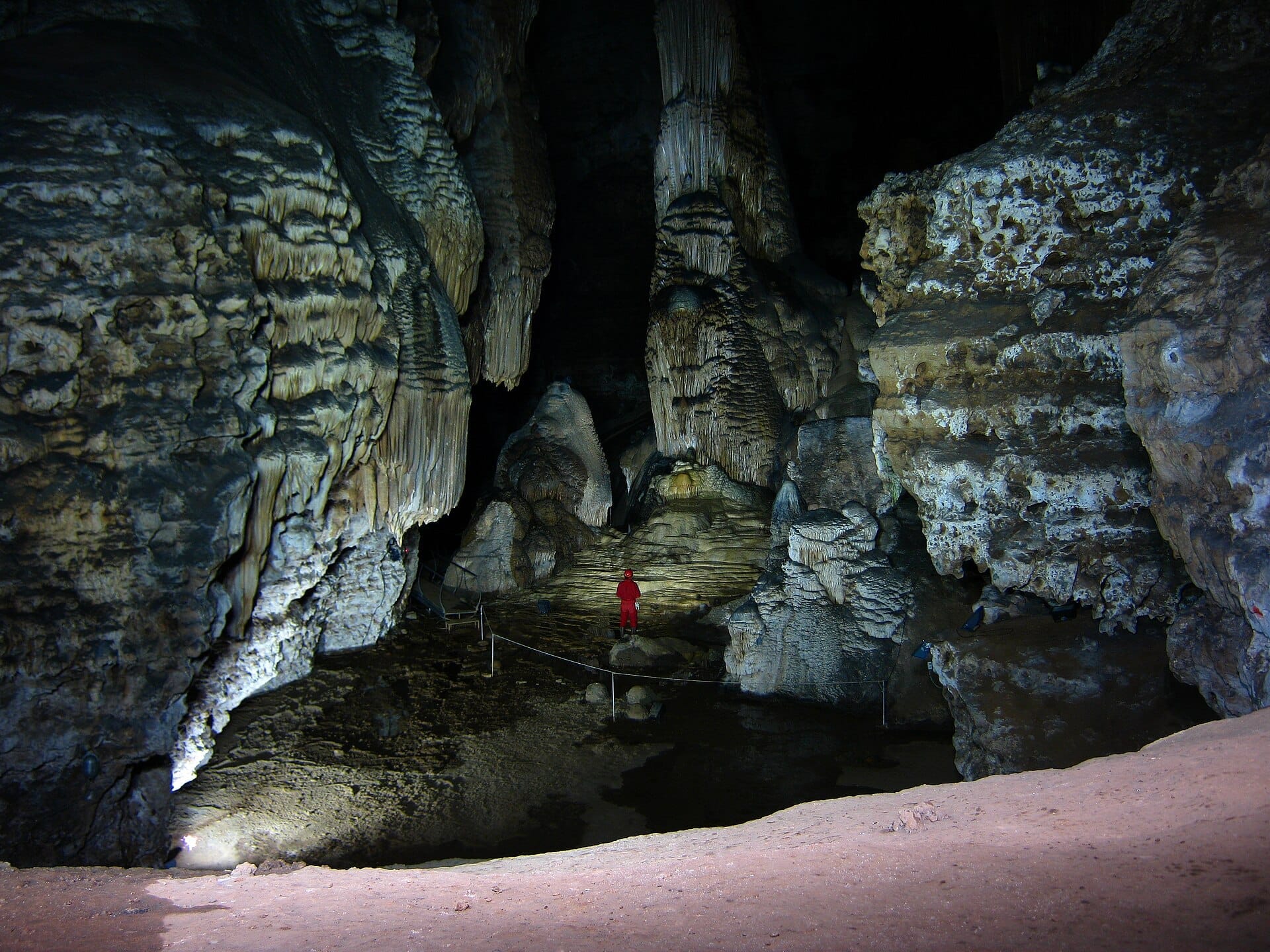
Grotte Su Marmuri is a limestone cave system located at roughly 860 to 880 metres above sea level, set into one of the distinctive flat-topped limestone plateaus — called tacchi — that define the Ogliastra landscape of eastern Sardinia. The cave formed approximately 150 million years ago through the slow erosion of ancient limestone by underground water. Today, it is still considered a living cave: water continues to seep through cracks, slowly depositing calcium carbonate and adding millimetres to stalactites and stalagmites that took tens of thousands of years to form.
The visitor route covers approximately 850 metres of underground passageways and chambers. Ceiling heights range from a modest few metres in narrower sections to nearly 50 metres in the largest halls, with an average height around 35 metres throughout much of the route. These proportions are unusual. Most tourist caves feel enclosed; Su Marmuri often feels cathedral-like, with the darkness above the floodlights swallowing the ceiling entirely in the grandest chambers.
⚠️ What to skip
The cave maintains a constant internal temperature of approximately 10°C year-round, regardless of outdoor conditions. A warm layer is essential even in July and August when Ogliastra's hillsides can exceed 30°C in full sun.
The Approach: Ulassai and the Landscape Above
Ulassai is a small hill village in the Ogliastra subregion, built into the flanks of a limestone plateau in the interior of eastern Sardinia. The road up from the valley is dramatic: a series of tight switchbacks climbing through scrubby macchia vegetation and exposed limestone outcrops, with views opening across the Ogliastra basin as you rise. The village itself sits at a considerable elevation, and the cave entrance is a further walk or short drive above the main settlement.
Ulassai is also known beyond the cave for the large-scale outdoor murals that cover many of its building facades, the work of sculptor Maria Lai and other artists who transformed the village into an open-air art site over decades. If you have time before or after the cave visit, walking through the village streets to see these murals adds genuine cultural context to the day. The wider Ogliastra area is one of Sardinia's least-touristed corners and connects naturally to the Tacchi d'Ogliastra, the same system of limestone plateaus that shelters the cave.
Getting to Ulassai without a car is technically possible using ARST regional buses, but connections from the coastal towns of Ogliastra are infrequent and the final approach to the cave still requires a steep uphill walk. For most visitors, a rental car is the practical choice. From Lanusei, the nearest larger town and regional hub, Ulassai is around 25 kilometres via mountain roads. From the Tyrrhenian coastal village of Baunei or from Arbatax on the coast, driving times are typically 40 to 60 minutes depending on the route.
Tickets & tours
Hand-picked options from our booking partner. Prices are indicative; availability and final rates are confirmed when you complete your booking.
Cala Goloritze, Mariolu, Gabbiani, Biriala, Grotta del Fico boat tour
From 69 €Instant confirmationFree cancellationVineyard Guided Tour and 7 Wine Tasting in Palau
From 84 €Instant confirmationFree cancellationFull-Day Sailboat Tour in La Maddalena Archipelago from Cannigione
From 112 €Instant confirmationFree cancellationHiking excursion to the Devil's Saddle
From 35 €Instant confirmationFree cancellation
The Descent and the Cave Interior
Access to the cave begins with a descent of approximately 200 steps from the entrance structure down to the cave opening. The steps are concrete and maintained, but they are steep in places, and the same 200 steps must be climbed on the way out. This alone makes the visit physically demanding for anyone with significant mobility difficulties or knee problems. The descent takes around 10 minutes at a moderate pace, and by the time you reach the cave mouth the temperature drop is already noticeable.
Inside, the tourist path is described by the cave's official association as flat and comfortable for its approximately 850-metre length. The route passes through a succession of chambers of vastly different scales, connected by short passages. Lighting is installed throughout, shifting from warm amber tones in intimate sections to brighter white floods in the largest rooms, designed to emphasise the geometry of the rock formations. Stalactites hang from ceilings that sometimes disappear into darkness far above the lights' reach. On the cave floor, stalagmites rise in clusters — some slender and glassy with ongoing mineral deposition, others broad and ancient-looking.
The acoustic quality inside the larger chambers is striking. Sound carries differently underground, and in the cathedral-height rooms even a quiet conversation produces noticeable reverb. During guided tours, the guides frequently demonstrate this by dimming sections of the lighting, reducing the space to near-total darkness for a few seconds. The effect on a group of visitors is reliably dramatic — it is a reminder of how remote the underground environment feels even on a curated tourist path.
💡 Local tip
Photography is possible throughout the cave, but bring a camera that handles low light well. Phone cameras struggle in the darker sections between spotlights. A wide-angle lens helps capture the full scale of the large chambers — a standard phone focal length often fails to convey the true height of the ceilings.
Guided Tours: How the Visit Works
Entry to Grotte Su Marmuri is exclusively by guided tour. There is no self-guided option, and tours depart at set intervals throughout the operating day. The standard tour lasts approximately 1.5 hours and covers the full visitor route. Guides provide commentary in Italian, and English-language guidance is available at many departures — it is worth calling ahead or checking the current schedule on the official site if you require a specific language.
Opening hours vary by season and the cave advises checking its official website before making the trip, particularly outside the main summer period from June to September when hours are longest. A general working timetable cited on visitor platforms runs from approximately 11:00 to 19:30, but this is a seasonal figure and should be confirmed directly. Arriving without checking hours first is the single most common mistake visitors make when visiting attractions in this part of Sardinia — rural sites operate on genuine seasonal schedules, not year-round tourist hours.
Admission is approximately €12 per adult in high season, including the guided tour, based on recent visitor reports — though this should be verified before your visit via the official site. The cave is managed as a regulated tourist attraction under Italian speleological tourism guidelines. For broader context on visiting caves and geological sites across Sardinia, the Grotte di Nettuno near Alghero and the Grotte di Ispinigoli near Dorgali represent the island's other major showcave options, each with different physical characters and logistics.
Best Time to Visit and Seasonal Considerations
Su Marmuri is usable year-round in terms of the cave environment — the 10°C interior is constant regardless of season. The practical constraints are the cave's own operating schedule and the road conditions in the Ogliastra highlands. Summer, from late June through August, is when the cave is busiest and opening hours are longest, but the contrast between the fierce external heat and the cave's cool interior is at its most extreme. Stepping out of 32°C sunshine into a 10°C underground world with a damp chill requires immediate layering.
Shoulder months — May, June, and September — tend to offer the best balance: the cave is open on a full schedule, visitor numbers are manageable, and the surrounding Ogliastra landscape is at its most photogenic, with green vegetation before summer parches the macchia. October and beyond requires confirming hours directly. The area around Ulassai and the broader Ogliastra province is one of the quietest parts of Sardinia in the off-season, and some local services in the village may be reduced.
ℹ️ Good to know
Morning visits have a practical advantage: tour groups from coastal resorts tend to arrive in the early afternoon. Arriving at opening time typically means a smaller group and a more comfortable experience in the cave's tight connecting passages.
Physical Requirements and Accessibility
The 200-step descent and ascent is the primary physical demand of the visit. Inside the cave, the tourist path is flat and well-maintained for its 850-metre length. However, the steps at access and exit make the site unsuitable for standard wheelchairs and challenging for visitors with significant mobility impairments or severe knee problems. There is no lift or alternative access route documented. Children who are comfortable on stairs and old enough to maintain attention during a 1.5-hour guided tour handle the visit well — younger children may struggle with the length and the darkness.
Footwear matters more than people expect. The path inside the cave is damp in sections — the cave is actively forming, which means there is ongoing dripping water and slick patches even on paved surfaces. Closed-toe shoes with some grip are strongly preferable to sandals or smooth-soled footwear.
Combining Su Marmuri with Nearby Attractions
Grotte Su Marmuri works best as part of a full day in the Ogliastra highlands rather than a standalone detour. The Gola di Su Gorropu, one of Europe's deepest canyons, is accessible from the Ogliastra side and suits visitors who want to pair the cave with a more active outdoor experience on the same trip. For travellers based on the coast, Cala Gonone is the main coastal base for exploring this stretch of Sardinia's east and lies within reasonable driving distance of Ulassai via the mountain interior.
Visitors with an interest in Sardinia's prehistoric past can extend the Ogliastra day to include the Valle di Lanaittu, which contains the Tiscali Nuragic village and significant archaeological remains, or explore the wider nuragic heritage of the island via Sardinia's Nuragic sites guide. The interior of Ogliastra is also one of Sardinia's documented Blue Zone communities, associated with exceptional longevity in the local population — a dimension covered in the Sardinia Blue Zone guide if you want broader cultural context for the area.
Insider Tips
- Call ahead to confirm the day's first tour time, especially in spring and autumn — the cave sometimes delays opening if a minimum group size has not been reached, which can strand drivers who have come from the coast.
- Dress in proper layers rather than just carrying a jacket. Spending 1.5 hours at 10°C with high humidity is colder than it sounds if you are wearing summer clothing. A light fleece and a windproof top is the minimum practical combination.
- The largest chambers are at their most impressive when the guide cuts the main lighting. Position yourself toward the back of the group before these moments — you get a longer view down the chamber rather than the back of other visitors' heads.
- If you are driving from the coast, fill your fuel tank before heading into the Ogliastra highlands. Ulassai is a small village and petrol stations in this part of interior Sardinia are sparse.
- The murals of Ulassai village are free to see and take roughly 30 to 45 minutes to walk through. Combining them with the cave makes the trip to the interior feel worthwhile even for visitors who are not primarily interested in geology.
Who Is Grotte Su Marmuri (Ulassai) For?
- Geology and natural history enthusiasts who want to understand Sardinia's limestone landscape from the inside out
- Families with children aged roughly 8 and above who can manage stairs and a 1.5-hour guided walk
- Visitors seeking cool relief during July and August heat — the cave is one of the most effective natural air-conditioned experiences on the island
- Travellers on a Sardinia road trip through the interior who want to engage with the island beyond its beaches
- Photography-focused visitors interested in low-light, high-contrast geological subjects
Nearby Attractions
Other things to see while in Ogliastra:
- Capo Comino Dunes & Beach
A 3-kilometre stretch of white sand and wind-sculpted dunes on Sardinia's eastern coast, near Siniscola. The shallow sea, open access, and historic shipwrecks offshore make it one of the Nuoro province's most distinctive beaches.
- Parco Nazionale del Golfo di Orosei e del Gennargentu
Covering roughly 74,000 hectares of rugged mountain, gorge, and coastal wilderness in central-eastern Sardinia, the area commonly referred to as Gennargentu National Park is the island's most ambitious proposed protected landscape. From the island's highest peak to sheer sea cliffs dropping into the Golfo di Orosei, this is where Sardinia's raw geography is on full display.
- Punta La Marmora
At 1,834 metres, Punta La Marmora is the highest point in Sardinia and the crown of the Gennargentu massif. The hike rewards those who make the effort with panoramic views across the island's rugged interior, a genuine sense of remoteness, and a perspective on Sardinia that most visitors never see.
- Rocce Rosse di Arbatax
The Rocce Rosse di Arbatax are a formation of deep vermillion porphyry cliffs rising up to about 15 metres from the Tyrrhenian Sea on Sardinia's Ogliastra coast. Free to visit year-round, they sit steps from the port and the Trenino Verde station, making them one of the more accessible natural landmarks on the island's eastern shore.