Rocce Rosse di Arbatax: Sardinia's Red Porphyry Cliffs Up Close
The Rocce Rosse di Arbatax are a formation of deep vermillion porphyry cliffs rising up to about 15 metres from the Tyrrhenian Sea on Sardinia's Ogliastra coast. Free to visit year-round, they sit steps from the port and the Trenino Verde station, making them one of the more accessible natural landmarks on the island's eastern shore.
Quick Facts
- Location
- Spiaggia delle Rocce Rosse, Arbatax (frazione of Tortolì), former Province of Ogliastra (now in the Province of Nuoro), Sardinia
- Getting There
- Follow the SS125 toward Arbatax port, then signs for Rocce Rosse. The site is a short walk east of the harbor, directly in front of the Trenino Verde narrow-gauge station.
- Time Needed
- 30–90 minutes for most visitors; longer if you plan to swim or snorkel
- Cost
- Free. No ticket or entry fee required. Open 24/7, year-round.
- Best for
- Geology enthusiasts, photographers, swimmers, snorkelers, road-trippers on the SS125
- Official website
- www.sardegnaturismo.it/en/explore/rocce-rosse
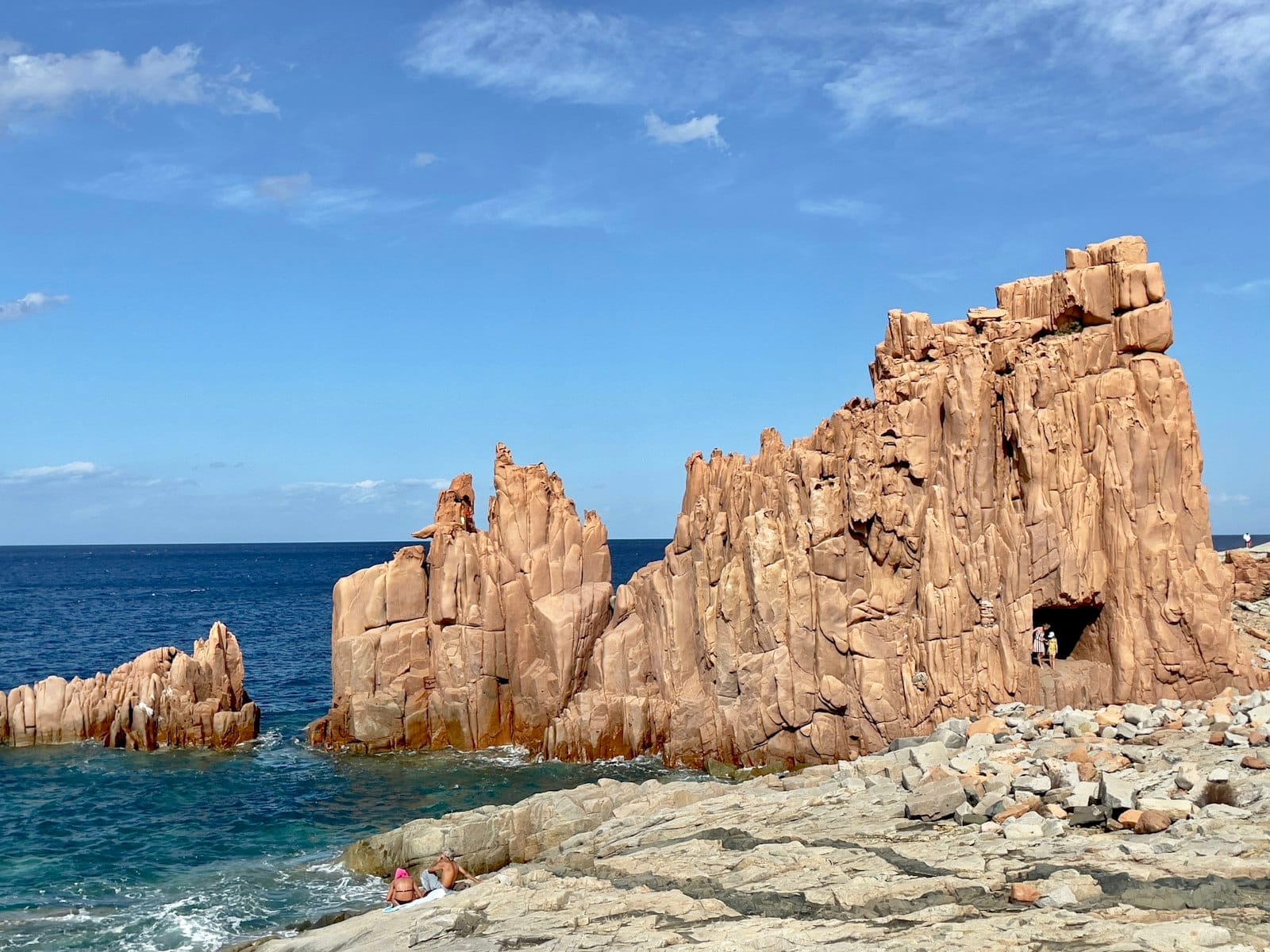
What You're Actually Looking At
The Rocce Rosse di Arbatax are not a beach in any conventional sense. They are a dramatic outcrop of red porphyry and granite of volcanic origin, the same iron-rich stone that gives this stretch of the Ogliastra coast its unmistakable crimson color. The main cliff face stands roughly 15 metres above sea level, part of a largely submerged porphyry dyke that continues beneath the water. The color shifts as the light changes: at noon in midsummer the rocks look almost terracotta; at golden hour they burn a deep rust-red that photographers make long detours to capture.
The surrounding flat area was once an active porphyry quarry. In the 1950s, stone from this site was quarried for port construction works, which reduced the original rock formation. What remains is still substantial, and the old quarry floor is now a paved open square where visitors park, gather, and walk to the water's edge. That industrial past gives the site an unusual texture: raw geological spectacle surrounded by the remnants of human extraction.
ℹ️ Good to know
The Rocce Rosse sit directly in front of the Arbatax Trenino Verde station. If you're arriving or departing on the narrow-gauge tourist train from Mandas, the rocks are the first thing you'll see when you step off.
How the Experience Changes Through the Day
Early morning is the calmest window. Before 9am, the light comes from the east, hitting the cliff face directly and saturating the red pigment in the stone. The sea is typically flat at this hour, and the reflections on the water are crisp. With the port activity just starting up across the bay, there is a low background hum of engines and rigging but no crowds at the rocks themselves.
By mid-morning in July and August, tour buses arrive from Tortolì and from the campsite strip to the south, and the viewing area fills quickly. Families with children spread across the lower platforms; snorkelers kit up and enter from the rocky ledges. The water around the formation is notably deep and clear, which is why experienced divers favor this spot. If you are a casual swimmer, be aware there is no gently sloping sandy entry: you step or jump from rock into open water.
Afternoon light loses the drama somewhat, as the sun moves behind the rocks from the visitor's perspective. Late afternoon and the hour before sunset reverse this, casting long shadows across the formation and turning the sea from green to deep blue. Sunset itself is not visible directly from the Rocce Rosse (the cliffs face roughly east), but the lingering color in the sky still makes the last hour of daylight one of the better times to photograph the formation against the water.
💡 Local tip
Arrive before 9am in summer for the best light, no crowds, and calm water. The site is free and open 24 hours, so early access costs nothing extra.
Tickets & tours
Hand-picked options from our booking partner. Prices are indicative; availability and final rates are confirmed when you complete your booking.
4x4 tour of the Golgo Plateau in Baunei from Arbatax
From 68 €Instant confirmationFree cancellationDinghy Tour Exploring Gulf of Orosei from Arbatax Port
From 57 €Instant confirmationFree cancellationBarbagia 4x4 Tour and Lunch at The Shepherd's from Arbatax
From 135 €Instant confirmationFree cancellationSailing trip in the Gulf of Orosei from Arbatax
From 150 €Instant confirmationFree cancellation
The Geology and the Quarrying History
Porphyry is an igneous rock characterized by large crystals set in a fine-grained matrix, and the variety found at Arbatax, together with associated red granite, is rich in mineral components that produce the deep red and pink tones. This type of stone was commercially valuable: stone from the Arbatax area was used in construction and port works in the mid‑20th century. Quarrying in the mid‑20th century, including the 1950s, reduced the original rock mass, and it's worth knowing that what visitors see today is a diminished version of the original formation.
The submerged rocky formation extends into the sea, contributing to the notable depth directly off the rocks. The hard porphyry does not erode into sand the way softer limestone does, so the seabed here is rock and boulder rather than sandy floor. Visibility for snorkelers and divers is often excellent, particularly before the peak-season boat traffic picks up.
The wider Ogliastra coast that frames Arbatax is among the most geologically varied stretches of Sardinia. If the formations here interest you, the cliffs and sea caves of the Golfo di Orosei to the north offer a different but complementary perspective on the island's coastal geology, best reached by boat from Cala Gonone.
The Film Connection
The bay at Arbatax was chosen as the setting for the final scene of Lina Wertmüller's 1974 film "Travolti da un insolito destino nell'azzurro mare d'agosto" (largely shot in other parts of Sardinia), (released internationally as "Swept Away"). Wertmüller was one of the most significant Italian directors of the postwar era, and the film, a class-warfare drama set almost entirely on a deserted island, was a major critical and commercial success. The red rocks appear in that final sequence, lending the scene a color palette that is almost luridly cinematic, though entirely real.
The film brought international attention to this corner of Sardinia during the 1970s and helped cement the Ogliastra coast's reputation as a place of raw, unsettled beauty. There are no formal plaques or interpretive panels at the site connecting it to the film, so most visitors today arrive without knowing the backstory. That is either a pleasant gap in the signage or a missed opportunity, depending on your point of view.
Practical Walkthrough: Getting There and Moving Around
Arbatax is a small port town in the municipality of Tortolì, in the former Province of Ogliastra, now part of the Province of Nuoro. The closest major road is the SS125, the panoramic highway that runs the length of Sardinia's eastern coast. From the north (Dorgali, Baunei direction), follow the SS125 south and take the Arbatax port exit, then follow signs for Rocce Rosse. From Cagliari and the south, the same road leads north to Tortolì and Arbatax. The drive from Cagliari takes approximately two hours under normal conditions.
There is a paved parking area directly at the site, which is free but fills by mid-morning on peak summer days. Overflow parking is available near the port a short walk away. On foot from the port itself, the rocks are visible and reachable in under five minutes.
If you are traveling without a car, Arbatax is reachable by ARST regional bus from Tortolì and from towns further along the SS125. The Trenino Verde narrow-gauge tourist train also terminates at Arbatax, running seasonally from Mandas through the interior of Sardinia. For context on getting around the eastern coast more broadly, the getting around Sardinia guide covers car hire, bus routes, and the train network in detail.
The terrain at the site itself is uneven porphyry rock. The flat quarry square is accessible to most visitors, including those with pushchairs on level ground. However, reaching the water's edge and climbing onto the rocks requires scrambling over irregular surfaces. It is not suitable for visitors with significant mobility limitations, and the entry into the sea from the rocks requires confidence in open water with no lifeguard on duty.
⚠️ What to skip
There is no sandy beach entry here. Swimmers enter from rocky ledges directly into deep water. Children should be supervised carefully, and those who are not confident in open water should observe from the viewpoint area rather than attempt to swim.
Photography Tips and What to Bring
The red-on-blue contrast between the cliffs and the sea photographs well in almost any light, but the two most productive windows are the first hour after sunrise and the 90 minutes before sunset. At midday in summer, the light is flat and harsh, and heat shimmer can affect distant shots. A polarizing filter reduces surface glare on the water and deepens the blue.
For snorkeling photographs or underwater shots, the water is clear enough that even basic waterproof cameras produce usable results. The best underwater detail is in the first few meters down from the rock face, where the porphyry continues below the surface.
Wear shoes with grip. The porphyry surface is hard and irregular, and bare feet on sun-heated rock is uncomfortable. Bring water, particularly in summer when shade is minimal at the site. If you are combining the Rocce Rosse with a longer Ogliastra itinerary, the Ogliastra region has several other geological landmarks and coastal paths worth linking together on the same day.
Is It Worth the Stop?
The Rocce Rosse di Arbatax deliver on their visual promise. The color is real, the scale is genuine, and the combination of port activity nearby and raw coastal geology makes for an unusual atmosphere that is hard to replicate elsewhere on the island. As a free site open without restriction, it is one of the most straightforward stops on the eastern Sardinia circuit.
That said, it is a short stop. Most visitors who are not swimming or snorkeling see everything there is to see in 30 to 45 minutes. The site lacks shade, interpretive signage, and facilities beyond what is available in the port area nearby. In peak August, the small viewing area becomes crowded between 10am and 4pm, which diminishes the experience considerably.
Visitors looking for a beach day with sand and facilities would be better served elsewhere on the Ogliastra coast. For those who want the full eastern Sardinia experience including longer swims in clear water, the coves accessible from Cala Luna or by boat along the Golfo di Orosei are a different category of experience, though they require more logistical effort and planning. The Rocce Rosse are best understood as a compelling 45-minute stop rather than a destination in themselves.
Insider Tips
- The light on the rocks is best in the first hour after sunrise. Because the site is open 24 hours and free, arriving at dawn adds no cost or complexity and dramatically improves both the photography and the solitude.
- If you are driving the SS125 south toward Cagliari, the rocks are visible from the road as you descend toward Arbatax port. There is a pull-off viewpoint that gives a different perspective than the ground-level view from the site itself.
- The Trenino Verde narrow-gauge railway terminates at Arbatax on the same square as the Rocce Rosse. If you are taking the scenic train journey from Mandas through the Barbagia interior, the rocks are directly at your arrival point. It is a dramatic way to end that particular journey.
- The water directly off the rocks is deep and cold even in summer, making it popular with experienced snorkelers who want to see the submerged continuation of the porphyry dyke. Bring your own equipment; there is no rental at the site.
- Parking fills by 10am in July and August. If you arrive then and the quarry square is full, the port area a few minutes' walk west has additional parking along the waterfront.
Who Is Rocce Rosse di Arbatax For?
- Geology and landscape photographers wanting a distinctive coastal subject with no entry fee
- Snorkelers and experienced swimmers looking for deep, clear water off unusual rock formations
- Road-trippers following the SS125 who want a significant visual stop without a long detour
- Travellers arriving or departing on the Trenino Verde scenic railway who have time before or after the journey
- Couples and solo travelers looking for dramatic scenery that is accessible but not over-commercialized
Nearby Attractions
Other things to see while in Ogliastra:
- Capo Comino Dunes & Beach
A 3-kilometre stretch of white sand and wind-sculpted dunes on Sardinia's eastern coast, near Siniscola. The shallow sea, open access, and historic shipwrecks offshore make it one of the Nuoro province's most distinctive beaches.
- Grotte Su Marmuri (Ulassai)
Grotte Su Marmuri is a vast living limestone cave carved into the rocky highlands above the village of Ulassai in Ogliastra, eastern Sardinia. With chambers reaching up to around 50 metres high, active stalactite formations, and a constant interior temperature of 10°C, it offers one of the most impressive underground experiences on the island. Entry is by guided tour only, lasting approximately 1.5 hours.
- Parco Nazionale del Golfo di Orosei e del Gennargentu
Covering roughly 74,000 hectares of rugged mountain, gorge, and coastal wilderness in central-eastern Sardinia, the area commonly referred to as Gennargentu National Park is the island's most ambitious proposed protected landscape. From the island's highest peak to sheer sea cliffs dropping into the Golfo di Orosei, this is where Sardinia's raw geography is on full display.
- Punta La Marmora
At 1,834 metres, Punta La Marmora is the highest point in Sardinia and the crown of the Gennargentu massif. The hike rewards those who make the effort with panoramic views across the island's rugged interior, a genuine sense of remoteness, and a perspective on Sardinia that most visitors never see.