Cala Luna: Sardinia's Most Dramatic Cove, Reached Only by Sea or Trail
Cala Luna is an 800-metre crescent of pale pink-tinged sand framed by limestone cliffs that rise up to 300 metres above the waterline. Straddling the municipal boundary between Baunei and Dorgali in the Gulf of Orosei, it has no road access and only minimal seasonal beach infrastructure — which is precisely why it looks the way it does.
Quick Facts
- Location
- Gulf of Orosei, between Baunei and Dorgali, eastern Sardinia
- Getting There
- Boat from Cala Gonone or Santa Maria Navarrese, or on foot via the Cala Fuili trail
- Time Needed
- Half day minimum; a full day recommended if arriving by boat
- Cost
- Beach entry is free; boat transfers vary by operator — check current fares at Cala Gonone pier
- Best for
- Swimmers, snorkellers, photographers, and hikers seeking an uncommercialised beach
- Official website
- www.turismobaunei.eu/en/services/cala-luna
What Cala Luna Actually Is
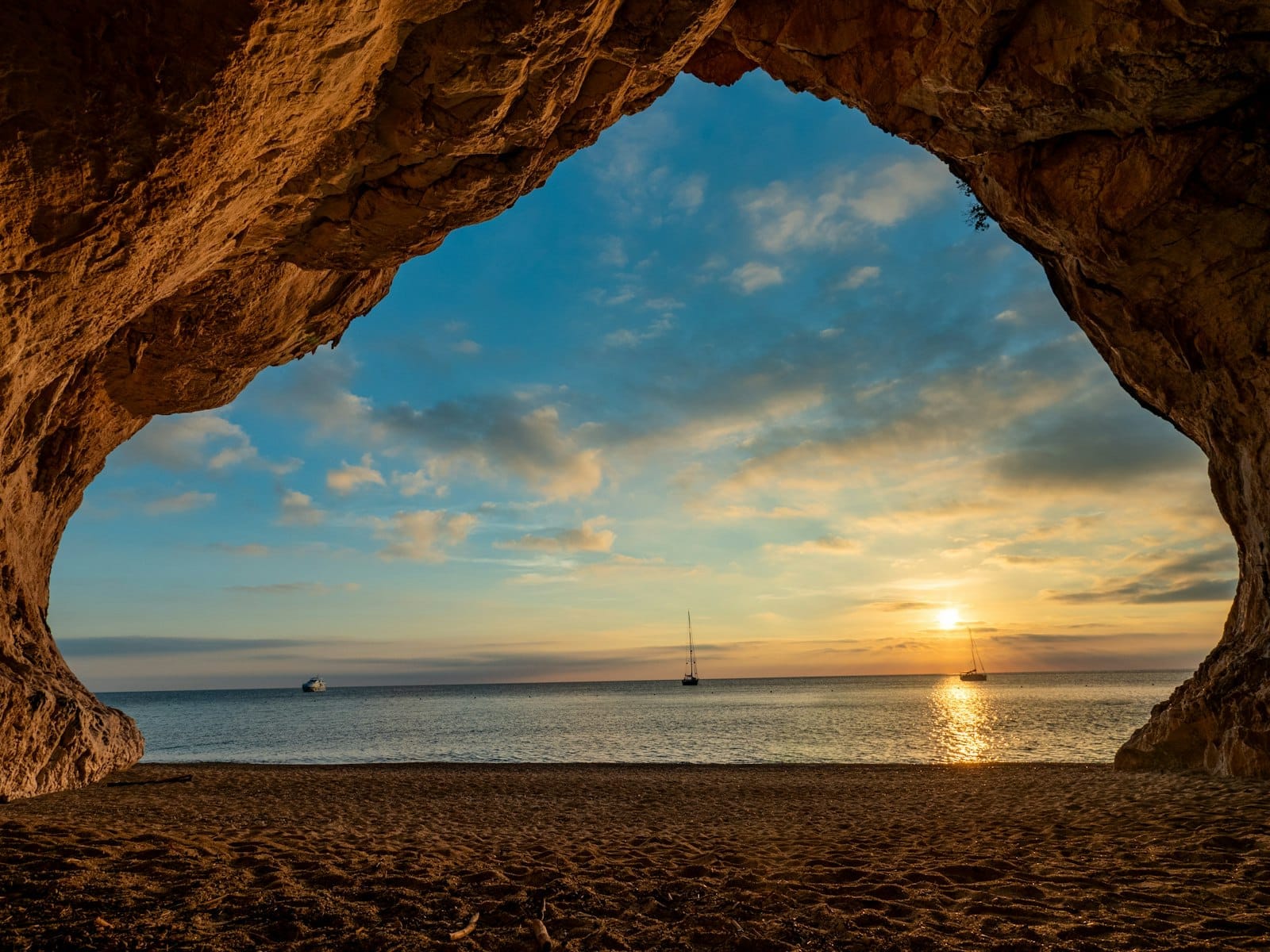
Cala Luna is a natural cove on Sardinia's eastern coast, sitting on the administrative boundary between the municipalities of Baunei and Dorgali, both in the Province of Nuoro. The beach stretches roughly 450–700 metres, lined with coarse pale sand, produced by tiny shell fragments mixed into the sediment. Behind the sand, the limestone Supramonte massif rises in sheer walls to around 200 metres, with cave mouths visible at the base of the cliffs where freshwater springs seep into the sea.
The modern Italian form of the name derives from the original Sardinian toponyms 'Elune' or 'Ilune', used locally in Baunei and Dorgali, and is often associated with the crescent shape of the cove. The crescent shape of the cove made the name stick. Locals still use the older forms in dialect, and both the Baunei and Dorgali tourism offices document this etymology.
Cala Luna sits within the broader Gulf of Orosei, one of the most geologically intact stretches of Mediterranean coastline. The area falls within the Parco Nazionale del Golfo di Orosei e del Gennargentu (Gulf of Orosei and Gennargentu National Park), which limits development and keeps the shoreline in a state that most of the Mediterranean coast lost decades ago. No hotels, no road. A small seasonal kiosk and some basic services may operate in the main summer months selling drinks and snacks, but they are not guaranteed.
ℹ️ Good to know
Cala Luna appeared as a filming location for Lina Wertmüller's 1974 film 'Travolti da un insolito destino nell'azzurro mare d'agosto' ('Swept Away') — the cliffs and isolation were as much a character in that film as they are today.
How to Get There: Your Two Options
By Boat from Cala Gonone
The most popular approach is by boat from Cala Gonone, a small resort town about 20 kilometres south of Dorgali. Regular excursion boats depart from the central pier during the main summer season, typically from late spring through early autumn. Some operators run dedicated Cala Luna stops; others include it as part of a longer coastline tour that might also take in the Grotta del Bue Marino and nearby coves. Tickets are purchased at the pier or directly through operators — there is no central booking system and prices change by season and operator, so verify current fares when you arrive or contact operators directly before visiting.
The boat ride itself takes around 20–40 minutes from Cala Gonone, travelling south along cliffs that give a very different perspective from what you see on foot. You pass sheer limestone faces dropping straight into deep water, small sea caves, and arched rock formations. Morning departures are advisable: the sea is calmer before midday, the beach receives fewer visitors in the early hours, and the light on the cliffs before 10:00 is significantly better for photography.
On Foot via the Cala Fuili Trail
The hiking route begins at Cala Fuili, a small cove roughly 3 kilometres south of Cala Gonone reachable by car. The path follows the coastal cliff edge south to Cala Luna, a distance of approximately 5–6 kilometres one way. Trail surfaces vary from compacted rock to loose scree, with some scrambling sections. The route usually takes between 2 and 3 hours depending on pace and fitness, and the return adds equivalent time and effort.
⚠️ What to skip
Do not attempt the Cala Fuili trail in summer midday heat without at least 2 litres of water per person. The path offers almost no shade between 10:00 and 16:00, temperatures regularly exceed 35°C in July and August, and there is no rescue infrastructure along the route. Start before 07:30 or after 17:00 if hiking in peak summer.
Additional trails descend from the Baunei plateau, but these involve longer approaches and are generally used by guided trekking groups familiar with the terrain. If you are not experienced with unmarked Sardinian mountain paths, the Cala Fuili route or the boat are the appropriate choices.
Tickets & tours
Hand-picked options from our booking partner. Prices are indicative; availability and final rates are confirmed when you complete your booking.
Cala Goloritze and Cala Luna dinghy tour from Orosei
From 149 €Instant confirmationFree cancellationTrekking to Cala Luna from Cala Gonone
From 54 €Instant confirmationFree cancellationGulf of Orosei mini cruise from Cala Gonone
From 53 €Instant confirmationFree cancellationSpeedboat Trip to Gulf of Orosei with Aperitif from Cala Gonone
From 119 €Instant confirmationFree cancellation
The Beach Experience, Hour by Hour
The first boats from Cala Gonone tend to arrive around 09:30–10:00. Before that, if you have hiked in at dawn, you have the beach to yourself — the sound is almost entirely the water pressing into the cave mouths at the base of the cliffs, a low resonant sound unlike anything on an open beach. The sand is cool and compact underfoot in the morning, and the water is glassy enough in early hours that the underwater rock formations are visible to a depth of several metres with the naked eye.
By noon in July and August, Cala Luna holds several hundred people. The central part of the beach fills first; the northern end, nearer the larger cave openings, stays slightly quieter because the sand there is coarser and the shade from the cliffs arrives later in the day. The caves at the back of the beach are large — you can walk into the cool interior, where the temperature drops noticeably and the sound changes to hollow drips and the occasional rush of a subterranean stream. Children are drawn to them immediately; adults who don't notice them miss one of the more interesting features of the cove.
By mid-afternoon, most day-trip boats have returned or are loading passengers. The crowd thins sharply after 15:30, and the quality of the light on the cliffs improves again as the sun drops toward the west. If you can arrange a later return boat (check departure times carefully with your operator when you board), the late afternoon at Cala Luna is calmer and cooler than any other part of the day.
Swimming and Snorkelling
The water at Cala Luna is among the clearest in the Gulf of Orosei, which is itself considered one of the clearest stretches of the Mediterranean. Visibility can reach around 15–20 metres in calm conditions. Freshwater springs emerge at the base of the cliffs and mix with the sea, creating visible thermohaline layers: you can feel distinct temperature changes as you swim across them. The seabed close to the cave walls is rocky with sea urchins — water shoes or fins are worth bringing. The open-sand section of the seabed is safe for barefoot wading. For more detail on what to see underwater along this coastline, the Sardinia snorkelling and diving guide covers the Gulf of Orosei in depth.
There are no lifeguards. There is no medical station. The nearest road is several kilometres away by trail or a 30–40 minute boat ride. Visitors with limited swimming ability should stay in the shallow, sandy-bottomed central section and should not enter the water during or after afternoon winds, which can develop quickly and create choppier conditions than the morning calm suggests.
Practical Logistics and What to Bring
There is no shade on most of the beach except what the cliffs provide in the early morning and late afternoon. Between 11:00 and 15:00 from June through August, the sand is in full sun and the reflected heat from the limestone walls intensifies it. Bring a beach umbrella if arriving by boat (you can carry it on most excursion vessels), sun protection rated for high UV, and more water than you think you need. A packed lunch is sensible; the seasonal kiosk, when operating, covers drinks only.
Photography at Cala Luna works best in two windows: the hour after sunrise (arrive by hike only, since no boats run this early) and the two hours before sunset. The midday sun washes out the colour gradients in the water and flattens the texture of the cliff faces. A polarising filter helps at any time of day by cutting the surface glare on the water and revealing the submerged rock colours. The cave mouths photograph best with a wide-angle lens in the early morning when direct light enters the opening.
Accessibility is a genuine limitation here. No road reaches the beach, the hiking path involves rocky terrain and elevation change, and even the boat landing involves stepping onto a slightly uneven shore. Visitors with reduced mobility or those who require flat, accessible surfaces will find the beach difficult. If Cala Luna is on your list but mobility is a concern, compare it carefully against more accessible Gulf of Orosei beaches. The Grotta del Bue Marino is reachable by the same boats from Cala Gonone and offers a very different but equally striking experience with a more managed landing.
Seasonal Considerations and When to Visit
Boat services to Cala Luna operate roughly from May to September. Outside these months, access requires the hiking trail, which remains open year-round but is exposed in winter and requires good footwear and preparation. The optimal windows for visiting are late May to mid-June and September, when the water is warm enough for comfortable swimming (sea temperatures reach around 22–25°C in late summer and early autumn), boat services are running, and the beach carries perhaps a third of the August crowd. The September in Sardinia guide covers why the shoulder season consistently outperforms peak summer for beach visits on this coast.
July and August are the months when Cala Luna receives the heaviest traffic. This is not a reason to avoid it, but it does change the experience substantially. The beach is large enough that it never reaches the shoulder-to-shoulder density of smaller coves, but solitude is impossible during these months unless you hike in before the first boats arrive. Parking at Cala Fuili fills early on summer mornings — by 08:30 in August, roadside overflow parking begins along the access road.
Weather affects the experience more than most visitors expect. The Gulf of Orosei faces east, and afternoon winds can push sizeable waves into the cove. Boat operators cancel or delay services in rough conditions, and the hike back over the cliff path in strong winds is unpleasant and carries some risk. Check local forecasts before committing to a hiking approach; the boat operators are generally more conservative with cancellations than the sea conditions strictly require, which works in your favour. For a broader overview of how Sardinia's climate patterns affect planning, the Sardinia weather guide breaks down the eastern coast's wind patterns in detail.
Is the Reputation Deserved?
Cala Luna is one of the exceptional beaches in the Mediterranean, not because of amenities — it has almost none — but because of the scale and completeness of the natural setting. The combination of the cliff height, the cave system, the water quality, and the beach length at one location is unusual. Comparable coves on this coast are either smaller, less accessible, or lack the cave complex.
The reputation can, however, set expectations that the logistics don't match. Visitors who picture a remote, empty paradise will find in July a beach with several hundred people, no shade infrastructure, no toilets beyond a basic seasonal facility, and a 40-minute return boat journey that queues. Those who visit in shoulder season, or who hike in early, encounter something much closer to the postcard. Manage the timing, and the beach consistently delivers.
Who should reconsider: travellers with very young children who need consistent shade and facilities, anyone who cannot manage a beach landing without a flat pier, and those who are inflexible about timing. The beach rewards patience and planning; it does not reward arriving on a peak-season afternoon expecting a quiet cove.
Insider Tips
- If you take the boat, ask the operator specifically about their last return departure — some run as late as 17:30 or 18:00 in high season, which gives you the afternoon light on the cliffs almost to yourself after the 15:30 crowd departure.
- The caves at the back of the beach have a narrow inner section that most visitors ignore after a quick look. Bring a small torch and walk further in: the temperature is noticeably cooler than the beach, the formations are significant, and you will usually find no one else there.
- The northern end of the beach, closest to the larger cliff formation, is coarser underfoot but tends to be noticeably less crowded throughout the day. The sand quality difference is minor; the crowd difference in August is not.
- If you are hiking in from Cala Fuili, the outbound path in the early morning offers the best light for photography of the cliff faces. On the return leg in the afternoon, the same cliffs are backlit and far less dramatic.
- Water shoes are worth carrying even if you plan to swim in the sandy central section — the cave entrances and the rocky shallows near the cliff bases involve sea urchins, and the boat landing sometimes involves stepping on submerged rocks.
Who Is Cala Luna For?
- Swimmers and snorkellers who prioritise water clarity and untouched seabed over facilities
- Photographers targeting dramatic limestone coastal landscapes and cave formations
- Hikers looking for a trail with a proper payoff at the end
- Travellers willing to plan carefully around timing to experience a major Sardinian landmark without peak-season crowds
- Couples and small groups who value natural scenery over beach services
Nearby Attractions
Other things to see while in Golfo di Orosei:
- Cala Goloritzè
Cala Goloritzè is a protected natural monument on Sardinia's eastern coast, where a limestone pinnacle of about 143–148 metres towers over a pebble beach and crystalline water. Accessible only by a moderately strenuous hike or by sea, it rewards the effort with scenery that few coves in the Mediterranean can match.
- Cala Gonone
Cala Gonone is a small seaside town tucked beneath limestone cliffs on Sardinia's eastern coast, serving as the main launch point for the Golfo di Orosei's famous sea caves, secluded coves, and dramatic hiking routes. Whether you arrive by boat, bus, or car, this is where the real adventure begins.
- Cala Mariolu
Tucked beneath the limestone cliffs of Costa di Baunei, Cala Mariolu is one of the eastern Sardinian coast's most extraordinary beaches. Famous for its white pebble shore, improbably clear water, and sheer rock walls rising hundreds of metres, it demands effort to reach but rewards accordingly. This guide covers every access route, the new reservation system recently introduced to manage visitor numbers, and what first-time visitors consistently get wrong.
- Grotte del Bue Marino
Carved into the limestone cliffs of the Gulf of Orosei, the Grotte del Bue Marino is a sea cave accessible only by boat, with a guided walk through roughly 1 km of stalactite chambers, underground lakes, and walls marked by Neolithic petroglyphs dating to around 4000 BC. It is one of the most distinctive geological and archaeological sites on Sardinia's eastern coast.