Grotte del Bue Marino: Inside Sardinia's Cave of the Monk Seal
Carved into the limestone cliffs of the Gulf of Orosei, the Grotte del Bue Marino is a sea cave accessible only by boat, with a guided walk through roughly 1 km of stalactite chambers, underground lakes, and walls marked by Neolithic petroglyphs dating to around 4000 BC. It is one of the most distinctive geological and archaeological sites on Sardinia's eastern coast.
Quick Facts
- Location
- Cala Gonone, Comune di Dorgali (NU), Gulf of Orosei, Sardinia
- Getting There
- Boat only — excursion ferries depart mainly from Cala Gonone harbour, also from Arbatax, La Caletta, Orosei, and Santa Maria Navarrese
- Time Needed
- Half day including boat transfer; guided cave tour approx. 1 hour
- Cost
- Cave entry: €10–€12 adults, €5–€6 reduced; boat transport extra. Children under 5 free.
- Best for
- Geology enthusiasts, families with older children, history and archaeology travellers
- Official website
- www.grottabuemarino.com/en-home
What the Grotte del Bue Marino Actually Is
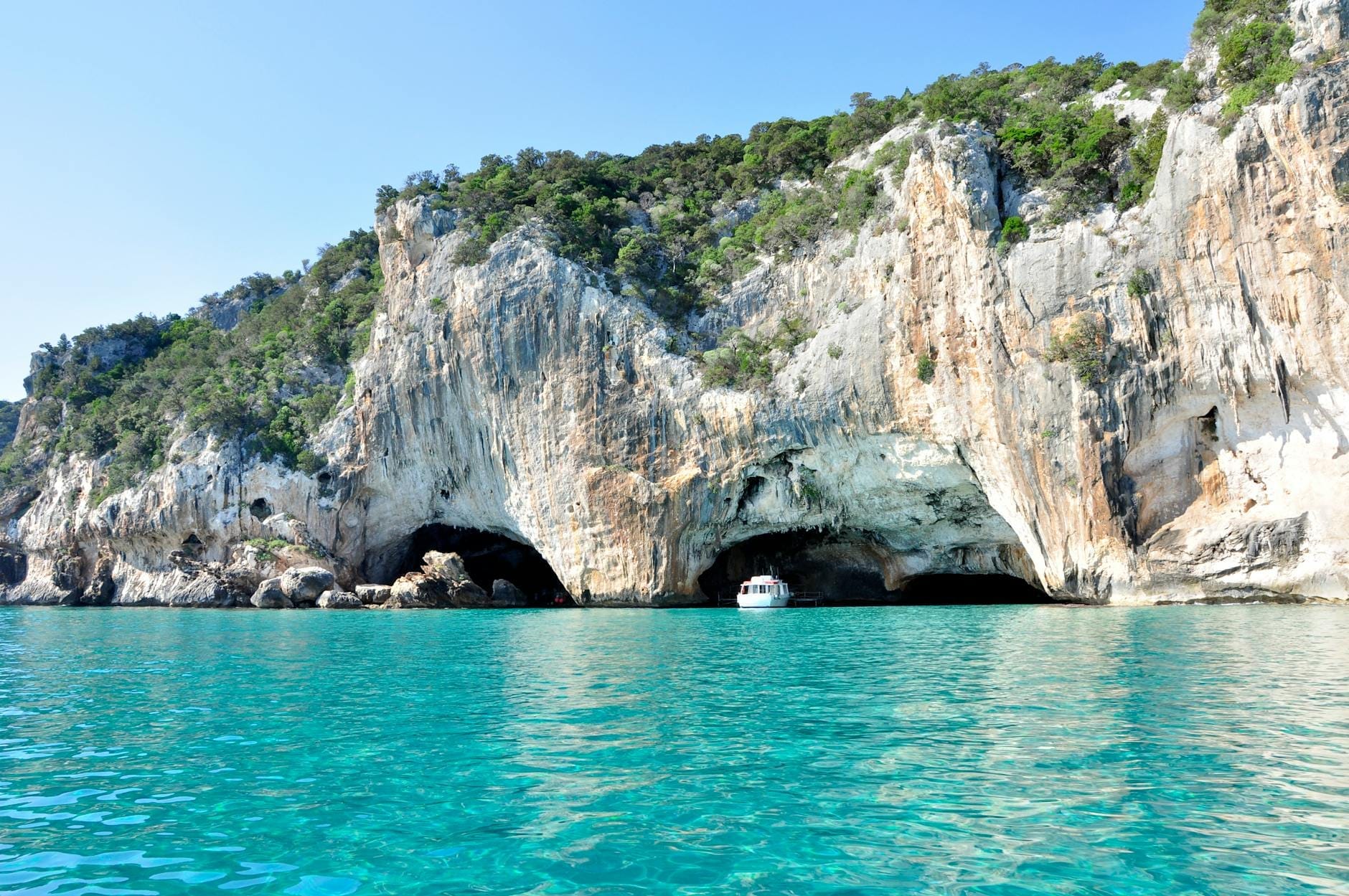
The Grotte del Bue Marino — the Cave of the Monk Seal — opens directly onto the sea cliffs of the Gulf of Orosei, accessible only from the water. There is no road to the entrance. You arrive by boat, the cliff face rises ahead of you, and the cave mouth appears at water level: low, dark, and immediately unlike anything you encounter on land. This is not a tourist cave retrofitted into a hillside. It is a coastal karst system with its entrance at sea level, formed over millions of years as limestone dissolved under the pressure of fresh and saltwater working together.
The cave system extends more than 70 km inland in total, making it one of the largest karst networks in Sardinia, though the tourist route covers around 1 km of illuminated, walkway-equipped passages. That 1 km is enough. The chambers build slowly: first narrow corridors with rough walls still wet from tidal movement, then sudden openings into cathedral-height rooms where stalactites hang in formations that have been accumulating for tens of thousands of years.
ℹ️ Good to know
The cave's name comes from the Mediterranean monk seal (foca monaca), known locally as 'Su Oe 'e Mare' (sea ox) by Sardinian shepherds. A colony lived inside the cave until the 1970s. The seals are gone, but the name — and a kind of atmospheric residue — remains.
The Boat Journey: Getting There Is Part of the Experience
Most visitors join an excursion boat from Cala Gonone harbour. The crossing takes you along one of the most dramatic coastlines in the Mediterranean: vertical limestone cliffs dropping straight into water that moves from turquoise at the shallows to deep indigo further out. The cliffs are largely roadless and uninhabited — the Gulf of Orosei is protected as part of a national park — so what you see from the boat is essentially the same landscape that existed before tourism arrived.
Many boat operators combine the cave visit with stops at one or more beaches along the way — Cala Luna, Cala Mariolu, or Cala Goloritzé are common additions. If you are combining the cave with a beach day, book the cave visit for the morning slot when light inside is at its best for photography and the cave itself is cooler.
The sea on this stretch of coast can be choppy, particularly in the afternoon when thermal winds build. If you are prone to motion sickness, a morning departure is strongly preferable. In high summer, the boat journey itself can be hot and exposed — bring sunscreen, a hat, and water. The cave interior runs cool regardless of outside temperatures, so a light layer is useful once you step inside.
💡 Local tip
Book your boat ticket in advance during July and August. Cave tours operate at fixed times and departure slots fill quickly in peak season. Arriving at the harbour on the day and hoping for a spot is unreliable.
Tickets & tours
Hand-picked options from our booking partner. Prices are indicative; availability and final rates are confirmed when you complete your booking.
Cala Goloritze, Mariolu, Gabbiani, Biriala, Grotta del Fico boat tour
From 69 €Instant confirmationFree cancellationGuided Tasting of Sardinian Food and Drink Delicacies
From 48 €Instant confirmationFree cancellationSanta Teresa di Gallura hiking tour of Valle della Luna
From 30 €Instant confirmationFree cancellationCagliari small-group boat escape to Sella del Diavolo with swim stops
From 0 €Instant confirmationFree cancellation
Inside the Cave: What You Actually See
The guided tour begins at the cave mouth and moves through a sequence of chambers that grow progressively more impressive. Near the entrance, the air is moist and cool, and the smell shifts from salt and seaweed to something earthier — wet limestone and still water. The floor underfoot is paved walkway rather than raw rock, but the walls remain untouched, and the lighting is placed carefully enough to avoid the over-illuminated fluorescence that ruins some Italian cave systems.
The stalactites and stalagmites in the main chambers are the predictable centrepiece, and they earn attention. Formations that took tens of thousands of years to reach current size are reflected in the underground pools and lakes that punctuate the route. The water in those pools is extraordinarily clear — shallow enough to see the bottom in places, with a slight mineral blue that is not colour-filtered or enhanced.
Less expected, and more lasting in memory for many visitors, are the Neolithic petroglyphs carved into the cave walls. Dating to the Ozieri Culture, approximately 4000 to 3500 BC, these engravings — geometric shapes, animal figures, and abstract marks — were made by people who entered this cave with torches, deep into the cliff, for purposes that were almost certainly ritual. The fact that they survive in this condition, at a site still actively visited, is remarkable.
Historical and Archaeological Significance
The Ozieri Culture, responsible for the cave's prehistoric markings, produced some of the most sophisticated Neolithic art found anywhere in the western Mediterranean. Sardinia has a remarkable concentration of Ozieri-era sites — the island's long prehistoric record is covered in detail in the guide to Sardinia's nuragic and prehistoric sites — but the Grotte del Bue Marino marks an early phase of that tradition, predating the nuraghi by roughly two thousand years. The choice of a sea cave as a ritual space suggests a relationship with the sea and the dark interior that went beyond shelter.
The monk seal connection adds a more recent layer of ecological history. The Mediterranean monk seal (Monachus monachus) is now one of the most endangered marine mammals in the world, with a global population estimated in the hundreds. That a colony persisted here until the 1970s — using the cave as a breeding and resting space, exactly as they would have done for thousands of years before — gives the site a melancholy context that the name preserves. The cave is a document of loss as much as a geological spectacle.
Practical Walkthrough: Tours, Timing, and What to Expect
Guided visits run from April through October. In April, May, and October, tours depart at 10:00, 11:00, and 15:00. From June through September, the schedule expands significantly with departures at 9:00, 10:00, 11:00, 12:00, 14:00, 15:00, 16:00, and 17:00. Tours are guided only — independent visits are not permitted. All times should be confirmed directly with the cave management or your boat operator before travel, as seasonal adjustments occur.
Cave admission (excluding boat transport) costs €12 for adults and €6 for reduced-rate visitors during June through September. In April, May, and October the rates drop slightly to €10 and €5. Children under 5 and disabled visitors with companions enter free. Boat transport is sold separately by individual operators at Cala Gonone and the other departure points.
Inside the cave, the tourist route is equipped with paved walkways and permanent lighting across approximately 900 to 1000 metres of the southern branch. Visitors with limited mobility should contact the managing cooperative in advance, as the entrance involves a boat landing and some uneven terrain near the cave mouth. The official tariff includes free access for disabled visitors and companions, but confirming specific accessibility provisions directly is advisable.
⚠️ What to skip
The cave is closed from November to March for visits. If you are travelling in shoulder season (April or October), verify current operating status directly, as late-season conditions can affect boat services independently of the cave schedule.
Photography, Weather, and Who Should Think Twice
Photography inside the cave is possible but challenging. The lighting is low and warm, which creates atmospheric images of the formations but makes handheld shots difficult without a high ISO setting. Tripods are not practical on the guided walkways given group pace. A smartphone with a strong night mode or a mirrorless camera will produce better results than a basic point-and-shoot. Flash photography, where permitted, tends to flatten the textures that make cave formations interesting in photographs.
For the boat crossing and the time on deck, light is best in the morning, when the cliffs catch direct sun and the sea is typically calmer. Early-afternoon crossings in summer can be glaring and rough. The cave interior itself does not change with time of day — it is artificially lit — but arriving on an early tour means smaller groups and more attentive guiding.
Visitors who find enclosed underground spaces uncomfortable should approach this attraction with care. The route does not involve tight squeezes or significant claustrophobic passages, but the cave is a cave: low ceilings in places, minimal natural light, and restricted sight lines. Travellers who struggled at similar sites — the Grotte di Nettuno near Alghero being the obvious Sardinian comparison — may find the Bue Marino tour manageable but should be prepared. The cave is not suitable for very young children who cannot follow a guided tour.
Travellers primarily interested in beaches, and who have limited days in the Golfo di Orosei, may find the time investment — half a day including boat — better spent on the water itself. The cave is a significant site, but it is not necessary viewing for everyone who passes through Cala Gonone.
Insider Tips
- The first tour of the day (9:00 or 10:00 depending on season) consistently draws smaller groups than midday slots. A smaller group means the guide can pause longer at the petroglyphs, which are easy to miss in a crowd and receive less explanation when the pace is rushed.
- If your boat operator offers a combined cave-plus-beaches excursion, request that the cave visit comes first. Spending the cave portion of the day when the sea is calm and the light is good for the cliffs, then reaching a beach by early afternoon, is the more comfortable sequence.
- The cave interior runs at a noticeably cool temperature year-round — typically around 14–16°C. In summer, stepping inside from 30-degree heat is a genuine physical shock. A light layer in your daypack is not optional if you feel the cold.
- Parking at Cala Gonone fills completely by mid-morning in July and August. If you are driving from Dorgali, leave early. The road down to the harbour is narrow with limited overtaking options, and reversing back up to find parking wastes more time than arriving 45 minutes early.
- Some operators at Cala Gonone sell combined tickets for the cave and boat transport as a single package, which can simplify booking. Compare this against buying separately, as the package price occasionally includes a beach stop that adds significant time to the day if you only want the cave.
Who Is Grotte del Bue Marino For?
- Geology and natural history travellers who want to understand the coastal karst landscape of eastern Sardinia beyond its surface
- Archaeology-focused visitors tracing Sardinia's Neolithic and pre-nuragic cultures
- Families with children aged roughly 7 and above who can manage a 1 km guided walk and a boat journey
- Travellers doing a multi-day base in Cala Gonone who want to fill a morning with something beyond the beach
- Anyone combining the Gulf of Orosei coastline by boat, where the cave makes a natural anchor point for a longer day on the water
Nearby Attractions
Other things to see while in Golfo di Orosei:
- Cala Goloritzè
Cala Goloritzè is a protected natural monument on Sardinia's eastern coast, where a limestone pinnacle of about 143–148 metres towers over a pebble beach and crystalline water. Accessible only by a moderately strenuous hike or by sea, it rewards the effort with scenery that few coves in the Mediterranean can match.
- Cala Gonone
Cala Gonone is a small seaside town tucked beneath limestone cliffs on Sardinia's eastern coast, serving as the main launch point for the Golfo di Orosei's famous sea caves, secluded coves, and dramatic hiking routes. Whether you arrive by boat, bus, or car, this is where the real adventure begins.
- Cala Luna
Cala Luna is an 800-metre crescent of pale pink-tinged sand framed by limestone cliffs that rise up to 300 metres above the waterline. Straddling the municipal boundary between Baunei and Dorgali in the Gulf of Orosei, it has no road access and only minimal seasonal beach infrastructure — which is precisely why it looks the way it does.
- Cala Mariolu
Tucked beneath the limestone cliffs of Costa di Baunei, Cala Mariolu is one of the eastern Sardinian coast's most extraordinary beaches. Famous for its white pebble shore, improbably clear water, and sheer rock walls rising hundreds of metres, it demands effort to reach but rewards accordingly. This guide covers every access route, the new reservation system recently introduced to manage visitor numbers, and what first-time visitors consistently get wrong.