Grotte di Ispinigoli: The Cave of the Giant Stalagmite Near Dorgali
Grotte di Ispinigoli is a dramatic karst cave in Sardinia's Supramonte range, home to a limestone column about 38 metres high, regarded as the tallest in Europe. Guided tours descend through a main chamber 80 metres across, passing speleothems formed over millennia and the remnants of Bronze Age ritual activity.
Quick Facts
- Location
- Località Ispinigoli, 08022 Dorgali (NU), Golfo di Orosei, Sardinia
- Getting There
- By car from Dorgali via SS125 toward Orosei; turn right at km 209.4. No public transit to the site.
- Time Needed
- 1 to 1.5 hours including the guided tour (approx. 40–45 minutes) and surrounding area
- Cost
- Adults €10, groups €8, concessions €5, under 5s, disabled visitors and accompanying carers, and teachers with school groups free
- Best for
- Geology enthusiasts, families with older children, travellers escaping summer heat
- Official website
- www.grottaispinigoli.com/en/home
What Is Grotte di Ispinigoli?
Grotte di Ispinigoli is a show cave cut into the limestone of the Supramonte massif, about 8 to 9 kilometres from Dorgali in the province of Nuoro. Opened to the public in 1974, it is managed by the Ghivine cooperative and draws over 40,000 visitors each year, primarily because of one extraordinary feature: a single freestanding limestone column measuring 38 metres in height, placing it among the tallest speleothems in Europe. The cave is part of a much larger karst system with explored passages reported at up to about 17 kilometres in length, though the public tour covers only the principal chamber.
The cave sits within the broader Golfo di Orosei landscape, a stretch of coastline and interior karst terrain that also contains the gorge of Gola di Su Gorropu and the sea caves accessible from Cala Gonone. Ispinigoli is therefore a natural stop if you are spending several days exploring this part of the island's interior.
💡 Local tip
Visits are guided only and depart at set times. In peak summer (July–August) tours generally run at least hourly from 10:00 until around 18:00–19:00, depending on the season’s published schedule. In winter (November, January–February) departures are very limited, sometimes just one tour per day on weekdays. Check the official site before you drive out.
The Geology and the Main Chamber
The descent into Ispinigoli begins at the cave entrance and continues down approximately 250–280 steps cut into the rock and fitted paths that spiral into the earth. As you go deeper, the air temperature drops noticeably. Inside the cave, even in August, the temperature stays around 15 to 17 degrees Celsius, making it a genuine relief from the summer heat outside. Bring a light layer regardless of the season.
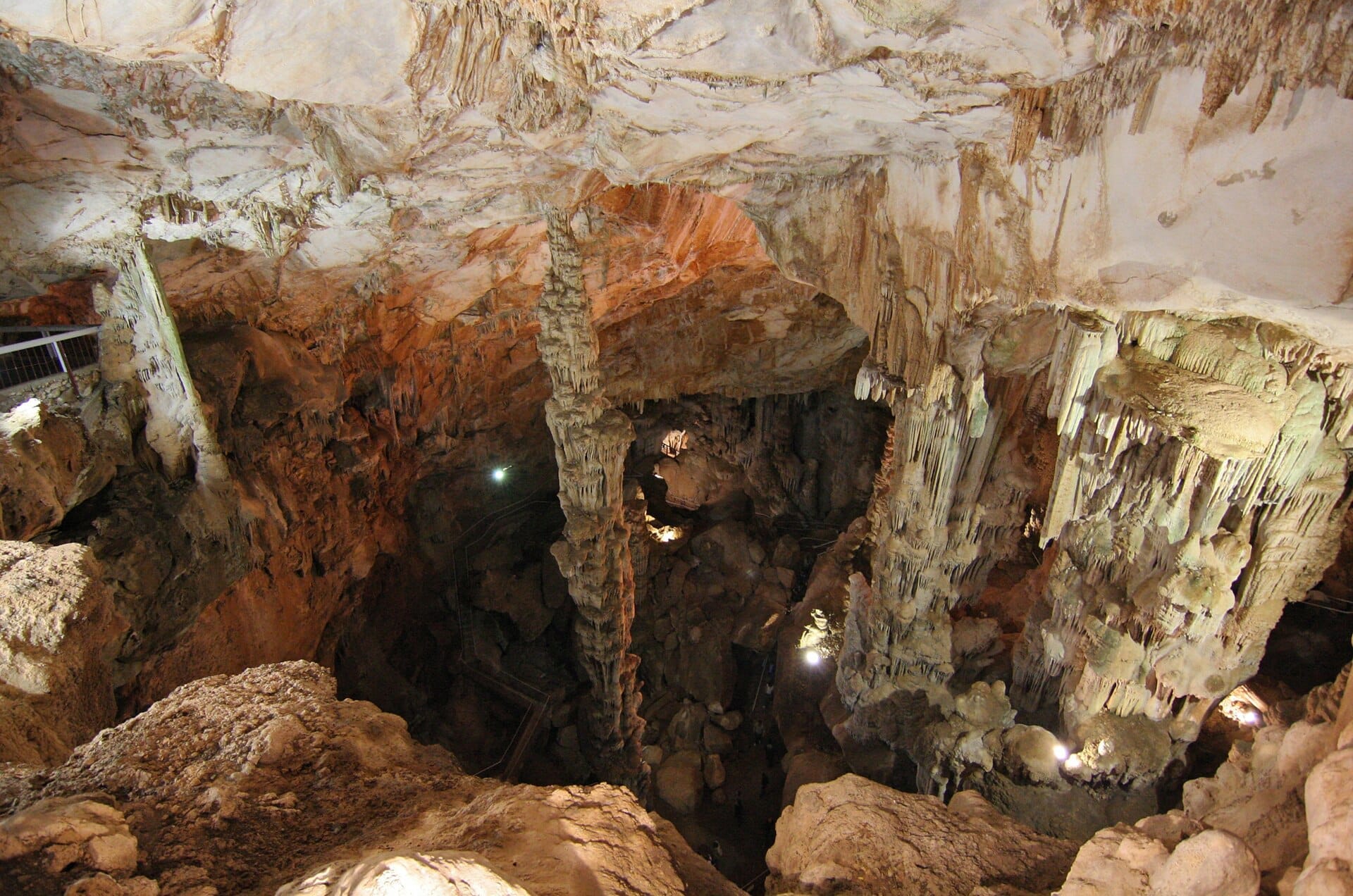
The main chamber opens to roughly 80 metres in diameter, and it is here that the 38-metre column dominates the space. It is the result of a stalactite growing downward from the ceiling meeting a stalagmite growing upward from the floor over an immense span of geological time. The column is lit from below during the tour, and the scale of it is difficult to process at first glance. Surrounding it are clusters of smaller formations, cave curtains, and draperies in cream and amber tones, with moisture catching the artificial light along the limestone walls.
The cave is classified as a karst formation within the Supramonte's Jurassic limestone system. The same geological conditions that shaped the coastal cliffs of the Golfo di Orosei underground produced these interior passages, meaning the cave and the coastline are part of one continuous hydrological story playing out across millions of years.
Tickets & tours
Hand-picked options from our booking partner. Prices are indicative; availability and final rates are confirmed when you complete your booking.
Cala Goloritze, Mariolu, Gabbiani, Biriala, Grotta del Fico boat tour
From 69 €Instant confirmationFree cancellationVineyard Guided Tour and 7 Wine Tasting in Palau
From 84 €Instant confirmationFree cancellationFull-Day Sailboat Tour in La Maddalena Archipelago from Cannigione
From 112 €Instant confirmationFree cancellationHiking excursion to the Devil's Saddle
From 35 €Instant confirmationFree cancellation
The Archaeological Significance
The cave was not only shaped by geology. Excavations in the deeper sections of the system uncovered remains connected to the Nuragic period, the Bronze Age civilisation that built the circular stone towers scattered across Sardinia. Artifacts including jewellery and human skeletal material have been recovered, suggesting the cave served a ritual or funerary purpose for communities living in this part of Sardinia more than 3,000 years ago. Some sources refer to the inner abyss as the Abisso delle Vergini, the Abyss of the Virgins, though the interpretation of this find remains a matter of ongoing archaeological discussion.
If this period of Sardinian prehistory interests you, the Museo Archeologico Nazionale in Cagliari holds a significant collection of Nuragic artefacts, and the Museo Archeologico in Dorgali itself (a short drive away) contextualises finds from this immediate area. The nuraghe tower of Nuraghe Losa offers an above-ground comparison point for understanding the culture that may have used this cave.
The Guided Tour: What to Expect
The tour lasts approximately 45 minutes and is conducted in Italian, with guides often able to accommodate English-speaking groups or individuals to a reasonable degree. Group sizes vary: in July and August, you may find yourself with 30 or more people, which makes the experience noisier and slightly less atmospheric but does not diminish the scale of the main column. In May, early June, or September, group sizes are smaller and the dynamic is more relaxed.
The 280-step descent is uneven in places. The path is fitted with handrails throughout but requires reasonable mobility and confidence on stairs. The Ghivine cooperative's own notes classify the cave as not accessible for visitors with significant mobility impairments or wheelchair users. Children under about five years old may find the steps challenging depending on their confidence. Children from five upwards typically manage the route well.
Photography is permitted inside the cave, but conditions are difficult. The artificial lighting creates deep contrast and your standard phone camera will struggle without manual exposure adjustment. A camera with manual ISO control will perform considerably better. Flash photography of the column and formations is possible, though the scale of the chamber means wide-angle lenses capture more of the context.
⚠️ What to skip
The steps are damp in places and the stone can be slippery. Wear closed-toe shoes with grip. Sandals and flip-flops are not suitable for this visit.
When to Visit and How to Get There
The cave is open for guided visits in every month of the year, but with dramatically reduced hours outside of the April to October window. The most comfortable visiting period is May, early June, and September. Tours run hourly across most of the day in these months, you avoid the August crush, and the surrounding Supramonte landscape is at its most appealing for driving through. If you are visiting in July or August, the cave itself is a logical midday stop because the interior temperature provides a cool break from heat that regularly exceeds 30 degrees outside.
The cave is not reachable by public transport. You need your own vehicle. From Dorgali, take the SS125 in the direction of Orosei. At kilometre marker 209.4 you will see the sign for Grotta di Ispinigoli on your right. The road to the entrance is short and there is a parking area at the site. The drive from Dorgali takes around 10 to 15 minutes. From Cala Gonone, allow about 20 minutes. From Nuoro, the journey is roughly 45 minutes.
If you are planning a fuller day in the area, a road trip through the Golfo di Orosei pairs the cave with a morning or afternoon at the coast. The drive along the SS125 itself, known as the Orientale Sarda, is one of the more dramatic stretches of Sardinian road.
ℹ️ Good to know
Tour departure times for January–February and November–December are very limited: typically one or two departures around 11:00–12:00 even on weekdays. Always check the official Ghivine cooperative website before travelling, especially outside peak season.
Is It Worth the Visit?
The 38-metre column is the centrepiece and it earns the journey. Few formations of this scale are accessible to the general public in Europe, and the context of the Bronze Age finds adds a layer of meaning that goes beyond pure geology. The guided format means you see what the guide shows you rather than exploring freely, which suits most visitors but will frustrate anyone hoping to linger or photograph at their own pace.
People who prefer outdoor experiences and find show caves underwhelming may feel the 45-minute guided tour delivers less than the drive warrants. The entrance fee of 10 euros for adults is reasonable for a managed site of this quality, but if your Sardinian schedule is already dense with coastal and archaeological stops, it is worth noting that Ispinigoli requires a conscious detour inland. It rewards those detours, but it is not something you pass by accident.
Families with children aged roughly 8 and upward will find this an engaging stop, particularly if combined with time at Grotte del Bue Marino near Cala Gonone, another cave system accessible by boat. Combining both in a single day is feasible with an early start.
Insider Tips
- Arrive for the first tour of the day, especially in July and August. The cave temperature is always around 16°C but early departures mean smaller groups, quieter acoustics, and a less rushed experience before the tour buses arrive.
- The site has a small bar and gift area at the entrance. If you are driving from Dorgali in the morning, there may not be options for breakfast en route. Either eat in Dorgali before leaving or bring something with you.
- The parking area outside the cave also marks the start of a walking path into the surrounding Supramonte scrubland. If you arrive early for a later tour, the 20 to 30 minutes before departure are well spent on this path rather than waiting inside.
- Combine with the Museo Archeologico di Dorgali, which is a short drive back toward town. It holds artefacts from the Ispinigoli excavations in proper archaeological context, and adds genuine depth to what you have just seen underground.
- Book your visit in advance in peak summer through the official Ghivine site if you are planning around a specific departure time. Walk-ins are usually fine in shoulder season but July and August slots can fill, particularly around midday.
Who Is Grotte di Ispinigoli For?
- Geology and speleology enthusiasts drawn by the 38-metre column, one of Europe's tallest known speleothems
- Families with children aged 8 and above, particularly those interested in prehistory alongside natural science
- Travellers exploring the Golfo di Orosei interior who want a half-day alternative to coast and beach activities
- Visitors seeking shelter from peak summer heat, given the cave maintains around 16–17°C year-round
- Anyone with an interest in Nuragic and Bronze Age Sardinia who wants to pair an archaeological site with a natural landmark
Nearby Attractions
Other things to see while in Golfo di Orosei:
- Cala Goloritzè
Cala Goloritzè is a protected natural monument on Sardinia's eastern coast, where a limestone pinnacle of about 143–148 metres towers over a pebble beach and crystalline water. Accessible only by a moderately strenuous hike or by sea, it rewards the effort with scenery that few coves in the Mediterranean can match.
- Cala Gonone
Cala Gonone is a small seaside town tucked beneath limestone cliffs on Sardinia's eastern coast, serving as the main launch point for the Golfo di Orosei's famous sea caves, secluded coves, and dramatic hiking routes. Whether you arrive by boat, bus, or car, this is where the real adventure begins.
- Cala Luna
Cala Luna is an 800-metre crescent of pale pink-tinged sand framed by limestone cliffs that rise up to 300 metres above the waterline. Straddling the municipal boundary between Baunei and Dorgali in the Gulf of Orosei, it has no road access and only minimal seasonal beach infrastructure — which is precisely why it looks the way it does.
- Cala Mariolu
Tucked beneath the limestone cliffs of Costa di Baunei, Cala Mariolu is one of the eastern Sardinian coast's most extraordinary beaches. Famous for its white pebble shore, improbably clear water, and sheer rock walls rising hundreds of metres, it demands effort to reach but rewards accordingly. This guide covers every access route, the new reservation system recently introduced to manage visitor numbers, and what first-time visitors consistently get wrong.