Nuraghe Losa: Inside One of Sardinia's Most Impressive Bronze Age Fortresses
Standing on the basalt plateau of Abbasanta in central-western Sardinia, Nuraghe Losa is a remarkably well-preserved trilobed nuraghe dating back to the 14th century BC. With its massive central tower, three surrounding bastions, and a sprawling village complex covering 3.5 hectares, this is one of the most complete and legible Nuragic sites on the island — and one of the few that rewards visitors who take the time to climb inside.
Quick Facts
- Location
- SS 131 'Carlo Felice', località Losa, 09071 Abbasanta (OR) — near km 123–124, central-western Sardinia
- Getting There
- By car via SS 131 from Cagliari or Sassari; exit at the Nuoro junction. No dedicated bus or train stop at the entrance — local ARST buses and Trenitalia trains serve Abbasanta town a few kilometres away, so a car or taxi is strongly recommended
- Time Needed
- 1.5 to 2.5 hours, including the village walk and a guided tour
- Cost
- Adults €6 / Groups (20+) €4.50 / Children 6–13 €3 / Under 5 and visitors with disabilities free (verify locally)
- Best for
- History enthusiasts, families with older children, travellers connecting Cagliari to Sassari or Olbia
- Official website
- http://www.nuraghelosa.net
What Is Nuraghe Losa?
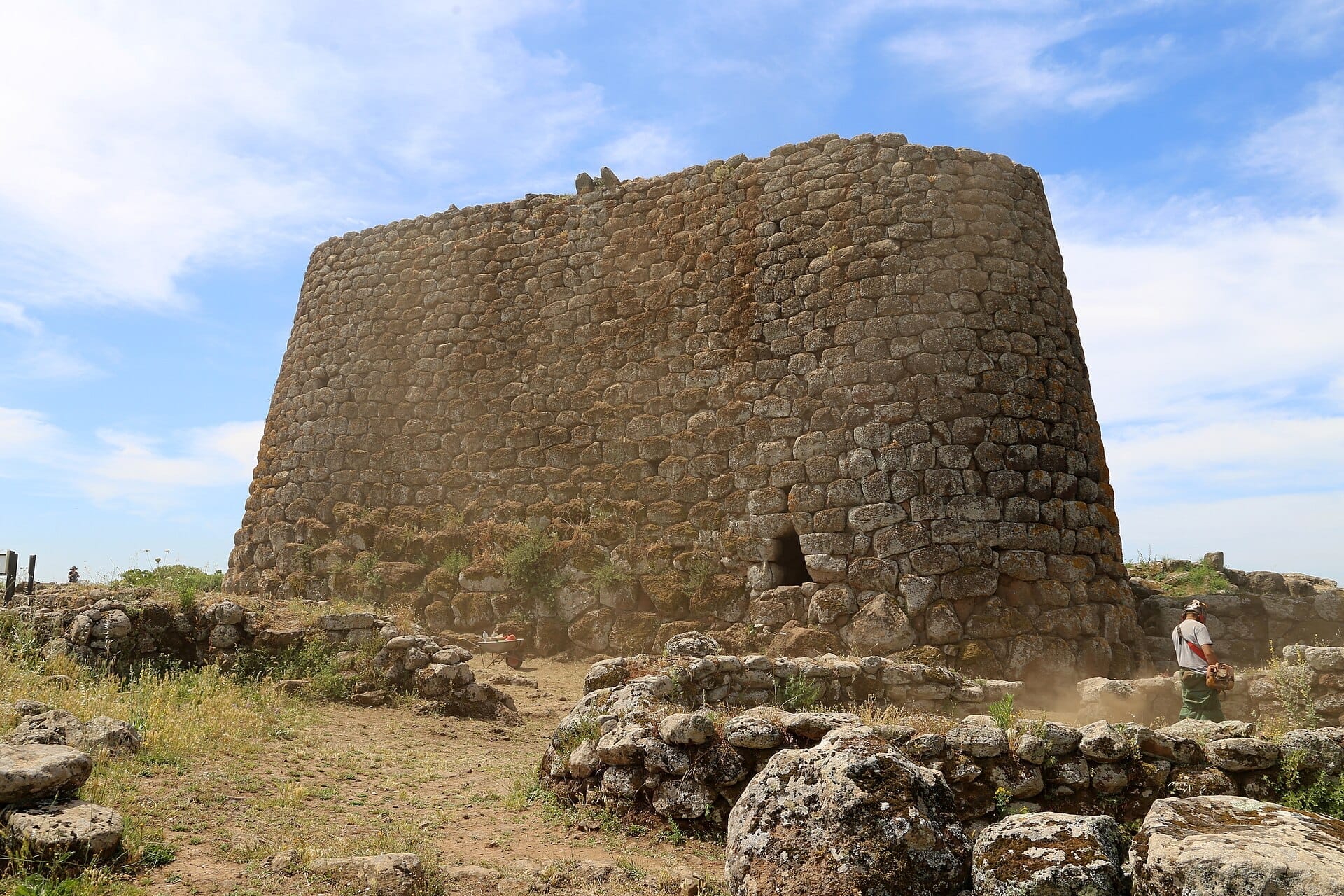
Nuraghe Losa is a complex trilobed nuraghe — that is, a central defensive tower flanked by three smaller towers joined by a rampart — built on the dark basalt plateau of Abbasanta in the Oristano province. It is one of the largest and best-preserved examples of Nuragic architecture in Sardinia, and one of relatively few sites where visitors can actually enter the tower, climb its internal stairways, and understand the spatial logic of a 3,400-year-old fortress.
The site covers approximately 3.5 hectares in total, encompassing not just the fortified nuraghe itself but the ruins of the surrounding Nuragic village — a dense scatter of circular hut foundations that give a genuine sense of the settlement that once grew up around the tower. The preserved height of the central keep is about 13 metres, though it is estimated to have originally reached around 20 metres. The base follows a solid triangular plan, roughly 20 to 25 metres per side.
For travellers already planning to visit the more famous Su Nuraxi di Barumini (a UNESCO World Heritage Site), Nuraghe Losa offers a complementary perspective — it is less visited, comparably impressive in scale, and positioned along the main SS 131 highway, making it a logical stop on any Sardinian road trip.
A Deep History: From Bronze Age Fortress to Early Medieval Settlement
Construction at Nuraghe Losa unfolded across multiple phases, each legible in the stone if you know what to look for. The central tower — the oldest part — dates to around the 14th century BC, during the Middle Bronze Age. The outer bastion, antewall, and enclosing rampart were added during the 13th century BC, reflecting either a period of heightened defensive concern or the growing status of the site within its territory.
The surrounding village expanded from the late 12th century BC into the Early Iron Age. But what makes Nuraghe Losa particularly significant among archaeologists is the duration of occupation: the site shows evidence of continued use through Phoenician, Carthaginian, and Roman periods, and settlement apparently persisted at least into the 7th century BC. This is not just a Bronze Age curiosity — it is a site that people returned to, adapted, and lived in for over two millennia.
The Nuragic civilisation that built Losa remains one of the ancient world's most intriguing puzzles. Sardinia is estimated to have once contained more than 7,000 nuraghi (with over 7,000 sites recorded) — the island's extraordinary density of these stone towers has no parallel anywhere in Europe. To put Nuraghe Losa in wider context, the guide to Sardinia's Nuragic sites covers the distribution and variety of structures across the island.
Tickets & tours
Hand-picked options from our booking partner. Prices are indicative; availability and final rates are confirmed when you complete your booking.
Tour of the Nuraghe of Barumini and Casa Zapata from Cagliari
From 101 €Instant confirmationFree cancellationAperitif on a sailing ship to La Pelosa from Stintino
From 75 €Instant confirmationFree cancellationVineyard Guided Tour and 7 Wine Tasting in Palau
From 84 €Instant confirmationFree cancellationFull-Day Sailboat Tour in La Maddalena Archipelago from Cannigione
From 112 €Instant confirmationFree cancellation
What the Visit Actually Feels Like
You approach Nuraghe Losa across a car park bordered by Mediterranean scrub — cork oak and wild rosemary grow close to the perimeter fence, and in summer the air carries the dry, resinous smell of heated stone and herbs. The site is open to clear views across the Abbasanta plateau in all directions, which immediately tells you something about why this location was chosen: sight lines matter when you are building a watchtower.
After collecting your ticket at the small entrance booth, you follow a path through the outer village ruins before reaching the nuraghe itself. The circular hut foundations are shallow and partially reconstructed, but walking among them creates a genuine spatial sense of community density — these were not isolated structures but tightly packed dwellings. Interpretive panels (in Italian and English) explain the phasing of construction and the finds recovered during excavation.
The central tower is entered through a low corbelled doorway that requires most adults to duck. Inside, the walls close in — the interior chamber is cool even in August, the stone damp to the touch, and the acoustics oddly muffled. A spiral staircase cut into the wall thickness leads upward. The stairs are uneven and worn smooth by millennia of use, then by modern visitors. The handrail is a practical addition. From the upper levels, the plateau opens out in every direction: flat, dark basalt land stretching to distant hills.
💡 Local tip
Wear closed-toe shoes with grip. The interior stairs are ancient stone, worn smooth, and often slightly damp even in summer. Sandals are risky here.
Best Time to Visit and How the Site Changes Through the Day
Nuraghe Losa opens daily at 09:00, and the first hour after opening is the calmest window of the day. Tour groups — mostly Italian school groups in spring and mixed European visitors in summer — tend to arrive from mid-morning onwards. By 11:00 in July and August, the site can feel noticeably crowded inside the tower, where the passage narrows and queues form on the stairs.
Late afternoon is an underrated time to visit. The light on the basalt blocks shifts from harsh white to warm amber after 16:00, and the plateau takes on a quieter quality as coach tours depart. The site closes approximately one hour before sunset, which means in summer you have access until around 19:00 — long enough to walk the village perimeter in good light without heat or crowds.
Autumn and spring are the most comfortable seasons overall. Temperatures in the Oristano area sit between 17 and 24°C in May and September, the basalt is not radiating summer heat, and the surrounding scrub is greener. Winter visits are perfectly possible — the site is open year-round — but the plateau is exposed to Sardinia's occasional tramontane wind, which can make a short visit feel punishing without a windproof layer.
⚠️ What to skip
The Abbasanta plateau has almost no natural shade outside the tower itself. In July and August, midday temperatures can exceed 35°C in full sun. Bring water, a hat, and sunscreen if visiting between 11:00 and 16:00.
Guided Tours and What They Add
On-site guided tours are available in Italian, Sardinian, English, and French, and they improve the visit. Without a guide, the interior of the tower is atmospheric but somewhat cryptic — the corbelled gallery, the upper chamber, the relationship between the three outer towers and the central keep are not immediately legible to a visitor without architectural context. A guide who knows the construction phases can point to the visible seam where the bastion was joined to the original tower, explain which stones were cut with bronze tools and which were simply stacked, and tell you what the excavation revealed about daily life in the surrounding village.
Group tours can be arranged at the ticket office; individual visitors are often absorbed into a departing tour if timing aligns. Night tours are available during certain periods by prior arrangement — worth investigating if you have flexibility, since the nuraghe illuminated against a dark Sardinian sky is a different experience entirely.
Practical Information: Getting There, Facilities, and Accessibility
The site sits directly off the SS 131 highway — the main north-south artery crossing Sardinia — near km 123–124, at the junction for Nuoro. Driving from Cagliari takes roughly 90 minutes; from Sassari, about 75–90 minutes. From Olbia, take the SS 131 DCN to Abbasanta and follow signs to the site. Parking is ample and free directly beside the entrance.
Public transport to Nuraghe Losa is not straightforward. ARST buses and regional trains serve Abbasanta town, but the site itself is several kilometres from the town centre and there is no dedicated stop at the entrance. For travellers without a car, the most realistic option is a taxi from Oristano or a guided tour departing from Cagliari or Oristano. If you are planning a road trip across central Sardinia, Nuraghe Losa fits naturally as a stop between the capital and the north.
On-site facilities are better than at most Nuragic sites: there is a cafeteria, a picnic area, toilets, and a ticket office with multilingual staff. The surrounding grounds are walkable on compacted paths, but the nuraghe interior involves ancient stone stairs and uneven surfaces — it is not accessible for wheelchairs or pushchairs. People with disabilities enter free of charge. If you are combining this stop with a visit to the Tharros archaeological site on the Sinis Peninsula, the drive between the two takes under an hour and makes a coherent full-day itinerary around Oristano.
ℹ️ Good to know
Admission: adults €6, groups of 20+ €4.50 per person, children aged 6–13 €3, children under 5 and visitors with disabilities enter free. Verify current prices at nuraghelosa.net before your visit.
Who Should Skip Nuraghe Losa
Travellers with limited mobility or anyone who has difficulty with narrow stone stairs and uneven surfaces will find the interior of the tower inaccessible. The surrounding village grounds are walkable, but much of what makes this site rewarding is the climb inside the tower itself. If that is not possible, the external impression of the nuraghe — substantial and striking — can still be appreciated from ground level.
Travellers primarily focused on beaches and coastal scenery may find this detour hard to justify unless they have a strong interest in ancient history. Sardinia offers extraordinary coastal attractions, from the quartz-sand beach of Is Arutas on the nearby Sinis Peninsula to the dramatic sea stacks of the Golfo di Orosei further east. Nuraghe Losa is for those who want to understand the island's interior as well as its coastline.
Very young children may also find the confined interior passages unsettling, and the site offers limited entertainment for toddlers beyond the open-air walk through the village area. Older children with an interest in history, castles, or ancient civilisations, however, often find the interior exciting.
Insider Tips
- Arrive at 09:00 when the site opens — you will likely have the interior to yourself for at least 30 to 40 minutes before the first tour groups appear.
- Ask at the ticket office about the schedule for guided tours in English. Timings change seasonally and are not always posted clearly, but staff are generally helpful if asked directly.
- The upper level of the central tower offers views across the Abbasanta plateau that are worth the climb alone. Bring a wide-angle lens or a phone with panoramic mode — the flatness of the plateau in every direction is striking and very photogenic in the late afternoon light.
- Night tours are occasionally organised during summer and cultural event periods. Check nuraghelosa.net or contact the site directly if you are visiting in July or August — this is not widely advertised through mainstream travel channels.
- If you are northbound on the SS 131, Nuraghe Losa is on your right just before the Nuoro junction. It is easy to miss at highway speed — watch for the brown heritage signs starting about 3 km before the turnoff.
Who Is Nuraghe Losa For?
- History and archaeology enthusiasts who want an accessible, well-interpreted Nuragic site with proper facilities
- Road trippers driving between Cagliari and Sassari or Olbia who want a meaningful stop with context
- Families with children aged 8 and older who can handle stone stairs and will enjoy the tower climb
- Photographers seeking the early-morning or late-afternoon light on basalt stone with an open plateau backdrop
- Travellers combining the site with a wider Oristano and Sinis Peninsula day, pairing prehistoric and Phoenician history in one loop
Nearby Attractions
Other things to see while in Oristano & the Sinis Peninsula:
- Giants of Mont'e Prama (Cabras Museum)
The Giants of Mont'e Prama are Nuragic stone statues discovered near Cabras in 1974 — carved warriors, archers, and boxers currently dated to roughly 900–750 BCE. Displayed at the Civic Archaeological Museum “Giovanni Marongiu” in Cabras (with additional sculptures in Cagliari), they represent one of the most significant archaeological finds in the entire Mediterranean world.
- Lago Omodeo
Lago Omodeo is the largest artificial reservoir in Sardinia, formed by damming the Tirso River and stretching almost 30 km² across the central-western interior of the island. Its layered history, from a record-breaking 1924 dam to a torpedo attack in 1941 to a 100-metre replacement inaugurated in 1997, makes it far more than a scenic viewpoint. Entry is free, access requires a car, and the reward is a landscape that most coastal-focused visitors never see.
- Pozzo Sacro di Santa Cristina
The Pozzo Sacro di Santa Cristina, near Paulilatino in the Oristano province, is one of the best-preserved sacred wells of the Nuragic civilization, dating to around the 11th century BC. Its keyhole-shaped staircase descends into the earth with architectural precision that still puzzles researchers. This is not a site you pass through quickly — it rewards slow attention.
- Spiaggia di Is Arutas
Spiaggia di Is Arutas is a protected crescent beach on Sardinia's Sinis Peninsula where the shoreline is composed of tiny rounded quartz grains in shades of white, pink, and grey — not conventional sand. Access is free, but strict environmental rules apply. A car is almost essential to get here.