Pozzo Sacro di Santa Cristina: Inside Sardinia's Most Extraordinary Nuragic Sanctuary
The Pozzo Sacro di Santa Cristina, near Paulilatino in the Oristano province, is one of the best-preserved sacred wells of the Nuragic civilization, dating to around the 11th century BC. Its keyhole-shaped staircase descends into the earth with architectural precision that still puzzles researchers. This is not a site you pass through quickly — it rewards slow attention.
Quick Facts
- Location
- Località Santa Cristina, Paulilatino, Provincia di Oristano, Sardinia
- Getting There
- By car from SS 131 (Sassari–Cagliari highway), exit at km 114 — well signposted. No direct public transit to the site; a car or taxi from Oristano is strongly recommended.
- Time Needed
- 1.5 to 2.5 hours for the full sanctuary complex
- Cost
- Paid entry; standard tickets are currently €8 for adults (14+), €4 for ages 6–13, with discounts for groups and free entry for children 0–5. Tickets are available at the park office and online; check pozzosantacristina.com for any updates.
- Best for
- Archaeology enthusiasts, history-minded travelers, photographers, curious visitors wanting something well beyond beach tourism
- Official website
- pozzosantacristina.com
What Is the Pozzo Sacro di Santa Cristina?
The Pozzo Sacro di Santa Cristina is an ancient Nuragic sacred well located on the Abbasanta basalt plateau in central-western Sardinia, within the municipality of Paulilatino. Built around the 11th century BC during the Final Bronze Age, it belongs to a class of ritual monuments unique to Sardinia: wells constructed not for domestic water supply but for religious ceremonies, almost certainly connected to the worship of water as a sacred element.
The well is the centerpiece of a larger sanctuary complex covering about one hectare, which includes a circular meeting hut, an enclosure, ancillary huts, and a nuraghe. Later Punico-Roman structures were added to the area, layering over three thousand years of human presence onto a single site. Few places in Sardinia compress this much archaeological depth into so compact a space.
ℹ️ Good to know
The site is open every day, all year round, from 08:30 until dusk (until sunset/“tramonto”), with closing time shifting seasonally. Arriving by mid-afternoon is a safe strategy in any season.
The Architecture: A Keyhole Into the Bronze Age
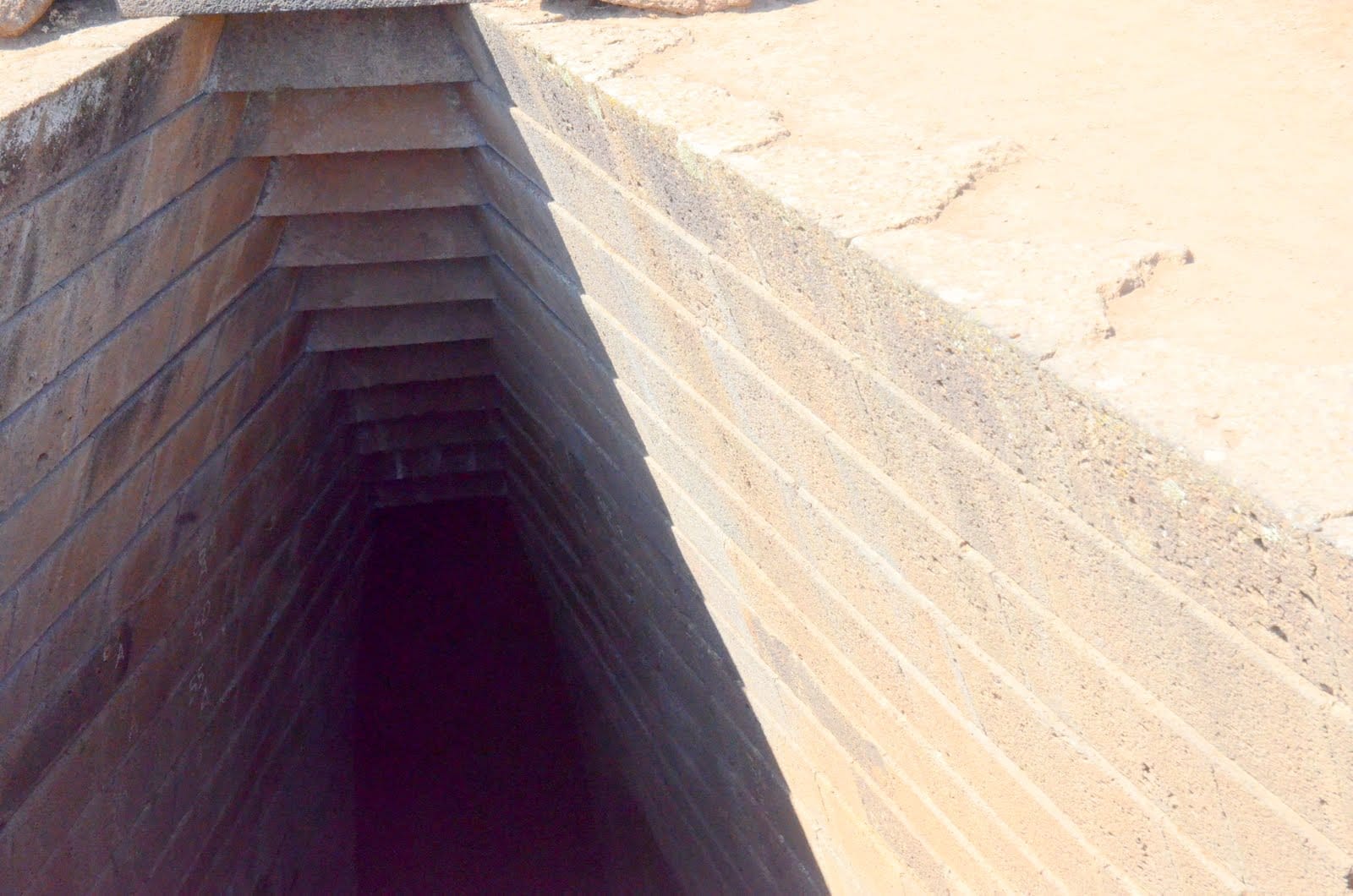
The well's design is immediately striking. Viewed from above, the plan is keyhole-shaped: a vestibule leads to a trapezoidal staircase that descends underground, narrowing as it approaches the circular well chamber below. The chamber itself measures approximately 2.5 meters in diameter, and the ogival tholos — a false cupola built in corbelled basalt — is about 7 meters high. The entire structure was assembled from local basalt blocks cut and fitted with a tightness that required no mortar.
Standing at the top of the staircase and looking down, the proportions feel deliberate and almost theatrical. The light at the base of the well shaft shifts significantly depending on the time of day and season. Scholars have noted that the well's orientation may have been aligned to astronomical events — specifically, that on the equinoxes, sunlight or moonlight would reflect directly onto the water surface — though this interpretation is still debated in the archaeological literature. What is certain is that the precision of the construction goes far beyond utilitarian need.
For broader context on the Nuragic civilization's architectural legacy across Sardinia, the Sardinia Nuragic sites guide covers the island's most significant Bronze Age monuments in one place.
⚠️ What to skip
Mobility note: reaching the well requires descending a narrow stone staircase with uneven basalt steps. There is no step-free alternative route to the well itself. Visitors with limited mobility can view the exterior and approach area, but the descent into the chamber will not be accessible to everyone.
Tickets & tours
Hand-picked options from our booking partner. Prices are indicative; availability and final rates are confirmed when you complete your booking.
Catamaran excursion to La Maddalena from Santa Teresa di Gallura
From 118 €Instant confirmationFree cancellationQuad biking tour from Santa Teresa di Gallura
From 0 €Instant confirmationFree cancellationSanta Teresa di Gallura hiking tour of Valle della Luna
From 30 €Instant confirmationFree cancellationSailboat trip to Maddalena archipelago from Santa Teresa Gallura
From 167 €Instant confirmationFree cancellation
The Sensory Experience of Visiting
The sanctuary sits within a grove of centuries-old olive trees, which creates an atmosphere unlike any open-air archaeological site in Sardinia. The trees are gnarled and enormous — some with trunks several meters in circumference — and their canopy provides deep shade that keeps the air noticeably cooler even in July. The ground underfoot is a combination of packed earth and exposed basalt, slightly uneven, with roots threading across the paths.
In the morning, before tour groups arrive, the site is very quiet. You hear insects, wind through the olive branches, and occasional birdsong. The stone of the well structure retains the cool of the night into the early hours, and the humidity at the base of the staircase is perceptibly higher than the air above. If you press your hand against the basalt blocks lining the well shaft, they feel slightly damp and cold — a physical reminder that you are standing beside water that has been here for three millennia.
By late morning in peak summer, organized tour groups begin to cycle through, and the intimacy of the site changes. The olive grove absorbs some of the noise, but the well chamber itself is small and can feel crowded when more than a handful of people are standing at the top of the staircase simultaneously. Early arrival — 08:30 to 09:30 — is consistently the most rewarding window.
Historical and Cultural Significance
The Nuragic civilization flourished in Sardinia from roughly 1800 BC until the island came under Carthaginian and later Roman influence. At its peak, the civilization produced more than seven thousand nuraghi — stone tower structures scattered across the island — along with sacred wells, giant tombs, and other monument types found nowhere else in the Mediterranean with this density or consistency.
Sacred wells served a religious function connected to water cults, and the Pozzo Sacro di Santa Cristina is considered among the finest examples of this typology in all of Sardinia. The meeting hut adjacent to the well — a circular structure with stone benches along the interior walls — suggests that the site hosted communal gatherings, possibly pilgrimage events or ritual assemblies. Votive objects including bronze figurines and other offerings have been recovered from Nuragic sacred wells across the island, pointing to sustained ritual use over centuries.
The nearby site of Su Nuraxi di Barumini — a UNESCO World Heritage nuraghe complex in the Marmilla region — provides a complementary view of Nuragic architecture at its most monumental scale, and many visitors combine both sites in a single day trip.
The Tharros archaeological site on the nearby Sinis Peninsula adds a Punico-Roman dimension to any archaeology-focused itinerary in the Oristano area, and the two sites together make a full and rewarding day.
Practical Walkthrough: What to Expect on the Day
From the SS 131, the turnoff at km 114 is well signed and easy to spot even at road speed. The access road leads through olive groves before reaching the parking area, which is free and reasonably sized — though it fills quickly during peak summer weekends. The ticket office is near the entrance; tickets can also be purchased in advance online or at Museo Palazzo Atzori in Paulilatino.
After entering, most visitors head directly to the well, which is a short walk from the gate along a shaded path. You can view the full length of the keyhole-shaped staircase from above and look down the shaft to the water below. Take time with this view — the geometry of the corbelled walls converging toward the water is the site's central visual. Then walk the perimeter of the meeting hut, the enclosure walls, and the associated nuraghe before finishing in the olive grove.
There is a small visitor facility near the entrance with basic information panels. The on-site interpretation is adequate but not extensive — visitors who want deeper context should read up beforehand or purchase one of the guide booklets sometimes available at the ticket office. Wearing closed, flat shoes with grip is advisable given the basalt surfaces, which can be slippery when damp.
💡 Local tip
Photography tip: the well interior photographs best in the two hours after opening, when direct morning light enters the shaft from the east. By midday the lighting is flat and often overexposed at the top while underexposed at the base. A wide-angle lens and patience with exposure bracketing will serve you well.
When to Visit and Honest Limitations
Spring (April to early June) and autumn (September to October) offer the most comfortable conditions. Temperatures are mild, the olive trees are at their most atmospheric, and crowds are manageable. Summer visits are possible but the heat on the open sections of the site is intense — the olive grove provides relief, but midday in July or August on a basalt plateau in central Sardinia is hot, often reaching 35°C or above.
Winter visits are quiet and the light on the stone is sometimes extraordinary, but opening hours contract significantly as dusk arrives early. For a fuller picture of seasonal conditions across the island, the best time to visit Sardinia guide covers what each month actually offers.
One caveat: the Pozzo Sacro di Santa Cristina is a site that rewards real curiosity about prehistoric architecture and Nuragic culture. If that interest is absent, the visit can feel underwhelming to some travelers — it is a stone well and associated ruins in an olive grove, and the experience is quiet and reflective rather than spectacular in a visual sense. Travelers expecting something on the scale of a major museum or a dramatic landscape attraction should calibrate expectations accordingly. For those who do engage with the history, it is one of the most affecting archaeological sites in the western Mediterranean.
If this type of Nuragic archaeology interests you, the Oristano area also contains the Stagno di Cabras lagoon ecosystem and the site where the remarkable Giants of Monte Prama statues were discovered — another layer of Nuragic culture that pairs well with a Santa Cristina visit.
Insider Tips
- Arrive at opening time (08:30) on any day, including weekends — the first 30 to 45 minutes before tour buses arrive offer a quality of quiet that is simply not available later in the morning.
- The meeting hut (capanna delle riunioni) next to the well gets less attention than the well itself, but its interior — stone benches lining a circular wall — is remarkably intact and worth spending time in.
- Combine the visit with Tharros archaeological site on the Sinis Peninsula, about 40 minutes west by car. The contrast between the deep Bronze Age character of Santa Cristina and the Punico-Roman coastal city of Tharros gives both sites more meaning.
- Bring water. The nearest café or bar facilities are not at the site itself, and in summer the olive grove shade is welcome but hydration is essential.
- If you want to purchase the illustrated site guide booklet, ask at the ticket office — they are not always displayed prominently but provide significantly more detail than the on-site information panels.
Who Is Pozzo Sacro di Santa Cristina For?
- Travelers with a genuine interest in prehistoric and Nuragic archaeology
- Photographers seeking atmospheric, low-crowd conditions early in the day
- Those building an Oristano-area day trip combining multiple archaeological sites
- Visitors in spring or autumn looking for a substantive inland excursion away from beach crowds
- History-focused families with older children who can engage with the context
Nearby Attractions
Other things to see while in Oristano & the Sinis Peninsula:
- Giants of Mont'e Prama (Cabras Museum)
The Giants of Mont'e Prama are Nuragic stone statues discovered near Cabras in 1974 — carved warriors, archers, and boxers currently dated to roughly 900–750 BCE. Displayed at the Civic Archaeological Museum “Giovanni Marongiu” in Cabras (with additional sculptures in Cagliari), they represent one of the most significant archaeological finds in the entire Mediterranean world.
- Lago Omodeo
Lago Omodeo is the largest artificial reservoir in Sardinia, formed by damming the Tirso River and stretching almost 30 km² across the central-western interior of the island. Its layered history, from a record-breaking 1924 dam to a torpedo attack in 1941 to a 100-metre replacement inaugurated in 1997, makes it far more than a scenic viewpoint. Entry is free, access requires a car, and the reward is a landscape that most coastal-focused visitors never see.
- Nuraghe Losa
Standing on the basalt plateau of Abbasanta in central-western Sardinia, Nuraghe Losa is a remarkably well-preserved trilobed nuraghe dating back to the 14th century BC. With its massive central tower, three surrounding bastions, and a sprawling village complex covering 3.5 hectares, this is one of the most complete and legible Nuragic sites on the island — and one of the few that rewards visitors who take the time to climb inside.
- Spiaggia di Is Arutas
Spiaggia di Is Arutas is a protected crescent beach on Sardinia's Sinis Peninsula where the shoreline is composed of tiny rounded quartz grains in shades of white, pink, and grey — not conventional sand. Access is free, but strict environmental rules apply. A car is almost essential to get here.