Stagno di Cabras: Inside Sardinia's Largest Lagoon
Stagno di Cabras is one of Sardinia's largest coastal wetlands, stretching across roughly 2,200 hectares on the Sinis Peninsula west of Oristano. A protected natural site with free access, it draws birdwatchers, photographers, and travelers curious about the region's ancient fishing traditions and archaeological landscape.
Quick Facts
- Location
- Municipality of Cabras, Province of Oristano, western Sardinia
- Getting There
- By car from SS131: exit Oristano Nord, follow signs to Torregrande, then right toward Cabras (approx. 3–4 km). No regular public bus serves the lagoon perimeter directly.
- Time Needed
- 1.5–3 hours for a lakeside walk and birdwatching; half a day if combining with Tharros or Cabras town
- Cost
- Free admission — this is an open natural wetland with no entry ticket
- Best for
- Birdwatchers, photographers, nature travelers, and those exploring the Sinis Peninsula archaeological circuit
- Official website
- www.sardegnaturismo.it/en/explore/pond-cabras
What Is Stagno di Cabras?
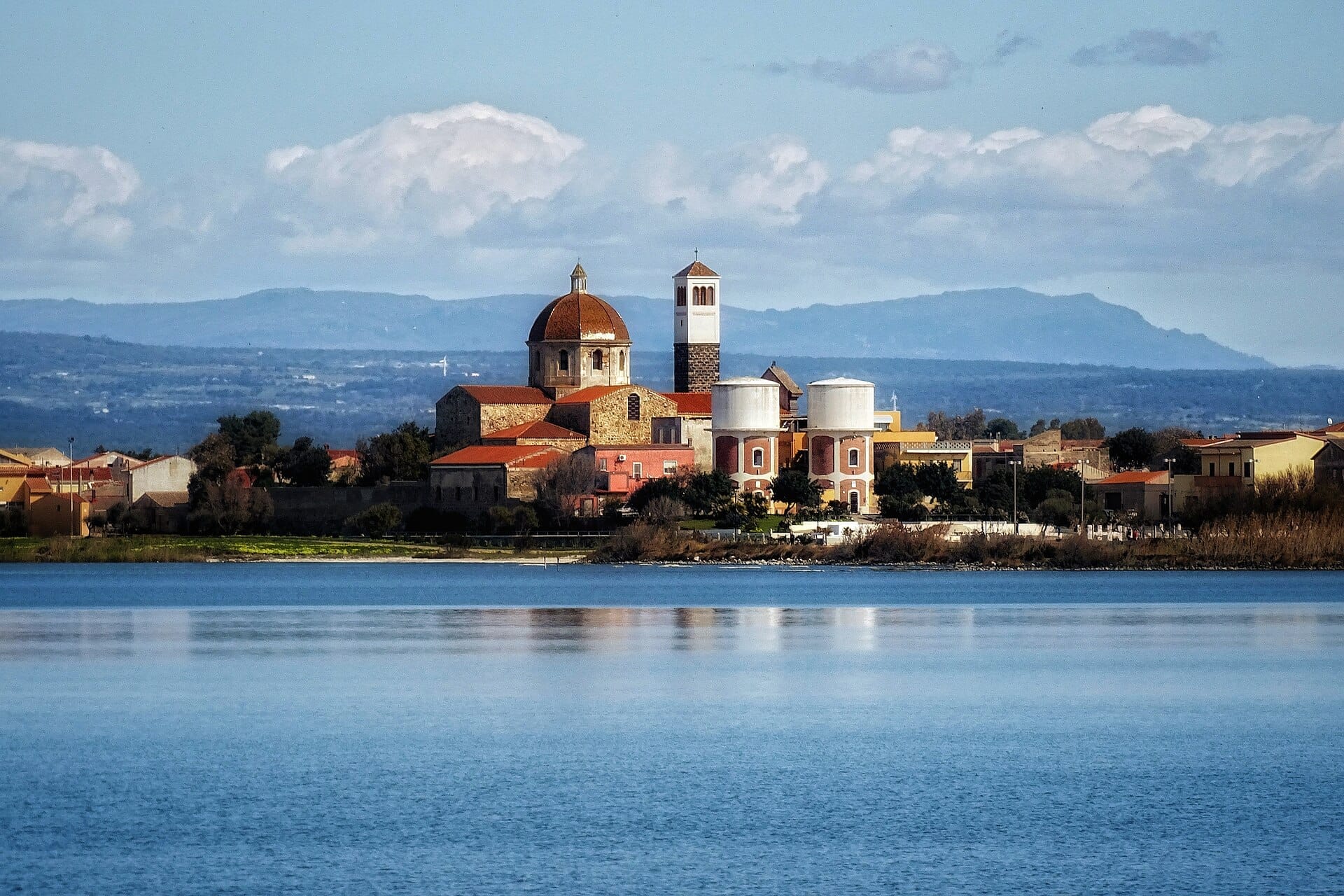
Stagno di Cabras is among the largest ponds in Sardinia and one of the most significant coastal wetlands in the entire Mediterranean basin. Occupying approximately 2,200 hectares in the municipality of Cabras, with parts extending into Nurachi and Riola Sardo, the lagoon sits on the western side of the Sinis Peninsula a few kilometers from the Tyrrhenian coast. Its protected status within the Natura 2000 network reflects both its ecological rarity and its vulnerability to disturbance.
The lagoon is shallow and brackish, fed by freshwater springs and connected to the sea in a way that creates a complex, ever-shifting ecosystem. Flat as a mirror on still mornings, its surface reflects the pink of flamingo flocks and the grey of herons standing motionless in the shallows. It does not perform for visitors. It simply exists, and that is largely why it rewards those who come prepared to watch.
💡 Local tip
Bring binoculars. The bird activity is often concentrated in the middle of the lagoon, far from the road edges where most people stop. A basic pair of binoculars transforms the experience entirely.
The Natural Environment: What You Will Actually See
The landscape around Stagno di Cabras is remarkably flat. Reeds and salt grass line the margins; the interior of the lagoon is open water broken by reed islands. The color of the water shifts across the day, ranging from pewter-grey under cloud cover to a vivid copper-green in afternoon light. In autumn and spring, the lagoon hosts one of the largest concentrations of waterbirds on the island.
Greater flamingos are the headline species, and they are impressive in numbers. But the supporting cast is just as rich: grey herons, little egrets, black-winged stilts, glossy ibis, cormorants, and various duck species depending on the season. In spring, migrating waders pass through in good numbers. The sound at dusk is something visitors rarely anticipate: a low, layered chorus of bird calls that carries across the flat water with unusual clarity.
The vegetation along the edges is low and wind-sculpted. There are no dramatic cliffs or forest backdrops here. The drama comes from scale and sky, especially at dawn and dusk when the light operates in a palette that professional photographers describe as difficult to replicate.
Tickets & tours
Hand-picked options from our booking partner. Prices are indicative; availability and final rates are confirmed when you complete your booking.
Vineyard Guided Tour and 7 Wine Tasting in Palau
From 84 €Instant confirmationFree cancellationFull-Day Sailboat Tour in La Maddalena Archipelago from Cannigione
From 112 €Instant confirmationFree cancellationHiking excursion to the Devil's Saddle
From 35 €Instant confirmationFree cancellationExcursion to the Archaeological site of Nora
From 70 €Instant confirmationFree cancellation
Time of Day: How the Lagoon Changes Hour by Hour
Dawn is the most rewarding time to be here. In the first hour after sunrise, the light comes in low across the water, the flamingos are active and moving between feeding areas, and the road along the lagoon edge is almost entirely empty. The air carries a faint saline smell mixed with the organic richness of the reed beds. There is very little noise except wind and birds.
By mid-morning, especially in summer, the light becomes harsher and the birds retreat to the middle of the lagoon. This is the least interesting window for observation. If you arrive between 10 AM and 3 PM on a July or August day, expect flat light, heat reflecting off the shallow water, and limited wildlife activity close to the banks.
Late afternoon recovers much of the quality lost in midday. The sun drops behind the hills toward Cabras town, the temperature becomes more comfortable, and the birds begin moving again. Sunset from the eastern bank of the lagoon, looking west toward the sea, can be striking — particularly when flamingos are in the foreground.
⚠️ What to skip
In July and August, midday temperatures around the lagoon can exceed 35°C with very little shade available along the road and bank areas. Bring sun protection, water, and a hat regardless of how brief you expect the visit to be.
Cultural and Historical Context: More Than a Bird Reserve
Stagno di Cabras has been economically and culturally important to the surrounding communities for thousands of years. The lagoon supports a significant mullet fishery, and the bottarga — salted, pressed mullet roe — produced here is considered among the finest in Sardinia. Local fishing families still work the lagoon using traditional methods, and their flat-bottomed wooden boats, known as fassoni, have been built from reed bundles harvested from these very margins for generations. If you are curious about Sardinian food traditions, the Sardinian food guide covers bottarga and other regional specialities in detail.
The archaeological weight of this area is considerable. A short drive from the lagoon edge brings you to the ruins of Tharros, a Phoenician and Roman settlement on the tip of the Sinis Peninsula that was inhabited for over a millennium. The lagoon served as a resource base and transport corridor for this ancient city. Artifacts recovered from the surrounding area are displayed at the Museo Civico Giovanni Marongiu in Cabras town, which also houses the famous Giants of Mont'e Prama — massive stone warrior statues from the Nuragic period, among the most significant pre-Roman sculptures found anywhere in the Mediterranean.
The Giants of Monte Prama were discovered in agricultural fields just a few kilometers north of the lagoon in 1974. Their presence in the museum means that a visit to Stagno di Cabras can logically be combined with one of the most remarkable archaeological collections in Sardinia — and most visitors who come only for the birds leave without knowing this.
Practical Walkthrough: Getting Around the Lagoon
There is no formal visitor infrastructure at the lagoon itself. No ticket booth, no official trail maps posted at entry points, no guided walks automatically available. Access is from the roads that run along its margins, and from a few informal stopping points where visitors park and walk to the water's edge.
The most accessible viewpoints are along the road that runs between Cabras town and the coast toward Torregrande to the east, and the SP4 road that heads south toward Tharros. Both offer flat walking on compacted ground beside the water. The terrain is not demanding, but paths are not surfaced or maintained for accessibility, and uneven ground and soft edges occur near the water. Formal accessibility facilities are not documented for this site.
A car is essentially required for most international visitors. There is no regular public bus route that serves the lagoon perimeter. From Oristano city, the drive takes roughly 20 minutes. From the SS131 motorway, take the Oristano Nord exit and follow signs toward Torregrande, then turn right toward Cabras. The SP4 approach from the south, following signs for Tharros from the Madonna del Rimedio junction, is another route that offers different views of the lagoon's southern section.
ℹ️ Good to know
Combining Stagno di Cabras with a visit to Tharros archaeological site on the same day makes strong geographic sense. The two are less than 15 km apart by road, and both reflect the deep layering of human activity on the Sinis Peninsula.
Photography Tips and Seasonal Timing
The lagoon rewards photographers who understand flat-light landscapes. The wide, unobstructed horizon means that overcast days can work surprisingly well — the diffuse light eliminates harsh shadows and brings out the subtle color differences in the water and reed beds. On such days, the pink of flamingo flocks reads clearly against the grey-green surface.
Golden hour at dawn is the premium slot. Position yourself on the eastern bank to have the rising sun behind you and the western sky in front. In October and November, the light comes in at a shallow angle for longer, and the flamingo population is often at its densest as the birds settle in for the winter. Spring (April to May) brings migrating species and generally good light conditions.
For those planning around Sardinia's seasons more broadly, the best time to visit Sardinia guide covers climate patterns across the island in detail. For this specific site, late September through November and March through May represent the best windows for birdwatching, with summer visits better suited to early morning arrivals.
Who Should Probably Skip This
Travelers looking for a conventional beach day, a specific organized activity, or a site with visitor facilities will find Stagno di Cabras frustrating. There is no cafe, no gift shop, no rental equipment, and no signed trail. The lagoon does not deliver its rewards on a fixed schedule, and visits that are rushed or poorly timed can feel underwhelming.
Families with very young children may find the lack of facilities and the informal access points difficult to manage. Those primarily interested in swimming and coastal scenery should note that this is a protected wetland, not a beach. For beach options on the Sinis Peninsula, Is Arutas is within easy reach and offers a very different but complementary experience.
Insider Tips
- The fishing cooperative in Cabras town occasionally runs guided lagoon tours in traditional fassoni boats during the summer months. These are not heavily advertised to international visitors, but asking locally at the cooperative or the town's tourist information point can yield results.
- The Museo Civico Giovanni Marongiu in Cabras, which houses the Giants of Monte Prama statues, is often combined with a lagoon visit by day-trippers from Oristano. Arrive at the museum when it opens to avoid the busiest periods, then head to the lagoon for the late afternoon light.
- The southern end of the lagoon, approached via the SP4 toward Tharros, tends to be quieter than the eastern margins near Cabras town. The views here look across open water with no road infrastructure visible on the far bank, which makes for cleaner photography.
- Mosquitoes can be significant near the reed beds in late summer and early autumn, especially at dawn and dusk. Insect repellent is useful rather than a precaution.
- The bottarga from Cabras is available in local shops in the town itself and is generally priced more reasonably than in Cagliari or tourist-facing delis. If you intend to bring some home, buying directly in Cabras is the sensible option.
Who Is Stagno di Cabras For?
- Birdwatchers and naturalists looking for one of Sardinia's most significant wetland sites
- Photographers seeking flat-water reflections, flamingos, and open-sky landscape compositions
- Travelers combining natural and archaeological interests on a Sinis Peninsula day trip
- Food-focused visitors curious about the bottarga production culture rooted in this specific lagoon
- Those who prefer unhurried, unstructured natural spaces over organized attractions
Nearby Attractions
Other things to see while in Oristano & the Sinis Peninsula:
- Giants of Mont'e Prama (Cabras Museum)
The Giants of Mont'e Prama are Nuragic stone statues discovered near Cabras in 1974 — carved warriors, archers, and boxers currently dated to roughly 900–750 BCE. Displayed at the Civic Archaeological Museum “Giovanni Marongiu” in Cabras (with additional sculptures in Cagliari), they represent one of the most significant archaeological finds in the entire Mediterranean world.
- Lago Omodeo
Lago Omodeo is the largest artificial reservoir in Sardinia, formed by damming the Tirso River and stretching almost 30 km² across the central-western interior of the island. Its layered history, from a record-breaking 1924 dam to a torpedo attack in 1941 to a 100-metre replacement inaugurated in 1997, makes it far more than a scenic viewpoint. Entry is free, access requires a car, and the reward is a landscape that most coastal-focused visitors never see.
- Nuraghe Losa
Standing on the basalt plateau of Abbasanta in central-western Sardinia, Nuraghe Losa is a remarkably well-preserved trilobed nuraghe dating back to the 14th century BC. With its massive central tower, three surrounding bastions, and a sprawling village complex covering 3.5 hectares, this is one of the most complete and legible Nuragic sites on the island — and one of the few that rewards visitors who take the time to climb inside.
- Pozzo Sacro di Santa Cristina
The Pozzo Sacro di Santa Cristina, near Paulilatino in the Oristano province, is one of the best-preserved sacred wells of the Nuragic civilization, dating to around the 11th century BC. Its keyhole-shaped staircase descends into the earth with architectural precision that still puzzles researchers. This is not a site you pass through quickly — it rewards slow attention.