Giants of Mont'e Prama: Sardinia's Most Astonishing Archaeological Discovery
The Giants of Mont'e Prama are Nuragic stone statues discovered near Cabras in 1974 — carved warriors, archers, and boxers currently dated to roughly 900–750 BCE. Displayed at the Civic Archaeological Museum “Giovanni Marongiu” in Cabras (with additional sculptures in Cagliari), they represent one of the most significant archaeological finds in the entire Mediterranean world.
Quick Facts
- Location
- Via Tharros, 09072 Cabras (OR), Sinis Peninsula, Sardinia
- Getting There
- By car from Oristano (approx. 8 km). Check ARST for regional bus options. No direct rail link to Cabras.
- Time Needed
- 1.5 to 2.5 hours for a thorough visit
- Cost
- Admission fees not consistently published online — contact Cooperativa Penisola del Sinis: +39 0783 290 636 or prenotazioni@penisoladelsinis.it
- Best for
- Archaeology enthusiasts, history lovers, cultural travellers, curious visitors of any age
- Official website
- monteprama.it/en/the-sinis/giovanni-marongiu
What Are the Giants of Mont'e Prama?
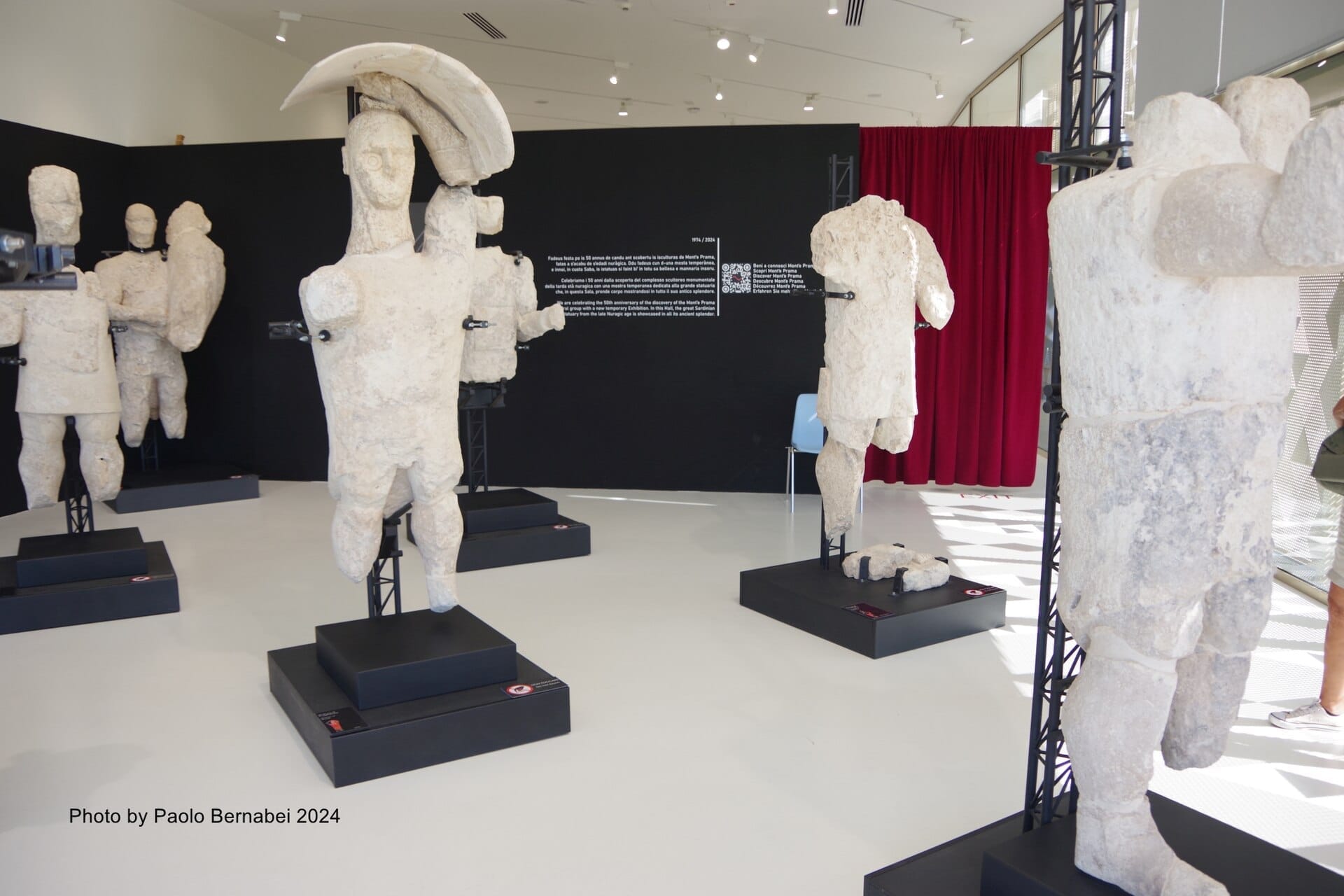
The Giants of Mont'e Prama are a group of Nuragic stone statues discovered in March 1974 in farmland near the archaeological site of Mont'e Prama, in the municipality of Cabras on Sardinia's Sinis Peninsula. Carved from local sandstone, the figures stand roughly 2 to 2.5 metres tall and depict warriors, archers, and boxers, alongside miniature models of nuraghe towers. Dated by many scholars to approximately 900–750 BCE, at the transition between the Final Bronze Age and early Iron Age, they may represent the oldest life-size or larger-than-life stone sculptures yet found in the Mediterranean world outside of Egypt and the Near East.
That last point is worth letting settle. These figures predate Greek kouros statues by at least a century. When they were unearthed, fragmentary and scattered across a burial field, scholars struggled to categorize them. Decades of painstaking restoration followed before the public could appreciate them properly. Today, the best of the restored corpus is displayed at the Museo Civico Archeologico Giovanni Marongiu in Cabras, where they form one of the most viscerally compelling museum experiences in all of Sardinia.
ℹ️ Good to know
Hours and ticket prices are not fixed far in advance on the official Fondazione Mont'e Prama website. Before visiting, confirm opening times and admission fees directly with the managing cooperative: Cooperativa Penisola del Sinis, tel. +39 0783 290 636, email prenotazioni@penisoladelsinis.it.
The Discovery and Its Significance
In March 1974, a farmer ploughing a field near Mont'e Prama, a low hill on the western edge of the Sinis Peninsula, struck stone fragments. Initial excavations recovered hundreds of broken sandstone pieces. The scale of the find only became clear over subsequent years and further digs, especially renewed excavation campaigns in the 2010s that yielded additional fragments and new statues. In total, the sculptural corpus now comprises several dozen figures across three types: archers with distinctive round shields raised above their heads, warriors in combat poses, and boxers with a single forearm guard. Alongside them, archaeologists found small-scale nuraghe models, likely votive in function.
The statues were buried alongside a Nuragic necropolis, suggesting they served as funerary guardians for a warrior elite. The precise identity of those buried, and the full religious or ceremonial context, remains actively debated among archaeologists. What is not in question is the craftsmanship: the figures display a stylized but coherent artistic vocabulary, with oversized eyes rendered as concentric rings, geometric musculature, and rigid frontality that feels almost archaic in the Greek sense, yet entirely its own.
For travellers already interested in Sardinia's prehistoric past, the Giants sit at the apex of the island's Nuragic heritage. They complement rather than replace the standing structures you can visit elsewhere, such as Su Nuraxi di Barumini or Nuraghe Santu Antine. Where those sites give you the architecture, the Cabras museum gives you the human face of the civilization.
Tickets & tours
Hand-picked options from our booking partner. Prices are indicative; availability and final rates are confirmed when you complete your booking.
Supramonte Full-Day Jeep Off-Roading and Hiking Tour in Dorgali
From 95 €Instant confirmationFree cancellationVineyard Guided Tour and 7 Wine Tasting in Palau
From 84 €Instant confirmationFree cancellationFull-Day Sailboat Tour in La Maddalena Archipelago from Cannigione
From 112 €Instant confirmationFree cancellationHiking excursion to the Devil's Saddle
From 35 €Instant confirmationFree cancellation
Inside the Museum: What to Expect
The Museo Civico Archeologico Giovanni Marongiu occupies a purpose-adapted building in Cabras town. The exhibition dedicated to the Giants is the museum's centrepiece, though the broader collection also covers finds from the nearby Tharros archaeological site and the Cabras lagoon area.
When you enter the Giants gallery, the scale registers immediately. The statues are displayed at floor level or on low platforms, without glass barriers, which means you stand directly in front of figures that are taller than most adult humans. The sandstone is a warm honey-brown in good light, with a slightly rough texture that makes the carving feel immediate rather than polished. The oversized, almost otherworldly eyes, formed as wide concentric circles, hold attention in a way that photographs do not fully prepare you for. There is a weight to the room that goes beyond aesthetics.
The gallery also includes a multimedia component with touch-screen displays allowing virtual exploration of the Mont'e Prama sculpture complex and broader archaeological context. Signage covers the discovery story, restoration process, and interpretive debates. The exhibition is well-designed for visitors without prior archaeological knowledge, though serious enthusiasts will find enough depth to sustain longer engagement.
💡 Local tip
Photography is generally permitted in the museum without flash. The statues are best photographed in the morning when natural light entering the gallery is soft and even. Midday can create harsh shadows in the exhibition space.
Time of Day and Crowd Patterns
Cabras is a small town and the museum, while nationally significant, draws a more specialist audience than Sardinia's beach resorts. In July and August, mornings from opening until around midday tend to be the calmest periods. Coach tours from Oristano and organised archaeological itineraries typically arrive late morning, so arriving at opening time gives you the gallery largely to yourself. The atmosphere in the Giants room when it is quiet — the only sounds being the faint hum of climate control and the occasional shuffle of feet on stone — is affecting.
Shoulder season visits in May, June, September, and October offer a noticeably more relaxed experience overall. The light in Cabras in early autumn is particularly good for photography, and the heat, which can exceed 35°C in peak summer, is less punishing for the drive out to the Sinis Peninsula and any time spent outdoors before or after the museum.
Getting There: Practical Details
Cabras sits on the Sinis Peninsula roughly 8 kilometres west of Oristano, the nearest city with a train station on Trenitalia's Cagliari–Sassari mainline. The most practical way to reach the museum is by car. Oristano is about 90 minutes by road from Cagliari and around two hours from Sassari in typical traffic conditions. Parking in Cabras is generally straightforward.
ARST regional buses connect Oristano with Cabras, but schedules are limited and should be checked directly on the ARST website before planning. A car also allows you to combine the museum visit with the nearby Tharros archaeological site, a Phoenician and Roman coastal settlement at the tip of the Sinis Peninsula, making for a full day of historically coherent exploration. The Stagno di Cabras, one of the largest coastal lagoons in Italy and home to flamingos, is also immediately adjacent.
If you are planning a broader circuit of western Sardinia, the Oristano and Sinis Peninsula area rewards at least two days. The region is covered in detail in our guide to Sardinia's Nuragic sites.
Honest Assessment: Is It Worth the Detour?
For visitors primarily in Sardinia for beaches, the museum requires a deliberate detour into a small inland town, and those who arrive without any background interest in prehistory may find the visit briefer and less revelatory than the promotional material suggests. The exhibition, though well-executed, is compact. If your itinerary is already full of coastal commitments and you have no appetite for archaeological context, this may not compete for your limited time.
For everyone else — for travellers who want to understand what Sardinia actually is beneath its postcard surface — the Giants are essential. They are not well-known internationally in the way that the Colosseum or Acropolis are, which means you can encounter them without the fatigue of over-touristed monuments. Standing in front of a two-and-a-half-metre sandstone warrior from 800 BCE in a quiet room in a small Sardinian town is exactly the kind of encounter that makes travel meaningful.
⚠️ What to skip
The museum's official website does not consistently publish fixed opening hours or ticket prices far in advance. Always call or email ahead to confirm before making a special trip: +39 0783 290 636 or prenotazioni@penisoladelsinis.it. Some visitors have arrived to find the museum closed for maintenance or local events.
Insider Tips
- Some of the Giants are also displayed at the Museo Archeologico Nazionale in Cagliari, where 33 sculptures are exhibited. If you cannot reach Cabras, you will encounter a portion of the corpus there — but the Cabras installation is larger and purpose-built for the statues.
- Book by phone or email before visiting. The managing cooperative (Cooperativa Penisola del Sinis) can also arrange guided tours in Italian and sometimes English, which add considerable depth to the experience.
- Combine the museum visit with Tharros, about 20–25 minutes further south by car. The two sites together tell a continuous story of human settlement on the Sinis Peninsula from the Nuragic through the Roman period.
- The Cabras lagoon directly outside town often hosts flamingos, especially in spring and autumn. Bring binoculars if birdwatching interests you — the detour adds almost no time and the spectacle can be remarkable.
- The sandstone used for the Giants is described in studies as local stone from the Sinis area of western Sardinia. When you drive through the landscape on the way to the museum, the pale, flat-topped stone outcrops you see are the same material the Nuragic sculptors worked with.
Who Is Giants of Mont'e Prama (Cabras Museum) For?
- Archaeology and ancient history enthusiasts who want to encounter one of the Mediterranean world's most important prehistoric finds
- Culturally curious travellers looking beyond Sardinia's beaches for genuine depth
- Photographers interested in sculpture and museum lighting, particularly in low-season morning visits
- Families with older children or teenagers who can engage with the historical context
- Anyone already visiting the Sinis Peninsula for Tharros or the Cabras lagoon
Nearby Attractions
Other things to see while in Oristano & the Sinis Peninsula:
- Lago Omodeo
Lago Omodeo is the largest artificial reservoir in Sardinia, formed by damming the Tirso River and stretching almost 30 km² across the central-western interior of the island. Its layered history, from a record-breaking 1924 dam to a torpedo attack in 1941 to a 100-metre replacement inaugurated in 1997, makes it far more than a scenic viewpoint. Entry is free, access requires a car, and the reward is a landscape that most coastal-focused visitors never see.
- Nuraghe Losa
Standing on the basalt plateau of Abbasanta in central-western Sardinia, Nuraghe Losa is a remarkably well-preserved trilobed nuraghe dating back to the 14th century BC. With its massive central tower, three surrounding bastions, and a sprawling village complex covering 3.5 hectares, this is one of the most complete and legible Nuragic sites on the island — and one of the few that rewards visitors who take the time to climb inside.
- Pozzo Sacro di Santa Cristina
The Pozzo Sacro di Santa Cristina, near Paulilatino in the Oristano province, is one of the best-preserved sacred wells of the Nuragic civilization, dating to around the 11th century BC. Its keyhole-shaped staircase descends into the earth with architectural precision that still puzzles researchers. This is not a site you pass through quickly — it rewards slow attention.
- Spiaggia di Is Arutas
Spiaggia di Is Arutas is a protected crescent beach on Sardinia's Sinis Peninsula where the shoreline is composed of tiny rounded quartz grains in shades of white, pink, and grey — not conventional sand. Access is free, but strict environmental rules apply. A car is almost essential to get here.