Benedictine Monastery of San Nicolò l'Arena: Catania's Baroque Giant
Founded in 1558 and rebuilt after twin catastrophes, the Benedictine Monastery of San Nicolò l'Arena is one of the largest monasteries in Europe and a cornerstone of Catania's UNESCO-listed Baroque heritage. Today it serves as a university faculty, which gives it a lived-in energy unlike any museum. Guided tours reveal extraordinary frescoed halls, hidden gardens, and the raw lava walls swallowed by the 1669 eruption of Etna.
Quick Facts
- Location
- Piazza Dante Alighieri 32, 95124 Catania – historic centre, about 10 min on foot from Piazza del Duomo
- Getting There
- AMT bus lines 1–4 or D to Piazza Dante; also walkable from Catania Centrale railway station in roughly 25–30 min
- Time Needed
- 1.5 to 2.5 hours for a guided tour; allow extra time to explore the attached church and cloister garden
- Cost
- Admission fee applies; verify current prices at monasterodeibenedettini.it before visiting, as rates are updated periodically
- Best for
- Architecture enthusiasts, history lovers, Baroque art fans, and anyone curious about how a living university inhabits an 18th-century monument
- Official website
- www.monasterodeibenedettini.it/en
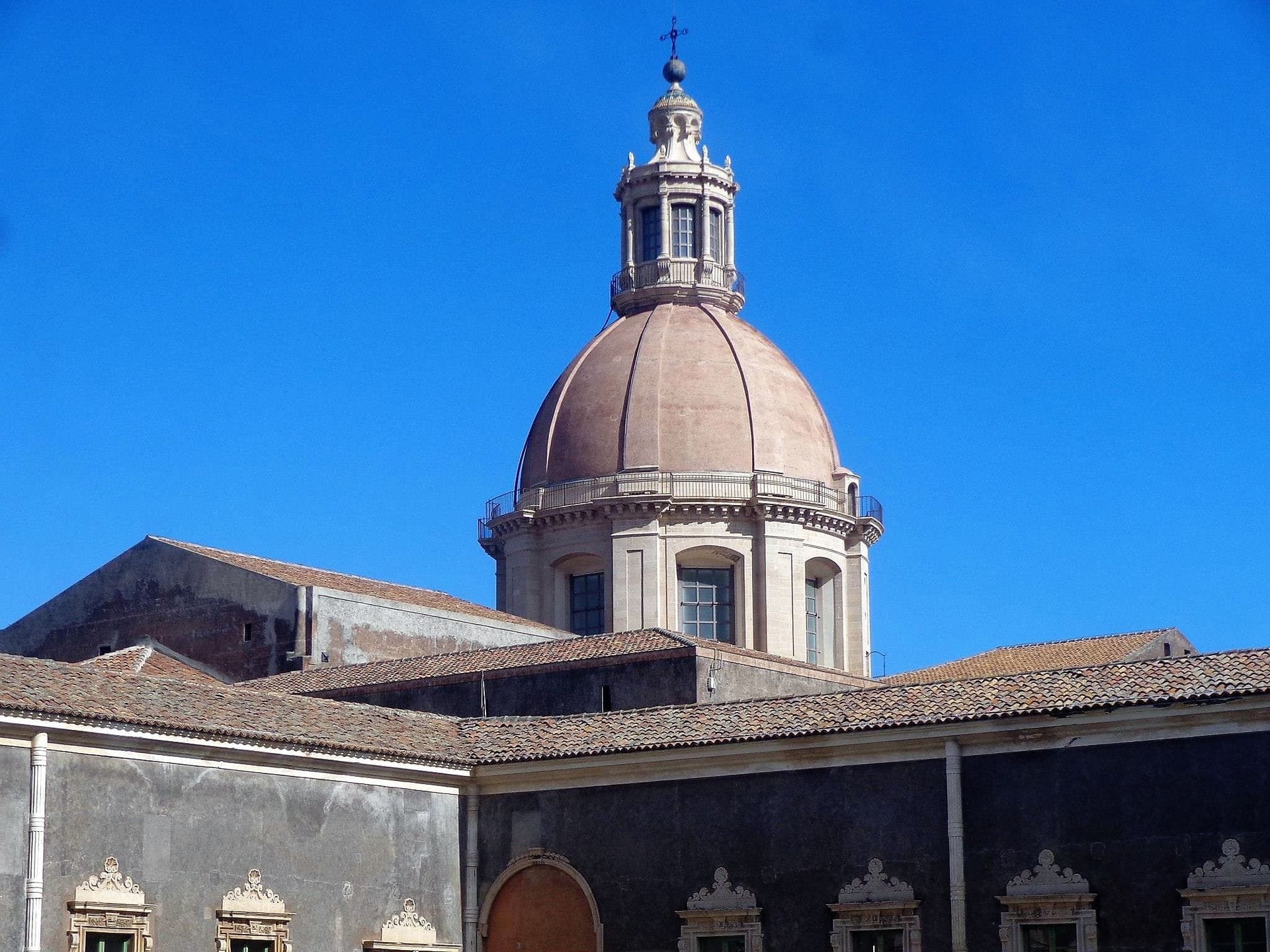
Why This Monastery Deserves More Than a Glance From the Street
From Piazza Dante Alighieri, the facade of the Benedictine Monastery of San Nicolò l'Arena stretches so far in both directions that it takes a moment to process the scale. This is not a compact jewel-box church. The complex extends roughly 210 by 130 metres, making it one of the largest Benedictine monasteries ever built in Europe and, together with the Palace of Mafra in Portugal, among the largest Benedictine complexes in existence. The exterior in lava stone and pale limestone gives little away, which is part of what makes stepping inside so striking.
The monastery forms part of the UNESCO World Heritage property known as the Late Baroque architecture of Sicily, though it sits within the Val di Noto cluster rather than the Arab-Norman tradition. What earned it that designation is the sheer ambition of the post-1693 reconstruction: following the earthquake that flattened much of eastern Sicily, the monks rebuilt not just their home but an architectural statement about permanence and power.
💡 Local tip
The monastery is an active faculty of the University of Catania. Visiting hours are approximately 09:00–17:00 daily, but access to certain areas can be restricted during academic events, exam periods, or public holidays. Always confirm the current tour schedule at monasterodeibenedettini.it or by calling ahead.
A History Written in Lava and Stone
The monastery was founded in 1558 by reformed Benedictine monks who chose a site on the western edge of what was then Catania's urban boundary. For over a century the community grew steadily, accumulating land, wealth, and artistic commissions. Then came two consecutive disasters that would have finished a less determined institution.
In 1669, a prolonged eruption of Mount Etna sent lava flows directly through the city. Rather than demolish what remained, the monks incorporated the solidified lava into their rebuilt foundations, and in several places you can still see the black basalt walls of the pre-eruption structures exposed beneath later construction. It is one of the most visceral connections to Etna's destructive power you will find anywhere in Catania.
The 1693 Val di Noto earthquake then collapsed much of what had been rebuilt. The reconstruction that followed produced the Baroque complex visible today, designed largely by the architect Giovanni Battista Contini and later expanded over the 18th century. The same seismic catastrophe reshaped the aesthetics of the entire region, a story explored in the Baroque Sicily guide.
Tickets & tours
Hand-picked options from our booking partner. Prices are indicative; availability and final rates are confirmed when you complete your booking.
Etna South Upper Craters Guided Excursion from Taormina
From 42 €Instant confirmationFree cancellationTaormina private tour with an expert guide
From 42 €Instant confirmationFree cancellationIsola Bella boat tour and snorkeling
From 55 €Instant confirmationFree cancellationSyracuse and Ortygia Island guided tour from Taormina
From 65 €Instant confirmationFree cancellation
What You Actually See on a Tour
Guided tours are the standard way to access the interior, and they are genuinely worth the structure they impose. Without a guide, many of the most significant rooms are locked, and the spatial logic of the complex is hard to read. A typical tour lasts around 90 minutes and takes in the main ceremonial halls, the kitchen quarters, the terraced gardens, and at least one section where lava-buried remains are exposed.
The ceremonial rooms on the piano nobile are the visual highlight. Ceiling frescoes in the refectory and the abbot's quarters are rich with 18th-century allegory, painted in a palette of ochre, terracotta, and faded blue that has survived without heavy restoration. The acoustics in the larger halls are extraordinary, something the university uses to its advantage for recitals and cultural events.
The kitchen block deserves specific mention. Built on an industrial scale, it has a central hearth large enough to stand inside and a drainage and water system that, for the 18th century, represented serious hydraulic engineering. It is one of the more unexpected rooms in any Sicilian monument, and tour guides tend to linger here because visitors consistently find it more compelling than they anticipated.
The terraced garden to the rear of the complex offers a different kind of pleasure: a quiet upper level with citrus trees and views across Catania's rooftops toward the coast. In the afternoon, when sunlight crosses the garden at a low angle, the lava stone of the perimeter walls shifts from black to a deep iron-grey. It is the kind of detail that does not photograph well but stays in the memory.
Timing Your Visit: How the Atmosphere Changes Through the Day
Morning visits, particularly before 11:00, are quieter and cooler. The entrance hall and courtyard face southeast, so early light falls directly across the facade and into the lower cloister, making the basalt and limestone contrast particularly sharp. Photography of the exterior is best done at this hour.
Midday brings university students through the courtyards and corridors, which is one of the more interesting aspects of this monument: it is not a frozen relic. Lectures take place in rooms metres from 18th-century frescoes. The café on site fills up around 13:00 with students as well as visitors, and the bookshop, which has a solid selection of architectural history titles in Italian and English, is worth browsing.
Afternoon tours, usually the last slot around 15:30 or 16:00, tend to move at a slightly faster pace as the site approaches closing time. However, the garden is at its best in this light, and on weekdays the academic crowds have often thinned by mid-afternoon, leaving some of the hallways noticeably calm.
⚠️ What to skip
In July and August, temperatures inside the unair-conditioned halls and the garden can exceed 35°C by early afternoon. Bring water and wear light clothing. The months of April to June and September to October offer far more comfortable conditions for extended exploration.
The Adjacent Church of San Nicolò l'Arena
Immediately next to the monastery stands the Church of San Nicolò l'Arena, which is often described as one of the largest churches in Sicily. It is unfinished: the facade was never completed, and the raw columns and half-built stone front have an arresting quality that a polished Baroque facade would not have provided. The interior is vast and relatively austere by Sicilian standards, with a famous 18th-century astronomical meridian line inlaid in the nave floor, used historically to track the solar calendar.
The church and the monastery are technically separate visits, though they share the same piazza and are often combined. Check locally whether access to the church is included in your monastery ticket or requires a separate arrangement, as this has varied over time.
Practical Details for Getting There and Getting In
The monastery sits on Piazza Dante Alighieri, about 10 minutes on foot west from Piazza del Duomo. The walk takes you through quieter residential streets away from the tourist main drag of Via Etnea, which is actually a pleasant introduction to the more lived-in parts of the city centre.
AMT city bus lines 1, 2, 3, 4, and D all stop at or close to Piazza Dante. If you are arriving from Catania Centrale railway station, the walk takes about 25–30 minutes along Via Etnea heading north and then cutting west. Visitors arriving by cruise ship can follow Via Vittorio Emanuele from the port directly to the historic centre.
The complex is reported as wheelchair accessible, with on-site facilities including a bookshop, a small café, and a cloakroom. Comfortable flat shoes are advisable: some of the interior floor surfaces are uneven basalt or worn marble, and a portion of the garden is on a slope.
ℹ️ Good to know
Modest dress is required inside the monastery and church: shoulders and knees should be covered. The entrance is on Piazza Dante Alighieri 32. Guided tours in English are typically available, but availability can vary by season and group size. Booking in advance through the official website is strongly recommended during spring and summer.
Who May Find This Less Rewarding
Visitors with very limited time in Catania and a primary interest in natural sights should weigh this against a trip toward Mount Etna's trails or the Alcantara Gorge. The monastery demands attention and benefits enormously from the guided tour format; if you are pressed for time or easily fatigued by indoor monument visits, the experience may feel long.
Young children may find the guided tour format challenging. The rooms are extensive, the content is complex, and the pace is adult-oriented. There is no dedicated children's programme mentioned in current visitor information, so families with small children should factor this in.
Those who visit specifically to see the church facade as a dramatic photographic subject may be mildly surprised: the unfinished exterior is arresting but not conventionally beautiful in the way of Noto or Ragusa Ibla's Baroque fronts. The reward here is interior and historical, not primarily visual from the street.
Insider Tips
- Ask your guide specifically to show the sections where pre-1669 lava-buried walls are exposed. Not all guides include this by default, but it is one of the most tangible reminders of Etna's historical reach into the city.
- The bookshop carries academic publications on Sicilian Baroque architecture that are difficult to find elsewhere, including monographs on the monastery itself. Worth browsing even if you do not buy.
- The university uses the monastery's ceremonial halls for concerts and cultural events, some of which are open to the public. Check the official website's events calendar if your visit coincides with spring or autumn cultural seasons.
- The meridian line in the adjacent church of San Nicolò is easy to miss without prior knowledge. It runs along the nave floor and connects to a small aperture in the ceiling that allows a beam of sunlight to mark the solar noon, a functional astronomical instrument built into sacred architecture.
- Visiting on a weekday rather than a weekend tends to mean smaller tour groups and more time to linger in individual rooms. Weekends between April and June attract considerably higher visitor numbers.
Who Is Benedictine Monastery of San Nicolò l'Arena For?
- Architecture and design enthusiasts drawn to late Sicilian Baroque on a monumental scale
- History travellers interested in how Catania rebuilt its identity after volcanic and seismic catastrophe
- UNESCO heritage seekers completing Sicily's Val di Noto circuit
- Photographers looking for interior frescoes, cloister geometry, and atmospheric garden light in the afternoon
- Travellers who want to understand the relationship between Etna and the city, told through the evidence still visible in the foundations
Nearby Attractions
Other things to see while in Catania:
- Aci Trezza & the Cyclopean Islands
Just 10 kilometres north of Catania, the volcanic sea stacks known as the Cyclopean Islands rise from the Ionian Sea with enough drama to explain why the ancient Greeks blamed a blinded giant for putting them there. The village of Aci Trezza wraps around a small working port, and the combination of legend, geology, and unhurried southern Sicilian life makes for one of the most atmospheric half-days on the island's eastern coast.
- Castello Ursino
Built by Emperor Frederick II between 1239 and 1250 or slightly earlier, Castello Ursino is one of Sicily's best-preserved medieval fortresses and home to Catania's Civic Museum. Surrounded but not destroyed by the catastrophic 1669 Etna eruption, it now stands in the city center, housing a rich collection of ancient sculpture, coins, and decorative art.
- Fish Market of Catania (La Pescheria)
La Pescheria, Catania's fish market, is one of the most visceral and culturally telling experiences in all of Sicily. Set in a sunken piazza behind the Baroque Amenano Fountain, it operates Monday through Saturday and draws an equal mix of local fishmongers, home cooks, and curious visitors. Entry is free, the atmosphere is unrepeatable, and it is over by early afternoon.
- Piazza del Duomo, Catania
Piazza del Duomo is the symbolic and geographic center of Catania, where the city's civic, religious, and cultural identities converge around the iconic Fontana dell'Elefante. Rebuilt after a catastrophic 1693 earthquake, the square is a masterpiece of Sicilian baroque urban planning — free to enter and open around the clock.