Aci Trezza and the Cyclopean Islands: Myth, Basalt, and the Ionian Sea
Just 10 kilometres north of Catania, the volcanic sea stacks known as the Cyclopean Islands rise from the Ionian Sea with enough drama to explain why the ancient Greeks blamed a blinded giant for putting them there. The village of Aci Trezza wraps around a small working port, and the combination of legend, geology, and unhurried southern Sicilian life makes for one of the most atmospheric half-days on the island's eastern coast.
Quick Facts
- Location
- Aci Trezza, frazione of Aci Castello (CT), Sicily — about 9–10 km north of Catania on the Ionian coast
- Getting There
- Regional bus from Catania (approx. 20–30 min); also reachable by car along the coastal road toward Aci Castello
- Time Needed
- 2–4 hours for a shore visit; half a day if you add a boat excursion or snorkelling
- Cost
- Free to view from the seafront; boat/snorkelling excursions priced by private operators (vary by season)
- Best for
- Geology lovers, mythology buffs, photographers, snorkellers, day-trippers from Catania
- Official website
- www.visitsicily.info/en/aci-trezza
What You Are Actually Looking At
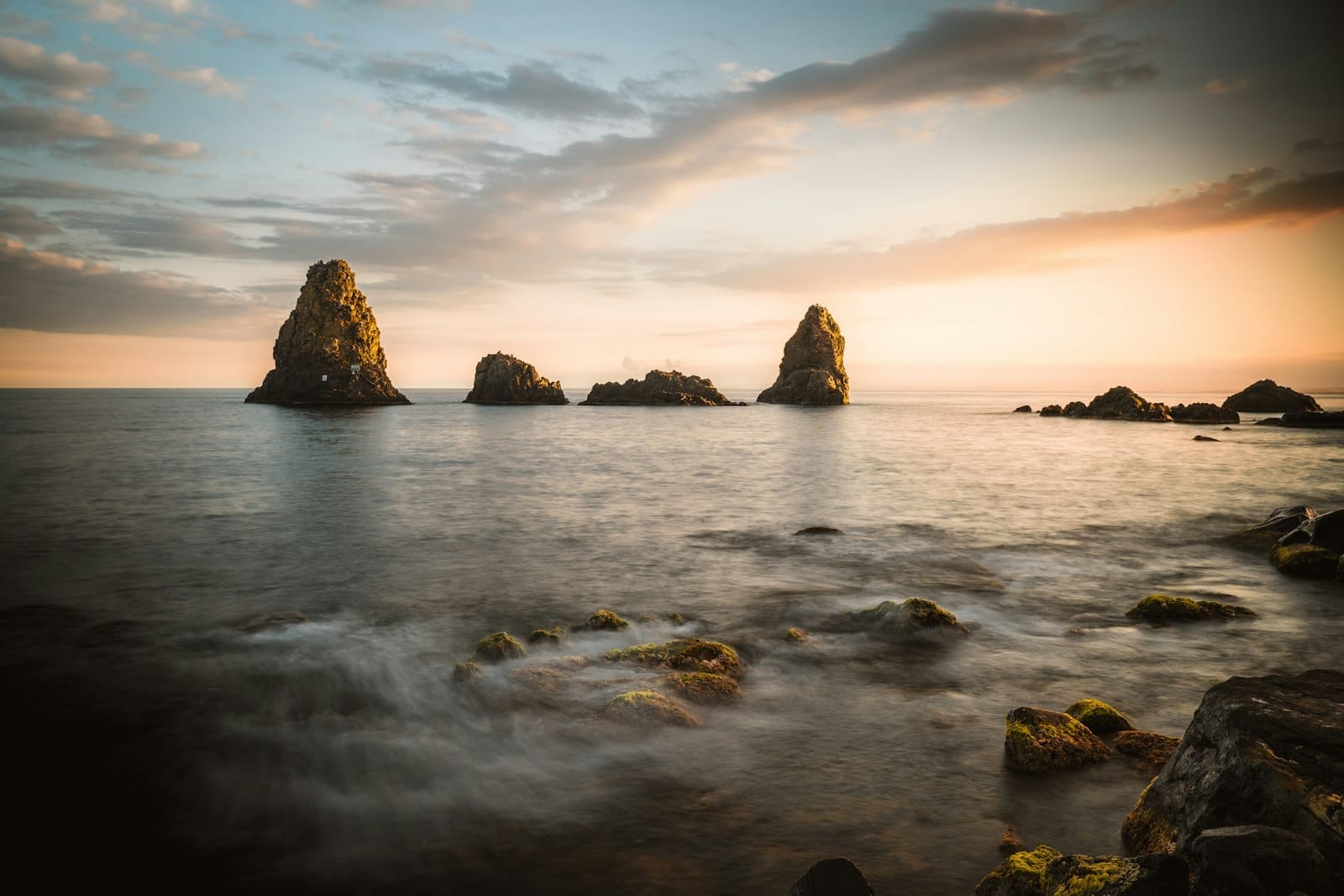
The Isole dei Ciclopi, also called the Faraglioni dei Ciclopi, are a cluster of black basalt sea stacks that jut from shallow Ionian water within about 400 metres of the Aci Trezza shoreline. The largest, the Faraglione Grande, reaches around 70 metres above sea level. The others are lower, jagged, and draped in sea spray on breezy days. Together they form the core of the Area Marina Protetta Isole Ciclopi, a designated marine protected area with regulated zones for swimming, diving, and boating.
Geologically, these stacks are remnants of a submarine laccolith, a lens-shaped intrusion of magma that pushed up into soft seabed sediments around 500,000 years ago and cooled slowly underground before erosion gradually exposed it. The result is dense, dark columnar basalt, very different in appearance from the loose cinder and lava flows associated with nearby Mount Etna. Up close, the rock faces show a tight, almost geometric pattern of columns and joints that rewards a slow look from a boat.
ℹ️ Good to know
The Cyclopean Islands are natural sea stacks with no fixed opening hours. Viewing from the Aci Trezza seafront promenade is free and possible at any time of day. Access to the water around them is regulated by the marine protected area authority and may vary seasonally.
The Mythology That Defines the Place
In Homer's Odyssey, after Odysseus blinds the Cyclops Polyphemus, the enraged giant tears rocks from a clifftop and hurls them toward the sound of the departing Greek ships. Ancient tradition placed this scene here, off the coast of what is now Aci Trezza, and the association has held for millennia. The name 'Aci' itself is thought to derive from the river Acis, the shepherd who, in Ovid's Metamorphoses, was loved by the sea nymph Galatea and crushed by a jealous Polyphemus before the gods transformed him into a river.
Later literary history deepened the connection. Giovanni Verga, the 19th-century Sicilian novelist, set his masterwork I Malavoglia (The House by the Medlar Tree) in Aci Trezza, using the fishing village and its rocks as the backdrop for a story about poverty, family, and the sea. A small museum in the village commemorates the novel, and several streets carry references to its characters. For visitors with a literary interest, the stacks carry dual meaning: ancient myth and modern Italian literature layered over the same basalt.
Tickets & tours
Hand-picked options from our booking partner. Prices are indicative; availability and final rates are confirmed when you complete your booking.
Guided tour of Catania, Aci Castello and Aci Trezza by mountain bike
From 150 €Instant confirmationFree cancellationBoat Tour and Snorkelling Around the Cyclopean Islands
From 59 €Instant confirmationFree cancellationIslands of Lipari and Vulcano from Cefalu
From 75 €Instant confirmationFree cancellationFull Day Islands of Lipari and Vulcano Tour from Taormina
From 82 €Instant confirmationFree cancellation
The Village: What to Expect on Arrival
Aci Trezza is a frazione of the municipality of Aci Castello, a small administrative unit that does not appear on every road map. The village itself is compact: a curved seafront, a small fishing port where coloured wooden boats still outnumber pleasure craft, and a main street lined with trattorias and bars. It does not have the theatrical baroque architecture of Noto or Ragusa, and it is not trying to. Its appeal is in the combination of ordinary Sicilian coastal life and an extraordinary natural backdrop.
The seafront promenade runs along the water's edge and gives a direct sightline to the Faraglioni. At the southern end of the promenade, the small port is the departure point for boat excursions around the islands. If you are also visiting Catania, the Cyclopean Islands work well as an afternoon addition after a morning at the Catania fish market or the Piazza del Duomo.
In the late afternoon, local families take the promenade walk that Italians call the passeggiata. Older men play cards at tables outside the bar near the port. The smell of grilled fish drifts from a couple of waterfront restaurants by around seven in the evening. If you want a meal with a view of the stacks rather than just a quick look, timing your visit to end at dinner is a reasonable plan.
How the Experience Changes by Time of Day
Morning light hits the basalt from the east, which means the Faraglioni catch direct sun early and the dark rock appears almost bronze rather than black. This is the best window for photography from the shore: the stacks are front-lit, the sea is usually calmer before the afternoon thermal winds pick up, and the promenade is quiet enough to frame a clean shot without tourist groups in the foreground.
By midday in summer, the heat along the seafront becomes significant. The rocks shimmer in the distance and the light flattens, making photography less rewarding. This is when most day-trippers are also arriving from Catania, so the promenade gets busier. If you are visiting in July or August, aim to arrive by 9:00 and wrap up or find a shaded table by 12:30.
Late afternoon and the hour before sunset bring the most atmospheric conditions. The western light catches the water surface at an angle, and the stacks darken against an orange sky. The village comes to life again after the afternoon lull. A small granita or gelato from one of the bars on the seafront is the standard way to bridge the gap between afternoon and dinner.
💡 Local tip
For photography: arrive between 8:00 and 10:00 for front-lit basalt and calm water. In summer, the light quality drops sharply after 11:00. A polarising filter helps cut glare on the water surface.
Getting On the Water: Boat Excursions and Snorkelling
Viewing the Cyclopean Islands from shore is free and satisfying. Getting out on the water is better. Small boats and motorised dinghies operated by private companies depart from the port and circle the stacks, allowing close inspection of the basalt columns, the sea caves at their base, and the underwater rock formations visible through remarkably clear water. Some operators offer snorkelling stops in the marine protected area's permitted zones.
Prices and operators change seasonally and year to year, so specific fares are not listed here. The practical approach is to walk to the port on arrival and check directly with the boats moored there. Most trips run from spring through early autumn. In winter, boat excursions become infrequent and depend heavily on sea conditions. The marine protected area authority sets the rules for which zones can be accessed and under what conditions, so excursion operators are the most reliable source of current access information.
Kayaking and paddleboarding are also available from some operators during summer months. If you are a confident swimmer and the sea is calm, swimming out to the base of the nearest stack from a designated swimming area is possible, though the volcanic rock surfaces are sharp and uneven. Water shoes are essential. The stacks themselves have no regular public landing infrastructure, and the wet rock is slippery.
⚠️ What to skip
The Cyclopean Islands are within a marine protected area. Swimming and diving zones are regulated. Do not anchor boats or land on the stacks without checking current rules with the area authority or your excursion operator.
Getting There from Catania
Aci Trezza sits about 10 kilometres north of Catania along the Ionian coast. By car, the drive along the coastal road takes roughly 20 to 30 minutes depending on traffic, and parking is available near the seafront. By regional bus, services connect Catania with Aci Castello and Aci Trezza; journey times are similar. Check current timetables with local operators before your visit. Aci Trezza pairs naturally with the nearby Catania and can also be combined with a visit to the clifftop Castello di Aci Castello, a Norman-era castle a few minutes' drive or a coastal walk away.
If you are building a wider eastern Sicily itinerary, Aci Trezza works as a morning or afternoon stop between Catania and Taormina. The coastal road north continues through Acireale toward Taormina, and the drive is scenic enough to justify taking it slowly. For broader route ideas around the region, the day trips from Catania guide covers the main options along this stretch of coast.
Practical Notes and Accessibility
The seafront promenade in Aci Trezza is largely flat and suitable for visitors with limited mobility. The view of the stacks from the promenade is excellent, and several cafe and restaurant terraces face the water directly. This part of the visit presents no physical challenges.
The boat excursions, snorkelling, and any approach to the stacks by water require reasonable mobility and comfort with open-water swimming or uneven boat decks. The volcanic rock at and near water level is sharp and extremely slippery when wet. Sandals or bare feet are not suitable; water shoes with grip soles are necessary if you plan to touch rock near the waterline.
Weather matters more here than at inland attractions. The Ionian coast can see strong afternoon thermal winds in summer, which make the sea choppy and boat trips less pleasant. If conditions look rough when you arrive, a walk to Aci Castello to see the clifftop castle is a sensible alternative. For help planning around Sicily's seasonal patterns, the best time to visit Sicily guide covers month-by-month conditions across the island.
In peak summer (July and August), the seafront and boat operators attract a noticeable flow of Italian domestic tourists as well as international visitors. The village handles the volume without becoming overwhelming, but arriving early in the day remains the most comfortable choice. Spring and early autumn are quieter, the light is softer, and the sea temperature is warm enough for swimming from approximately June through October.
Who Might Not Enjoy This
Visitors expecting a manicured tourist attraction with ticketed entry, guided commentary, and smooth paths will find Aci Trezza underwhelming. The stacks are rocks in the sea. The village is a working fishing community, not a stage set. If your travel priorities lean toward dense historical interiors, major art collections, or baroque architecture, your time on the eastern coast is probably better spent in Catania itself or further south at the archaeological parks around Syracuse.
The Cyclopean Islands are also not the right choice if your primary interest is ancient Greek archaeology. For that, the eastern coast's strongest offering is the Neapolis Archaeological Park in Syracuse. The Cyclopean Islands' connection to Greek mythology is evocative but atmospheric rather than physically tangible in the way a Greek theatre or temple is.
Insider Tips
- Walk south along the promenade past the main tourist cluster to reach the working end of the port. The boats moored here are active fishing vessels, not excursion craft, and the smells and textures of a real Sicilian fishing operation are more vivid here than anywhere else in the village.
- The Faraglione Grande has a small natural arch at its base that is only clearly visible from a boat at low angles of approach. Ask your excursion operator to approach from the south to see it before circling the stack.
- Granita in this part of Sicily is served looser and icier than the tourist-facing versions in Taormina. The bar nearest the port tends to serve the most authentic local style. Order it with a brioche bun for the classic Sicilian breakfast combination, even at 10:00 in the morning.
- The village's connection to Verga's I Malavoglia adds literary depth that most visitors miss entirely. Even a brief read of a plot summary before arriving changes how the port and the stacks look. The small local museum dedicated to the novel is easy to overlook but worth a short stop.
- For the clearest underwater visibility, snorkel or dive in the morning before the afternoon currents stir up sediment. The protected area's waters are notably clear by Sicilian coastal standards, but morning conditions are consistently better than afternoon.
Who Is Aci Trezza & the Cyclopean Islands For?
- Geology and natural history enthusiasts drawn to volcanic landforms and basalt formations
- Photographers looking for dramatic coastal subjects with minimal human infrastructure
- Snorkellers and kayakers wanting protected, clear Ionian water within easy reach of Catania
- Literature and mythology travellers following Homer, Ovid, or Verga through Sicily
- Day-trippers from Catania looking for a coastal counterpoint to the city's baroque monuments
Nearby Attractions
Other things to see while in Catania:
- Benedictine Monastery of San Nicolò l'Arena
Founded in 1558 and rebuilt after twin catastrophes, the Benedictine Monastery of San Nicolò l'Arena is one of the largest monasteries in Europe and a cornerstone of Catania's UNESCO-listed Baroque heritage. Today it serves as a university faculty, which gives it a lived-in energy unlike any museum. Guided tours reveal extraordinary frescoed halls, hidden gardens, and the raw lava walls swallowed by the 1669 eruption of Etna.
- Castello Ursino
Built by Emperor Frederick II between 1239 and 1250 or slightly earlier, Castello Ursino is one of Sicily's best-preserved medieval fortresses and home to Catania's Civic Museum. Surrounded but not destroyed by the catastrophic 1669 Etna eruption, it now stands in the city center, housing a rich collection of ancient sculpture, coins, and decorative art.
- Fish Market of Catania (La Pescheria)
La Pescheria, Catania's fish market, is one of the most visceral and culturally telling experiences in all of Sicily. Set in a sunken piazza behind the Baroque Amenano Fountain, it operates Monday through Saturday and draws an equal mix of local fishmongers, home cooks, and curious visitors. Entry is free, the atmosphere is unrepeatable, and it is over by early afternoon.
- Piazza del Duomo, Catania
Piazza del Duomo is the symbolic and geographic center of Catania, where the city's civic, religious, and cultural identities converge around the iconic Fontana dell'Elefante. Rebuilt after a catastrophic 1693 earthquake, the square is a masterpiece of Sicilian baroque urban planning — free to enter and open around the clock.