Piazza del Duomo, Catania: The Baroque Heart of a Volcanic City
Piazza del Duomo is the symbolic and geographic center of Catania, where the city's civic, religious, and cultural identities converge around the iconic Fontana dell'Elefante. Rebuilt after a catastrophic 1693 earthquake, the square is a masterpiece of Sicilian baroque urban planning — free to enter and open around the clock.
Quick Facts
- Location
- Piazza del Duomo, 95124 Catania CT, Italy — historic centre, where Via Etnea, Via Garibaldi, and Via Vittorio Emanuele II converge
- Getting There
- Catania Centrale train station is roughly 15–20 minutes on foot; city buses run by AMTS stop nearby. From the Port of Catania, exit, turn left following the arched passage to Porta Uzeda and cross directly into the square.
- Time Needed
- 30–45 minutes for the square itself; 2–3 hours if you visit the Cathedral of Sant'Agata and surrounding buildings
- Cost
- Free to enter the square. Cathedral entry is generally free; certain interior areas or chapels may have separate fees — confirm on-site.
- Best for
- Architecture lovers, first-time visitors to Catania, history enthusiasts, photographers, and anyone wanting to understand the city's identity in a single stop
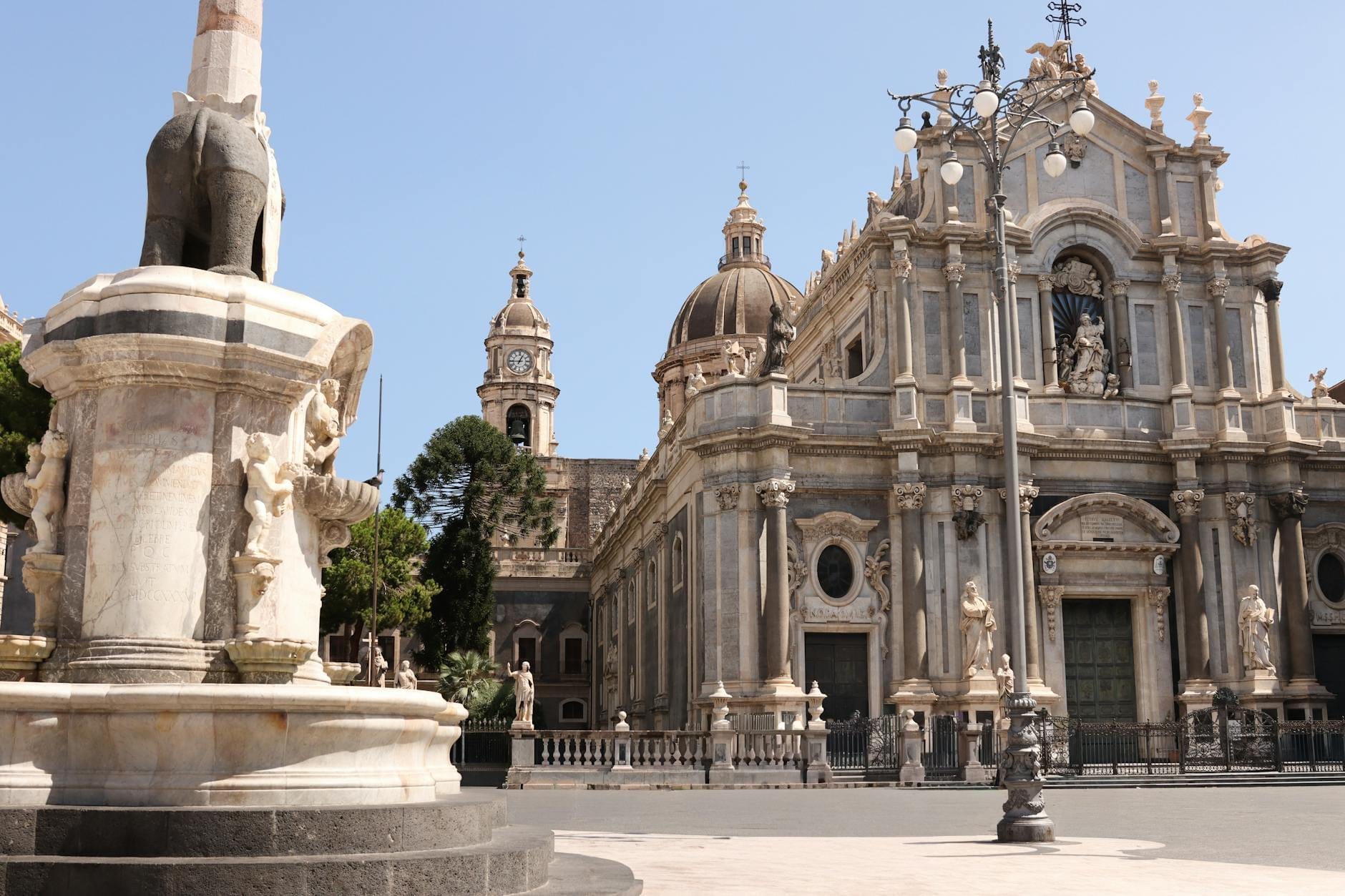
What Piazza del Duomo Actually Is
Piazza del Duomo is not just the main square of Catania — it is the physical expression of the city's identity. Stand in the centre and you have the Cathedral of Sant'Agata on your east, the Palazzo degli Elefanti (City Hall) on your north, the 18th-century Porta Uzeda arch framing the southern view toward the port, and the baroque facade of the Palazzo dei Chierici on your south-west. Every major axis of the historic city radiates from this point.
The square's defining feature is the Fontana dell'Elefante, a volcanic lava-stone elephant bearing an Egyptian obelisk on its back, positioned at the precise centre of the piazza. Created by architect Giovanni Battista Vaccarini between 1735 and 1737, the fountain gave Catania its most recognised symbol. Locals call the elephant 'u Liotru,' a name rooted in local legend connecting the sculpture to a mythical sorcerer. The elephant, carved from black lava stone like that found on Etna's slopes, feels less like civic decoration and more like a statement: this city was born from volcanic rock and rebuilt itself after disaster more than once.
ℹ️ Good to know
The square is a public space open 24 hours. There are no entrance gates, barriers, or ticket booths for the piazza itself. The Cathedral of Sant'Agata has its own visiting hours — check locally or via the Comune di Catania before planning a specific interior visit.
The Earthquake That Built a Masterpiece
In January 1693, a catastrophic earthquake devastated much of eastern Sicily, killing tens of thousands and flattening entire cities. Catania was largely destroyed. What could have been the end of the city became, paradoxically, the opportunity for one of the most ambitious urban rebuilding projects in European history. Within decades, architects worked to create an entirely new city plan in the baroque style, with wide streets designed to reduce earthquake damage and grand public spaces meant to project confidence and order.
Piazza del Duomo was rebuilt in the early 18th century under this vision, with Vaccarini later shaping much of the square into the coherent ensemble visible today. The result belongs to the same cultural and architectural tradition as the baroque towns of the Val di Noto further south — a tradition now recognised as a UNESCO World Heritage Site. If you want to understand Sicily's remarkable capacity for reinvention after catastrophe, the broader context is captured in the baroque Sicily guide, which situates Catania within the region's wider 18th-century reconstruction.
The Cathedral of Sant'Agata on the eastern flank of the square has an even longer story. The original structure dates to the 11th century, built under Norman rule on the foundations of Roman baths. It was damaged or destroyed multiple times by Etna's eruptions and by the 1693 earthquake, before being rebuilt in its current baroque form. The cathedral is dedicated to Sant'Agata, Catania's patron saint, whose festival in early February draws hundreds of thousands of participants and is one of the largest religious processions in Italy.
Tickets & tours
Hand-picked options from our booking partner. Prices are indicative; availability and final rates are confirmed when you complete your booking.
Agrigento and Piazza Armerina guided tour from Taormina
From 70 €Instant confirmationFree cancellationPrivate Cooking Class with Le Mamme del Borgo with Transfer from Taormina
From 1.025 €Instant confirmationFree cancellationMondello and Sanctuary in Monte Pellegrino Tour
From 25 €Instant confirmationFree cancellationDay-trip to Agrigento and Piazza Armerina from Palermo
From 122 €Instant confirmationFree cancellation
The Square at Different Times of Day
Early morning, around 7 to 9am, is when Piazza del Duomo belongs to Catanians rather than tourists. City Hall staff cut across the square heading to work, elderly residents sit on benches near the fountain, and the air carries the scent of coffee from nearby bars. The light at this hour is remarkable: it hits the pale limestone facades from low angles, pulling out shadows in the carved stonework and giving the entire square a warm, golden quality that photographs cannot fully capture.
By mid-morning, tour groups arrive from cruise ships docked at the port — the walking route through Porta Uzeda is short and direct, which means the piazza absorbs large numbers quickly. From roughly 10am to 1pm in peak season (June through September), the square can feel genuinely crowded. This is not necessarily a reason to avoid it; the activity adds energy. But if you want the fountain to yourself for photographs, come before 8:30am or after 6pm.
Late afternoon and evening transform the atmosphere. As the temperature drops and the day's heat releases from the dark basalt paving stones, residents spill back into the space. The cathedral facade is lit from below after dark, and the Elephant Fountain becomes a social gathering point. This is the version of the piazza that feels most alive and most Catanian — informal, loud in a relaxed way, with gelato and conversations rather than guided commentary.
💡 Local tip
For photography: arrive before 8:30am for empty foreground shots of the Elephant Fountain, or return after sunset for the illuminated cathedral facade reflected in the basalt paving. Midday summer light is harsh and tends to flatten the detail on the baroque stonework.
What to Look at Closely
Most visitors photograph the Elephant Fountain from one angle and move on. It rewards slower attention. The elephant itself is ancient — widely believed to be a Roman-era lava-stone sculpture that was already in Catania before Vaccarini incorporated it into his 18th-century fountain design. Vaccarini added the obelisk above (originally Egyptian, later relocated through various sites) and the basin below. The combination is genuinely strange: an African animal carved from Sicilian volcanic rock, topped with an Egyptian monument, in an Italian baroque square. That layering of civilisations is precisely what makes Catania interesting.
The Palazzo degli Elefanti on the north side is the city's town hall. Its name alone — the Palace of Elephants — tells you how central the symbol is to civic identity. The facade, also attributed to Vaccarini, has a controlled elegance compared to the more exuberant baroque of some Palermitan buildings. Look at the iron balconies: the decorative brackets and ironwork are characteristic of eastern Sicilian baroque, distinctly different in character from the western half of the island.
Porta Uzeda, the arched gateway on the southern edge of the square, was built in 1696 as part of the city walls and named after the Viceroy of Sicily at the time. Walking through it toward the port gives you a sudden view down to the water — a reminder that Catania was always a port city before it was anything else. The city's relationship with the sea and with Via Etnea stretching north toward the volcano creates the two great axes that define how the city is oriented.
Practical Walkthrough: Getting There and Getting Around
The piazza sits at the intersection of Catania's main arteries, which makes it nearly impossible to miss if you are walking through the historic centre. From Catania Centrale railway station, the walk takes around 10 minutes southwest through the city grid. AMTS city buses serve the surrounding streets; the metro operated by FCE (Ferrovia Circumetnea) has a stop at Stazione Centrale that puts you within comfortable walking distance.
If you are arriving by cruise ship, the route is deliberately simple: exit the port, follow the arched colonnades to the left, pass through Porta Uzeda, and you are standing in the piazza. No navigation required. Taxis and ride-hail services drop off on the surrounding streets — the square itself is pedestrianised.
The surface of the piazza is flat, open paving — broadly manageable for wheelchairs and pushchairs across the main open space. The interiors of buildings around the square have their own accessibility considerations that are best confirmed directly with each venue.
⚠️ What to skip
Summer heat in Catania is intense. By late morning the dark basalt paving radiates significant heat underfoot, and there is minimal shade in the open square. Bring water, wear sun protection, and consider combining your visit with early morning or evening hours if you are visiting between June and August.
The Square in Context: What Surrounds It
Piazza del Duomo is the logical starting point for any exploration of central Catania, not a standalone destination. Via Etnea runs north from the square directly toward the base of Mount Etna — on a clear day, the volcano frames the view from the piazza in a way that is quietly dramatic. A short walk east along Via Vittorio Emanuele II leads toward what was the ancient Greek and Roman city, including the Roman Amphitheatre of Catania and the Benedictine Monastery of San Nicolò l'Arena, one of the largest baroque monasteries in Europe.
A few blocks north, the Catania fish market operates every morning except Sunday in the area around Piazza Alonzo di Benedetto, behind the cathedral. The noise, the colour, the smell of fresh catch on ice: it is one of the most sensory-rich urban experiences in Sicily, and it is most intense between 7am and noon. Combining the fish market with an early visit to Piazza del Duomo makes for a genuinely full morning in the city centre.
Catania is also the main gateway for excursions to Mount Etna's volcano trails. If you are based in the city, the piazza provides useful orientation: Etna is always visible to the north on clear days, and the black lava stone used throughout the historic centre is a constant reminder of the mountain's geological dominance over the city.
Who Will Love This and Who Might Not
Piazza del Duomo works well for almost every type of traveller passing through Catania. It is free, central, and concentrated — you absorb a lot of history and architecture without covering significant distance. For architecture and history enthusiasts, the quality of the baroque ensemble and the depth of the layers beneath it (Norman, Roman, Greek) offer genuine substance.
Travellers who have already spent significant time in Rome, Florence, or other Italian cities and have developed high thresholds for piazzas may find it less revelatory than some guides suggest. The square is not on the scale of Piazza San Marco or Piazza Navona in terms of sheer spectacle. Its interest is more concentrated and more local. If you arrive expecting a major tourist set piece, adjust your expectations: this is a working city square that happens to have remarkable architecture, not a curated museum environment.
Families with young children find it practical — flat, open, no admission barriers, with cafes and gelaterias within easy reach on the surrounding streets. Solo travellers and photographers get the most from early morning visits. Those with limited mobility will find the open square itself manageable, though the surrounding streets in this part of the historic centre involve some uneven basalt cobblestones.
Insider Tips
- The best unobstructed view of the Elephant Fountain with the Cathedral behind it is from the southern end of the square, near Porta Uzeda. Most visitors photograph from the sides or too close — step back toward the arch for the full compositional depth.
- The cafe inside the Palazzo degli Elefanti courtyard (city hall building) is not widely advertised but accessible during business hours. It is considerably quieter than the tourist-facing bars directly on the piazza.
- During the Festa di Sant'Agata in early February, the square is the epicentre of one of the largest religious processions in Italy. If you are in Catania during this period, plan for massive crowds and road closures but also an extraordinary spectacle.
- The dark basalt paving absorbs heat aggressively in summer. Locals wear sandals with thick soles for a reason. Thin-soled footwear becomes uncomfortable by late morning on hot days.
- Via Etnea runs directly north from the piazza toward the volcano. On clear winter and spring mornings, Etna with snow on its summit is visible straight down the street axis — a photograph worth planning for.
Who Is Piazza del Duomo, Catania For?
- First-time visitors to Catania wanting a single location that anchors the city's history and layout
- Architecture enthusiasts interested in Sicilian baroque urban design and its post-earthquake origins
- Photographers working in low-light conditions — early morning and evening illumination are exceptional
- Cruise passengers on short port stops: the square is a 5-minute walk from the port through Porta Uzeda
- Travellers combining a morning visit with the adjacent fish market for a fuller picture of daily Catanian life
Nearby Attractions
Other things to see while in Catania:
- Aci Trezza & the Cyclopean Islands
Just 10 kilometres north of Catania, the volcanic sea stacks known as the Cyclopean Islands rise from the Ionian Sea with enough drama to explain why the ancient Greeks blamed a blinded giant for putting them there. The village of Aci Trezza wraps around a small working port, and the combination of legend, geology, and unhurried southern Sicilian life makes for one of the most atmospheric half-days on the island's eastern coast.
- Benedictine Monastery of San Nicolò l'Arena
Founded in 1558 and rebuilt after twin catastrophes, the Benedictine Monastery of San Nicolò l'Arena is one of the largest monasteries in Europe and a cornerstone of Catania's UNESCO-listed Baroque heritage. Today it serves as a university faculty, which gives it a lived-in energy unlike any museum. Guided tours reveal extraordinary frescoed halls, hidden gardens, and the raw lava walls swallowed by the 1669 eruption of Etna.
- Castello Ursino
Built by Emperor Frederick II between 1239 and 1250 or slightly earlier, Castello Ursino is one of Sicily's best-preserved medieval fortresses and home to Catania's Civic Museum. Surrounded but not destroyed by the catastrophic 1669 Etna eruption, it now stands in the city center, housing a rich collection of ancient sculpture, coins, and decorative art.
- Fish Market of Catania (La Pescheria)
La Pescheria, Catania's fish market, is one of the most visceral and culturally telling experiences in all of Sicily. Set in a sunken piazza behind the Baroque Amenano Fountain, it operates Monday through Saturday and draws an equal mix of local fishmongers, home cooks, and curious visitors. Entry is free, the atmosphere is unrepeatable, and it is over by early afternoon.