Roman Amphitheatre of Catania: Ancient Rome Beneath the City Streets
Beneath the traffic and noise of central Catania lies one of the largest Roman amphitheatres in Sicily and among the larger ones in Roman Italy. The Anfiteatro romano di Catania once held over 15,000 spectators and is now partly exposed at Piazza Stesicoro, offering a striking encounter with the city's layered past.
Quick Facts
- Location
- Piazza Stesicoro, 95124 Catania, Sicily, Italy
- Getting There
- Multiple city buses stop at Piazza Stesicoro; walkable from Catania Centrale train station (approx. 15 min on foot)
- Time Needed
- 30–60 minutes
- Cost
- Approx. €4 full / €3 reduced (verify locally for any updates)
- Best for
- History enthusiasts, architecture lovers, curious walkers, budget travelers
- Official website
- www.visitsicily.info/en/attrazione/roman-amphitheatre-of-catania
What You're Actually Looking At
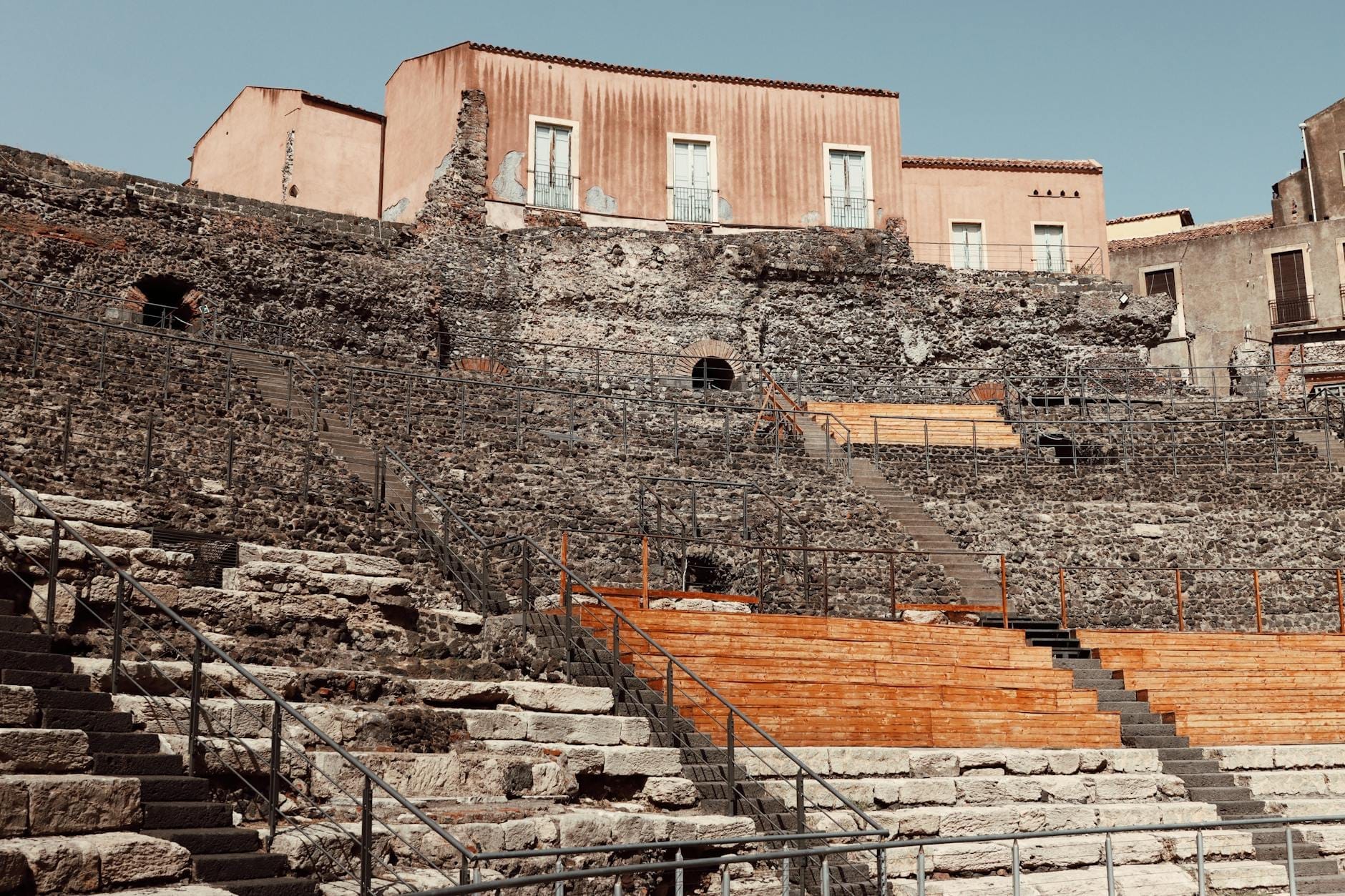
Most of the Roman Amphitheatre of Catania, known locally as the Anfiteatro romano di Catania, is invisible. That is the first thing to understand before you arrive. The structure extends beneath Via Neve, Via Manzoni, Via del Colosseo, and Via Penninello, with modern apartment buildings and streets sitting directly on top of two thousand years of history. What you see at Piazza Stesicoro is only a fragment: a curved section of the original structure excavated from below street level, surrounded by a low iron railing and descending into the dark lava-stone architecture of the Roman Imperial period.
That fragment, however, is genuinely impressive. The radial walls, arched vaults, and massive basalt blocks convey the scale of what was once one of the largest amphitheatres in the Roman world. Built primarily of lava stone sourced from the slopes of nearby Mount Etna, the elliptical arena was designed to hold about 15,000 seated spectators, and nearly double that number including additional wooden bleachers. For reference, the Colosseum in Rome held approximately 50,000 to 80,000 people. Catania's amphitheatre was not that size, but it ranked among the largest outside Rome, which says something significant about Catania's importance as a Roman city.
ℹ️ Good to know
Entry is paid (around €4 full price, with reductions available) and no booking is required. Recent visitor information lists opening hours as daily from 09:00, with seasonal closing times (typically 17:00 in winter and 19:00 in summer), with the site closed only on 25 December. Always verify current hours locally before visiting, as times are subject to change.
Historical Context: From Arena to Rubble to Rediscovery
The amphitheatre was likely constructed during the reign of Hadrian or Antoninus Pius in the 2nd century CE, though scholars believe an earlier, smaller structure existed on the same site from the late 1st century CE. The mid-2nd century expansion brought it to its maximum capacity and architectural ambition. Like all Roman amphitheatres, it was built for spectacle: gladiatorial combat, animal hunts, and public entertainment that reinforced civic identity and imperial authority.
By the 4th century CE, the amphitheatre had fallen out of use for its original purpose. Over the following centuries it was repurposed by traders and craftsmen, then gradually stripped for building material as Catania expanded and rebuilt around it. The catastrophic earthquake of 1693, which leveled much of eastern Sicily, accelerated the burial. New construction on top of the ruins effectively sealed the amphitheatre beneath what became the modern city center. Systematic excavation began only in the early 20th century, and even now, much of the structure remains unexcavated and inaccessible beneath active streets and buildings.
This layering of civilizations is the defining characteristic of Catania as a city. The same earthquake that buried the amphitheatre also prompted a grand Baroque rebuilding effort, producing the cathedral, the Piazza del Duomo, and the sweeping Via Etnea that defines the city's spine today. To understand both layers together, it helps to read about Piazza del Duomo Catania alongside this site. They are less than ten minutes apart on foot, and together they tell the full arc of Catania's reinvention after disaster.
Tickets & tours
Hand-picked options from our booking partner. Prices are indicative; availability and final rates are confirmed when you complete your booking.
Street Food Tour of Catania
From 49 €Instant confirmationFree cancellationDining experience and cooking show at a Cesarina's home in Catania
From 85 €Instant confirmationFree cancellationGuided excursion on Etna from Catania with tasting
From 74 €Instant confirmationFree cancellationCatania coast sailing tour with local food tasting
From 69 €Instant confirmationFree cancellation
The Experience at Ground Level
Standing at the edge of the excavated section in Piazza Stesicoro, you are looking down into a trench of dark volcanic stone that drops several meters below the surrounding pavement. The lava-stone walls absorb heat slowly and radiate it back in the afternoon, giving the site a particular warm, dry quality in summer. In cooler months, the lower sections hold a slight chill and a faint smell of damp stone and mineral earth that is oddly vivid.
The exposed curved section clearly shows the original construction logic: radiating walls that supported the seating tiers above, arched passages that once served as entry corridors for spectators, and the remains of the arena floor below. Information panels installed around the site provide context in Italian and English, including reconstructed diagrams that help you visualize what the full amphitheatre once looked like. These panels are genuinely useful rather than decorative.
The piazza itself is one of Catania's main intersections, with buses, scooters, and foot traffic flowing constantly around the excavation. This contrast between the ancient ruins and the ordinary noise of the city is part of the experience. It is not a hushed archaeological park; it is an open-air site embedded in daily urban life, and that actually adds to its authenticity. Catanians walk past it on their way to work without a second glance. Tourists stop and stare down into it. Both are valid responses.
Best Time to Visit and What Changes by Hour
Morning visits, particularly on weekdays between 9:00 and 11:00, offer the most comfortable conditions. The site is at its quietest, the light falls cleanly across the stone, and the piazza has not yet reached its midday peak of traffic and noise. Photographers will find the angle of early morning light favorable for picking out texture in the dark lava stone.
Midday in summer is genuinely uncomfortable. Catania sits on Sicily's eastern coast at sea level, and temperatures regularly exceed 32°C from June through August with minimal shade around the open excavation. If you are visiting in peak summer, arrive early or come in the late afternoon when the light is better and the heat begins to ease. Autumn and spring, roughly September to November and March to May, are significantly more pleasant for this kind of outdoor site.
💡 Local tip
The amphitheatre is not illuminated at night, and the iron railings around the excavation make it difficult to see much after dark. Daytime visits only are worthwhile. Bring water in summer: there are no facilities at the site itself, though cafes and bars around Piazza Stesicoro are plentiful.
Practical Walkthrough: Getting There and Getting Around
The amphitheatre is located in Catania's historic center, on the north side of Piazza Stesicoro. Multiple AMTS city bus lines stop at or near the piazza; check current routes with the AMTS Catania app or maps before you go. From Catania Centrale train station, the walk takes roughly 15 minutes heading northwest along Via Etnea. The Catania Metro (operated by FCE Ferrovia Circumetnea) has a station close to the center; confirm the nearest stop to Piazza Stesicoro when planning your route.
For visitors flying into Sicily, Catania-Fontanarossa Airport (IATA: CTA) is approximately 5 to 6 km south of the city center. The ALIBUS shuttle connects the airport to central Catania and the main railway station; from there the amphitheatre is walkable. Taxis from the airport operate at regulated tariffs.
The site involves uneven ancient surfaces and steps descending below street level. Visitors with limited mobility should contact the managing authority, the Parco Archeologico Greco-Romano di Catania, in advance to confirm current access conditions. The exposed section is not large, so the physical visit itself is low-effort for most travelers.
How This Fits Into a Day in Catania
The amphitheatre is most rewarding when combined with other nearby sites rather than visited in isolation. A logical morning route starts here at Piazza Stesicoro, then walks south along Via Etnea to Piazza del Duomo, Catania's monumental baroque heart. From there, the famous Catania fish market is just steps away, at its noisiest and most spectacular before midday. This sequence gives you Roman Catania, Baroque Catania, and daily-life Catania within a two-hour walk.
For those spending more time in the region, Catania also serves as the main gateway to Mount Etna's volcano trails. The same lava stone that built the amphitheatre was produced by the same volcano looming over the city today. That geological continuity, Etna shaping Catanian architecture across two millennia, is one of the more quietly interesting things to reflect on while standing at the site. A broader look at day trips from Catania can help you plan what to combine.
Honest Assessment: Is It Worth Your Time?
If you are expecting a well-preserved, fully accessible ancient arena, you will be disappointed. The Roman Amphitheatre of Catania is a fragment of a buried monument, and most of the structure will never be uncovered in your lifetime or anyone else's. What is exposed is significant and interesting, but the visit requires some imagination and historical curiosity to land properly.
For travelers who find urban archaeology genuinely compelling, the site delivers something rare: a direct, unmediated encounter with Roman infrastructure at no cost, in the middle of a living city, without the crowds or commercialization that surround more famous ancient sites. It is not competing with the Valley of the Temples or the Greek theatre at Taormina. It is a different kind of experience: quiet, cerebral, and slightly surreal.
Travelers who are primarily beach and food focused, or who are moving quickly through Catania on the way elsewhere, can reasonably skip it. The thirty-second glance over the railing from street level captures roughly seventy percent of what a full visit offers. Only those who want to descend and read the panels need to plan around the opening hours.
Insider Tips
- Walk the surrounding streets, particularly Via del Colosseo and Via Manzoni, to appreciate the scale of the buried structure. The street names are a direct reference to the amphitheatre lying beneath them, and in places you can see the original Roman masonry incorporated into later building foundations.
- The site is managed by the Parco Archeologico Greco-Romano di Catania, which also oversees the nearby Roman Theatre and Odeon on Via Vittorio Emanuele II. Both are a short walk away and worth combining into a single archaeology-focused itinerary.
- Photography is best done from the western side of the excavation in the morning, when sunlight enters the trench at an angle that highlights the texture and depth of the lava-stone construction.
- Visiting on a weekday gives you the site largely to yourself. Saturday mornings attract more visitors, partly because weekend timing creates a tighter window. The main closure currently applies only on 25 December, but hours and closing days can change, so always confirm locally.
- If you want context before arriving, the Museo Civico at Castello Ursino holds Roman-era artifacts from Catania. Combining a visit there with the amphitheatre gives the ancient history of the city much more depth than either site alone.
Who Is Roman Amphitheatre of Catania For?
- History and archaeology enthusiasts who appreciate urban stratigraphy and Roman-era engineering
- Budget travelers: the site is free and requires no booking
- Photographers interested in texture, contrast, and the collision of ancient and modern
- Visitors doing a full Catania city walk who want to understand the city's pre-Baroque layers
- Curious generalist travelers who enjoy finding ancient history in unexpected, lived-in places
Nearby Attractions
Other things to see while in Catania:
- Aci Trezza & the Cyclopean Islands
Just 10 kilometres north of Catania, the volcanic sea stacks known as the Cyclopean Islands rise from the Ionian Sea with enough drama to explain why the ancient Greeks blamed a blinded giant for putting them there. The village of Aci Trezza wraps around a small working port, and the combination of legend, geology, and unhurried southern Sicilian life makes for one of the most atmospheric half-days on the island's eastern coast.
- Benedictine Monastery of San Nicolò l'Arena
Founded in 1558 and rebuilt after twin catastrophes, the Benedictine Monastery of San Nicolò l'Arena is one of the largest monasteries in Europe and a cornerstone of Catania's UNESCO-listed Baroque heritage. Today it serves as a university faculty, which gives it a lived-in energy unlike any museum. Guided tours reveal extraordinary frescoed halls, hidden gardens, and the raw lava walls swallowed by the 1669 eruption of Etna.
- Castello Ursino
Built by Emperor Frederick II between 1239 and 1250 or slightly earlier, Castello Ursino is one of Sicily's best-preserved medieval fortresses and home to Catania's Civic Museum. Surrounded but not destroyed by the catastrophic 1669 Etna eruption, it now stands in the city center, housing a rich collection of ancient sculpture, coins, and decorative art.
- Fish Market of Catania (La Pescheria)
La Pescheria, Catania's fish market, is one of the most visceral and culturally telling experiences in all of Sicily. Set in a sunken piazza behind the Baroque Amenano Fountain, it operates Monday through Saturday and draws an equal mix of local fishmongers, home cooks, and curious visitors. Entry is free, the atmosphere is unrepeatable, and it is over by early afternoon.