La Pescheria: Inside Catania's Legendary Fish Market
La Pescheria, Catania's fish market, is one of the most visceral and culturally telling experiences in all of Sicily. Set in a sunken piazza behind the Baroque Amenano Fountain, it operates Monday through Saturday and draws an equal mix of local fishmongers, home cooks, and curious visitors. Entry is free, the atmosphere is unrepeatable, and it is over by early afternoon.
Quick Facts
- Location
- Via Pardo & Piazza Alonzo di Benedetto, behind Piazza del Duomo, central Catania
- Getting There
- Walk about 10 min from Catania Centrale railway station; Catania Metro (FCE) to 'Stesicoro' then a short walk, or local AMTS bus to Piazza del Duomo
- Time Needed
- 30–60 minutes to browse; 2 hours if you stop for breakfast or lunch nearby
- Cost
- Free entry; costs only if you buy produce (prices in euros)
- Best for
- Food lovers, photographers, early risers, and anyone wanting unfiltered local Catanese life
What La Pescheria Actually Is
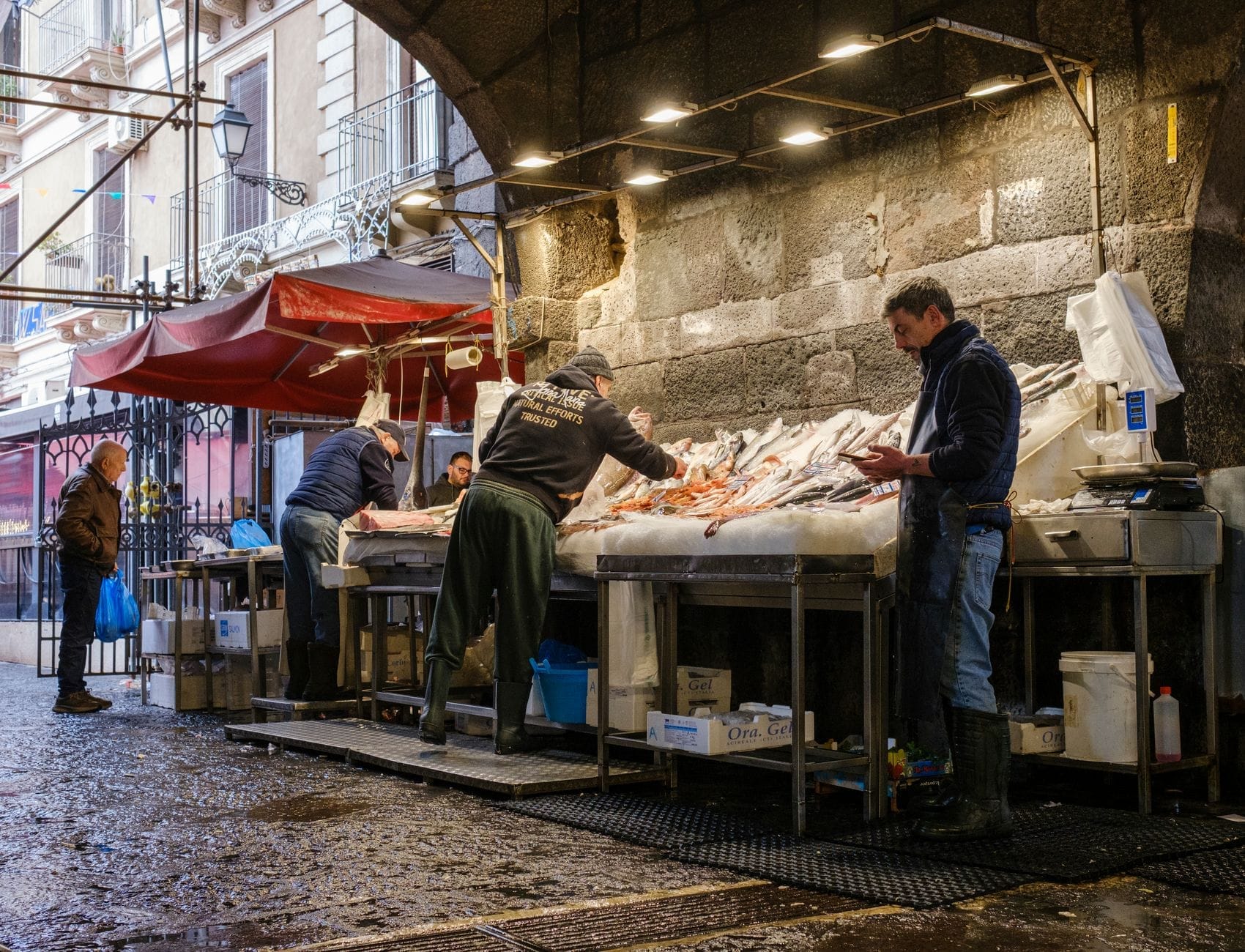
La Pescheria is Catania's working fish market, and it has occupied the streets behind Piazza del Duomo since at least the early 19th century. The market was established when a gallery space was excavated along the line of Catania's 16th-century city walls, carving out the sunken, lava-stone courtyard that gives the market its distinctive, almost amphitheatric quality. It is not primarily a tourist market: the main customers are Catanese shoppers and buyers for local restaurants. Visitors are welcome and common, but the market exists for commerce, not performance.
The full name in standard Italian is Mercato di Pesce di Catania, though most locals call it La Pescheria in Italian or 'A Piscaria in Sicilian dialect. It opens Monday through Saturday, roughly from 7:00 to 14:00, with most vendors clearing their stalls by noon. It is closed on Sundays and does not operate as an evening market.
⚠️ What to skip
Arrive before 10:00 for the best selection and peak atmosphere. By 12:30, many stalls begin packing up and the most prized catches — red prawns, sea urchins, swordfish heads — will already be gone.
The Sensory Experience: What You'll Actually Encounter
The smell reaches you before the market does. Turn off Piazza del Duomo past the small Amenano Fountain — a modest Baroque structure where a stream of underground water surfaces — and within a few steps the air changes: salt, iodine, cold stone, and something slightly sweet from the blood of freshly butchered fish. This is not unpleasant if you know what it is; it is simply honest.
The market descends into a broad, open lava-stone square lined with trestle tables and stalls. The floor is perpetually wet, slicked by ice melt, seawater, and the hosing-down that vendors do between batches. On a bright winter morning the cobblestones gleam dark grey, the same volcanic basalt used across all of central Catania. On a summer morning the low walls trap the shade and keep temperatures manageable until about 10:00, after which the heat builds fast.
The noise is percussive and theatrical. Vendors call prices and the names of fish in Sicilian dialect — rapid, clipped syllables that compress entire phrases into sounds that seem to come from somewhere older than standard Italian. Knives meet wooden boards, ice scrapes across tin surfaces, and somewhere nearby a motorbike invariably tries to navigate an alley that is clearly not wide enough for it. At peak hours, around 8:30 to 10:00, conversation and commerce blur into a single sustained roar.
Tickets & tours
Hand-picked options from our booking partner. Prices are indicative; availability and final rates are confirmed when you complete your booking.
Street Food Tour of Catania
From 49 €Instant confirmationFree cancellationDining experience and cooking show at a Cesarina's home in Catania
From 85 €Instant confirmationFree cancellationGuided excursion on Etna from Catania with tasting
From 74 €Instant confirmationFree cancellationCatania coast sailing tour with local food tasting
From 69 €Instant confirmationFree cancellation
What's on the Stalls: The Catch and the Produce
The fish displayed at La Pescheria reflects the eastern Sicilian catch: swordfish (pesce spada), often sold in thick cross-section slabs with the metallic skin intact; tuna (tonno) arranged in deep-red cubes; sea bream, sea bass, and red mullet in graduated sizes on beds of crushed ice. Sea urchins (ricci di mare) sit in shallow trays of seawater. Octopus is piled in glistening heaps, sometimes still moving. Razor clams, mussels, and clams (vongole) are sold by weight from buckets. The range and quality depend partly on what the previous night's fishing yielded.
Beyond the fish, the market extends into a peripheral zone of fruit and vegetable stalls selling blood oranges (arancia rossa di Sicilia IGP, the prized Catania-area variety), broccoli, artichokes, dried legumes, and seasonal produce. These stalls are typically quieter and are a useful entry point if the fish zone feels overwhelming on arrival.
If you want to understand what ends up on the plate, La Pescheria pairs naturally with a broader look at Sicilian food culture and the street food traditions that have shaped Catanese cooking for centuries.
How the Market Changes Through the Morning
At 7:00, the market is already mid-flow. Vendors have been setting up since before dawn, and the serious buyers, chefs, and daily-shop locals, are already working through the stalls. The social temperature is high: quick negotiations, recognition between regulars, the occasional loud disagreement that resolves itself in seconds. Tourists at this hour are rare enough that you will attract mild curiosity.
Between 8:30 and 10:30, the market reaches its highest density. This is the window that most visitors experience, and it is genuinely worth the early start. The display is at its fullest, the calling is loudest, and the theatrical quality of the place, vendors arranging fish like still-life paintings, rearranging ice to keep things looking fresh, is at its peak.
After 11:00, the character shifts. Remaining vendors are selling down stock rather than showing it off. Prices may drop, but variety contracts. By 12:30, some stalls are already being dismantled, and by 14:00 the piazza is largely cleared and quiet, with just puddles, a few scraps of ice, and the smell persisting on the warm stone.
💡 Local tip
For photography: arrive at 8:30 on a weekday. Weekend visitors are fewer (the market is closed Sunday) and Saturday mornings can be slightly less frantic than weekdays. Overcast light is ideal; bright direct sun creates harsh contrast on wet surfaces and reflective fish skin.
Location, Access, and Getting There
La Pescheria occupies Via Pardo and Piazza Alonzo di Benedetto, a short block southeast of Piazza del Duomo in the historic center of Catania. The most intuitive entry point is through the alley just behind the Amenano Fountain at the edge of Piazza del Duomo: follow the sound and the smell downhill into the sunken market square.
From Catania Centrale railway station, the market is roughly a 10-minute walk north through the city center. The AMTS local bus network serves Piazza del Duomo directly. If you are arriving from further afield, Catania is served by Fontanarossa Airport (CTA), about 5–6 km from the center, with the ALIBUS shuttle connecting the airport to the central station and city center.
The ground throughout the market is wet lava-stone cobbling, often filmed with ice melt and occasionally slippery. Closed-toe shoes with grip are strongly recommended; sandals are not. The narrow lanes and the density of stalls and shoppers make wheelchair and stroller access genuinely difficult during peak hours. There are no formal ramps or accessibility infrastructure within the market itself, which is integrated into the historic street fabric. Visitors with limited mobility may find the perimeter fruit and vegetable stalls more navigable than the central fish zone.
Historical and Cultural Context
Catania's relationship with the sea is ancient and practical. The city sits on the eastern coast of Sicily, and fishing has been central to its economy and diet since antiquity. The current market has been in its specific location since the early 19th century, when the sunken gallery was cut from the remains of 16th-century fortification walls. The lava-stone setting is not incidental: Catania was largely rebuilt in volcanic basalt after the catastrophic 1693 earthquake, and the market's dark stone surroundings are part of that Baroque reconstruction, the same architectural moment that produced Piazza del Duomo itself.
That Baroque layer gives the market a visual coherence that markets in modern market halls lack. The stone walls, the low surrounding buildings, and the recessed piazza create a contained world. Nearby, Piazza del Duomo and the Cathedral of Sant'Agata represent the monumental face of the same post-earthquake rebuilding. La Pescheria is its working, unpolished counterpart.
The market's dialect, energy, and social codes are Catanese in a way that transcends tourism. If you want to move beyond the surface of what Catania is, this is one of the most direct routes. For a full day built around this part of the city, combining the market with the nearby Roman Amphitheatre and a walk along Via Etnea gives a compact but layered picture of the city across its different historical periods.
Who Should Skip This (An Honest Assessment)
La Pescheria is often described in superlatives, and for the right traveler it earns them. But it is not for everyone, and it is worth being clear about that before you set an early alarm.
If you are sensitive to strong smells, particularly the combined odor of fresh fish, seawater, and wet stone in an enclosed space, the central market area will be genuinely uncomfortable. The smell is intense and clings to clothing. If raw food markets cause you distress, or if the sight of whole animals, including full fish heads, live shellfish, and freshly cut tuna, is something you would rather avoid, this is not the place. There is nothing sanitized or euphemistic about the display: this is how Sicilians buy the fish they eat, presented exactly as caught.
Those who arrive expecting a curated food market in the style of a northern European covered hall will also be disappointed. There are no artisan stalls, no English-language signage, no sample platters. La Pescheria is a functioning wholesale and retail fish market that happens to be extremely photogenic. Approach it on those terms and it delivers completely.
Insider Tips
- Do not buy fish to cook unless you have a kitchen and plan to cook it the same day. The quality is exceptional but perishable; carrying raw swordfish around Catania in July is a commitment.
- Vendors generally tolerate photography but pointing a large camera directly in someone's face without acknowledgment will get a negative reaction. Make eye contact first, give a small nod, and most sellers will either ignore you or play up to the lens.
- The Amenano Fountain entry is the most photographed approach, but walking in from Via Garibaldi to the south gives a different angle on the vegetable and spice stalls before the main fish zone, and is significantly less crowded at peak hours.
- If you want to eat near the market, look for small street food counters on the perimeter rather than the sit-down restaurants immediately facing the square. Stigghiola (grilled lamb intestine) and pane con la milza (spleen sandwich) vendors often set up within a few hundred meters by mid-morning.
- On rainy winter mornings the market continues regardless of weather, and the atmosphere is arguably more intense: fewer tourists, vendors working faster to keep produce fresh, and the lava stone even darker and more dramatic when wet.
Who Is Fish Market of Catania (La Pescheria) For?
- Food-focused travelers who want to understand the raw ingredients behind Sicilian cuisine before sitting down to eat it
- Photographers seeking unposed, high-energy street scenes with strong color and texture
- Early risers who want to experience local Catanese daily life outside the tourist circuit
- Travelers curious about how Mediterranean fishing culture translates into daily commerce
- Anyone combining a morning in central Catania with nearby Baroque architecture and a short walk to Piazza del Duomo
Nearby Attractions
Other things to see while in Catania:
- Aci Trezza & the Cyclopean Islands
Just 10 kilometres north of Catania, the volcanic sea stacks known as the Cyclopean Islands rise from the Ionian Sea with enough drama to explain why the ancient Greeks blamed a blinded giant for putting them there. The village of Aci Trezza wraps around a small working port, and the combination of legend, geology, and unhurried southern Sicilian life makes for one of the most atmospheric half-days on the island's eastern coast.
- Benedictine Monastery of San Nicolò l'Arena
Founded in 1558 and rebuilt after twin catastrophes, the Benedictine Monastery of San Nicolò l'Arena is one of the largest monasteries in Europe and a cornerstone of Catania's UNESCO-listed Baroque heritage. Today it serves as a university faculty, which gives it a lived-in energy unlike any museum. Guided tours reveal extraordinary frescoed halls, hidden gardens, and the raw lava walls swallowed by the 1669 eruption of Etna.
- Castello Ursino
Built by Emperor Frederick II between 1239 and 1250 or slightly earlier, Castello Ursino is one of Sicily's best-preserved medieval fortresses and home to Catania's Civic Museum. Surrounded but not destroyed by the catastrophic 1669 Etna eruption, it now stands in the city center, housing a rich collection of ancient sculpture, coins, and decorative art.
- Piazza del Duomo, Catania
Piazza del Duomo is the symbolic and geographic center of Catania, where the city's civic, religious, and cultural identities converge around the iconic Fontana dell'Elefante. Rebuilt after a catastrophic 1693 earthquake, the square is a masterpiece of Sicilian baroque urban planning — free to enter and open around the clock.