Via Etnea, Catania: Baroque Grandeur, Lava Stone, and the Street That Frames a Volcano
Via Etnea is Catania's main thoroughfare, a roughly 3-kilometre corridor of 18th-century baroque architecture rebuilt after the catastrophic 1693 earthquake. Free to walk, open always, and oriented so that Mount Etna fills the horizon at the northern end, it is both the city's commercial spine and its most architecturally coherent public space.
Quick Facts
- Location
- Via Etnea, Catania, Sicily, Italy — from Piazza del Duomo north to Tondo Gioeni
- Getting There
- Catania Metro (FCE) to Stazione Centrale, then 15–20 min on foot; city buses serve stops along the street
- Time Needed
- 1–3 hours depending on pace; the full length is approximately 3 km
- Cost
- Free to walk; costs apply only to individual shops, cafés, and optional guided tours
- Best for
- Architecture lovers, evening passeggiata, photography, casual shopping, first-time Catania visitors
What Via Etnea Is — and Why It Matters
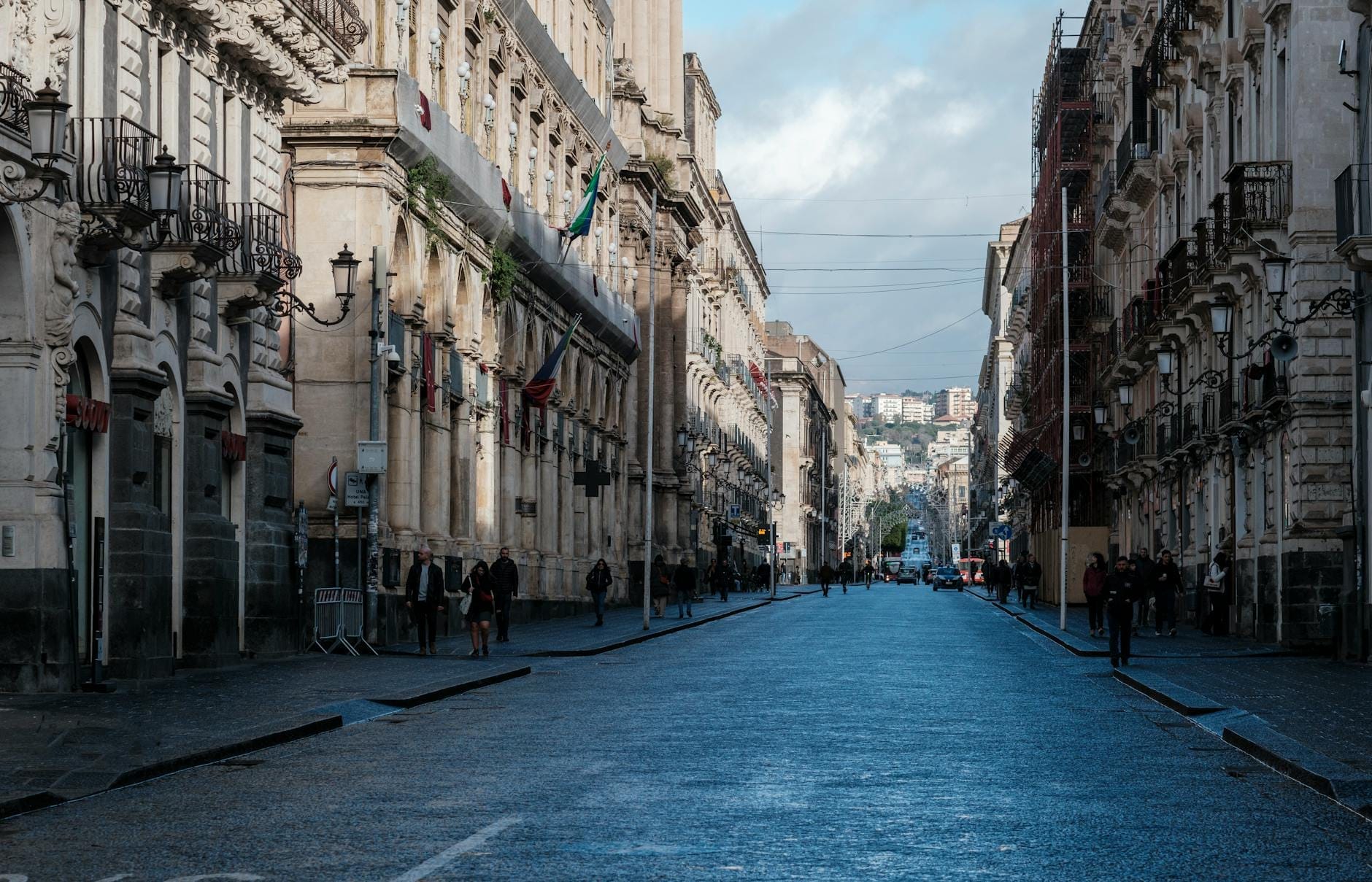
Via Etnea is Catania's primary street, running a near-perfectly straight line for approximately 3 kilometres from Piazza del Duomo, the cathedral square at the city's historic core, north to the Tondo Gioeni gardens at the upper edge of the urban centre. It is simultaneously a working commercial high street, a baroque architectural showpiece, and one of the most scenically positioned urban thoroughfares in Italy: on a clear day, Mount Etna fills the northern horizon from almost any point on the street, framed between the buildings like something from a 17th-century veduta painting.
The street is named after that volcano, and the connection runs deeper than the view. The lava stone that paves Via Etnea and lines many of its facades came from Etna's eruptions. The earthquake of 1693 — one of the most destructive in European history, which levelled much of eastern Sicily — created the blank canvas on which the Via Etnea we see today was drawn. What exists now is essentially an 18th-century urban planning project executed in Sicilian baroque, the architectural style that emerged from that catastrophe.
For context on the broader baroque reconstruction across eastern Sicily, the Baroque Sicily guide covers the planning and architectural logic behind these rebuilt cities, of which Catania is among the most ambitious examples.
ℹ️ Good to know
Via Etnea is a public street with no admission fee and no opening hours. Access is unrestricted 24 hours a day, year-round. Individual businesses set their own schedules.
The Architecture: Baroque Rebuilt on Roman Foundations
A road ran along this alignment in Roman times, but the current Via Etnea was deliberately laid out after the 1693 earthquake as part of a comprehensive rebuilding plan. The principal architects involved in reshaping Catania's centre during the 18th century included Giovanni Battista Vaccarini, who designed the cathedral's facade and the elephant fountain in Piazza del Duomo, and Francesco Battaglia. Their influence is visible in the proportions and ornamentation of the palazzi that line the southern sections of the street.
The material palette is immediately distinctive. Catanian baroque is characterised by the use of dark grey-black lava stone from Etna, often in contrast with lighter limestone details. The result is a street that looks unlike anywhere else in Italy: the facades are simultaneously austere in their colouring and extravagant in their carved ornamentation, with protruding balconies supported by grotesque brackets, heavy cornices, and church facades that lean into the narrow sky overhead.
The most architecturally concentrated section runs between Piazza del Duomo and Piazza Stesicoro, roughly the lower third of the street. Here you will find the densest sequence of baroque churches, noble palaces, and public buildings. Piazza Stesicoro itself, roughly a quarter of the way along the full street and about halfway along the central walkable section, contains the partially excavated remains of the Roman Amphitheatre of Catania, visible behind protective railings in a sunken area below street level. It is an odd, striking juxtaposition: 2nd-century Roman stonework surrounded by 18th-century baroque and 20th-century traffic.
The Roman Amphitheatre of Catania at Piazza Stesicoro merits a brief stop even if you are only passing through. The visible section represents a fraction of the original structure, most of which remains buried beneath the city.
Tickets & tours
Hand-picked options from our booking partner. Prices are indicative; availability and final rates are confirmed when you complete your booking.
Honey extraction workshop with honey tasting in Zafferana Etnea
From 56 €Instant confirmationFree cancellationEtna South Upper Craters Guided Excursion from Taormina
From 42 €Instant confirmationFree cancellationTaormina private tour with an expert guide
From 42 €Instant confirmationFree cancellationIsola Bella boat tour and snorkeling
From 55 €Instant confirmationFree cancellation
Walking Via Etnea: A Practical Orientation
Most visitors begin at Piazza del Duomo at the southern end, which makes logical sense: the piazza is Catania's formal centre, anchored by Vaccarini's 18th-century elephant fountain — the city's symbol — and the Cathedral of Sant'Agata with its landmark facade. From here the street climbs gently northward, and the view of Etna progressively opens as the buildings thin toward the upper sections.
The first 800 metres or so, from Piazza del Duomo to Piazza Stesicoro, are the most historically rewarding. After Piazza Stesicoro the street becomes progressively more commercial and residential, with chain stores and apartment blocks replacing the baroque set pieces. The section from Piazza Stesicoro to Villa Bellini, a large 19th-century public garden on the eastern side of the street, offers a useful halfway pause. The garden is free to enter and provides shade and benches, important considerations in summer when Via Etnea can be uncomfortably hot in the middle of the day.
💡 Local tip
If your interest is primarily architecture and atmosphere, the stretch from Piazza del Duomo to Villa Bellini covers the essential ground without requiring the full 4.8 km. Allow 45–60 minutes at a comfortable pace with stops.
The lava stone paving, while beautiful, is uneven in places. Wear shoes with adequate grip and flat soles. This is especially relevant after rain, when the polished stone surface becomes slippery. Visitors using wheelchairs or pushchairs should note that while the street itself is largely pedestrianised in its central sections, the pavement texture can make progress slower than expected.
Time of Day: How the Street Changes
Early morning, from around 7:30 to 9:30, Via Etnea belongs to commuters and cafe regulars. The pastry shops and coffee bars are open, the street is relatively quiet, and the lava stone facades catch a low light that intensifies their texture. The Etna view is clearest at this hour before heat haze builds. This is also when you can walk without the friction of competing pedestrians and photograph the street's architecture without crowds in the frame.
Midday in summer should be approached with caution. Between roughly 12:30 and 15:30, the street offers little shade, temperatures can exceed 30°C, and reflected heat from the dark lava stone amplifies the effect noticeably. If you are visiting in July or August, plan your walk for morning or late afternoon and use Villa Bellini for a midday break.
The most atmospheric time to be on Via Etnea is the passeggiata hour, typically from around 17:30 to 20:00. Catania takes its evening promenade seriously. Families, couples, and groups of friends move up and down the street in a slow, social current. The gelaterie fill up. The cafes that have been closed during the afternoon heat reopen. The light shifts to a warm amber that makes the baroque facades glow against the darkening sky. If you can arrange your schedule around only one window on this street, this is it.
After 21:00 the street quiets in its upper sections but remains active near Piazza del Duomo and around the university buildings, where bars and restaurants draw evening crowds. The Etna view at dusk, with the volcano faintly silhouetted against the last light, is memorable.
Photography and the Etna View
The alignment of Via Etnea was not accidental. The street was oriented north so that Mount Etna would be visible from it — a deliberate choice by the 18th-century planners who built the city. The view is most dramatic from the stretch between Piazza Stesicoro and Via Etnea's intersection with Via Umberto, where the buildings step back enough to frame a clean sightline. On days when Etna is active and a plume of smoke rises from the summit, the effect is extraordinary: a baroque European streetscape with an active stratovolcano at the end of it.
For photography, morning light from the east hits the western facades and creates strong contrast on the carved stonework. Late afternoon light does the opposite, illuminating the eastern side. Wide-angle lenses work well for the full street perspective; telephoto compression at around 85–135mm flattens the buildings against the Etna backdrop effectively. The elephant fountain in Piazza del Duomo, photographed from the Via Etnea axis with the cathedral behind, is one of Catania's canonical images.
💡 Local tip
For the clearest Etna view from Via Etnea, come between November and April when the volcano is most likely to have snow on its upper slopes and the air is clearest. Summer heat haze can obscure the summit entirely even on otherwise sunny days.
For dedicated Etna exploration beyond the view from street level, see the guide to Etna volcano trails which covers how to reach and walk the volcano's upper slopes.
Shopping, Eating, and the Street's Commercial Character
Via Etnea is Catania's main retail street and has been for centuries. It is not a pedestrianised boutique zone in the manner of some northern Italian cities. It mixes high-street clothing chains with long-established local shops, pastry and coffee bars, bookshops, pharmacies, and jewellers. The commercial density is highest in the lower section between Piazza del Duomo and Piazza Stesicoro, and again around the Via Etnea and Via Umberto intersection.
For food, the street itself is not the best place to eat in Catania, the side streets and the areas around the fish market offer better value and more authentically local options. But as a place for a coffee and a brioche col tuppo, the Catanian breakfast pastry traditionally filled with granita or cream, the bars on Via Etnea are convenient and largely reliable. Granita is taken seriously in Catania and a pistachio or almond granita from one of the established bars on the street is a reasonable introduction to the local obsession with it.
The Catania fish market is a short walk from the southern end of Via Etnea, near Piazza del Duomo, and represents a completely different register of Catanian street life — raw, loud, chaotic, and one of the most viscerally alive markets in Sicily.
Getting There and Nearby Context
Via Etnea effectively begins at Piazza del Duomo for visitors, though the official street name starts just north of the piazza, which is a 15 to 20 minute walk from Catania Centrale railway station via Via VI Aprile. City buses operated by AMTS Catania serve stops along Via Etnea. The Catania Metro, operated by FCE (Ferrovia Circumetnea), connects Catania Centrale with the city centre area. For visitors arriving from Catania-Fontanarossa Airport, located about 5 to 6 km south of the city centre, the ALIBUS shuttle connects the airport to the central railway station area, from which Via Etnea is walkable.
Via Etnea is the natural spine around which most of Catania's principal sights are arranged. The Piazza del Duomo anchors the southern end of the walk and should be included in any visit. The Benedictine Monastery of San Nicolò, one of the largest baroque monasteries in Europe, is a short distance from the upper sections of the street.
If you are using Catania as a base for wider exploration, the day trips from Catania guide covers destinations including Taormina, the Alcantara Gorge, and the slopes of Etna, all of which are accessible within an hour.
Who Should Skip This (or Adjust Expectations)
Visitors who expect a curated, car-free historic centre in the manner of Syracuse's Ortigia or Taormina's Corso Umberto will find Via Etnea rougher and more urban than anticipated. This is a functioning city street in a large, working Italian city. It has traffic noise in sections, uneven paving, and the visual texture of commercial Catania alongside its baroque monuments.
Visitors with significant mobility limitations should be aware that the lava stone paving, while largely flat, can be challenging, particularly in the southern section around Piazza del Duomo where the stones are oldest and most worn. The street is not uniformly accessible, and some of the buildings and side-street entries have steps without ramps.
If you are visiting Sicily primarily for beach days or rural scenery, Via Etnea is unlikely to be a priority and does not need to be. It is most rewarding for people with a genuine interest in urban baroque architecture, in the texture of a real southern Italian city, or in the particular experience of walking a straight line toward an active volcano.
Insider Tips
- Stand in the middle of Via Etnea just north of Piazza Stesicoro and look toward the mountain around 8am in winter: Etna's snow-capped cone lines up precisely with the street's axis and the light is clear enough to see the summit fumaroles. This is arguably the best single photograph you can make in Catania.
- The bars on the side streets just off Via Etnea, particularly along Via Antonino di Sangiuliano, tend to charge less for coffee and granita than those directly on the main street with tourist-facing frontages.
- Villa Bellini, the public garden partway along Via Etnea, opens early and is a calm place to sit with a coffee before the street fills up. The garden's terraced hill offers an elevated view back down toward the city and Etna — a perspective most visitors miss entirely.
- The Roman Amphitheatre visible at Piazza Stesicoro is free to view from street level through the railings. The sections visible represent only about a quarter of the original structure's circumference; the rest is under the surrounding apartment buildings and has never been fully excavated.
- In the weeks leading up to the Feast of Sant'Agata in early February, Via Etnea is the processional route for one of Sicily's largest religious festivals. The candelore, tall ornate wooden structures carried by devoti, move along this street through the night. If your timing overlaps with the festival dates, this is worth building your schedule around.
Who Is Via Etnea For?
- Architecture and history enthusiasts focused on Sicilian and Italian baroque
- Photographers wanting the iconic Etna-framed streetscape shot
- Evening walkers joining the Catanian passeggiata ritual
- First-time Catania visitors orienting themselves around the city's layout
- Travellers who enjoy the layered texture of a real urban environment rather than a preserved tourist zone
Nearby Attractions
Other things to see while in Catania:
- Aci Trezza & the Cyclopean Islands
Just 10 kilometres north of Catania, the volcanic sea stacks known as the Cyclopean Islands rise from the Ionian Sea with enough drama to explain why the ancient Greeks blamed a blinded giant for putting them there. The village of Aci Trezza wraps around a small working port, and the combination of legend, geology, and unhurried southern Sicilian life makes for one of the most atmospheric half-days on the island's eastern coast.
- Benedictine Monastery of San Nicolò l'Arena
Founded in 1558 and rebuilt after twin catastrophes, the Benedictine Monastery of San Nicolò l'Arena is one of the largest monasteries in Europe and a cornerstone of Catania's UNESCO-listed Baroque heritage. Today it serves as a university faculty, which gives it a lived-in energy unlike any museum. Guided tours reveal extraordinary frescoed halls, hidden gardens, and the raw lava walls swallowed by the 1669 eruption of Etna.
- Castello Ursino
Built by Emperor Frederick II between 1239 and 1250 or slightly earlier, Castello Ursino is one of Sicily's best-preserved medieval fortresses and home to Catania's Civic Museum. Surrounded but not destroyed by the catastrophic 1669 Etna eruption, it now stands in the city center, housing a rich collection of ancient sculpture, coins, and decorative art.
- Fish Market of Catania (La Pescheria)
La Pescheria, Catania's fish market, is one of the most visceral and culturally telling experiences in all of Sicily. Set in a sunken piazza behind the Baroque Amenano Fountain, it operates Monday through Saturday and draws an equal mix of local fishmongers, home cooks, and curious visitors. Entry is free, the atmosphere is unrepeatable, and it is over by early afternoon.