Mount Etna Trails & Summit: What to Expect on Europe's Largest Active Volcano
Mount Etna dominates the eastern Sicilian skyline at about 3,357 metres and earns its UNESCO World Heritage status through sheer geological drama. Whether you ride the cable car to 2,500 metres or push on to the summit craters with a licensed guide, the scale, silence, and sulfurous air are unlike anything else in Italy.
Quick Facts
- Location
- Metropolitan City of Catania, eastern Sicily; main southern access at Rifugio Sapienza (Etna Sud)
- Getting There
- Approx. 1-hour drive from Catania; organised tours depart daily from Catania and Taormina
- Time Needed
- Half day minimum for cable car + guided walk; full day for summit crater tour
- Cost
- No park entrance fee; cable car + 4x4 bus extra; guided summit tours typically €50–€100 per person (verify with operator)
- Best for
- Hikers, geology enthusiasts, photographers, adventure seekers, families with older children
- Official website
- www.parcodiletna.it
What Mount Etna Actually Is
Mount Etna, known in Italian as Monte Etna and locally as Mongibello, is Europe's largest and most active stratovolcano. Its summit elevation fluctuates around 3,320 to 3,357 metres depending on recent eruptions that alter the crater rims, making it the highest point in Sicily and the tallest mountain on any Mediterranean island. The UNESCO World Heritage property covers 19,237 hectares of high-altitude terrain and sits within the Parco dell'Etna Regional Nature Park, inscribed in 2013.
This is not a dormant or extinct volcano you observe from a safe distance. Etna erupts frequently, sometimes several times a year, typically through lava flows from flank vents and gas-and-ash explosions from the summit craters. The Istituto Nazionale di Geofisica e Vulcanologia monitors activity continuously, and authorities restrict access to higher elevations whenever conditions deteriorate. That unpredictability is part of what makes Etna compelling, but it also means your plans may need to flex.
⚠️ What to skip
Summit access above approximately 2,500 m is regularly restricted due to volcanic activity and requires a licensed guide even when permitted. Always check current conditions with your tour operator or the Parco dell'Etna before travelling to the mountain.
The Two Access Routes: Sud vs Nord
The southern approach via Rifugio Sapienza (Etna Sud) is the most visited route and the starting point for the cable car. Rifugio Sapienza sits at around 1,910 metres and is reachable by a well-maintained road from Catania in roughly one hour. The car park fills quickly on clear summer mornings, often by 9 am, so arriving early or joining an organised tour with reserved spots makes a real difference.
The northern approach via Piano Provenzana (Etna Nord) sees fewer visitors and offers a different texture: the 2002 lava flows obliterated large parts of the pine forest here, leaving a stark grey-black landscape that feels more remote and raw. Jeep-assisted excursions to the upper craters depart from this side as well. If you want a quieter experience with equally dramatic scenery, the northern route is worth considering, though it requires its own drive or transfer from Linguaglossa or similar towns.
Tickets & tours
Hand-picked options from our booking partner. Prices are indicative; availability and final rates are confirmed when you complete your booking.
Etna South Upper Craters Guided Excursion from Taormina
From 42 €Instant confirmationFree cancellationMount Etna and Alcantara Gorges guided tour from Taormina
From 100 €Instant confirmationFree cancellationEtna and Alcantara tour from Taormina
From 120 €Instant confirmationFree cancellationEtna 2,900 metres and Alcantara tour from Taormina
From 120 €Instant confirmationFree cancellation
How a Typical Visit Unfolds
From Rifugio Sapienza, the cable car climbs to approximately 2,500 metres. The ride takes around 15 minutes and the view opens fast: within the first few hundred metres of ascent, Catania, the Ionian Sea, and on clear days the Calabrian coast across the Strait of Messina come into view. At the top cable car station, a fleet of 4x4 buses can carry you up to around 2,800 metres, where guides lead small groups along the rim paths toward the active summit craters.
At altitude, the scale of the crater field becomes physically legible in a way no photograph prepares you for. The ground is loose volcanic gravel, dark and heat-split, and the air smells unmistakably of sulfur dioxide, sometimes sharply so when the wind shifts. Sound behaves strangely up here: distant rumbles from active vents, the crunch of cinders underfoot, and then stretches of near-total silence. Temperatures at the summit are routinely 10 to 15 degrees Celsius cooler than at sea level, even in July.
Independent hikers can access the slopes freely up to around 2,500 metres, but current regulations prohibit going beyond that threshold without a licensed guide. This applies even when the area is officially open. Tour companies operating from Catania and Taormina bundle cable car tickets, 4x4 transfers, and summit guide fees into packages that range from roughly €50 to €100 per person depending on inclusions and group size.
💡 Local tip
Dress in layers even in summer. At 3,000 metres, cold wind can make a 28°C Catania afternoon feel like early autumn in the Alps. Bring a windproof jacket, sturdy closed-toe shoes, and sunscreen — UV exposure is strong at altitude even on overcast days.
Time of Day and Seasonal Considerations
Morning visits have two advantages: clearer skies and smaller crowds. Cloud cover on Etna builds through the day, particularly in summer, and by midday the upper craters are often obscured. Arriving at Rifugio Sapienza before 8 am gives you the best chance of a clear summit. The light in early morning also turns the basalt landscape in shades of copper and rust that disappear under the flat midday glare.
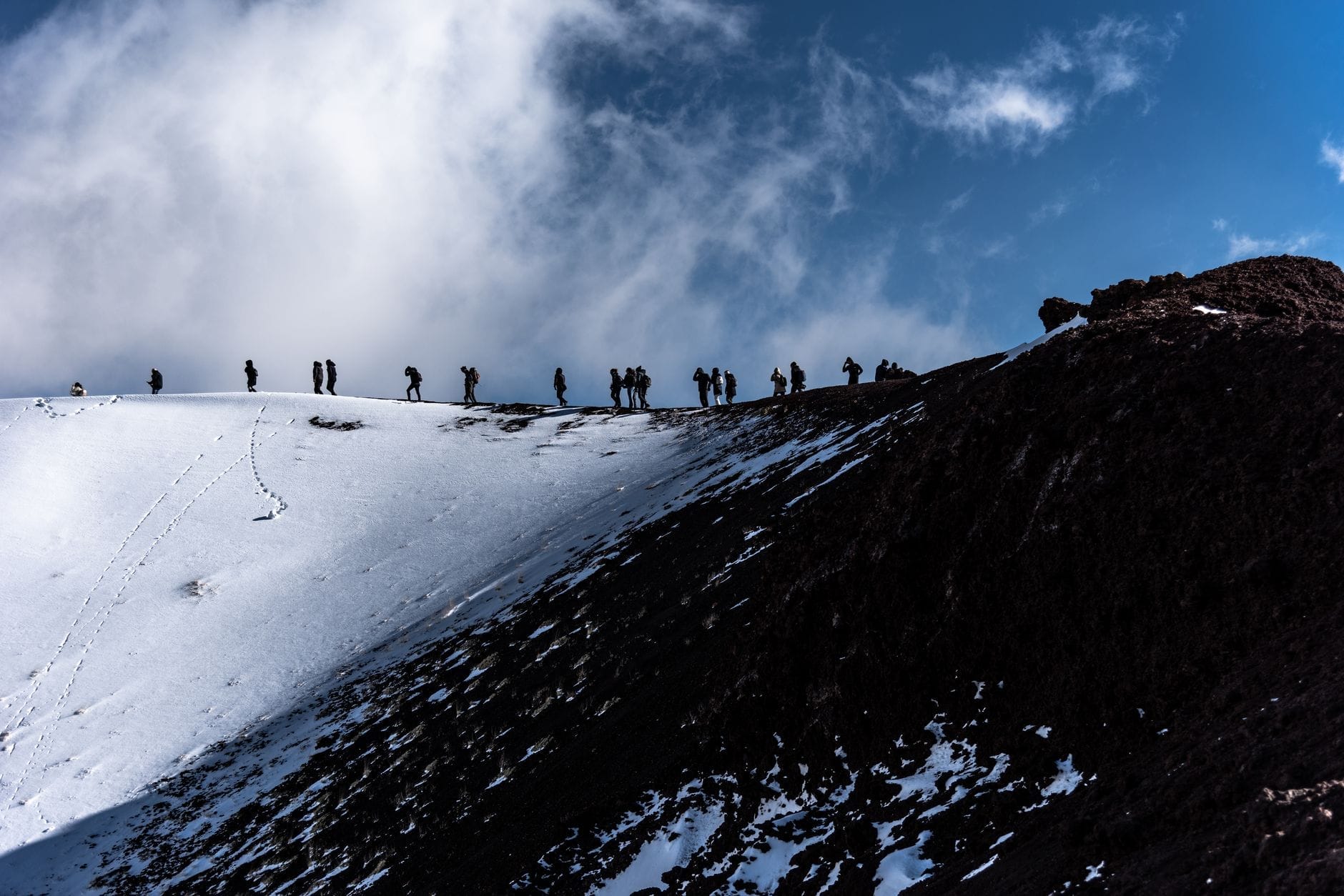
Summit access is realistically possible from April to September, though late spring snowfields can persist above 2,500 metres into May or June. Winter visits to the lower slopes are feasible and occasionally spectacular, with snow contrasting against black lava fields, but summit tours are generally suspended. October can deliver surprisingly good conditions with lower visitor numbers, and the surrounding beech and pine forests on the mid-slopes turn golden, adding colour to the descent.
If you are planning your visit around optimal conditions across Sicily more broadly, the best time to visit Sicily guide covers seasonal patterns in detail, including how weather affects the eastern coast around Catania.
Trails Below the Summit: The Mid-Slopes
Not every visit needs to push for the crater rim. The mid-altitude belt between roughly 1,000 and 1,900 metres is a different Etna entirely: forests of beech, oak, and Corsican pine cover slopes threaded by lava tubes, ancient eruption cones, and centuries-old lava flows now softened by lichen and low shrubs. Several well-marked trails cross this zone, and the Parco dell'Etna maintains route maps available at visitor centres near the park boundaries.
The Valle del Bove, a vast horseshoe-shaped collapse caldera on the eastern flank, is one of the most compelling landscapes accessible to walkers without summit permits. It measures roughly 6 km across and drops over 1,000 metres from its rim. The views into it from the crater rim footpaths are vertigo-inducing in the best way. These trails are typically accessible to fit walkers with proper footwear and do not require a guide, but you should carry water, as facilities are essentially nonexistent once you leave the Rifugio Sapienza area.
Etna is a natural anchor for day trips from the east coast. Both Catania and Taormina serve as convenient bases. See the day trips from Catania guide for how to combine Etna with other nearby sites.
Photography on Etna
The photographic possibilities at Etna shift dramatically with altitude and time of day. Near Rifugio Sapienza, the contrast between the dark lava fields and the distant blue of the Ionian Sea makes for strong wide-angle compositions, especially in early morning when the light is low and directional. Higher up, the textures of the crater walls, from smooth pahoehoe flows to jagged aa lava fields, reward close-up work.
If eruptions are producing visible lava flows or significant gas plumes during your visit, photography conditions can be extraordinary but also hazardous. Gas concentrations near active vents can spike without warning. Follow guide instructions precisely and resist the instinct to move closer for a better angle. Carry a lens cloth: volcanic dust is fine and abrasive and will coat your gear quickly.
Getting to Mount Etna Without a Car
The most practical option without a rental car is an organised day tour departing from Catania or Taormina. These typically include hotel pick-up, transport to Rifugio Sapienza, cable car and 4x4 fees, and a licensed summit guide, eliminating the logistics of driving mountain roads and finding parking. Booking a reputable operator in advance is important in peak summer months when tours sell out.
The Ferrovia Circumetnea, a narrow-gauge railway that circles the base of the volcano, connects Catania with towns including Adrano, Bronte, Randazzo, and Linguaglossa. The line does not reach Rifugio Sapienza, but it provides a scenic ground-level perspective on Etna's lower slopes and the surrounding agriculture, including the famous Bronte pistachio groves. It functions more as a scenic excursion than a practical summit access route.
For a broader overview of moving around the island, including car rental versus public transport trade-offs, the getting around Sicily guide covers the key options clearly.
Who Should Reconsider This Attraction
Mount Etna is a physically demanding environment at high altitude on unstable volcanic terrain. Visitors with cardiovascular conditions, significant mobility limitations, or severe respiratory issues should consult a doctor before planning a summit approach. The sulfur dioxide present near active vents can aggravate respiratory conditions and is not just a mild smell: on active days it is a genuine irritant.
If you are visiting Sicily on a tight schedule expecting a slick, predictable tourist attraction, Etna may frustrate you. Access can be suspended with minimal notice due to volcanic activity. The cable car and 4x4 service are weather-dependent. The mountain operates on geological time, not visitor timetables. If flexibility is not possible, manage expectations or consider a lower-altitude visit to the forests and lava tubes instead of committing to a summit tour.
Insider Tips
- Book guided summit tours at least a week in advance in July and August. Reputable operators sell out quickly and last-minute availability is limited, especially for English-language groups.
- The Rifugio Sapienza car park fills by 9 am on clear summer weekends. If driving independently, arrive before 8 am or park lower on the road and walk the short distance up.
- Pack a dust mask or buff. Fine volcanic ash near the craters is a genuine nuisance on windy days, coating contact lenses and irritating eyes in minutes.
- The mid-slope area around 1,200–1,600 metres is far less crowded than the summit zone and often completely clear when clouds obscure the upper craters. The lava tube caves and secondary cones in this zone are worth an afternoon even if summit conditions are poor.
- If you are staying in Taormina, several operators offer combined Etna morning tours with an afternoon stop at Alcantara Gorge on the return, making efficient use of a single day.
Who Is Etna Volcano Trails & Summit For?
- Hikers and trekkers looking for a physically engaging day with genuine altitude and volcanic terrain
- Geology and volcanology enthusiasts who want to see an active stratovolcano up close
- Photographers chasing dramatic landscapes, particularly in the golden hour before midday cloud builds
- Families with older children and teenagers who can handle altitude and uneven terrain
- Travellers using Catania or Taormina as a base who want one standout day excursion
Nearby Attractions
Other things to see while in Mount Etna:
- Alcantara Gorge
The Alcantara Gorge (Gole dell'Alcantara) is a dramatic basalt canyon near Mount Etna, where the Alcantara River has cut through ancient lava flows to create walls up to around 25 metres high. It is one of Sicily's most striking geological sites, open seasonally between April and early November.