Castello Ursino: Catania's Medieval Fortress That Survived a Lava Flow
Built by Emperor Frederick II between 1239 and 1250 or slightly earlier, Castello Ursino is one of Sicily's best-preserved medieval fortresses and home to Catania's Civic Museum. Surrounded but not destroyed by the catastrophic 1669 Etna eruption, it now stands in the city center, housing a rich collection of ancient sculpture, coins, and decorative art.
Quick Facts
- Location
- Piazza Federico di Svevia, 95121 Catania, Sicily, Italy
- Getting There
- Stesicoro metro station (Catania Metro), approx. 10–12 min walk
- Time Needed
- 1.5 to 2.5 hours for castle exterior and museum
- Cost
- Standard €10 / Reduced €6 / Schools €3. Last entry 18:00. Open Mon–Sun 09:00–19:00
- Best for
- History enthusiasts, architecture lovers, travelers seeking indoor culture on hot days
- Official website
- museocivicocastelloursino.comune.catania.it/?locale=en
What Is Castello Ursino?
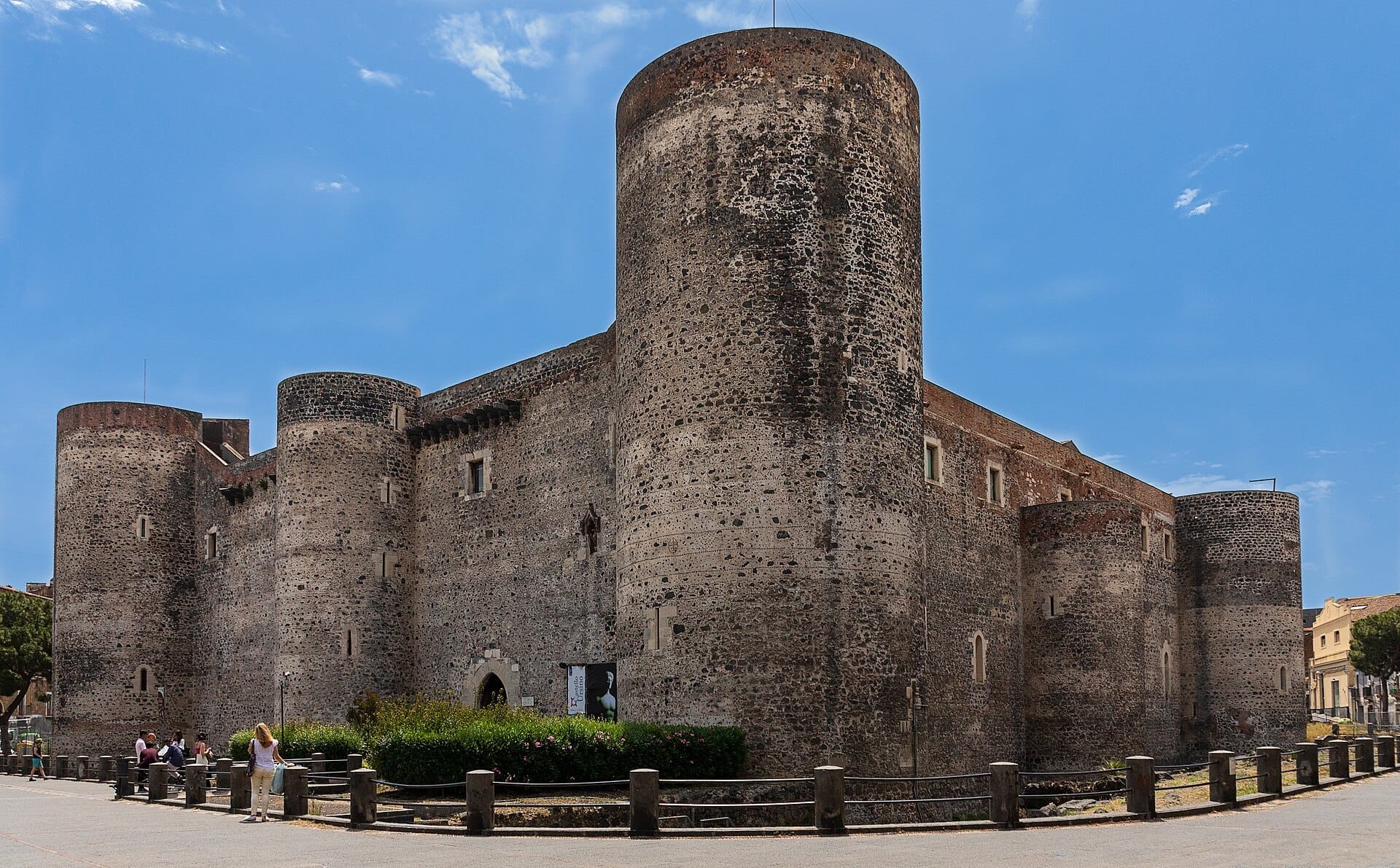
Castello Ursino, also known as the Museo Civico Castello Ursino, is a 13th-century royal fortress rising from the middle of a low-rise residential quarter in central Catania. Its four cylindrical corner towers, blackened basalt walls, and near-perfect 50 by 50 meter square footprint make it immediately recognizable as something built not for ceremony but for control. Frederick II of Swabia, Holy Roman Emperor and King of Sicily, commissioned the structure between 1239 and 1250, tasking his architect Riccardo da Lentini with creating a fortified coastal seat of power on Sicily's east coast.
Today it functions as the Civic Museum of Catania, displaying collections of Greek and Roman sculpture, medieval artifacts, coins, ceramics, and paintings across a series of vaulted halls arranged around a central courtyard. The collections themselves arrived from several sources after the museum's formal opening in 1934, including donations from the Benedictine Monastery of San Nicolò, and acquisitions originally assembled by Prince Biscari and Baron Asmundo-Zappalà. The result is an eclectic but substantial survey of Catania's ancient and early modern heritage under one roof.
ℹ️ Good to know
Opening hours: Monday to Sunday, 09:00–19:00. Last entry at 18:00. Admission: €10 standard, €6 reduced, €3 for school groups. Prices are subject to change; verify on the official website before visiting.
A Castle That Survived a Lava Flow
The most remarkable chapter in Castello Ursino's history has nothing to do with battles or sieges. In 1669, Mount Etna produced one of its most destructive eruptions in recorded history. Lava flows advanced south toward Catania, engulfing much of the lower city and burying the land between the castle and the sea. The castle, originally built right on the coastline as a maritime fortress, found itself suddenly landlocked as the lava solidified around it and pushed the shoreline several hundred meters further east.
The walls absorbed the thermal shock and survived intact. Walk around the castle's exterior today and you can still see, at the base of the walls, how lava rock was incorporated into or built up against the original Norman masonry. This geological episode is not just a historical curiosity: it is one of the defining physical facts of Catania itself, a city rebuilt almost entirely in volcanic basalt after the additional devastation of a 1693 earthquake. For context on how profoundly Etna has shaped this region, the Etna volcano trails offer a direct encounter with the same forces that altered the castle's surroundings three and a half centuries ago.
Tickets & tours
Hand-picked options from our booking partner. Prices are indicative; availability and final rates are confirmed when you complete your booking.
Guided tour of Catania, Aci Castello and Aci Trezza by mountain bike
From 150 €Instant confirmationFree cancellationScuba Diving Experience in the Gulf of Catania from Aci Castello
From 85 €Instant confirmationFree cancellationEtna South Upper Craters Guided Excursion from Taormina
From 42 €Instant confirmationFree cancellationTaormina private tour with an expert guide
From 42 €Instant confirmationFree cancellation
The Architecture: What to Look at Before You Go Inside
Give yourself time outside before buying a ticket. The exterior walls, built from dark volcanic stone and ashlar limestone, display the austere Swabian military aesthetic at its clearest. Frederick II used a similar design language at several fortresses across southern Italy: square plan, circular corner towers, minimal ornamentation, and a dry moat that originally separated the structure from the ground around it. The moat at Castello Ursino is now partially visible as a sunken perimeter, and at certain angles in the early morning light, the scale of the walls becomes genuinely impressive.
The main entrance faces north across Piazza Federico di Svevia, a square that doubles as a social gathering point for the surrounding neighborhood. During morning hours, the piazza is relatively calm and the light hits the north facade cleanly. By early afternoon, the walls absorb heat and the interior courtyard becomes warm; the museum's ground-floor rooms offer a useful reprieve. The four corner towers project beyond the wall line, a design that allowed defenders to cover the exterior walls with flanking fire, a standard technique for the period but executed here with an unusual precision of geometry.
💡 Local tip
Photography tip: The best exterior shots of the full castle are from the far southern edge of the piazza in the first two hours after opening. By midday, the sun is overhead and the dark basalt walls lose contrast. Arrive between 09:00 and 11:00 for the most defined shadows and wall texture.
Inside the Museo Civico: What the Collections Actually Contain
The museum is organized across multiple rooms on the ground floor and upper level, connected by the central courtyard. The collections are broad rather than narrowly focused, which is both a strength and a mild weakness: there is genuine depth in certain areas, particularly Greek and Roman antiquities, but the overall presentation can feel uneven, with some rooms more carefully displayed than others.
The ancient sculpture collection is the most substantive section. Several rooms contain sarcophagi, funerary reliefs, portrait busts, and architectural fragments recovered from the Catania area and broader eastern Sicily. A notable coin collection covers Greek, Roman, and Byzantine periods and gives a surprisingly clear sense of the succession of powers that controlled Sicily across fifteen centuries. Medieval artifacts, including ceramics, weapons, and ecclesiastical objects, occupy further rooms and connect the castle's military origins to the broader context of Norman and Swabian Sicily.
Paintings from the 15th through 18th centuries are distributed through several upper rooms, with works collected primarily from Catanian and Sicilian artists. The quality is inconsistent but the setting, vaulted stone rooms with stone-framed windows, lends even modest works a certain weight. Visitors with a strong interest in Sicilian painting and decorative arts might also consider the Palazzo Abatellis in Palermo, which holds a more focused and curated collection in a comparable historic building.
How Crowds and Atmosphere Change Through the Day
Castello Ursino draws a steady stream of visitors but rarely feels overwhelmed. Mornings between 09:00 and 11:00 are the quietest, with the courtyard largely empty and the museum rooms easy to move through at your own pace. Tour groups, particularly school groups from the city and region, tend to arrive from mid-morning onward and can make certain rooms more congested and louder between 10:30 and 13:00.
Early afternoon in summer sees a lull as many local visitors avoid the midday heat, making roughly 13:30 to 15:00 a second quiet window, though the interior can be warm. Late afternoon, from around 16:00 to closing, attracts a mixed crowd of tourists and Catanians making unhurried visits. The courtyard in this hour catches softer western light, and the atmosphere becomes noticeably more relaxed. On weekday mornings outside July and August, you can sometimes have whole rooms to yourself.
⚠️ What to skip
The castle occasionally closes partially or fully for special exhibitions, private events, or public holidays. Check the official museum website or call ahead if timing your visit closely around the opening hours.
Getting There and What to Bring
The castle sits in central Catania and is walkable from the main historic axis. From Piazza del Duomo, the city's main square, it is roughly a 10 to 15 minute walk southwest through a residential grid of streets. The fastest public transit option is the Catania Metro to Stesicoro station, from which the castle is about a 10 to 12 minute walk south. City buses also pass through the surrounding streets; check AMTS Catania route maps for current services.
The surrounding neighborhood, while not a tourist area in itself, is an authentic slice of everyday Catania, with small bars, bakeries, and local shops. If you are building a half-day itinerary, the castle pairs naturally with the Catania fish market (La Pescheria, best visited in the morning, near the cathedral) and the Piazza del Duomo, which anchor the historic center about 15 minutes on foot to the northeast.
Wear comfortable shoes with grip; the internal floors in older sections can be uneven polished stone. The castle lists accessibility for visitors with disabilities among its services, indicating assisted access is available, though the extent of internal coverage is not fully detailed on the official site. Contact the museum directly if specific mobility requirements need to be confirmed in advance. Bring water in summer: the surrounding piazza has limited shade and the castle can be warm in the upper rooms during July and August.
How It Fits Into a Catania Itinerary
Catania is underrated as a base city in Sicily. It has direct airport connections, fast rail links to Syracuse and Taormina, and a compact historic center that rewards walking. Castello Ursino fits naturally into a broader Catania day alongside the Benedictine Monastery, the fish market, and Via Etnea. For travelers considering day trips, day trips from Catania cover a wide range of options from the Alcantara Gorge to Taormina's Greek Theatre, all reachable without a car.
Visitors with more time in eastern Sicily should note that the castle represents a specific strand of Swabian-Norman military architecture that also appears, in different form, at sites across the island. The Arab-Norman legacy in Palermo, documented in detail in the Arab-Norman Sicily guide, provides useful context for understanding how Frederick II's building campaigns fit into the longer architectural history of the island.
Who Should Think Twice
Travelers with no particular interest in medieval history, Roman antiquities, or Sicilian painting may find the museum's collections less compelling than the fortress exterior itself. The presentation is functional rather than immersive: there are labels and some explanatory text, but nothing approaching the interpretive depth of major Italian national museums. If your primary goal is dramatic architecture rather than museum content, spending 30 to 45 minutes outside and in the courtyard without paying admission is a genuine option and still worthwhile.
Visitors traveling with very young children should know that the museum is not especially child-oriented: there are no interactive displays or family-focused activities mentioned in current offerings, and the stone floors and formal room layout are not suited to active toddlers. For family-friendly content in the Catania area, outdoor sites tend to work better.
Insider Tips
- The dry moat perimeter around the castle is partially accessible from the outside and worth a slow circuit before entering. The lava-rock geology embedded at the base of the walls is clearest on the south and west sides.
- If you arrive close to opening at 09:00 on a weekday, you will often have the courtyard entirely to yourself for the first 20 to 30 minutes. The silence inside those walls, with the city audible but distant, is a noticeably different experience from the busier midday visit.
- The ticket desk staff sometimes have a small selection of printed materials about the collections in Italian and English. These are worth picking up even if you don't need them at the time, as they contain more detail on provenance of specific pieces than the in-room labels do.
- The museum hosts temporary exhibitions that occasionally change the room layout or close certain sections. Check the official website for the current exhibition program before planning a visit focused on specific parts of the collection.
- From the upper level of the interior, narrow windows frame specific angles of the surrounding city and, on clear days, distant views toward the lower slopes of Etna. These are not observation points in any formal sense but they reward exploratory walkers who look up and around rather than only at the displayed objects.
Who Is Castello Ursino For?
- History and archaeology travelers who want to understand Sicily's layered past beyond the Greek ruins
- Architecture enthusiasts interested in Swabian and Norman military design in the Mediterranean
- Visitors seeking a cool indoor cultural anchor on a hot Catania afternoon
- Travelers building a full-day Catania itinerary who want a central, low-cost major attraction
- Anyone curious about how Mount Etna physically shaped the city of Catania over centuries
Nearby Attractions
Other things to see while in Catania:
- Aci Trezza & the Cyclopean Islands
Just 10 kilometres north of Catania, the volcanic sea stacks known as the Cyclopean Islands rise from the Ionian Sea with enough drama to explain why the ancient Greeks blamed a blinded giant for putting them there. The village of Aci Trezza wraps around a small working port, and the combination of legend, geology, and unhurried southern Sicilian life makes for one of the most atmospheric half-days on the island's eastern coast.
- Benedictine Monastery of San Nicolò l'Arena
Founded in 1558 and rebuilt after twin catastrophes, the Benedictine Monastery of San Nicolò l'Arena is one of the largest monasteries in Europe and a cornerstone of Catania's UNESCO-listed Baroque heritage. Today it serves as a university faculty, which gives it a lived-in energy unlike any museum. Guided tours reveal extraordinary frescoed halls, hidden gardens, and the raw lava walls swallowed by the 1669 eruption of Etna.
- Fish Market of Catania (La Pescheria)
La Pescheria, Catania's fish market, is one of the most visceral and culturally telling experiences in all of Sicily. Set in a sunken piazza behind the Baroque Amenano Fountain, it operates Monday through Saturday and draws an equal mix of local fishmongers, home cooks, and curious visitors. Entry is free, the atmosphere is unrepeatable, and it is over by early afternoon.
- Piazza del Duomo, Catania
Piazza del Duomo is the symbolic and geographic center of Catania, where the city's civic, religious, and cultural identities converge around the iconic Fontana dell'Elefante. Rebuilt after a catastrophic 1693 earthquake, the square is a masterpiece of Sicilian baroque urban planning — free to enter and open around the clock.