Neapolis Archaeological Park: Syracuse's Ancient World in Stone
Neapolis Archaeological Park in Syracuse contains one of the best-preserved Greek theatres in the world, a massive Roman amphitheatre, the sacrificial Altar of Hieron II, and the haunting Latomia del Paradiso quarries. Together they span centuries of Sicilian history carved directly into the Temenite hill.
Quick Facts
- Location
- Viale Paradiso 14, 96100 Siracusa, Sicily, Italy
- Getting There
- City bus line 2 from Molo Sant'Antonio (Ortygia) ~15 min; on foot ~30 min from Ortygia; limited free parking on Viale Augusto
- Time Needed
- 2–3 hours minimum; allow half a day to explore thoroughly
- Cost
- Paid entry; full, reduced, and combined tickets available at on-site ticket office — verify current prices at the official park site before visiting
- Best for
- Ancient history lovers, classical theatre fans, architecture enthusiasts, and curious travellers with half a day to spare
What Is Neapolis Archaeological Park?
Neapolis Archaeological Park is the archaeological heart of ancient Syracuse, one of the most powerful Greek city-states in the Mediterranean world. The park sits on the Temenite hill on the northwest edge of the modern city, about 30 minutes on foot from the island of Ortygia. Within its boundaries you will find four major monuments: the Greek Theatre, the Roman amphitheatre, the Altar of Hieron II, and the Latomia del Paradiso, a series of ancient limestone quarries whose most famous cave is the Ear of Dionysius.
This is not a reconstruction or a museum. Almost everything here is original stone, carved into or cut from the natural hillside over a span of more than five centuries. That fact alone separates it from most archaeological sites in Sicily and gives the park an atmosphere that photographs struggle to convey.
ℹ️ Good to know
Opening hours are often around 09:00–18:00, with last entry approximately one hour before closing, but hours vary seasonally and are set by the Regione Siciliana. Check the official Regione Siciliana park website or call the ticket office before visiting, especially in winter.
The Greek Theatre: 67 Rows Cut from Living Rock
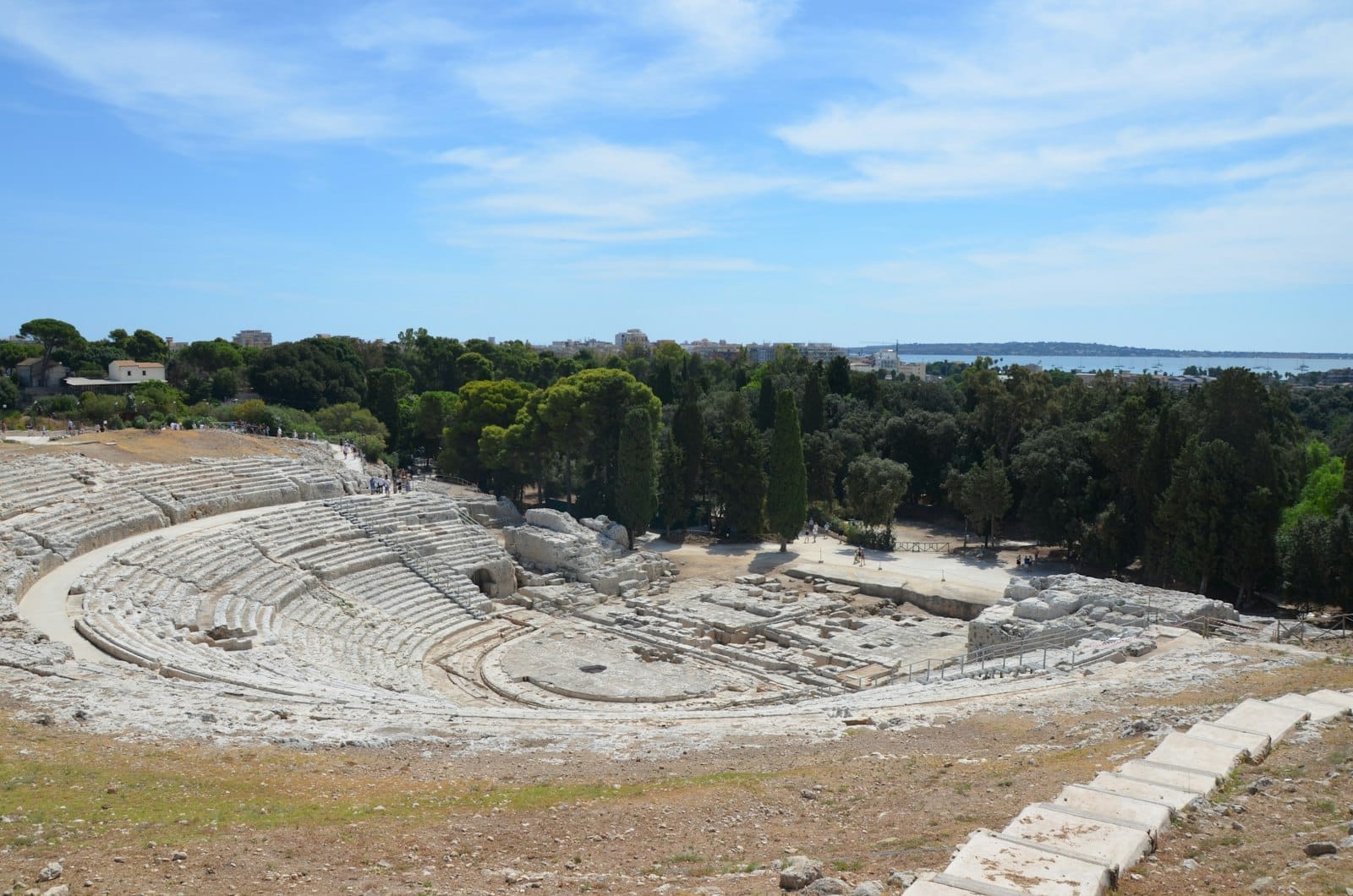
The Greek Theatre is the park's centrepiece and, by any measure, extraordinary. The cavea, with its 67 rows of seats divided into nine wedges by stairways, was carved directly into the Temenite hill rather than built up from the ground. The earliest phase of the theatre dates to the second half of the 5th century BC. Its current form was largely shaped during the 3rd century BC, when Syracuse was among the wealthiest cities in the western Mediterranean. It is one of the largest and best-preserved ancient Greek theatres anywhere.
Sitting in the upper rows on a clear morning, the view over the stage area and out toward the modern city is striking. The stone seats retain traces of carved names belonging to members of the royal family of Syracuse, a detail easy to overlook if you are not specifically looking for them. The orchestra circle and the remains of the stage building (skene) are visible at ground level, though much of the decorative superstructure has been lost.
Every spring and summer, the theatre hosts a classical drama festival organised by the INDA Foundation (Istituto Nazionale del Dramma Antico), which has staged productions here since 1914. During festival season the interior of the cavea is covered with temporary wooden seating to protect the ancient stone, which means the raw archaeological texture of the theatre is less visible during those months. If seeing the bare stone matters to you, plan your visit outside the festival period. For details on visiting Syracuse more broadly, the city rewards a full day or two beyond the park itself.
💡 Local tip
Arrive at opening time (09:00) to walk the theatre while it is still cool and relatively quiet. By mid-morning in summer, the stone seats radiate heat and tour groups arrive in numbers. Bring water and sun protection regardless of season — the theatre is fully exposed.
Tickets & tours
Hand-picked options from our booking partner. Prices are indicative; availability and final rates are confirmed when you complete your booking.
Syracuse's Greek Theatre and Neapolis Guided Tour
From 39 €Instant confirmationFree cancellationSyracuse's Neapolis Guided Sunset Tour
From 39 €Instant confirmationFree cancellationPrivate Tour of Syracuse's Greek Theatre and Neapolis
From 250 €Instant confirmationFree cancellationEtna South Upper Craters Guided Excursion from Taormina
From 42 €Instant confirmationFree cancellation
The Ear of Dionysius and the Latomia del Paradiso
Below and adjacent to the theatre lies the Latomia del Paradiso, a deep quarry system whose stone supplied much of ancient Syracuse's construction. The quarries were also used as prisons: after the disastrous Athenian expedition of 413 BC, thousands of Athenian prisoners of war were reportedly held here in conditions from which few survived. Walking down into the Latomia is a genuine shift in atmosphere. The air is cooler and damper, the walls of pale limestone rise steeply on all sides, and the vegetation is unusually lush: citrus trees, papyrus, ferns, and flowering plants that thrive in the sheltered microclimate.
The most famous feature is the Orecchio di Dionisio, the Ear of Dionysius: an S-shaped artificial cave carved to a height of roughly 23–25 metres, with remarkable acoustic properties. The name was coined by the painter Caravaggio during his visit to Syracuse in 1608, and the legend that the tyrant Dionysius I used it to eavesdrop on prisoners has never been verified, but it has stuck. Stand inside and speak at normal volume. The resonance is genuinely unsettling.
Adjacent to the Ear of Dionysius is the Grotta dei Cordari, a broader cave historically used by ropemakers who exploited the humidity to keep fibres pliable. Access to parts of the quarry system is restricted for safety reasons; follow the marked paths and official guidance at the entrance.
The Roman Amphitheatre and Altar of Hieron II
Near the park entrance stands the Roman amphitheatre, one of the largest in Sicily. Built in the Imperial period, it was partially cut from the rock and partially constructed. A rectangular trench running through the arena floor allowed for machinery and animal cages. Unlike the Greek theatre, the amphitheatre was used for gladiatorial combat and public spectacles. Its scale is impressive but the condition is more fragmentary than the Greek theatre, and many visitors spend only 10 to 15 minutes here before moving on.
Between the amphitheatre and the Greek theatre lies the base of the Altar of Hieron II, a monumental sacrificial altar commissioned by the tyrant Hieron II in the 3rd century BC. Originally stretching nearly 200 metres in length, it was described as the largest altar in antiquity. Today only the rectangular foundation platform survives, the altar having been dismantled by the Spanish in the 16th century to use its stone for fortifications. It is an oddly overlooked monument; most visitors walk past it without realising what it is. Read the site signage before entering the theatre to understand the scale of what once stood there.
How the Experience Changes Through the Day
The park reads very differently depending on the hour. At 09:00, the Temenite hill is quiet. The light catches the curved rows of the Greek theatre from a low angle, and the limestone looks almost white. By 11:00, the first tour groups arrive and the theatre fills with multiple guided explanations happening simultaneously. By early afternoon in summer, the exposed sections of the park become genuinely hot, with surface temperatures on the stone that make lingering uncomfortable.
The Latomia del Paradiso, by contrast, is cool at any hour. It provides welcome shade in summer and a notably different atmosphere from the open-air monuments above. Plan to spend time here in the middle of the day if you visit in July or August.
Late afternoon visits, particularly in spring and autumn, offer softer light and fewer visitors. The park typically closes at 18:00, so arriving at 15:30 or 16:00 on an October day gives a quieter window with pleasant temperatures and good photographic light on the theatre's upper tiers.
⚠️ What to skip
In July and August, temperatures inside the exposed Greek theatre area regularly exceed 35°C by midday. The park offers almost no shade outside the quarry areas. Carry at least 1.5 litres of water per person and wear a hat. There are limited food and drink options inside the park.
Practical Walkthrough: Getting There and Around
The park is located on the northwest edge of the modern city, roughly 30 minutes on foot from Ortygia, Syracuse's historic island centre. The walk is straightforward and largely flat, passing through the Tyche neighbourhood. If you prefer not to walk, Minibus 2 operated by Sd'A Trasporti departs from Molo Sant'Antonio on Ortygia and reaches the park in about 15 minutes; tickets are purchased on board. There is limited free parking on Viale Augusto for those arriving by car.
Tickets are sold at the on-site ticket office near the entrance on Viale Paradiso. The ticket covers the Greek theatre, Roman amphitheatre, Altar of Hieron II, and the Latomia del Paradiso including the Ear of Dionysius. Combined tickets with other sites in the Siracusa archaeological circuit are sometimes available; check at the ticket office.
Accessibility is limited. The Greek theatre involves significant staircases and steeply raked stone seating. The quarry paths are uneven and sometimes slippery. Visitors with reduced mobility will find parts of the park inaccessible; contact the park administration in advance for current accessibility information.
Photography is permitted throughout the park. The Greek theatre is best photographed from the upper rows looking down over the orchestra and out toward the horizon, or from outside the theatre looking up at the cavea from the Latomia path below. For context on how this site fits into Sicily's broader ancient Greek heritage, the best Greek ruins in Sicily guide offers useful comparison across the island's major archaeological sites.
Is It Worth the Time?
For travellers with genuine interest in ancient history or classical architecture, Neapolis is not just worth visiting, it is one of the most significant archaeological experiences available in the entire Mediterranean. The Greek theatre alone justifies the journey to Syracuse.
For travellers who find ruins vaguely interesting but not compelling, the park can feel like a long walk in the sun between disconnected stone remnants. The lack of on-site interpretive infrastructure, beyond basic signage, means that context depends heavily on prior knowledge, a guidebook, or a hired guide. Without that context, the Roman amphitheatre and the Altar of Hieron II base may register as little more than piles of old stone.
Children who are old enough to grasp the scale of what they are seeing often find the park engaging, particularly the Ear of Dionysius and the quarries. Very young children may struggle with the heat, the uneven terrain, and the walk between monuments. For broader suggestions on travelling with younger visitors, Sicily with kids covers practical options across the island.
Insider Tips
- Visit on a weekday rather than a weekend. Saturday and Sunday mornings see the highest concentration of day-trippers from Catania and Palermo, and the Greek theatre can feel crowded by 10:00.
- The carved royal names on the upper rows of the Greek theatre seating are rarely mentioned in standard guidebooks. Look for inscribed lettering in the stone of the middle and upper tiers, particularly in the central wedges.
- Audio guides and licensed local guides are available for hire near the ticket office. Given the limited on-site signage, hiring a guide for 90 minutes makes a noticeable difference in how much you understand, especially for the amphitheatre and altar.
- The Latomia del Paradiso path loops back toward the theatre exit. Do not retrace your steps from the Ear of Dionysius; follow the path through the quarry garden to emerge near the upper theatre entrance and save 10 minutes of backtracking.
- In spring (April to June), the Latomia garden is in full flower with orange blossom scent from the citrus trees. It is by far the most atmospheric time to visit the quarry section, and the temperature in the open theatre is still manageable.
Who Is Neapolis Archaeological Park For?
- Travellers with a specific interest in ancient Greek or Roman history and architecture
- Classical theatre enthusiasts, particularly those aware of the INDA festival productions
- Photographers seeking dramatic stone architecture and natural light in the early morning
- Visitors combining Syracuse with a broader Sicily archaeology itinerary including Agrigento or Selinunte
- Couples and solo travellers who appreciate quiet, contemplative historical spaces outside peak hours
Nearby Attractions
Other things to see while in Siracusa (Syracuse):
- Catacombs of San Giovanni
The Catacombs of San Giovanni are among the largest and best-preserved early Christian burial sites in Sicily, carved into the rock beneath a ruined 6th-century basilica near Syracuse's Neapolis archaeological zone. With over 10,000 tombs cut along a grid of Roman-planned tunnels, the site offers a rare, unhurried look at late antique funerary culture — guided, atmospheric, and genuinely unlike anything above ground.
- Ear of Dionysius
Carved into the limestone cliffs of Syracuse's Neapolis Archaeological Park, the Ear of Dionysius is a 65-metre limestone cave with a distinctive S-shaped curve and acoustics so remarkable that a whisper near the entrance can be heard clearly at the far end. Named by Caravaggio in 1608, it is one of Sicily's most genuinely surprising ancient sites.
- Ortigia Island
Ortigia is the historic core of Syracuse, a compact limestone island barely one kilometer long, where Greek temples, Baroque facades, and Arab-Norman traces stack up on top of each other across 2,700 years of history. Access is free, the streets are walkable, and almost every corner produces something unexpected.
- Pantalica Necropolis
Carved into the limestone cliffs of a river canyon northwest of Syracuse, the Necropolis of Pantalica holds more than 5,000 rock-cut tombs dating from the 13th to 7th centuries BC. A UNESCO World Heritage Site, it combines serious archaeological weight with one of Sicily's most dramatic natural landscapes.