Catacombs of San Giovanni, Syracuse: What to Expect Underground
The Catacombs of San Giovanni are among the largest and best-preserved early Christian burial sites in Sicily, carved into the rock beneath a ruined 6th-century basilica near Syracuse's Neapolis archaeological zone. With over 10,000 tombs cut along a grid of Roman-planned tunnels, the site offers a rare, unhurried look at late antique funerary culture — guided, atmospheric, and genuinely unlike anything above ground.
Quick Facts
- Location
- Via San Giovanni alle Catacombe 1, Siracusa, Sicily — near the Neapolis Archaeological Park
- Getting There
- About 30 min on foot from central Syracuse; reachable by taxi or bicycle.
- Time Needed
- 1 to 1.5 hours including the guided underground tour and the ruined basilica above
- Cost
- €8 standard; €5 reduced (children under 16, seniors 65+, groups, military and law enforcement — categories vary; confirm on-site). Guided tour included in ticket.
- Best for
- History and archaeology enthusiasts, travelers combining with the Neapolis zone, anyone wanting a cool, uncrowded alternative to the main sights
What the Catacombs of San Giovanni Actually Are
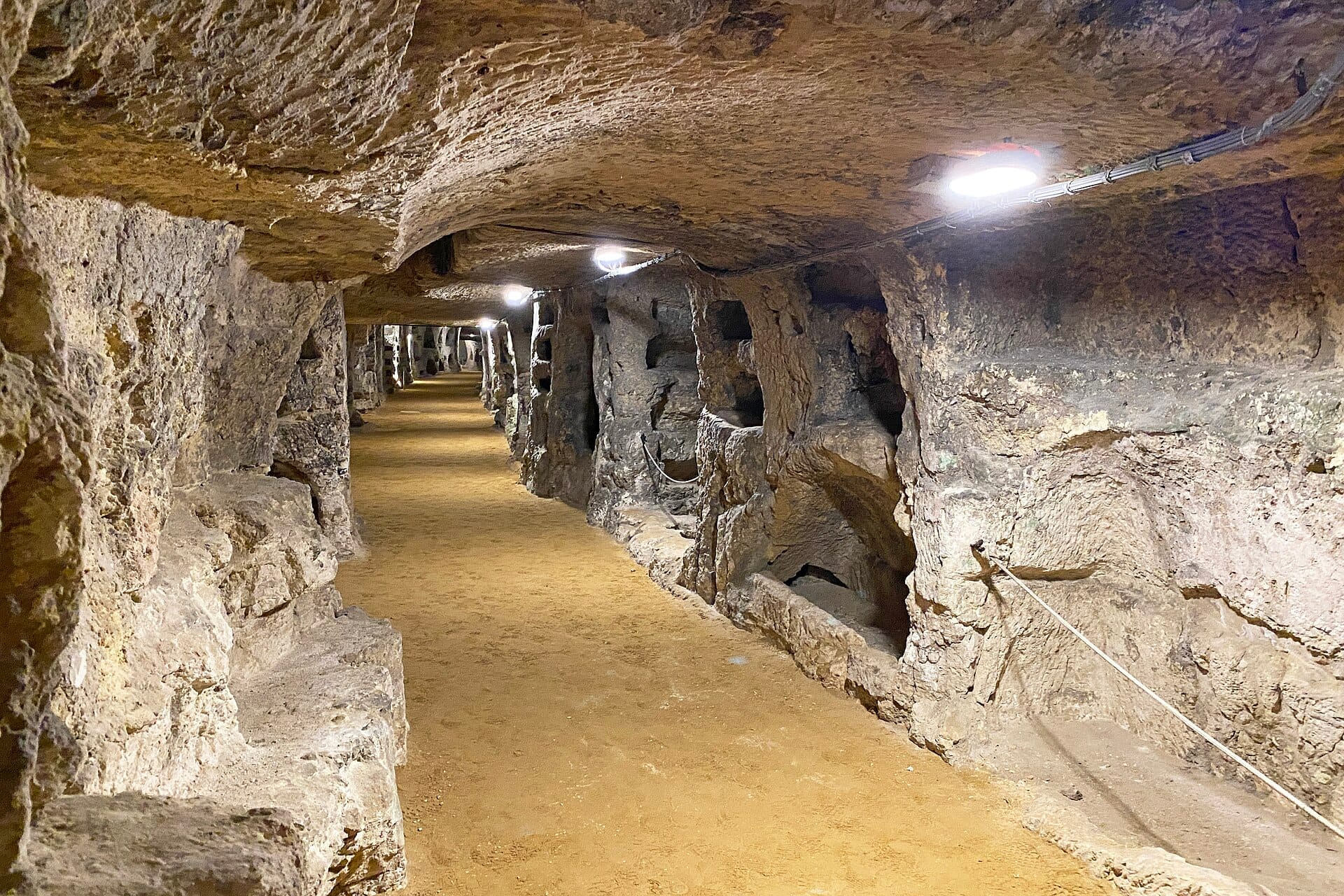
The Catacombs of San Giovanni — formally the Catacombe di San Giovanni Evangelista — are a network of early Christian underground burial galleries cut into the soft limestone beneath the ancient Greek and Roman city of Syracuse. Dating from roughly the 4th to the 6th century AD, they were created after the Edict of Milan in 313 AD made Christianity legal, giving the Christian community the ability to bury their dead openly and at scale.
The layout follows a notably organized plan: a wide central corridor called the Decumanus Maximus runs the length of the site, with approximately ten secondary passages (Cardines) branching off at right angles. This Roman-grid logic was not coincidental — the tunnels were dug along the channels of an older Greek aqueduct, reusing the existing underground infrastructure. The result is a catacomb that feels more spatially coherent than many comparable sites, though no less disorienting once you are inside.
The scale is significant. The underground area covers more than 10,000 square meters and contains around 10,000 individual tombs, with some estimates reaching up to 20,000 burials when grave reuse over centuries is accounted for. These numbers make Syracuse's catacombs second only to those of Rome in terms of size among early Christian underground cemeteries in Italy.
ℹ️ Good to know
Visits are by guided tour only — you cannot explore independently. This is both a safety measure and, in practice, a genuine improvement on self-guided wandering: the guides carry portable lighting into the darker side passages and point out details that would be easy to miss.
The Ruined Basilica Above: An Overlooked Starting Point
The entrance to the catacombs is not underground. You arrive first at the Basilica di San Giovanni Evangelista, a 6th-century church that was built directly above the burial site, using the catacombs as its sacred foundation. The basilica suffered heavy damage during the Norman conquest at the end of the 11th century and then largely collapsed in the 1693 earthquake that devastated much of southeastern Sicily. What remains is an open-roofed shell of apses, columns, and stone arches — roofless, weather-bleached, and genuinely beautiful in the way that ruins are when they have been allowed to stay ruined.
Visiting the basilica exterior before descending gives important architectural context. You can see the relationship between the two structures, understand the scale of what was once a major religious complex, and take photographs in natural light before entering the dark. In the morning, the low-angled sunlight catches the pale stone columns at a striking angle. By midday, the site becomes bright and flat, better for reading detail than for photography.
The basilica compound also connects to the broader landscape of Syracuse's archaeological heritage. The nearby Neapolis Archaeological Park is a short walk away, and combining both sites in a single morning or afternoon is a practical choice. Together they form a coherent picture of how Syracuse moved from the Greek and Roman world into late antiquity.
Tickets & tours
Hand-picked options from our booking partner. Prices are indicative; availability and final rates are confirmed when you complete your booking.
Visit to the Di Giovanna winery with tasting of four wines and a light lunch
From 48 €Instant confirmationVisit to the Di Giovanna winery with tasting of three wines
From 34 €Instant confirmationVisit to the Di Giovanna winery with tasting of three wines
From 34 €Instant confirmationVisit to the Di Giovanna winery with tasting of three wines
From 34 €Instant confirmation
Inside the Tunnels: What You See and How It Feels
The temperature underground is consistent — typically around 15 to 16°C regardless of the season above. In July or August, when Syracuse can reach 32°C, the drop is immediate and stark. Bring a light layer if you run cold; the visit lasts long enough that the chill becomes noticeable.
The air is dry and faintly mineral, the smell of old stone rather than damp earth. The tunnels are narrow enough in some stretches that two people cannot walk abreast comfortably, and the ceiling height varies. The main Decumanus Maximus is tall and relatively wide, more corridor than cave. The secondary Cardines are tighter and lower, and these are where most of the individual tombs — called loculi — are carved directly into the walls, stacked in rows. Many are empty; some retain traces of red ochre or Christian iconography scratched or painted onto the stone.
The guide will typically point out arcosolia, which are arched tomb niches designed to hold bodies horizontally in a posture suggestive of sleep rather than death — a distinctly Christian funerary symbolism. Some of these larger niches once held the burials of wealthy or prominent individuals and retain fragmentary decoration. There is also a crypt traditionally associated with Saint Marcian, the first bishop of Syracuse, though the historical claims attached to specific locations in ancient catacombs should be treated as devotional tradition rather than confirmed archaeology.
💡 Local tip
Wear closed shoes with grip. The tunnel floors are uneven stone and can be slightly damp near certain passages. Sandals are manageable but not ideal.
Crowds, Timing, and What the Seasonal Hours Mean in Practice
The catacombs receive a fraction of the visitors that comparable sites in Rome attract. Even in peak summer, the tours tend to be small groups — rarely more than fifteen to twenty people — and the atmosphere inside remains quiet. That said, the guided tour format means you are tied to the schedule. If you arrive just after a tour has started, you may wait up to thirty minutes for the next one. Arriving at opening time in the morning is the most reliable way to join the first tour without waiting.
Seasonal opening hours vary significantly. From November to February, the site is typically open Tuesday to Saturday from about 9:30 to 12:30 and 14:30 to 16:30; from March to June and again in September and October it generally opens daily from about 9:30 to 12:30 and 14:30 to 17:30, and in July and August from about 10:00 to 13:00 and 14:30 to 17:30, with a consistent midday closure between sessions. Planning around this gap matters — arriving at 12:15 means a two-hour wait or needing to return.
⚠️ What to skip
Opening hours and seasonal schedules can change without much notice. Confirm current times directly with the site or through Syracuse's official tourism information before building your itinerary around a specific session.
If you are spending a full day in the archaeological zone, a logical sequence is: morning at the catacombs and ruined basilica, then lunch in the Neapolis area or back toward the city center, then the Greek theatre and amphitheatre at Neapolis in the afternoon. Alternatively, pair the catacombs with a visit to Ortigia island in the evening, when the light on the old city is at its best.
Historical and Cultural Context: Why This Site Matters
Syracuse was one of the most important cities in the ancient Mediterranean. At its peak in the 4th and 5th centuries BC, it rivaled Athens in size and influence. By the time the catacombs were being dug, the city had passed through Greek, Roman, and then early Byzantine authority — and the Christian community that built these galleries was doing so in a city that had already been a major urban center for nearly a thousand years.
The reuse of the Greek aqueduct channels as the structural basis for the catacomb layout is a detail worth pausing on. The early Christian community did not start from scratch underground; they adapted what the city's Greek founders had already built for water management. It is a small but concrete example of the layered, reusing quality of Sicilian urban history, where each civilization tends to build not over but through what came before.
This same layered quality is visible across Syracuse more broadly, from the Greek temple columns embedded in the walls of the cathedral on Ortigia to the Roman amphitheatre cut into the same hillside as the Greek theatre at Neapolis. For travelers following the broader arc of Sicilian history, the catacombs are a useful link in the chain — connecting the ancient Greek city to the late antique Christian one.
Photography, Accessibility, and Practical Notes
Photography is generally permitted inside the catacombs, but flash and tripods are typically not allowed. The lighting inside is artificial and relatively dim in most areas. A smartphone with a capable low-light sensor will produce usable results; a mirrorless or DSLR set to high ISO will do better. The most photogenic moments tend to be where a tour guide's lamp illuminates a section of loculi against the darkness beyond — pure atmospheric contrast.
The site is not wheelchair accessible. The underground galleries involve stairs to descend, uneven tunnel floors, and sections with low ceilings. Anyone with mobility limitations should contact the site directly to understand what, if any, portions of the visit can be adapted. The ruined basilica above ground is accessible and worth seeing on its own even if the underground tour is not possible.
Children who are curious about history and comfortable in enclosed dark spaces generally find the catacombs engaging. Very young children or those prone to anxiety in underground environments may find it uncomfortable. There are no frightening theatrical elements — this is a serious archaeological site, not a novelty attraction.
For travelers building a wider Sicilian itinerary that includes other archaeological sites, the context offered here complements visits to the Valley of the Temples in Agrigento or the Selinunte Archaeological Park — all sites that chart different chapters of Sicily's layered past.
Insider Tips
- The first tour slot of the day is almost always the smallest group. Arrive at opening time rather than mid-morning and you will likely have a more intimate experience with the guide.
- The ruined basilica is open-air and gets direct sun by mid-morning. If you want photographs of the ruins without harsh shadows, aim to arrive at or just after opening, when the light is still low and angled.
- The site's midday closure is strict and the gap is roughly two hours. If you are driving, use the break to visit the Museo Archeologico Regionale Paolo Orsi — one of Sicily's best archaeology museums — which is a short drive or taxi ride away and shares the same general neighborhood.
- The guide's commentary is typically available in Italian and English. If you have a group with specific language needs, it is worth calling ahead to confirm availability rather than assuming on arrival.
- Combine your visit with the Neapolis Archaeological Park on the same day and ask at the catacombs ticket desk whether any joint or discounted entry is available for multiple sites — offerings change and are not always advertised online.
Who Is Catacombs of San Giovanni For?
- History and archaeology travelers who want to understand Syracuse beyond the Greek theatre
- Visitors looking for a genuinely cool refuge during the heat of a Sicilian summer afternoon
- Travelers interested in early Christian history and how the late Roman world transitioned into Byzantine and medieval Sicily
- Photographers working with low-light and atmospheric interior subjects
- Anyone combining a full-day itinerary around the Neapolis archaeological zone
Nearby Attractions
Other things to see while in Siracusa (Syracuse):
- Ear of Dionysius
Carved into the limestone cliffs of Syracuse's Neapolis Archaeological Park, the Ear of Dionysius is a 65-metre limestone cave with a distinctive S-shaped curve and acoustics so remarkable that a whisper near the entrance can be heard clearly at the far end. Named by Caravaggio in 1608, it is one of Sicily's most genuinely surprising ancient sites.
- Neapolis Archaeological Park
Neapolis Archaeological Park in Syracuse contains one of the best-preserved Greek theatres in the world, a massive Roman amphitheatre, the sacrificial Altar of Hieron II, and the haunting Latomia del Paradiso quarries. Together they span centuries of Sicilian history carved directly into the Temenite hill.
- Ortigia Island
Ortigia is the historic core of Syracuse, a compact limestone island barely one kilometer long, where Greek temples, Baroque facades, and Arab-Norman traces stack up on top of each other across 2,700 years of history. Access is free, the streets are walkable, and almost every corner produces something unexpected.
- Pantalica Necropolis
Carved into the limestone cliffs of a river canyon northwest of Syracuse, the Necropolis of Pantalica holds more than 5,000 rock-cut tombs dating from the 13th to 7th centuries BC. A UNESCO World Heritage Site, it combines serious archaeological weight with one of Sicily's most dramatic natural landscapes.