Ortigia Island: Syracuse's Ancient Island Heart
Ortigia is the historic core of Syracuse, a compact limestone island barely one kilometer long, where Greek temples, Baroque facades, and Arab-Norman traces stack up on top of each other across 2,700 years of history. Access is free, the streets are walkable, and almost every corner produces something unexpected.
Quick Facts
- Location
- Isola di Ortigia, 96100 Siracusa SR, Sicily, Italy
- Getting There
- Train to Siracusa railway station, then 15–20 min on foot or short taxi or bus ride to Ortigia; connected to the mainland by two bridges
- Time Needed
- Half day minimum; a full day allows you to visit monuments and linger at the market and seafront
- Cost
- Free to enter and walk around; individual monuments (Castello Maniace, Cathedral museum) charge separate admission — verify current prices directly
- Best for
- History lovers, architecture enthusiasts, slow walkers, food explorers, photographers
- Official website
- www.comune.siracusa.it
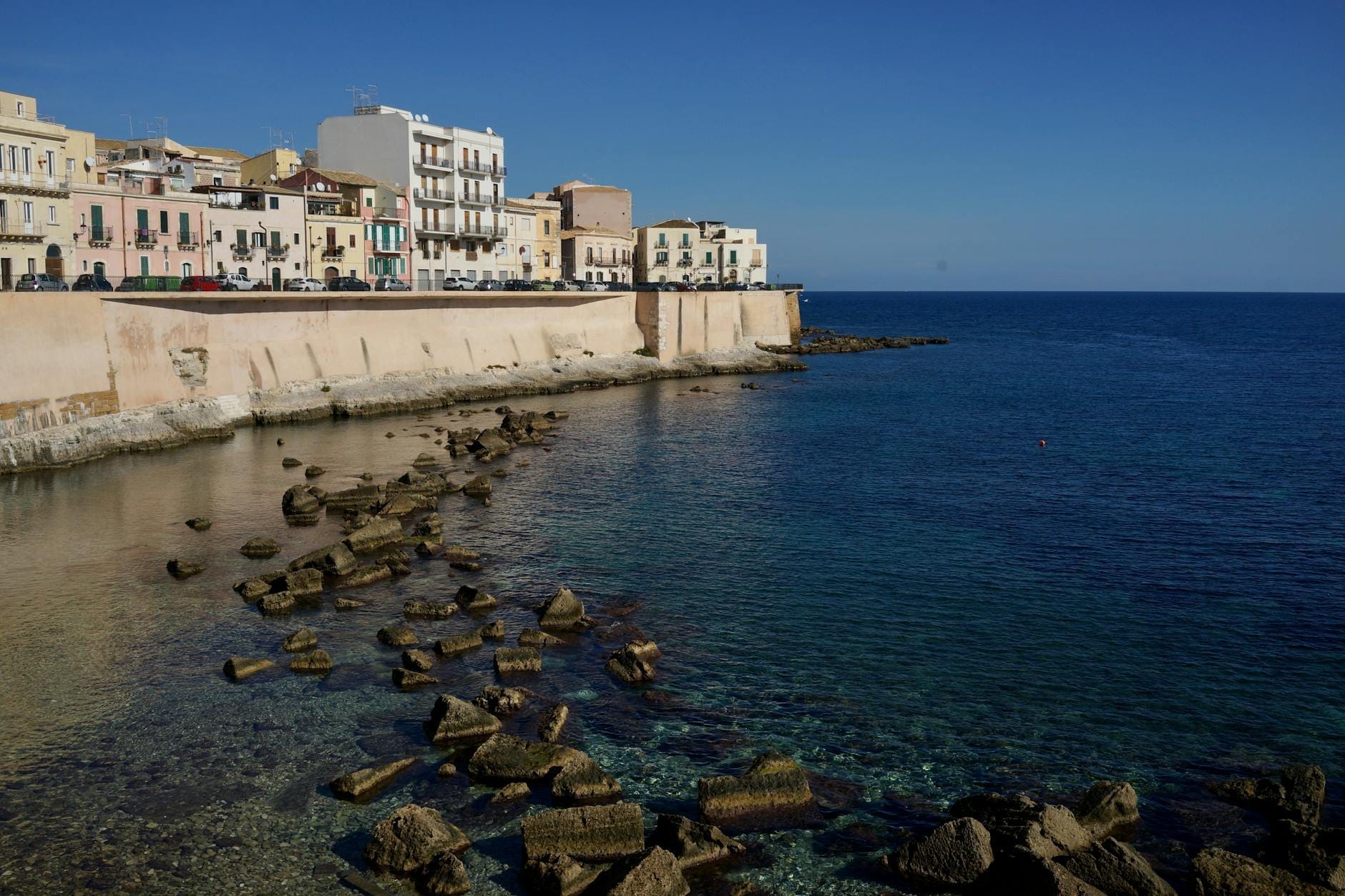
What Ortigia Actually Is
Ortigia Island is the original city of Syracuse, a roughly triangular island less than one square kilometer in size, attached to the Sicilian mainland by two road bridges. The Greeks established a settlement here around the 8th century BC, and the island has been continuously occupied ever since, layered by Phoenicians, Romans, Arabs, Normans, and Spanish Baroque architects, each leaving a mark that the next wave of rulers partially absorbed rather than erased. What you walk through today is not a reconstructed heritage zone but a living neighborhood where people hang laundry between Baroque window frames and local kids kick footballs in the shadow of a cathedral built over a 5th-century BC Greek temple.
The island measures approximately 1 km long and 500 m wide, which means you can cross it in about fifteen minutes on foot. That compactness is both its greatest strength and one of its limitations in high season: there are no wide boulevards to absorb tourist crowds, and the alleys between the old palazzi funnel everyone through the same central routes. Choosing the right time of day to visit makes a significant difference to the quality of the experience.
ℹ️ Good to know
Access to Ortigia as an island district is free and open at all times. You do not need a ticket to walk its streets or squares. Individual attractions such as Castello Maniace and the Cathedral's museum areas charge separate admission — check each site directly for current prices before visiting.
The Layers of History You Actually See
The oldest visible structure on Ortigia is the Temple of Apollo, a Doric temple built in the early 6th century BC, making it one of the oldest Greek temples in Sicily. It stands in a square near the main bridge entrance, partially collapsed and surrounded by a low railing, but still legible: column drums and sections of the cella wall survive to head height, enough to read the scale of the original building. In the centuries after the Greeks, it was converted into a church in later periods and reused over time, before abandoning ecclesiastical use altogether. The sequence of appropriations is not just history — the different-colored stone and interrupted masonry record each change in material terms.
The Cathedral of Syracuse, which sits at the center of the island on the Piazza del Duomo, takes this layering even further. The Baroque facade added in the late 17th and early 18th centuries conceals a Norman exterior, which was built around the original Doric columns of the Temple of Athena, dating from around 480 BC. Inside, those massive Greek columns are still in place, integrated into the cathedral walls. It is a genuinely unusual architectural experience: you are standing in a working Catholic church, leaning against a column that was erected to honor a Greek goddess more than 2,500 years ago. For more context on the Baroque transformation of southeastern Sicily, see the Baroque Sicily guide.
At the southern tip of the island stands Castello Maniace, a square defensive fortress built between 1232 and 1240 under the Holy Roman Emperor Frederick II. The exterior is austere Swabian military architecture, with round towers at each corner and walls that drop almost directly into the sea. The castle has been used as a prison and a military barracks at different points in its history. It now opens to visitors; access to the interior lets you walk the perimeter and look out over the open Mediterranean from the southernmost point of the island.
Tickets & tours
Hand-picked options from our booking partner. Prices are indicative; availability and final rates are confirmed when you complete your booking.
Syracuse, Ortygia and Noto tour from Catania
From 109 €Instant confirmationFree cancellationSiracusa 1-hour boat tour around Ortigia and sea caves adventure
From 25 €Instant confirmationFree cancellationPrivate 90-minute boat tour, Ortigia Island and its sea caves
From 95 €Instant confirmationFree cancellationFull-Day Siracusa and Ortigia Guided Tour from Taormina
From 55 €Instant confirmationFree cancellation
Piazza del Duomo: The Island's Center of Gravity
Piazza del Duomo is the visual and social heart of Ortigia. The square is long and relatively narrow, lined on both sides by Baroque palazzi in warm cream-colored limestone, with the Cathedral closing the upper end. In the early morning, typically before 9 a.m., it is nearly empty and the pale stone takes on a soft amber tone in the low light. Pigeons move around the pavement, cafes put out their chairs, and you can photograph the Cathedral facade without anyone in the frame. By mid-morning the tour groups arrive and the square fills steadily through lunchtime.
In the evenings, especially in summer, the piazza becomes a gathering space for the whole city: local families walk laps, young people cluster near the central fountain, and the outdoor tables of the surrounding bars fill up from around 7 p.m. onward. This is when the square shows a different face entirely, noisier and more social, the tourist layer absorbed into something that feels more genuinely local.
💡 Local tip
For the best photographs of the Cathedral facade, arrive before 9 a.m. in summer (earlier in July and August). The light comes from the east at that hour and hits the Baroque facade directly. By 10:30 a.m. the square is typically busy with groups.
The Market, the Waterfront, and the Daily Rhythms
The Mercato di Ortigia runs along Via Trento and the surrounding streets in the northern part of the island on Monday to Saturday mornings. It is a working food market: stalls selling fish caught the same morning, blood oranges from the Etna foothills in season, sheep's milk ricotta wrapped in reeds, and capers from the Aeolian Islands. The smell of sea brine and citrus zest is strong. The market moves fast and early, most of it winding down by 2 p.m., so arriving before noon is essential if you want to see it at full activity.
The island's eastern edge is fringed by a seafront walkway that runs roughly from the old port area near the market down toward Castello Maniace. In the late afternoon, locals come out to sit on the sea wall as the light shifts and the limestone facades across the water take on deeper tones. It is a useful route for avoiding the congestion of the central streets and provides good views back toward the mainland. If you want to understand how Ortigia fits into Syracuse's wider context, the Syracuse destination guide covers the full city including the archaeological zone on the mainland.
The Fonte Aretusa, a natural freshwater spring that emerges at sea level near the middle of the western waterfront, is one of the few places in the world where freshwater papyrus grows in the open. The spring features in Greek mythology as the nymph Aretusa transformed by Artemis, and it has been a landmark of the city since antiquity. Today it is a small sunken pool surrounded by a stone balustrade, with ducks, papyrus stalks, and generally a cluster of visitors photographing it. It is genuinely interesting historically, though its physical presence is modest: do not expect a dramatic waterfall.
Getting There and Moving Around
Ortigia is connected to the mainland by two bridges, two bridges in the northern section of the island. The easiest approach from the Siracusa railway station is on foot, roughly 15 to 20 minutes along a straightforward route. Taxis and local buses are also available from the station. There is no rail connection onto the island itself.
Once on the island, the only practical mode of transport is walking. The streets are stone-paved, often narrow, and largely pedestrianized in the historic core. Distances are short: from the Temple of Apollo at the northern entrance to Castello Maniace at the southern tip is about 15 minutes on a direct route. The actual experience takes considerably longer because the network of alleys invites detours.
If you are arriving from Catania, direct trains run to Siracusa and the journey takes roughly 1 hour to 1 hour 30 minutes on regional services. This makes Ortigia a practical day trip from Catania, though an overnight stay rewards you with the evening atmosphere and early morning calm. See the day trips from Catania guide for logistics and other options in the area.
⚠️ What to skip
Ortigia's stone-paved medieval streets and uneven surfaces present real challenges for wheelchairs and pushchairs. The bridges and main approaches are accessible, but many of the interior alleys and monument interiors involve steps or rough paving. Individual sites such as the Jewish ritual baths (mikveh) involve descending stairs. Check accessibility with specific monuments before planning a visit.
What to Wear, What to Bring, and Seasonal Conditions
Wear comfortable flat-soled shoes. The Baroque limestone paving is attractive but uneven, and after a few hours on it, inappropriate footwear becomes an issue. In July and August, the island offers very little shade outside of the narrow alleyways, and temperatures on the open seafront and piazzas can be genuinely harsh in the early afternoon. Starting your visit before 9 a.m. and pausing during the midday hours is practical advice, not just a suggestion.
Modest dress is recommended to enter the Cathedral and any working churches: shoulders and knees should be covered. The Cathedral is an active place of worship, not just a tourist attraction. Spring and autumn, broadly April to June and September to October, offer the most comfortable conditions for extended walking. For a fuller picture of how the seasons affect a visit to Sicily, the best time to visit Sicily guide is worth reading before you fix your dates.
Honest Assessment: What Ortigia Is and Isn't
Ortigia is not overhyped. It is genuinely one of the most historically dense small urban spaces in Sicily, possibly in the Mediterranean, and the fact that it functions as a lived-in neighborhood rather than a preserved museum set gives it a texture that more heavily touristed historic centers have lost. However, it is not a quiet, undiscovered place. In July and August especially, the Piazza del Duomo and the streets between the main monuments see significant visitor numbers, and the island's compactness means there is nowhere to retreat to for solitude during peak hours.
Travelers who want a purely archaeological experience should also visit the Neapolis Archaeological Park on the mainland, which holds the Greek theatre, the Roman amphitheatre, and the Ear of Dionysius. Ortigia handles the urban and architectural continuity; Neapolis handles the monumental Greek and Roman remains. The two complement each other and together make Syracuse one of the most rewarding cities in Sicily. The Neapolis Archaeological Park and the Ear of Dionysius are both worth factoring into your planning.
Visitors who have limited mobility, who need wide paved surfaces and lift access throughout, will find Ortigia difficult. The island is not inaccessible, but the historic street network was not built with accessibility in mind, and many of the most significant interior spaces involve uneven or stepped approaches. This is worth factoring into planning honestly, rather than discovering it on arrival.
Insider Tips
- The Jewish quarter in the center of the island, around Via della Giudecca, contains the remains of one of the oldest Jewish ritual baths (mikveh) in Europe, discovered during renovation works beneath a hotel. Access is by guided tour only and numbers are limited — book in advance if this interests you.
- The seafront road on the western edge of the island, the western seafront, is considerably quieter than the central streets even in high season. Walking this route in the late afternoon gives you unobstructed sea views and a good approach to the Fonte Aretusa without the midday crowds.
- The market on Via Trento moves fast and shuts early. If you want to buy food rather than just browse, arrive by 10 a.m. at the latest. The fish stalls in particular thin out quickly as the morning progresses.
- Castello Maniace sits at the far southern tip of the island, which means most visitors who spend time near the Cathedral and the market never quite make it there. The walk to the castle takes about 15 minutes from the Piazza del Duomo, and the panorama from its seaward walls over the open Mediterranean is the best wide-angle view on the island.
- The Piazza del Duomo is dramatically different after dark. In summer, eating dinner at one of the restaurants on the square after 8 p.m. gives you the Cathedral facade lit against the night sky — a very different experience from the daytime visit, and one the crowds of afternoon day-trippers entirely miss.
Who Is Ortigia Island For?
- History and archaeology enthusiasts who want to read 2,700 years of layered civilization in a single walkable space
- Architecture lovers interested in the rare sight of Greek temple columns absorbed intact into a working Baroque cathedral
- Food travelers who want to experience a working Sicilian produce and fish market in an authentic urban setting
- Photographers looking for early morning light on Baroque limestone facades and quiet medieval alleyways
- Travelers using Syracuse as a base, who want an evening destination with genuine local atmosphere rather than a tourist enclave
Nearby Attractions
Other things to see while in Siracusa (Syracuse):
- Catacombs of San Giovanni
The Catacombs of San Giovanni are among the largest and best-preserved early Christian burial sites in Sicily, carved into the rock beneath a ruined 6th-century basilica near Syracuse's Neapolis archaeological zone. With over 10,000 tombs cut along a grid of Roman-planned tunnels, the site offers a rare, unhurried look at late antique funerary culture — guided, atmospheric, and genuinely unlike anything above ground.
- Ear of Dionysius
Carved into the limestone cliffs of Syracuse's Neapolis Archaeological Park, the Ear of Dionysius is a 65-metre limestone cave with a distinctive S-shaped curve and acoustics so remarkable that a whisper near the entrance can be heard clearly at the far end. Named by Caravaggio in 1608, it is one of Sicily's most genuinely surprising ancient sites.
- Neapolis Archaeological Park
Neapolis Archaeological Park in Syracuse contains one of the best-preserved Greek theatres in the world, a massive Roman amphitheatre, the sacrificial Altar of Hieron II, and the haunting Latomia del Paradiso quarries. Together they span centuries of Sicilian history carved directly into the Temenite hill.
- Pantalica Necropolis
Carved into the limestone cliffs of a river canyon northwest of Syracuse, the Necropolis of Pantalica holds more than 5,000 rock-cut tombs dating from the 13th to 7th centuries BC. A UNESCO World Heritage Site, it combines serious archaeological weight with one of Sicily's most dramatic natural landscapes.