Ear of Dionysius (Orecchio di Dionisio): Syracuse's Extraordinary Whispering Cave
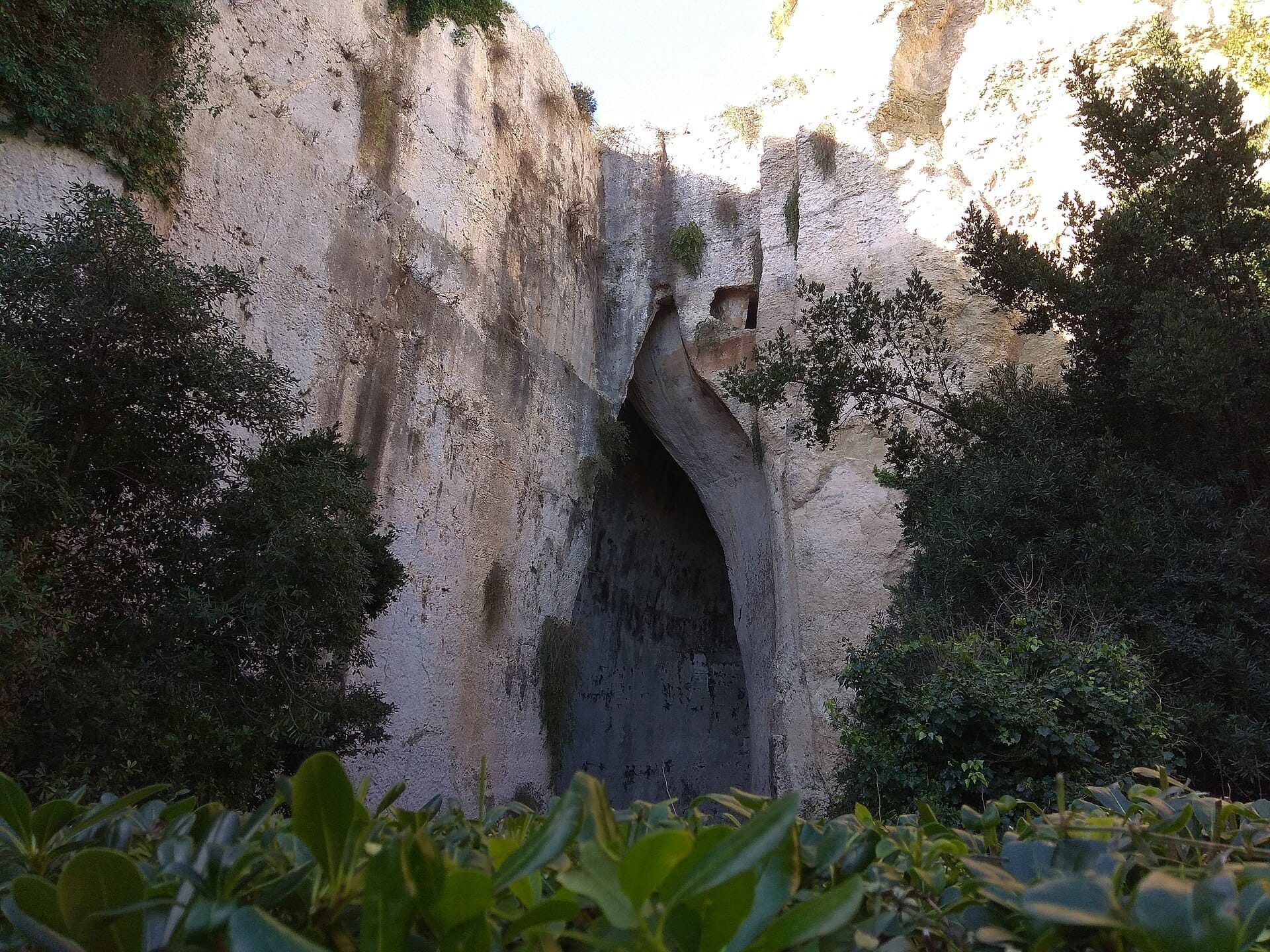
Carved into the limestone cliffs of Syracuse's Neapolis Archaeological Park, the Ear of Dionysius is a 65-metre limestone cave with a distinctive S-shaped curve and acoustics so remarkable that a whisper near the entrance can be heard clearly at the far end. Named by Caravaggio in 1608, it is one of Sicily's most genuinely surprising ancient sites.
Quick Facts
- Location
- Archaeological Park of Neapolis (Parco Archeologico della Neapolis), Via Ettore Romagnoli, Syracuse, Sicily
- Getting There
- About 15 minutes on foot from central Syracuse: head west along Viale Teocrito toward Viale Augusto, then follow park signs
- Time Needed
- 1.5–3 hours (including the broader Neapolis park)
- Cost
- €13.50 full price; €6.50 reduced (EU citizens 18–25); free under 18. Verify before visiting — fees change.
- Best for
- History lovers, archaeology fans, curious travellers drawn by unusual natural and ancient engineering
What You're Actually Looking At
The Ear of Dionysius — Orecchio di Dionisio in Italian — is not a natural formation. It is an artificial cave, quarried from Syracuse's distinctive white limestone (calcare bianco) during antiquity, most likely as part of the extensive latomie quarry system that surrounded the ancient city. The result is a tall, narrow S-shaped passage roughly 65 metres long, between 5 and 11 metres wide, and an imposing 23 metres high at its peak. That unusual vertical proportion, with the ceiling curving sharply to a narrow slit at the top, gives the cave its famous ear-like cross-section when viewed from the entrance.
What makes it genuinely remarkable is not its size but its acoustic behavior. Sound produced at the entrance — even at low volume — travels through the chamber and returns amplified and distorted by the curved limestone walls. Guides demonstrate this with a handclap or a spoken word. The effect is immediate and slightly unnerving. Ancient accounts suggested that Dionysius I, the powerful tyrant of Syracuse in the 4th century BCE, used the cave to imprison enemies and then eavesdrop on their conversations from above. There is no solid archaeological evidence for this story, but it has shaped how visitors have experienced the cave for centuries.
ℹ️ Good to know
The name 'Ear of Dionysius' was coined by the Baroque painter Caravaggio during a visit to Syracuse in 1608. He noted the cave's resemblance to a human ear, and the name stuck — it appears on maps and in guidebooks ever since.
Historical Context: Quarries, Tyrants, and a Painter's Eye
Syracuse in antiquity was one of the most powerful cities in the Mediterranean world, rivalling Athens and Carthage at its peak. The latomie — vast stone quarries cut into the plateau above the ancient city — were both an engineering resource and, at certain periods, a place of punishment. After the disastrous Athenian expedition of 413 BCE, thousands of Athenian prisoners were reportedly held in the Syracuse quarries under brutal conditions; the historian Thucydides describes their suffering in detail. The Latomia del Paradiso, the quarry garden within which the Ear of Dionysius sits, is part of this historically charged landscape.
The cave itself belongs to this quarrying tradition. Workers cut vertically through the rock, which explains its extreme height relative to its width. The precise original purpose — whether for storage, acoustics, or simply the efficient extraction of stone — remains a matter of debate among archaeologists. What is clear is that the artificial acoustics are far too consistent to be accidental: the curved ceiling acts as a resonating chamber, directing and amplifying sound toward the upper slit.
Syracuse's layered history, from Greek to Roman to Byzantine to Arab to Norman rule, is woven into nearly every corner of the city. If the archaeological side of that story interests you, the broader Neapolis Archaeological Park covers the Greek theatre, the Roman amphitheatre, and the quarry gardens in a single visit. For the broader Sicilian archaeological context, the best Greek ruins in Sicily guide places Neapolis alongside Agrigento, Selinunte, and Segesta.
Tickets & tours
Hand-picked options from our booking partner. Prices are indicative; availability and final rates are confirmed when you complete your booking.
Sicilian cooking class near Palermo
From 115 €Instant confirmationFree cancellationSicilian Cooking Class in the Heart of Catania
From 140 €Instant confirmationFree cancellationHistoric Market Tour and Cooking Class in the Heart of Catania
From 185 €Instant confirmationFree cancellationHomemade Dinner in the Heart of Catania
From 95 €Instant confirmationFree cancellation
The Experience at Different Times of Day
The cave faces roughly east, meaning it receives morning light directly at its entrance. Visiting between 9:00 and 11:00 gives the best natural illumination of the pale limestone interior, and the cool air inside the cave is a genuine relief during summer months when outside temperatures climb well above 30°C. The contrast between the warm, bright exterior of the Latomia del Paradiso garden and the sudden cool shadow of the cave entrance is part of what makes the first impression so striking.
By midday in peak season (June through August), tour groups cluster near the entrance, and the acoustic demonstration becomes harder to appreciate as voices overlap. The garden around the cave is largely unshaded, which matters when the sun is high. Arriving late afternoon — around 17:00 in summer, when the park stays open until 19:15 — reduces crowds noticeably and gives the limestone walls a warmer, amber tone in the angled light. Winter visits (November through February) offer near-solitude but shorter opening hours: the park closes at 16:30 until late February.
💡 Local tip
Go early on weekday mornings in spring or autumn for the quietest experience of the acoustics. Weekend afternoons in summer can see significant queuing at the park entrance, not the cave itself.
Walking Through the Cave: What to Expect
The approach to the Ear of Dionysius is through the Latomia del Paradiso, a sunken garden of ancient quarry workings now overgrown with citrus, oleander, and tall papyrus plants fed by natural springs. The papyrus is not decorative: Syracuse sits on one of the very few locations outside Africa where it grows naturally, fed by the freshwater springs of the Ciane river and its tributaries. The garden has a strange, enclosed quality — the quarry walls rise steeply on all sides, muffling city noise, and the air smells of earth and vegetation.
The cave entrance opens suddenly in the cliff face, wide enough for a small group to enter together. Inside, the floor is uneven limestone, worn smooth in the most-visited sections but rough toward the sides. There is minimal artificial lighting, which preserves the atmosphere but means the far end of the 65-metre passage fades into near-darkness. Bring a small torch or use your phone light if you want to examine the cut stone of the walls closely. The temperature inside stays noticeably cool regardless of the season — around 14–16°C is typical — so a light layer is worth carrying even in summer.
The acoustic effect is best tested in the first third of the cave, near the narrowing of the passage. Clap once, sharply. The echo returns fragmented and layered, arriving at slightly different intervals from different parts of the ceiling. Speaking in a normal voice near the entrance can be heard with surprising clarity at a point 20 or 30 metres away, though the amplification effect varies with the number of people already inside and the ambient noise level. It is genuinely impressive rather than gimmicky.
⚠️ What to skip
The cave floor is uneven and can be slippery near the rear where moisture seeps from the rock. Wear shoes with a grip. The cave is not accessible to wheelchairs or pushchairs.
Planning Your Visit: Practical Details
The Ear of Dionysius is not a standalone attraction. It sits within the Archaeological Park of Neapolis (Parco Archeologico della Neapolis), and the entrance ticket covers the entire park. Plan at least 90 minutes if you want to see the Greek theatre and the Roman amphitheatre as well, and up to half a day if you intend to sit in the Latomia del Paradiso for a while. The Greek theatre at Neapolis is one of the best-preserved in the ancient world and operates as a working performance venue in summer, which can mean restricted access to certain areas during rehearsal periods.
Opening hours: the park is open daily from 9:00, closing one hour before sunset. Seasonal closing times vary: until 16:30 through late February, 17:30 through March, and 19:15 from April through the summer months. On Sundays and public holidays, the ticket office closes at 13:00. Verify current hours before visiting, as these details are updated regularly by the park authority.
Admission as of the most recent available information: €13.50 standard; €6.50 reduced for EU citizens aged 18–25; free for visitors under 18. Tickets can usually be purchased at the park entrance. During peak summer months, joining a guided tour can help you skip ticketing delays and adds context that significantly enriches the cave visit.
Syracuse rewards more than a quick stop. The island of Ortigia, Syracuse's historic centre, is a 20-minute walk or short bus ride from Neapolis and contains the remarkable island of Ortigia with its Greek temple converted into a cathedral, Baroque piazzas, and a working morning market. If you are planning a broader southeastern Sicily trip, the two-week Sicily itinerary covers how to combine Syracuse with Ragusa, Noto, and the Vendicari nature reserve.
Photography Notes
The exterior of the cave entrance, framed by the pale cliff face and the dark interior, photographs well in morning light. The key compositional challenge is the extreme contrast between the bright exterior and the dark interior: most phone cameras will either blow out the cliff face or underexpose the cave mouth. The best approach is to position yourself about 10 metres back from the entrance and slightly to one side, shooting just after the cave mouth opens into shadow, and using manual or HDR mode.
Inside the cave, handheld shots are possible in the first 15 metres where ambient light is strongest, but a small tripod or a phone stabilizer gives sharper results toward the rear. The upward curve of the ceiling toward its narrow slit is the most architecturally interesting angle, and worth the awkward upward shot.
Who Should Skip This
If you have no interest in ancient history or archaeology and are primarily in Syracuse for the coast and food, the Ear of Dionysius may feel underwhelming in isolation. The cave itself is a single chamber, and the experience without any historical context amounts to a cool room with a decent echo. Combined with the broader Neapolis park, it fits naturally into a half-day archaeology visit. On its own, it is hard to recommend as a destination unless the acoustic or geological angle genuinely interests you.
Visitors with significant mobility difficulties should note that the quarry garden paths and the cave floor are both uneven and not wheelchair accessible. The Latomia del Paradiso garden can be partially experienced from the upper viewing path, but the cave entrance requires descending into the quarry.
Insider Tips
- Test the acoustics by standing alone near the first narrowing of the passage and speaking in a low, normal voice toward the far wall. The effect is clearest when the cave has fewer than five or six people in it — wait for a gap between tour groups.
- The Latomia del Paradiso garden around the cave is one of the most atmospheric spots in Syracuse for quiet sitting. Bring water and take 20 minutes in the shade of the papyrus and citrus before or after the cave.
- The park's Greek theatre hosts classical drama performances through the Instituto Nazionale del Dramma Antico (INDA). If these are running during your visit, book separately — performances often sell out and some areas of the park may have restricted daytime access on performance days.
- Sundays have shorter ticket office hours (closes at 13:00), which catches many visitors off guard. Arrive before noon if visiting on a weekend.
- A combined visit to the Museo Archeologico Regionale Paolo Orsi, just a short walk from the Neapolis park, is worth adding to the same day. It holds one of the finest Greek archaeological collections in Europe and provides context that makes the cave and theatre significantly more meaningful.
Who Is Ear of Dionysius For?
- Archaeology and ancient history enthusiasts who want to move beyond the obvious Greek temples
- Travellers curious about ancient acoustics and engineering — the cave's properties are genuinely hard to explain until you hear them
- Photographers looking for unusual interior subjects with dramatic natural light
- Families with children old enough to appreciate history (8+): the acoustic demonstration reliably impresses, and the garden is open and safe to walk
- Anyone combining a broader Syracuse day that includes Ortigia, the cathedral, and the archaeological museum
Nearby Attractions
Other things to see while in Siracusa (Syracuse):
- Catacombs of San Giovanni
The Catacombs of San Giovanni are among the largest and best-preserved early Christian burial sites in Sicily, carved into the rock beneath a ruined 6th-century basilica near Syracuse's Neapolis archaeological zone. With over 10,000 tombs cut along a grid of Roman-planned tunnels, the site offers a rare, unhurried look at late antique funerary culture — guided, atmospheric, and genuinely unlike anything above ground.
- Neapolis Archaeological Park
Neapolis Archaeological Park in Syracuse contains one of the best-preserved Greek theatres in the world, a massive Roman amphitheatre, the sacrificial Altar of Hieron II, and the haunting Latomia del Paradiso quarries. Together they span centuries of Sicilian history carved directly into the Temenite hill.
- Ortigia Island
Ortigia is the historic core of Syracuse, a compact limestone island barely one kilometer long, where Greek temples, Baroque facades, and Arab-Norman traces stack up on top of each other across 2,700 years of history. Access is free, the streets are walkable, and almost every corner produces something unexpected.
- Pantalica Necropolis
Carved into the limestone cliffs of a river canyon northwest of Syracuse, the Necropolis of Pantalica holds more than 5,000 rock-cut tombs dating from the 13th to 7th centuries BC. A UNESCO World Heritage Site, it combines serious archaeological weight with one of Sicily's most dramatic natural landscapes.