Pantalica Necropolis: Sicily's Ancient City of the Dead
Carved into the limestone cliffs of a river canyon northwest of Syracuse, the Necropolis of Pantalica holds more than 5,000 rock-cut tombs dating from the 13th to 7th centuries BC. A UNESCO World Heritage Site, it combines serious archaeological weight with one of Sicily's most dramatic natural landscapes.
Quick Facts
- Location
- Between Ferla and Sortino, approx. 25–40 km northwest of Syracuse, southeastern Sicily
- Getting There
- Car required; trailheads accessible from Ferla (south entrance) and Sortino (north entrance). No reliable public transport to the site.
- Time Needed
- 3–5 hours for a thorough trail walk; a full day if combining both access points
- Cost
- Necropolis access is generally free; parking and guided tours carry separate fees (verify locally)
- Best for
- History enthusiasts, hikers, photographers, and travelers who want archaeological depth without crowds
What Is the Necropolis of Pantalica?
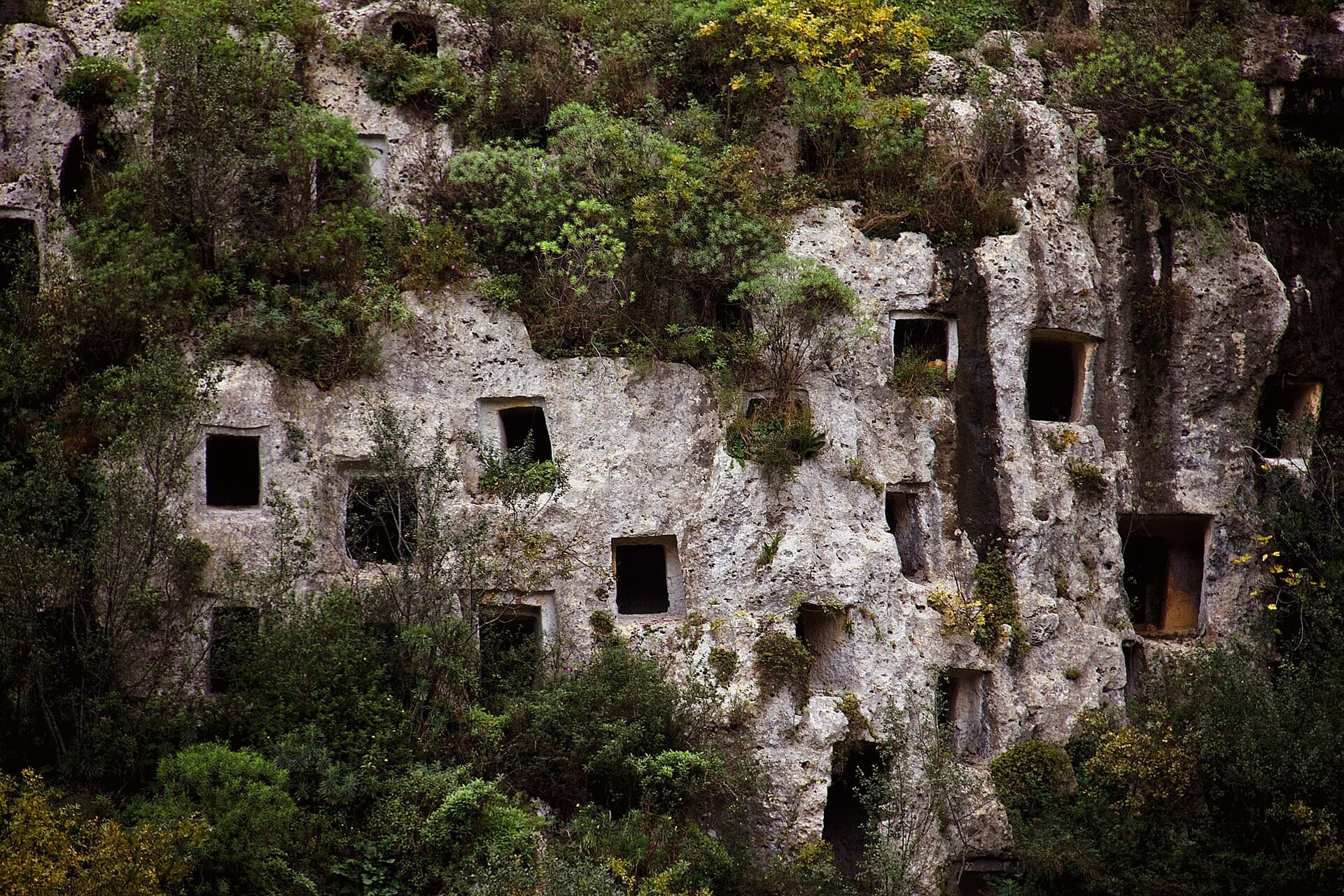
The Necropolis of Pantalica is one of the most remarkable prehistoric sites in the Mediterranean world. Spread across a limestone promontory above the meeting of the Anapo and Calcinara rivers, the site holds over 5,000 rock-cut tombs honeycombing the canyon walls at various heights, some accessible by path, others visible only as dark openings in sheer cliff faces above. The cemeteries date mainly from the 13th to the 7th centuries BC, spanning the late Bronze Age through the early Iron Age, and were associated with the ancient Sicel settlement known as Hybla.
In 2005, UNESCO inscribed the site as part of its Syracuse and the Rocky Necropolis of Pantalica World Heritage listing, recognizing both the extraordinary density of prehistoric funerary architecture and the ecological value of the surrounding river valley. The official Italian name of the wider protected area, Riserva Naturale Orientata Pantalica, Valle dell'Anapo e Torrente Cavagrande, reflects this dual identity: the site is simultaneously an archaeological zone and a protected nature reserve.
Pantalica is not a museum or a traditional archaeological park with roped-off exhibits and information panels. It is an open landscape, and the experience of visiting it is fundamentally physical. For travelers who have already explored Neapolis Archaeological Park or the Ear of Dionysius in Syracuse, Pantalica offers something categorically different: wilderness archaeology rather than structured heritage tourism.
The Physical Experience: Entering the Canyon
The approach from Ferla, on the southern side, drops steeply into the Anapo Valley along a narrow road that winds through scrubland before opening onto the canyon floor. In the early morning, particularly between April and June, the valley holds cool air and the sound of running water from the Anapo river, which still flows along the canyon bottom and can be forded at shallow crossings on some trails. The smell is of dry limestone and wild herbs, occasionally cut by the damp, mossy scent rising from the riverbank.
The tombs themselves appear gradually as you walk. At first you notice a few dark apertures in the rockface perhaps twenty meters above the path. Then the cliff opens up and suddenly the wall is pocked with hundreds of openings, some oval, some roughly rectangular, stacked in irregular rows from just above the scrub to near the canyon rim. The scale only becomes fully apparent when you find a point where you can scan a long section of the cliff face uninterrupted. It looks exactly like what it is: a city of the dead built into rock, layer upon layer, generation after generation.
💡 Local tip
Wear proper hiking shoes with grip. The canyon paths combine loose gravel, flat stone, and river crossings. The terrain is uneven throughout and becomes slippery when wet. Sandals or smooth-soled shoes are a genuine problem here.
Some tombs near the path can be entered, or at least peered into, though they are now bare stone chambers stripped of their original contents, which were largely excavated in the 19th century. The interiors are small, with rough-cut walls that bear faint tool marks. Standing at the entrance of one and looking back at the valley below gives a strong sense of how this landscape was understood by the people who built here: the promontory is a natural fortress, the canyon a moat.
Tickets & tours
Hand-picked options from our booking partner. Prices are indicative; availability and final rates are confirmed when you complete your booking.
Sicilian olive oil tour in Pantalica with tasting
From 40 €Instant confirmationFree cancellationTour of the Pantalica Nature Reserve
From 250 €Instant confirmationFree cancellationEtna South Upper Craters Guided Excursion from Taormina
From 42 €Instant confirmationFree cancellationTaormina private tour with an expert guide
From 42 €Instant confirmationFree cancellation
Historical and Archaeological Context
The burials at Pantalica span roughly six centuries, from approximately the 13th century BC to around the 7th century BC. Archaeologists have identified several distinct cemetery zones across the promontory, with the North Cemetery being among the most densely populated and the South Cemetery offering some of the most dramatic cliff settings. The tombs were cut by the Sicels, an Italic people who inhabited eastern Sicily before Greek colonization, and reflect evolving burial practices across multiple generations.
Excavations conducted primarily in the 19th century by Paolo Orsi, one of the most important archaeologists in Sicilian history, recovered thousands of bronze and ceramic objects from the tomb chambers. Much of this material is now held at the Paolo Orsi Archaeological Museum in Syracuse, making a visit to the museum a natural complement to a trip to the site itself. At Pantalica, the tombs are bare, but their geometry and their setting in the rock carry their own authority.
The site was not used exclusively for burial. The promontory also contains the foundations of a building known as the Anaktoron, or Prince's Palace, believed to date from the Bronze Age and associated with the ruling class of Hybla. It is modest in scale now, little more than foundation walls, but its position at the high point of the promontory confirms that the living and the dead shared this extraordinary location over centuries.
For travelers interested in the broader sweep of prehistoric and ancient Sicily, Pantalica fits into a meaningful itinerary alongside sites like Selinunte Archaeological Park or the Valley of the Temples at Agrigento, though it belongs to a much earlier and less-known layer of the island's history.
How to Visit: Trails, Access Points, and Timing
There are two main access points. The Ferla entrance, on the southern side, is generally the more straightforward starting point for first-time visitors. The road down from Ferla leads to a trailhead and parking area in the valley. From here, the main trail runs along the canyon floor past the denser tomb concentrations, and day hikers can cover significant ground without needing to commit to a full traverse.
The Sortino entrance, on the northern side, is the starting point for a longer trail that follows the old railway bed of the defunct Ferrovia Circumetnea branch line through the valley, passing the ruined station buildings at Pantalica before climbing toward the promontory. This approach is scenic and less steep on the valley floor, but the overall hike to see the main tomb clusters is longer. Some hikers combine both access points with a car shuttle between Ferla and Sortino, which requires coordination but gives the most complete picture of the site.
⚠️ What to skip
Public transport does not serve the trailheads. Taxis from Syracuse to Ferla or Sortino are possible but expensive and require pre-arrangement. A hire car is the practical solution for most visitors. Check road conditions and access gate hours locally before departure, as seasonal closures or maintenance can affect entry.
The site is generally open during daylight hours as part of the nature reserve, and there is no fixed ticketing infrastructure at the tombs themselves, though access gates for the reserve follow posted opening times. Arrive as early as the access allows, particularly in summer. By late morning in July and August, the canyon floor can become very hot, shade is limited on exposed sections of the path, and carrying at least 1.5 liters of water per person is not excessive advice.
Spring, specifically April through mid-June, is the optimal season. The Anapo still runs at a reasonable level, the vegetation is green rather than scorched, temperatures on the trail are manageable, and the wildflowers growing in the limestone cracks add unexpected color to the canyon walls. Autumn, from late September through October, is a close second. Summer is entirely doable but physically demanding. Winter visits are quiet and have a particular atmosphere, but the paths can be muddy and the light is flat.
Photography and What to Look For
The best light for photographing the tomb-studded cliffs comes in the early morning, when low-angle sunlight catches the texture of the rock face and emphasizes the depth of the tomb openings. By midday, the cliffs are often in flat, harsh light that flattens the detail. The North Cemetery, viewed from across the canyon, gives the widest panorama of tomb density and photographs well from the opposite bank in morning light.
For close detail photography, the accessible tombs along the main Ferla trail allow for entry-level compositions that show the scale relationship between a human figure and the tomb mouth, which is the most effective way to convey just how many openings there are in the rock. A wide-angle lens or phone camera is more useful here than a telephoto. Drone flying over protected reserves in Italy requires a permit and is subject to national regulations; do not assume it is permitted.
Practical Notes and Accessibility
The terrain at Pantalica is genuinely rugged. The main canyon trail involves uneven stone, loose gravel, short scrambles, and at some points narrow paths along cliff edges above the river. This is not a managed heritage walkway with handrails and surfaced paths. Visitors with limited mobility will find the site largely inaccessible by independent means, and there are no references in official materials to adapted routes or facilities. Those with young children should assess the trail conditions carefully and be aware that some sections require attentiveness near drop-offs.
Guided tours from Syracuse are available through local operators and are worth considering for first-time visitors who want historical interpretation alongside the hike. The site pairs naturally with a visit to Ortigia, Syracuse's historic island center, which can fill the remainder of a day without requiring significant extra driving. If you are building a broader itinerary across southeastern Sicily, the Catacombs of San Giovanni in Syracuse offer a thematically related underground experience at a very different period of history.
There are no cafes, restaurants, or shops at the trailheads. Ferla and Sortino are small towns where basic supplies are available, but neither is geared toward tourist services in any significant way. Bring food, water, sun protection, and a charged phone with an offline map downloaded before you leave Syracuse.
ℹ️ Good to know
The Pantalica necropolis area extends roughly 1,200 meters north to south and 500 meters east to west across the promontory plateau. A full exploration on foot, including time to sit and absorb the scale of the site, takes between three and five hours. Budget accordingly and do not plan a rushed half-day if you are combining it with other sites.
Who Should Think Twice
Travelers who prefer their archaeology delivered through interpretive displays, audio guides, and climate-controlled visitor centers will find Pantalica underwhelming in those terms. There is minimal on-site interpretation; what context exists is minimal and weathered. The experience is almost entirely visual and physical, driven by landscape rather than curated narrative. If that sounds unsatisfying, the Paolo Orsi Archaeological Museum in Syracuse has the objects and the context, and may be a better use of limited time.
Anyone with knee or ankle problems should be honest about their physical limitations before committing to the trail. The path is not dangerous by hiking standards, but it is sustained and uneven, and a twisted ankle several kilometers from the trailhead in summer heat would be a serious inconvenience. This is also not a destination for travelers whose primary goal is a beach day or a few hours of comfortable sightseeing between meals.
Insider Tips
- Download an offline map of the Anapo Valley trail system before leaving Syracuse. Mobile signal drops to zero in parts of the canyon, and the path junctions are not always clearly marked on the ground.
- The Ferla access road is narrow in the final descent to the valley floor. If you meet an oncoming vehicle, one of you will need to reverse to a passing point. Drive slowly and be prepared.
- A car shuttle between Ferla and Sortino, done with two vehicles or a prearranged taxi, allows you to walk the full length of the valley without doubling back. This is the best way to see both the southern tomb clusters and the old railway trail in the north in a single visit.
- Visit on a weekday if possible. Weekend mornings in spring and autumn bring local hikers and school groups, particularly from Syracuse. The canyon can absorb visitors, but the sense of solitude that makes Pantalica powerful is harder to find after 10 AM on a Saturday in May.
- The river can be crossed at certain shallow points, allowing you to view the cliff tombs from directly opposite. The contrast in scale between the rock face and the individual tomb openings is much clearer from across the water than from below.
Who Is Pantalica Necropolis For?
- History and archaeology travelers who want prehistoric Sicily beyond the Greek-period sites
- Hikers and outdoor enthusiasts looking for a trail with genuine cultural depth
- Photographers seeking dramatic natural and architectural compositions in a single landscape
- Independent travelers comfortable self-navigating remote terrain without infrastructure
- Visitors to Syracuse looking for a half-day or full-day excursion that is completely unlike the city experience
Nearby Attractions
Other things to see while in Siracusa (Syracuse):
- Catacombs of San Giovanni
The Catacombs of San Giovanni are among the largest and best-preserved early Christian burial sites in Sicily, carved into the rock beneath a ruined 6th-century basilica near Syracuse's Neapolis archaeological zone. With over 10,000 tombs cut along a grid of Roman-planned tunnels, the site offers a rare, unhurried look at late antique funerary culture — guided, atmospheric, and genuinely unlike anything above ground.
- Ear of Dionysius
Carved into the limestone cliffs of Syracuse's Neapolis Archaeological Park, the Ear of Dionysius is a 65-metre limestone cave with a distinctive S-shaped curve and acoustics so remarkable that a whisper near the entrance can be heard clearly at the far end. Named by Caravaggio in 1608, it is one of Sicily's most genuinely surprising ancient sites.
- Neapolis Archaeological Park
Neapolis Archaeological Park in Syracuse contains one of the best-preserved Greek theatres in the world, a massive Roman amphitheatre, the sacrificial Altar of Hieron II, and the haunting Latomia del Paradiso quarries. Together they span centuries of Sicilian history carved directly into the Temenite hill.
- Ortigia Island
Ortigia is the historic core of Syracuse, a compact limestone island barely one kilometer long, where Greek temples, Baroque facades, and Arab-Norman traces stack up on top of each other across 2,700 years of history. Access is free, the streets are walkable, and almost every corner produces something unexpected.