Valley of the Temples, Agrigento: What to Know Before You Visit
The Valley of the Temples is Sicily's most significant archaeological site and a UNESCO World Heritage landmark since 1997. Spread across a ridge south of Agrigento, the park preserves seven temples from the ancient Greek city of Akragas, some dating back to the 5th century BCE. This guide covers what you'll actually see, when to go, and how to make the most of your visit.
Quick Facts
- Location
- Via Panoramica dei Templi, 92100 Agrigento AG, Sicily, Italy
- Getting There
- Local buses and taxis from Agrigento town centre; approx. 3–4 km by road along Via Panoramica dei Templi
- Time Needed
- 3–5 hours for a thorough visit; 2 hours minimum to cover the main temples
- Cost
- Standard admission €14; reduced €7 (EU citizens 18–25); free for EU under-18s. Combined tickets with the regional museum cost more — book via CoopCulture
- Best for
- History enthusiasts, photographers, archaeology fans, and anyone serious about ancient Greece
What Is the Valley of the Temples?
The Valley of the Temples, known in Italian as the Valle dei Templi, is the archaeological and landscape park of the ancient Greek city of Akragas, founded in the late 6th century BCE. Today administered under the official name Parco Archeologico e Paesaggistico della Valle dei Templi di Agrigento, it spreads across roughly 1,300 hectares on a limestone ridge just outside modern Agrigento on Sicily's southern coast. The UNESCO World Heritage designation, granted in 1997, reflects both the quality of preservation and the sheer density of monuments within the park.
Despite the name, the temples do not sit in a valley. They stand on a long escarpment that drops toward the sea to the south, meaning most of the major monuments are silhouetted against sky and distant coastline. That backdrop is a large part of what makes this site so visually striking, and it shapes the entire logic of a visit: you are essentially walking a ridge road with temples punctuating the route at regular intervals.
For context on how this site fits into Sicily's broader ancient Greek legacy, the best Greek ruins in Sicily guide places the Valley of the Temples alongside Selinunte, Segesta, and Syracuse as the island's four essential ancient sites.
💡 Local tip
Buy tickets in advance through CoopCulture's official website. On busy days in spring and autumn, queues at the ticket office can add 30–45 minutes to your arrival time, and online booking lets you choose a timed entry window.
The Main Temples: What You're Actually Looking At
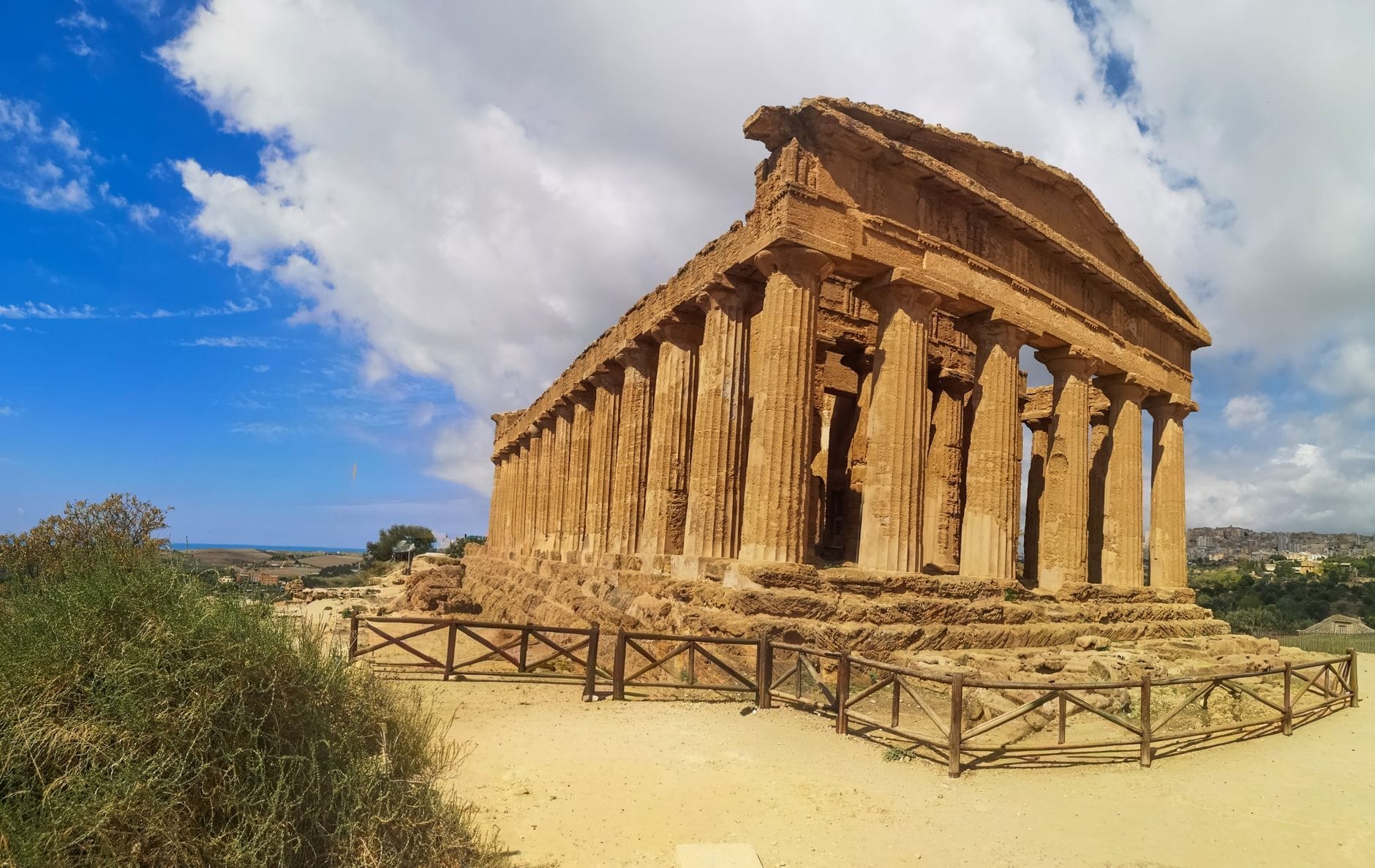
At least seven major temples are identified within the park, though they range from near-complete to fragmentary. The two that dominate every photograph of the site are the Temple of Concordia and the Temple of Juno (also called the Temple of Hera Lacinia). Both are Doric peripteral temples from the 5th century BCE, meaning they are surrounded by a single row of columns on all sides. The Temple of Concordia is one of the best-preserved Greek temples anywhere in the world: 34 of its original columns still stand, and the cella walls survive to considerable height. Its remarkable state of preservation is largely due to its conversion into a Christian church in the 6th century CE, which prevented the systematic quarrying of its stone for medieval construction.
The Temple of Juno sits at the eastern end of the ridge walk, and it is typically the starting point if you enter from the main ticket office on that side. It is less complete than the Temple of Concordia but commands a commanding position, with fire-scorched column drums that still bear the reddish staining from the Carthaginian sack of Akragas in 406 BCE. Walking between these two temples along the Sacred Way takes about 15 minutes at an unhurried pace, and this stretch of the route gives the most cinematic views of both monuments together.
The western zone of the park contains the Temple of Heracles (the oldest in the site, with eight standing columns), the Temple of Olympian Zeus (which was never completed and is now a vast field of collapsed stone blocks), the Temple of the Dioscuri (partially reconstructed and often used as the emblematic image of Agrigento), and the smaller Temple of Hephaestus. The Zeus temple deserves attention: it was intended to be the largest Doric temple ever built, and its scale is conveyed by the enormous fallen telamon — a male figure column about 7.6 metres tall — that lies on the ground nearby.
Tickets & tours
Hand-picked options from our booking partner. Prices are indicative; availability and final rates are confirmed when you complete your booking.
Agrigento and Scala dei Turchi Tour from Cefalu
From 65 €Instant confirmationFree cancellationValley of the Temples skip-the-line guided tour in Agrigento
From 39 €Instant confirmationFree cancellationAgrigento Valley of the Temples Entry with Audio Guide
From 25 €Instant confirmationFree cancellationEvening tour of the Valley of the Temples with ticket
From 40 €Instant confirmationFree cancellation
How the Experience Changes by Time of Day
Arriving at opening time, 8:30 in the morning, gives you roughly two hours before the first tour groups consolidate at the Temple of Concordia. In that window, the light is low and golden, raking across the columns from the east and throwing long shadows across the stone path. The air smells of dry grass, wild fennel, and almond blossom in spring. The only sounds are cicadas and distant birdsong. This is unambiguously the best time to be here if your priority is photography or quiet contemplation.
Midday in summer is genuinely difficult. Temperatures on the exposed ridge can reach 35°C or above, there is almost no shade along the main path between temples, and the site is at its most crowded. If you are visiting in July or August and have no choice but to come at midday, plan a route that ends at the western zone where there is more vegetation, carry at least a litre and a half of water, and wear a hat. The site does not offer consistent shade infrastructure.
The summer evening openings are genuinely worth the timing adjustment. From early July through late September, summer evening openings have in recent years extended regular hours to around 22:00–23:00 on weekdays and slightly later on weekends and holidays, but exact closing times vary annually and must be checked in advance. The temples are illuminated after dark, and the Temple of Concordia in particular takes on a different character entirely: the warm amber uplighting against a deep blue dusk sky produces the kind of view that appears on every poster of this site. Crowds thin considerably after 9 PM, and the temperature drops to something comfortable.
⚠️ What to skip
There is very little shade on the main ridge path between the Temple of Juno and the Temple of Concordia. From June to September, visiting between 10:30 and 16:00 without sun protection is not advisable. Bring water, a hat, and sunscreen regardless of the season.
Practical Walkthrough: How to Organise Your Visit
The park has two main entry points for independent visitors: the eastern ticket office near the Temple of Juno, and the western access near the Temple of Heracles. Most visitors start from the east. The conventional route walks westward from the Temple of Juno, passes the Temple of Concordia, then continues to the western zone temples. The distance from the eastern entrance to the far western edge of the main monument area is roughly 2 kilometres on foot.
Budget at minimum two hours for the eastern section, where the two best-preserved temples are. Add another hour for the western zone if you want to see the Zeus sanctuary ruins and the Temple of the Dioscuri. The Archaeological Museum of Agrigento (Museo Regionale Archeologico Pietro Griffo), located just outside the park near the Church of San Nicola, is the essential companion to the site: it houses the recovered telamon figure, pottery, coins, and artefacts from Akragas that give context to what you see in the park. Allow 90 minutes for the museum separately.
Footwear matters here. The path is paved in parts but also covers uneven stone and compacted earth. Comfortable closed shoes or walking sandals with support are the right choice. Flip-flops are a poor decision, particularly in the western zone where the terrain is more irregular.
Accessibility across the site is uneven. The main path between the eastern entrance and the Temple of Concordia is mostly manageable for wheelchairs, and the park can provide electric mobility aids for visitors with mobility needs on request at the ticket office, subject to availability. However, the western zone has more challenging terrain, and several areas have restricted access. Visitors with significant mobility limitations should enquire at the ticket office about current conditions before purchasing a full-park ticket.
Getting There and Practical Logistics
Agrigento is served by train from Palermo (journey time roughly 2–2.5 hours on regional Trenitalia services) and from Catania with connections via Caltanissetta. From Agrigento's central railway station, local buses run along Via Panoramica dei Templi to the archaeological site. Taxis are available from the station and from the main square. The site is approximately 3 to 4 kilometres from the town centre by road.
Arriving by car is straightforward: there is a car park near the eastern ticket office. If you are combining the Valley of the Temples with other southern Sicily sites, the Sicily road trip guide includes Agrigento as part of a southern route that also covers the baroque towns of Ragusa and Noto.
Standard park admission is €14 for adults (€7 for EU citizens aged 18–25; free for EU under-18s). Combined tickets that include the Museo Archeologico Regionale Pietro Griffo are priced separately on CoopCulture. Typical opening hours run from 08:30 to 20:00 (last entry 19:00) from January through June and from mid-September through December. Extended evening openings applied from July through late September, with the site open later into the evening, often until around 22:00–23:00 on weekdays and slightly later on weekends and holidays. These schedules are set annually and should be verified on the CoopCulture website before your visit, as they are subject to change.
Seasonal Considerations and Honest Expectations
April, May, and early June are the most rewarding months. The almond trees that line parts of the park have finished flowering by April but the landscape is still green, temperatures are mild, and the light has a clarity that flattens by midsummer. The annual Almond Blossom Festival in early February draws visitors specifically for the spectacle of trees in bloom around the ancient columns, but February can bring rain and cool temperatures that make a long outdoor visit less comfortable.
September and October see crowds drop while temperatures remain warm and the late-afternoon light is excellent for photography. For a broader view of when the season works best across the island, the best time to visit Sicily guide breaks down the tradeoffs month by month.
One honest note: the Valley of the Temples is not an undiscovered or lightly visited site. In peak season it receives thousands of visitors per day, and the main terrace in front of the Temple of Concordia can feel crowded between 10:00 and 17:00. If you are hoping for solitary communion with ancient ruins, the early morning is your only reliable option. That said, even at its most visited, the scale of the site means you can always find quieter sections, particularly in the western zone, where fewer tour groups linger.
Photography at the Valley of the Temples
The site is inherently photogenic, but a few positions reward the effort of seeking them out. The view looking east from the Temple of Concordia toward the Temple of Juno in the early morning, with both structures catching the first direct sun, is one of the most composed natural frames on the site. The north face of the Temple of Concordia, where you can frame columns against the hillside and the modern town of Agrigento above, provides interesting context shots. For the evening illumination, a position to the south of the Temple of Concordia, slightly below the ridge level, allows you to shoot the columns against the fading sky without the uplighters dominating the foreground.
Drone use is restricted within the archaeological park. Tripods are generally permitted on the public pathways, but you should confirm current rules at the ticket office or check the official park website before bringing equipment. The Temple of Concordia and the Temple of Juno each have dedicated pages with more detail on what to look for at each structure.
Insider Tips
- The western zone of the park, covering the ruins of the Temple of Olympian Zeus and the Temple of the Dioscuri, receives far fewer visitors than the main eastern ridge. If you are visiting during peak hours, start with the western zone and move east as the crowds arrive at the main temples.
- The Museo Regionale Archeologico Pietro Griffo, located just outside the park, is included in some combined tickets. The museum holds the original telamon figure from the Zeus sanctuary and significantly deepens what you understand when looking at the ruins. Do not skip it in favour of extra time at the temples.
- Bring cash for the small vendors and cafes near the western entrance. Card payment is not always available at the refreshment stalls inside the park, and after two hours in summer heat you will want a cold drink before walking back.
- If you are visiting in summer and cannot get an early morning slot, book an evening ticket specifically. The illuminated temples after dark are a genuinely different experience from the daytime visit and are substantially less crowded from about 21:00 onward.
- The almond trees along the Via Sacra path between the temples are the same variety (Mandorla di Naro) cultivated in this part of Sicily for centuries. In late January and February they flower white and pale pink directly alongside the ancient columns, a combination that is worth planning a winter trip around if you do not mind cooler weather.
Who Is Valley of the Temples For?
- History and archaeology enthusiasts who want sustained engagement with one of the ancient world's most significant surviving sites
- Photographers looking for one of the Mediterranean's most iconic subjects, especially at dawn or during evening illumination
- Travellers on a Sicily itinerary who want to understand the Greek colonial period beyond a single monument
- Families with children who are engaged by ancient history: the scale of the ruins and the fallen giant of the Zeus temple tend to make an impression
- Visitors combining the southern coast route with the baroque towns of Noto and Ragusa, for whom Agrigento makes a natural overnight stop
Nearby Attractions
Other things to see while in Agrigento:
- Eraclea Minoa
Eraclea Minoa is an ancient Greek archaeological site perched above the chalk-white cliffs of Capo Bianco on Sicily's southern coast. Founded in the mid-6th century BCE, it offers a remarkably peaceful alternative to the crowded Valley of the Temples, with a small Roman theatre, excavated residential quarters, and sweeping views over the Mediterranean.
- Porto Empedocle
Porto Empedocle is a working port town 8 km from Agrigento, serving as the main departure point for ferries to Lampedusa and Linosa. Beyond its practical role, it carries a layered history and a literary legacy that rewards a few hours of curious exploration.
- Scala dei Turchi
Scala dei Turchi is a natural marl cliff on Sicily's southern coast, carved by wind and waves into broad white terraces that cascade toward a clear Mediterranean sea. Located between Realmonte and Porto Empedocle in the province of Agrigento, it is one of the most visually striking geological formations in Italy. Direct access to the cliff has been restricted for safety and conservation reasons, and current regulations and access conditions should be checked in advance.
- Temple of Concordia
The Temple of Concordia in Agrigento is one of the most complete ancient Greek temples surviving anywhere in the world. Built around 430 BC in the Doric order and later converted into a Christian church, it stands above the Valley of the Temples with views stretching to the Mediterranean. This guide covers what to expect, when to go, and how to get the most from your visit.