Scala dei Turchi: Sicily's Iconic White Cliff Steps
Scala dei Turchi is a natural marl cliff on Sicily's southern coast, carved by wind and waves into broad white terraces that cascade toward a clear Mediterranean sea. Located between Realmonte and Porto Empedocle in the province of Agrigento, it is one of the most visually striking geological formations in Italy. Direct access to the cliff has been restricted for safety and conservation reasons, and current regulations and access conditions should be checked in advance.
Quick Facts
- Location
- Realmonte, Province of Agrigento, Sicily — between Realmonte and Porto Empedocle on the SS115 coast road
- Getting There
- By car via SS115 from Agrigento (approx. 20 min); no regular year-round public transit directly to the cliff, though seasonal tourist buses may operate in summer — taxis or rental car are usually recommended
- Time Needed
- Visit durations are not currently managed through a standard 60-minute regulated time slot; allow 30 extra minutes for parking and the walk down to the beach
- Cost
- €5 standard tourist pass (passaporto turistico); timed slots via official online booking — paid access since May 2026 (verify on i-ticket.it before visiting)
- Best for
- Coastal scenery, photography, geology, summer swimming, and afternoon light
- Official website
- www.i-ticket.it
What Is Scala dei Turchi?
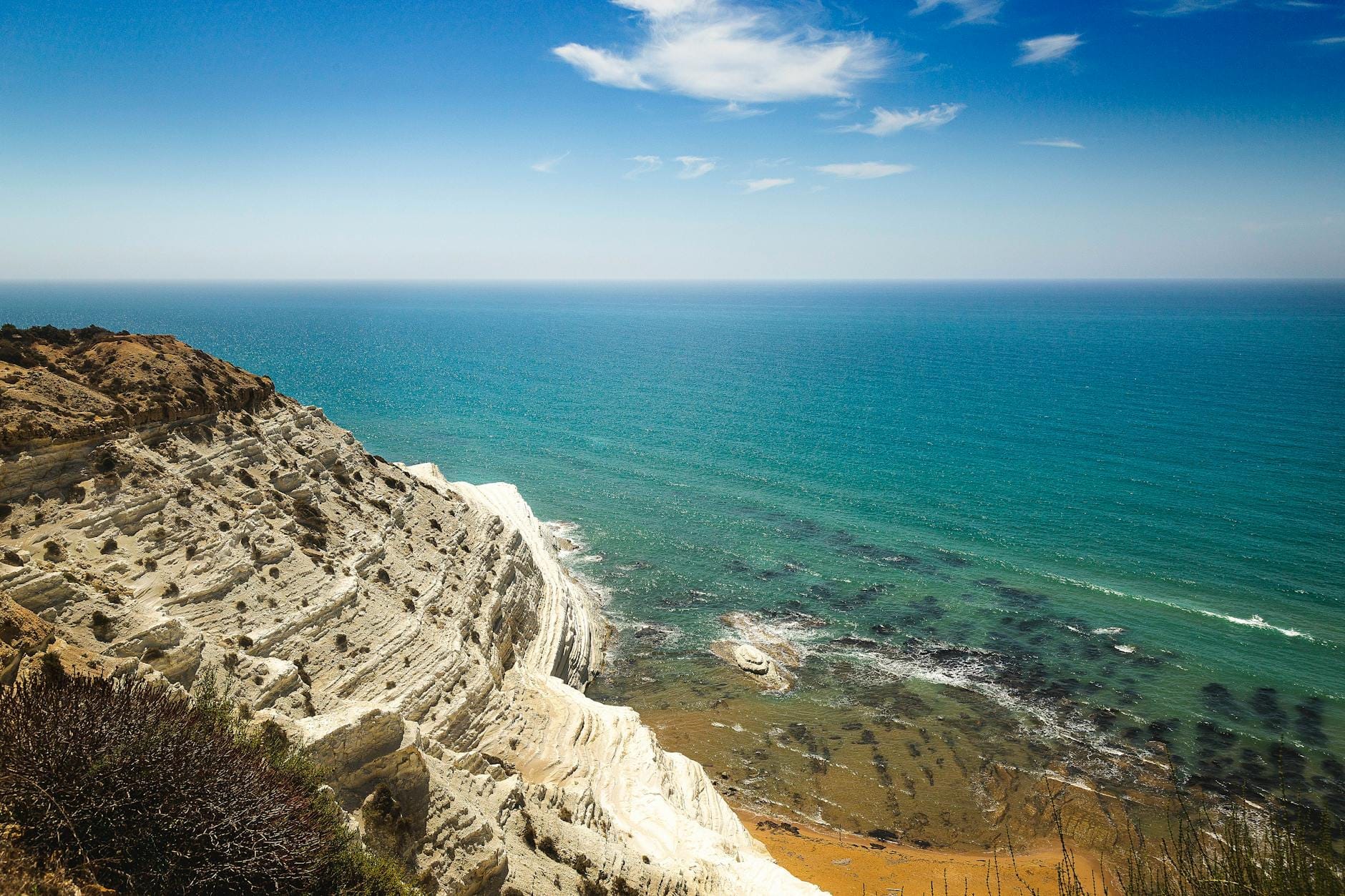
Scala dei Turchi, which translates as the Stair of the Turks, is a formation of brilliant white marl rock on the coast of southern Sicily, about 15 kilometers west of Agrigento, within the municipality of Realmonte. The cliff face has been sculpted over millennia by wave action and wind erosion into a series of wide, horizontal ledges that really do resemble a grand staircase descending to the water. The rock itself is a mix of soft calcareous and clayey sediment, pale enough to catch the light in a way that makes it glow faintly even on overcast days.
The name comes from a darker chapter of Mediterranean history. Historical tradition holds that Arab and Turkish raiding parties used the sheltered bay at the base of the cliff as a landing point during raids along Sicily's southern coast. The broad natural steps made hauling boats ashore easier, and the name stuck long after the raids ended. Today the only arrivals are tourists, who come for the spectacle of white rock against blue water.
ℹ️ Good to know
Since May 2026, cliff access requires a €5 standard tourist pass (passaporto turistico) and advance online booking for timed slots. Rules can change for safety and conservation — always check the official booking platform before you travel.
The Physical Experience: What the Cliff Actually Looks Like
The first view of Scala dei Turchi comes from the path above, and it is genuinely arresting. The white terraces drop steeply toward a beach of pale sand, bordered on one side by the dark blue of the Strait of Sicily. The color contrast is sharper than photographs suggest: the rock reads almost chalky white in midday sun, shifting to a warm cream in the low light of late afternoon. From a distance it looks almost architectural, like something deliberately constructed.
Up close, the surface of the marl is not smooth. The individual steps range from knee height to about a meter, and the surface texture is rough and slightly gritty underfoot, like coarse sandstone. The edges of the terraces are worn into gentle curves by decades of foot traffic and water. In a few places the rock dips into shallow pools where sea water collects and warms in the sun, attracting visitors who sit and soak their feet.
The beach below the cliff is narrow and composed of fine sand mixed with small pebbles. The water at the base is clear, and the bottom stays sandy for some distance out. The combination of the white cliff behind, the pale beach, and the exceptionally clean water explains why this stretch of coastline draws so many visitors during the summer months. It is also worth noting that the marl rock is actively eroding: small fragments break away regularly, and visitors should not attempt to chip pieces off or sit on overhanging ledges.
Tickets & tours
Hand-picked options from our booking partner. Prices are indicative; availability and final rates are confirmed when you complete your booking.
Agrigento and Scala dei Turchi Tour from Cefalu
From 65 €Instant confirmationFree cancellationHalf-day Dinghy Tour to Scala Dei Turchi from San Leone
From 50 €Instant confirmationFree cancellationPalazzo dei Normanni and Cappella Palatina guided tour
From 79 €Instant confirmationFree cancellationEtna South Upper Craters Guided Excursion from Taormina
From 42 €Instant confirmationFree cancellation
When to Visit: Light, Crowds, and Seasons
The best light for both viewing and photography arrives in the two hours before sunset. As the sun drops toward the western horizon, the white terraces take on a warm amber tone that contrasts sharply with the deepening blue of the sea below. The 17:00 or 18:00 entry slot is often the most rewarding for this reason, though it is also among the most popular in summer. Midday visits are fine for swimming but the flat overhead light flattens the texture of the rock.
In July and August, Scala dei Turchi operates at near-constant capacity throughout the day. Even with current access restrictions to the cliff itself, the surrounding roads, parking areas, and nearby beaches can still get very crowded in peak summer. If you visit in peak summer, book your slot at least several days ahead, arrive early to find parking, and expect the nearby beach bars and vendors to be fully operational.
The shoulder months of May, June, September, and October offer a noticeably calmer experience. The sea temperature remains warm enough for swimming through late October, and the light in September is particularly good. Spring visits, especially in April and May, bring cooler air and occasional breezes but the cliff looks no less dramatic, and the access paths are far less congested.
Winter visits are possible but the experience changes character entirely. The beach facilities close, the water is cold, and the wind off the strait can be sharp. Depending on current safety measures, direct access to the cliff itself may be restricted or prohibited, and for travelers focused purely on geology or photography rather than swimming, this is actually a compelling time to visit. Pair a winter trip with nearby Valley of the Temples for a full day around Agrigento, since both are far more manageable outside the summer peak.
⚠️ What to skip
The marl cliff is a living geological formation and erosion is ongoing. Official guidance advises staying on designated paths and not climbing beyond the marked areas. The rock near the upper edge can be unstable, and the surface becomes slippery when wet. Wear shoes with grip — sandals are fine for the beach but poor for the cliff steps themselves.
Getting There and Ticketing
Scala dei Turchi sits near the village of Realmonte in the province of Agrigento. It lies within the municipality of Realmonte (92010 Realmonte, AG) along the coast between Realmonte and Porto Empedocle. The most practical approach from Agrigento is to follow the SS115 toward Porto Empedocle, then turn onto via Nereo along the coast toward the Zona Lidi area. Signposting for the cliff improves as you get closer, and there is a paid parking area a short walk from the access point.
There is no regular year-round public bus service to the cliff itself, though seasonal tourist buses may run in summer from Agrigento. The closest public transport connections are to Agrigento and Porto Empedocle, from which a taxi is the most reliable onward option. For travelers without a rental car, it is worth budgeting for a taxi each way or asking your accommodation to arrange a driver for the half-day excursion.
Access is no longer free: since May 2026 visitors need the €5 standard tourist pass and a booked time slot through the official platform (typically i-ticket.it). Consult the Comune di Realmonte or current regional tourism information shortly before travel to confirm access rules, slot availability, and any seasonal closures.
Accessibility and Physical Requirements
This is not a wheelchair-accessible site. Reaching the cliff and beach involves descending a stairway cut into the cliff face, followed by walking on uneven natural rock surfaces and soft sand. There is no step-free route. Visitors with reduced mobility should review the site conditions carefully before booking. Even if special access provisions are in place for visitors with disabilities, the physical terrain remains challenging regardless of any entry arrangements.
Visitors with young children should be aware that the same terrain applies: strollers are not practical, and toddlers will need to be carried on the steeper sections. Older children (6 and above) typically manage the descent well with supervision. The beach at the base is shallow-entry, which suits families once they have made the descent.
What to Bring and Practical Preparation
Sunscreen is essential, especially in summer. The white rock reflects UV significantly, and shade is essentially nonexistent on the cliff terraces. A hat and sunglasses help considerably. Bring enough water for your slot duration: the managed access zone does not include vendors, and the heat on the exposed white rock in July or August can be more intense than expected.
Footwear: closed shoes or water-resistant sandals with a firm sole work best. Flip-flops are a liability on the cliff steps and on dry, wind-worn marl. If you plan to swim, bring a change of clothes and a towel, since the beach at the base is fully accessible during your slot.
For photography, a polarizing filter cuts the glare from the rock and saturates the blue of the water. The white marl can easily blow out in automatic exposure settings around midday; shoot in RAW or dial down exposure compensation by a stop. The most interesting compositional angles are from the upper terraces looking down at the beach, or from the waterline looking up at the cliff face.
Scala dei Turchi works naturally as part of a broader day on Sicily's southern coast. The Valley of the Temples is roughly 25 kilometers northeast and opens early, so a morning visit to the temples followed by an afternoon slot at the cliff makes a coherent and rewarding day. The town of Agrigento itself is also worth a few hours for its historic upper town and views over the valley.
Is It Worth the Visit? An Honest Assessment
Scala dei Turchi delivers on its visual promise. The white marl terraces against the blue Mediterranean is not a trick of photography or selective framing: the formation really is that striking in person. The timed ticketing system, despite initial resistance when it was introduced, has genuinely improved the experience: the cliff is no longer degraded by unrestricted foot traffic and the visit feels more considered.
That said, be honest about what you are getting: one hour on a cliff and a narrow beach. Visitors expecting an extended beach day or a full geological walking tour will be disappointed by the time limit and the compact area. The €5 ticket is fair, and the experience is swift but memorable. If white cliffs and clear water are what you want from a Sicilian afternoon, this delivers. If you are indifferent to geology and coastal scenery, the time might be better spent elsewhere.
Travelers who want more coastal and natural variety in the Agrigento area should also consider Eraclea Minoa, a Greek archaeological site set on white cliffs just a short drive along the same coastline, which pairs naturally with Scala dei Turchi for a half-day coastal loop. For broader planning across Sicily, the best beaches in Sicily guide puts this stretch of the south coast in useful context.
💡 Local tip
Who should skip Scala dei Turchi: visitors with significant mobility limitations (the terrain is demanding and there is no accessible alternative route), travelers who dislike intense sun and heat exposure with no shade, and anyone expecting a full beach day rather than a 60-minute timed visit.
Insider Tips
- Book the 17:00 or 18:00 time slot in summer for the best light: the white rock turns amber in late afternoon and the shadow play across the terraces is dramatically better than midday.
- The 35-person cap per slot means the cliff genuinely feels uncrowded during your visit — but the road, parking area, and surrounding beach outside the regulated zone can still be packed in August. Arrive 20 minutes early for parking.
- Bring water shoes or rubber-soled sandals if you plan to enter the water at the base: the seafloor is sandy but there are scattered rocks near the cliff face where waves push in.
- The marl cliff is actively eroding. Small fragments on the surface may shift underfoot, and the upper ledges should be treated with caution. Stick to the designated visitor paths rather than climbing to the highest natural points.
- If you are also visiting the Valley of the Temples on the same day, book the temples for the morning opening (they open early and the light is better on the columns before noon) and save the cliff for the afternoon slot.
Who Is Scala dei Turchi For?
- Photographers looking for dramatic natural geometry and color contrast on the Sicilian coast
- Couples and small groups wanting a short but scenic afternoon excursion from Agrigento
- Geology enthusiasts interested in Mediterranean marl formations and coastal erosion
- Summer swimmers seeking clear, shallow-entry Mediterranean water in a scenic setting
- Travelers combining a southern Sicily itinerary with the Valley of the Temples or Eraclea Minoa
Nearby Attractions
Other things to see while in Agrigento:
- Eraclea Minoa
Eraclea Minoa is an ancient Greek archaeological site perched above the chalk-white cliffs of Capo Bianco on Sicily's southern coast. Founded in the mid-6th century BCE, it offers a remarkably peaceful alternative to the crowded Valley of the Temples, with a small Roman theatre, excavated residential quarters, and sweeping views over the Mediterranean.
- Porto Empedocle
Porto Empedocle is a working port town 8 km from Agrigento, serving as the main departure point for ferries to Lampedusa and Linosa. Beyond its practical role, it carries a layered history and a literary legacy that rewards a few hours of curious exploration.
- Temple of Concordia
The Temple of Concordia in Agrigento is one of the most complete ancient Greek temples surviving anywhere in the world. Built around 430 BC in the Doric order and later converted into a Christian church, it stands above the Valley of the Temples with views stretching to the Mediterranean. This guide covers what to expect, when to go, and how to get the most from your visit.
- Temple of Juno
Built around 450–440 BCE and still standing on its rocky ridge above the Sicilian coastline, the Temple of Juno is one of the best-preserved Greek temples in the ancient world. Part of the UNESCO-listed Valley of the Temples complex near Agrigento, it rewards visitors who time their arrival for late afternoon, when the honey-colored limestone turns gold against a darkening Mediterranean sky.