Porto Empedocle: Agrigento's Port Town and the Door to the Pelagie Islands
Porto Empedocle is a working port town 8 km from Agrigento, serving as the main departure point for ferries to Lampedusa and Linosa. Beyond its practical role, it carries a layered history and a literary legacy that rewards a few hours of curious exploration.
Quick Facts
- Location
- Porto Empedocle, Province of Agrigento, Sicily — approx. 8 km from Agrigento city centre
- Getting There
- Regional buses (Licata Srl) connect Agrigento and Porto Empedocle; taxi from Agrigento takes around 15 minutes
- Time Needed
- 2–3 hours for the town itself; allow a full day if combining with the Valley of the Temples
- Cost
- Free to enter; the town and seafront are fully open. Individual exhibitions (Carlo V Tower) may charge a small local fee — verify on arrival
- Best for
- Ferry travellers heading to Lampedusa or Linosa, fans of Andrea Camilleri's Inspector Montalbano novels, and travellers who want an unfiltered Sicilian port atmosphere
- Official website
- www.visitsicily.info/en/porto-empedocle
What Porto Empedocle Actually Is
Porto Empedocle is not a polished tourist attraction. It is a real, functional port town on Sicily's southern coast, where fishing boats share the harbour with large overnight ferries, and the seafront bars serve espresso to dockhands at six in the morning. That is precisely what makes it worth knowing about.
The town sits roughly 8 km southwest of Agrigento, and for most travellers it appears on the itinerary for one specific reason: it is the primary departure point for ferry services to the Pelagie Islands, including Lampedusa and Linosa. Operators Siremar and Traghetti delle Isole run year-round crossings from here. If you are heading to Lampedusa, this is where your journey starts.
Beyond its role as a transit hub, Porto Empedocle rewards a slow walk. Its origins trace back to at least the 15th century as Marina di Girgenti, the coastal outlet for the inland city then known as Girgenti (modern Agrigento). It became an autonomous comune in 1853, and in 1863 took the name Porto Empedocle in honour of Empedocles, the pre-Socratic philosopher born in ancient Akragas, the Greek city whose extraordinary ruins now form the Valley of the Temples just a few kilometres inland.
ℹ️ Good to know
Porto Empedocle is an open town with no admission fee. You can walk the seafront, harbour area, and streets at any hour. The Carlo V Tower may charge a small entry fee for exhibitions — confirm locally before visiting.
The Literary Shadow of Vigata
If you have ever read Andrea Camilleri's Inspector Montalbano novels, Porto Empedocle will feel oddly familiar. Camilleri was born here in 1925, and his fictional town of Vigata, the setting for the entire Montalbano series, is transparently based on his hometown. The novels made Porto Empedocle internationally known to a certain readership, and in 2003 the town actually changed its official name to Porto Empedocle Vigata in a formal tribute to Camilleri. The decision was reversed in 2009, but the cultural connection remains strong.
Walking the seafront with even a passing familiarity with the Montalbano books adds a quiet dimension to what might otherwise look like an ordinary port. The smell of sea salt and diesel, the flat-roofed buildings in sun-bleached plaster, the bars where older men linger over small glasses of wine in the late afternoon: it all maps onto Camilleri's descriptions with striking fidelity.
Tickets & tours
Hand-picked options from our booking partner. Prices are indicative; availability and final rates are confirmed when you complete your booking.
Etna South Upper Craters Guided Excursion from Taormina
From 42 €Instant confirmationFree cancellationTaormina private tour with an expert guide
From 42 €Instant confirmationFree cancellationIsola Bella boat tour and snorkeling
From 55 €Instant confirmationFree cancellationSyracuse and Ortygia Island guided tour from Taormina
From 65 €Instant confirmationFree cancellation
The Carlo V Tower: History at the Harbour Mouth
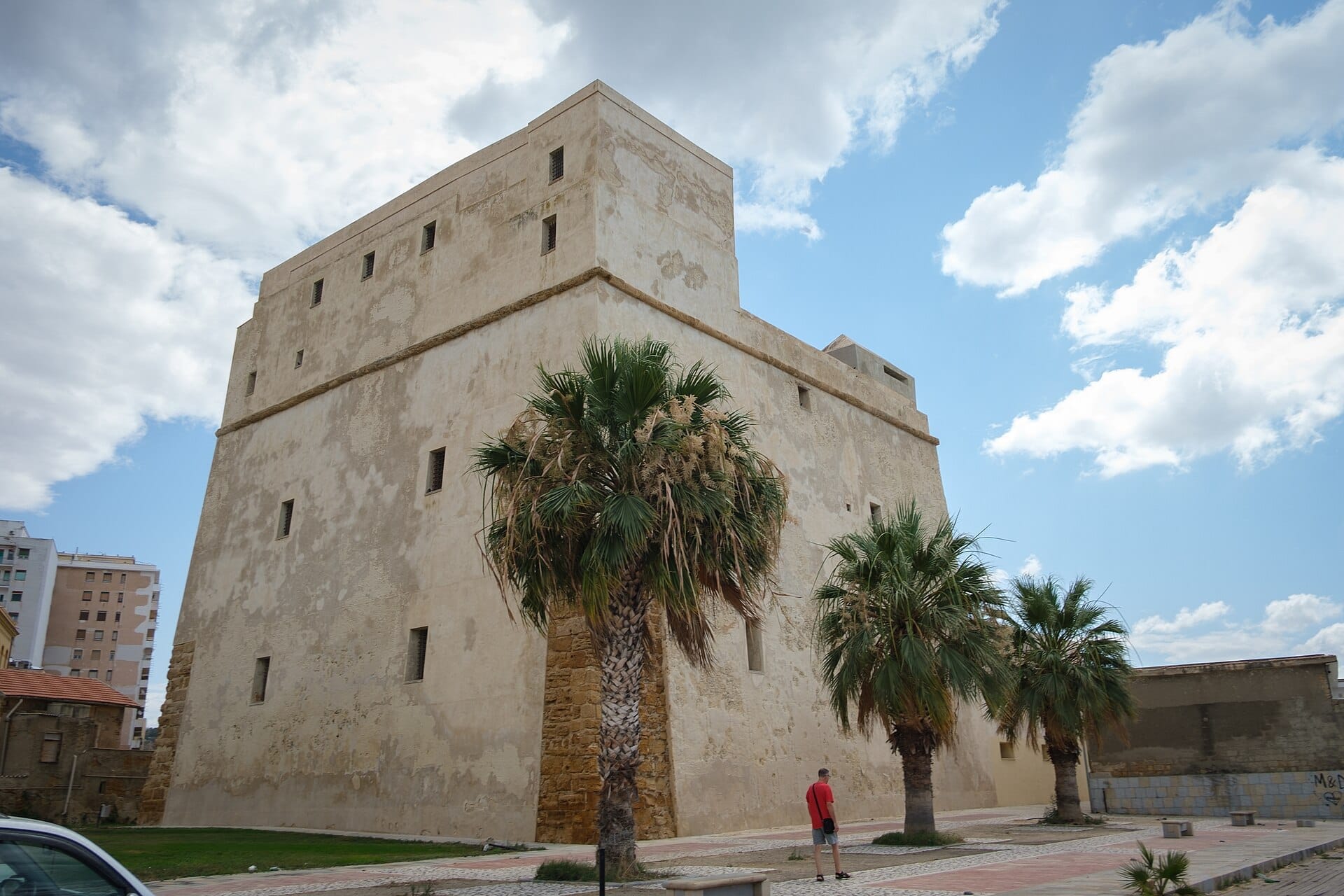
The most significant historic structure in Porto Empedocle is the Torre del Caricatore di Girgenti, better known as the Carlo V Tower. It was originally commissioned by Emperor Charles V in the 16th century, built to guard the harbour and protect grain reserves being loaded onto ships bound for the Spanish Empire. The tower later served as a prison, and today functions as a cultural venue.
Inside, visitors can find a Sala delle Armi (Hall of Arms) and a permanent exhibition of sculpture by local artist Giuseppe Agnello. The tower is compact, and a visit takes no more than 30 to 40 minutes, but its position at the harbour entrance makes it visually prominent whether you enter from the water or arrive by road. Note that opening hours and any admission fee for exhibitions are managed locally and should be confirmed on arrival or by contacting the town directly.
💡 Local tip
For the best view of the Carlo V Tower and the working harbour, walk to the far end of the main pier in the late afternoon when the light comes from the west. Ferry traffic tends to be heaviest in the evening hours before overnight departures.
The Seafront and the Feel of the Place
The Via Marina and the seafront promenade are where Porto Empedocle's daily rhythm is most readable. Early morning brings the strongest sensory contrast: fishing boats returning with the night's catch, the sound of ropes against cleats, the particular briny smell that only active fishing harbours have. By mid-morning, the activity shifts to the ferry terminal, where queues form for Lampedusa and Linosa crossings.
Midday is quiet. The sun in summer is intense and direct, and the white and ochre facades reflect it back with force. Most locals have retreated indoors or to shaded bars, and the waterfront takes on a bleached, almost cinematic stillness. This is not the best hour to explore on foot in July or August, but it does produce dramatic photographs of the harbour against a hard blue sky.
Late afternoon and early evening are the most comfortable time for a walk along the seafront. Temperature drops noticeably after 5 pm, the light turns warm and lateral, and the town comes back to life. Families, older residents on evening passeggiate, and travellers waiting for overnight ferries all share the promenade. The bars along Via Roma fill up, serving arancini, local olives, and cold drinks alongside coffee.
Using Porto Empedocle as a Ferry Gateway
The practical significance of Porto Empedocle for many travellers is as the departure point for the Pelagie Islands. Ferries to Lampedusa (home to one of the Mediterranean's most celebrated beaches, Spiaggia dei Conigli) and to the small volcanic island of Linosa depart from here year-round, operated by Siremar and Traghetti delle Isole. Crossing times to Lampedusa are roughly 9–10 hours on the standard overnight ferry, making a 9 pm departure practical for an early morning arrival.
If you are catching an overnight ferry, arriving in Porto Empedocle in the late afternoon gives you enough time to walk the town, eat dinner, and board without rushing. There is no need to book a hotel here specifically for a ferry connection. The terminal itself is straightforward and functional, but it is not a modern cruise-style facility: bring everything you need for the crossing. Ferry schedules and ticket availability vary by season and should be booked in advance, particularly in summer.
⚠️ What to skip
Summer crossings to Lampedusa fill quickly. Book ferry tickets well in advance through Siremar or Traghetti delle Isole if travelling between June and September. Walk-up availability cannot be relied on during peak season.
Getting There and Getting Around
Porto Empedocle is accessible from Agrigento by regional bus (Licata Srl operates the route) in around 15 to 20 minutes, or by taxi in roughly 15 minutes. If you are driving, parking near the seafront is generally possible, though spaces close to the ferry terminal fill up on departure days.
Most visitors combine Porto Empedocle with a visit to Agrigento and the Valley of the Temples. The two are close enough to manage in a single day, particularly if you are travelling by car. From Agrigento, you can spend the morning at the temples and the afternoon in Porto Empedocle before a ferry departure or the drive onward. For full context on organising this combination, the best Greek ruins in Sicily guide covers site priorities and logistics in detail.
The town itself is small enough to walk entirely. There are no internal buses required. Flat shoes are adequate for the seafront and main streets; the town is broadly level along the waterfront, though some side streets inland involve short slopes.
Honest Assessment: Who This Is For and Who Should Skip It
Porto Empedocle is not for travellers seeking polished monuments or curated sightseeing. It has one historic structure of real note, a compelling literary connection, and an authentic port atmosphere. If that combination interests you, even a two-hour visit adds genuine texture to an Agrigento itinerary.
If you are on a tight itinerary and have already committed significant time to the Valley of the Temples or are planning to visit Scala dei Turchi nearby, Porto Empedocle can reasonably be skipped unless you are taking a ferry. It is not the kind of place that rewards a dedicated visit on its own merit alone. Travellers looking for beach experiences or archaeological depth will find better returns elsewhere along the Agrigento coast.
Families with children will find limited dedicated activities, though the harbour area is visually engaging for kids interested in boats and ships. The evening ferry activity in particular can hold a child's attention.
Insider Tips
- If you are waiting for a late ferry, eat at one of the trattorias on or just off Via Roma rather than relying on harbour facilities. Local fish pasta dishes (pasta con le sarde, spaghetti ai ricci) are typically better value and quality here than closer to the terminal.
- The Carlo V Tower looks best from the water side. If a ferry or boat excursion passes the harbour mouth, you get the full view of its original defensive position — from the landward side it reads as just another building on the quay.
- Camilleri readers: a small amount of Vigata geography-hunting is possible with a paperback in hand. The descriptions of the harbour, the questura, and the evening passeggiata are drawn closely from real Porto Empedocle streets.
- Avoid the immediate area around the ferry terminal for dinner on peak summer nights — it gets crowded and service is rushed. Walk five minutes inland for the same food at a noticeably calmer pace.
- Bus timetables between Agrigento and Porto Empedocle are less frequent in the evening. If you plan to return to Agrigento after sunset, confirm the last departure time or arrange a taxi in advance.
Who Is Porto Empedocle For?
- Travellers catching ferries to Lampedusa (Pelagie Islands) — this is the departure point
- Fans of Andrea Camilleri and the Inspector Montalbano series
- Visitors who want to see an authentic, working Sicilian port town away from tourist infrastructure
- Agrigento day-trippers looking to extend their afternoon before heading on
- Travellers interested in Spanish-era coastal fortifications and the Carlo V Tower
Nearby Attractions
Other things to see while in Agrigento:
- Eraclea Minoa
Eraclea Minoa is an ancient Greek archaeological site perched above the chalk-white cliffs of Capo Bianco on Sicily's southern coast. Founded in the mid-6th century BCE, it offers a remarkably peaceful alternative to the crowded Valley of the Temples, with a small Roman theatre, excavated residential quarters, and sweeping views over the Mediterranean.
- Scala dei Turchi
Scala dei Turchi is a natural marl cliff on Sicily's southern coast, carved by wind and waves into broad white terraces that cascade toward a clear Mediterranean sea. Located between Realmonte and Porto Empedocle in the province of Agrigento, it is one of the most visually striking geological formations in Italy. Direct access to the cliff has been restricted for safety and conservation reasons, and current regulations and access conditions should be checked in advance.
- Temple of Concordia
The Temple of Concordia in Agrigento is one of the most complete ancient Greek temples surviving anywhere in the world. Built around 430 BC in the Doric order and later converted into a Christian church, it stands above the Valley of the Temples with views stretching to the Mediterranean. This guide covers what to expect, when to go, and how to get the most from your visit.
- Temple of Juno
Built around 450–440 BCE and still standing on its rocky ridge above the Sicilian coastline, the Temple of Juno is one of the best-preserved Greek temples in the ancient world. Part of the UNESCO-listed Valley of the Temples complex near Agrigento, it rewards visitors who time their arrival for late afternoon, when the honey-colored limestone turns gold against a darkening Mediterranean sky.