Temple of Juno, Agrigento: A Complete Visitor Guide to Sicily's Hilltop Greek Temple
Built around 450–440 BCE and still standing on its rocky ridge above the Sicilian coastline, the Temple of Juno is one of the best-preserved Greek temples in the ancient world. Part of the UNESCO-listed Valley of the Temples complex near Agrigento, it rewards visitors who time their arrival for late afternoon, when the honey-colored limestone turns gold against a darkening Mediterranean sky.
Quick Facts
- Location
- Valle dei Templi, Agrigento, Sicily, Italy
- Getting There
- Agrigento Centrale train station (approx. 3 km); local buses serve the Valle dei Templi entrance. By car, follow signs to Parco Valle dei Templi from the SS640.
- Time Needed
- 1–1.5 hours for the temple and immediate ridge; 3–4 hours if visiting the full Valle dei Templi park
- Cost
- Included in Valle dei Templi park ticket (standard admission €14; reduced €7 for EU 18–25). Verify on CoopCulture before visiting
- Best for
- Ancient history enthusiasts, architecture lovers, sunset photographers, and travelers on a Sicily archaeology itinerary
- Official website
- www.parcovaldeitempli.it
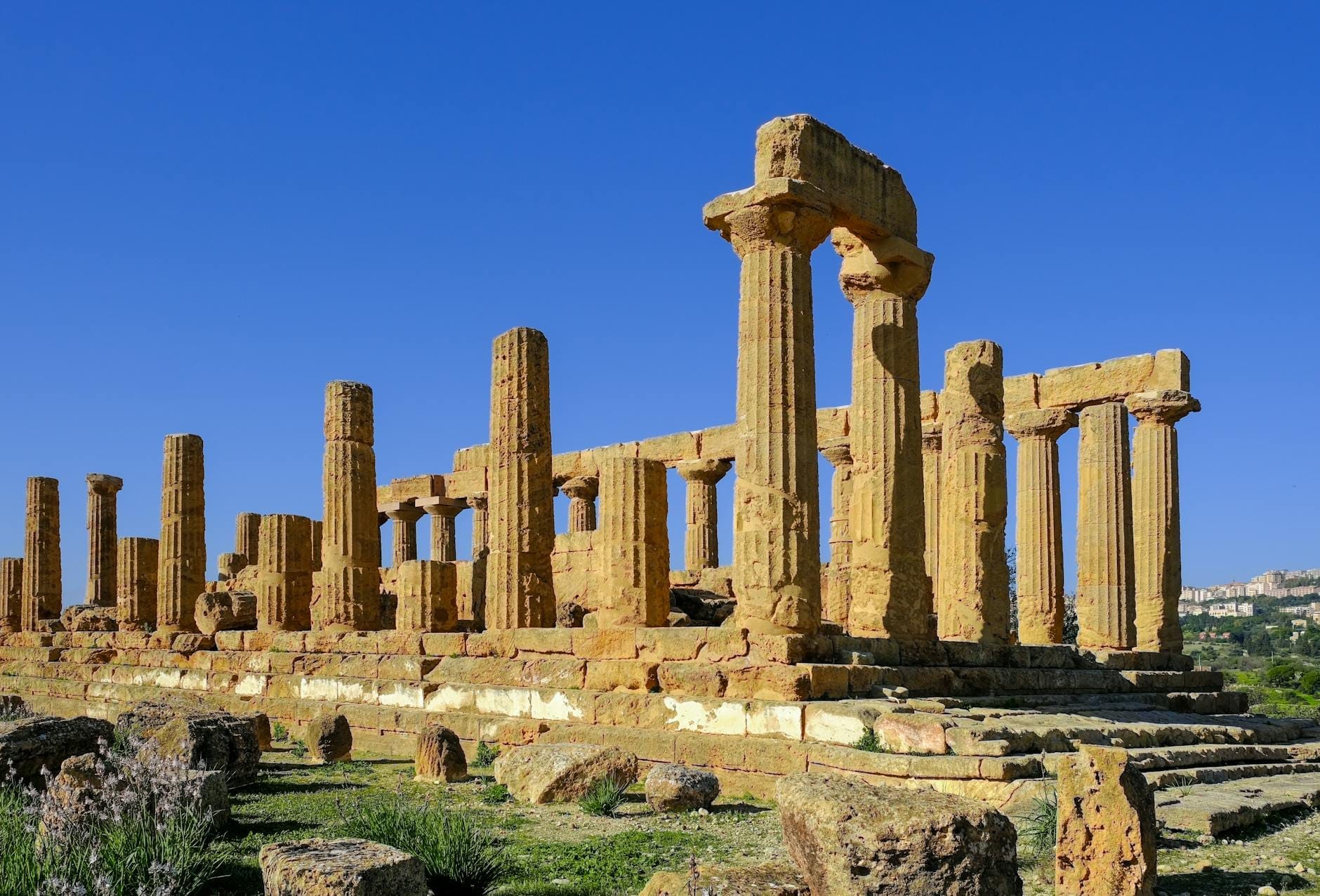
What Is the Temple of Juno?
The Temple of Juno — known officially in Italian as the Tempio di Giunone and also referred to as the Temple of Hera or Temple D within the Valle dei Templi complex — is a Doric Greek temple constructed around 450–440 BCE on the eastern end of a long limestone ridge south of modern Agrigento. It is one of the most intact Greek temples surviving anywhere in the Mediterranean world, and for many visitors it is the single most atmospheric structure in the entire Valle dei Templi archaeological park.
The attribution to Juno (the Roman equivalent of the Greek Hera) is a scholarly convention that took hold during the Renaissance and has never been conclusively verified. Ancient sources suggest it may have been dedicated to Hera Lacinia, a patron goddess associated with marriage and fertility, which would explain its prominent hilltop position at the easternmost tip of the sacred ridge. Whatever the original dedication, the temple's placement was clearly deliberate: it stands at the highest accessible point of the ridge, visible for miles from the sea and from the surrounding valley.
ℹ️ Good to know
The Temple of Juno is part of the Valle dei Templi archaeological park, a UNESCO World Heritage Site. You cannot visit the temple independently — you enter through the park's ticketing system. Check parcovaldeitempli.it for current opening hours and prices before your visit, as both change seasonally.
The Architecture: What You're Actually Looking At
The temple is a peripteral Doric structure, meaning it is surrounded on all four sides by a single row of columns. The original colonnade counted six columns on each short end and thirteen along each long side — a standard 6x13 Doric arrangement that follows the proportions common to mid-5th century BCE Sicilian Greek temples. The overall footprint measures approximately 38 by 17 meters. Today, 25 of the original columns remain standing, most along the north and south flanks, and several have been partially or fully restored using original fragments found on site.
Stand close to the base and look up at the column drums: you can see where individual sections were stacked and cemented with iron clamps over centuries of repair. The capitals are classically plain Doric, without the scrolled decoration of Ionic or the acanthus leaves of Corinthian. The entablature above — the horizontal band of stone bridging the columns — shows signs of fire damage, a reminder that the temple was attacked and burned, possibly during the Carthaginian assault on Akragas in 406 BCE. Charred patches on some of the stone are visible to a careful eye, especially on the southern flank.
The stone itself is a local golden limestone called calcarenite, quarried from the same ridge on which the city of Akragas was built. Millennia of weathering have given it a warm amber tone that intensifies dramatically in late afternoon sun. Morning light is flatter and better for inspecting architectural details; late afternoon is when the temple is most visually striking.
Tickets & tours
Hand-picked options from our booking partner. Prices are indicative; availability and final rates are confirmed when you complete your booking.
Etna South Upper Craters Guided Excursion from Taormina
From 42 €Instant confirmationFree cancellationTaormina private tour with an expert guide
From 42 €Instant confirmationFree cancellationIsola Bella boat tour and snorkeling
From 55 €Instant confirmationFree cancellationSyracuse and Ortygia Island guided tour from Taormina
From 65 €Instant confirmationFree cancellation
Historical Context: Akragas and Its Sacred Ridge
The temple was built during the golden age of Akragas, the ancient Greek city founded around 580 BCE by settlers from Gela. By the 5th century BCE, Akragas had grown into one of the wealthiest cities in the Greek world, rivaling Athens and Syracuse in both population and architectural ambition. The philosopher Empedocles, who proposed the theory that all matter consists of four elements, was a native of Akragas. The Greek poet Pindar described it as "the most beautiful city of mortals." You can learn more about the regional context in our guide to the Valley of the Temples, which covers the full arc of temples along the ridge.
The sacred ridge — the Via Sacra — was lined with temples facing east toward the rising sun, a consistent orientation across Greek religious architecture. The Temple of Juno anchors the eastern end of this procession. When the city was sacked by Carthaginian forces in 406 BCE, the temple was damaged but not destroyed. It survived well enough to be partially restored in Roman times, which accounts for some of the brick repair work visible within the cella, the inner chamber of the temple. The cella walls no longer stand to their full height, but sections of the interior walls survive.
For travelers who want to place the Temple of Juno within the broader sweep of Sicily's ancient Greek heritage, our guide to the best Greek ruins in Sicily compares it to sites at Selinunte, Segesta, and Syracuse.
How the Experience Changes by Time of Day
Early morning, before 9 a.m., the ridge is quiet and the air still carries the scent of wild fennel and almond blossom in spring. The light comes from the east and hits the temple's main facade directly, revealing the texture of the stone columns in sharp relief. Birdsong is audible, and the views south toward the coast and the almond groves below the ridge are clearest before the haze builds. This is the best time for travelers who want a contemplative experience without crowds and without the midday heat.
By mid-morning, tour groups arrive in volume. The path along the ridge from the main ticket entrance to the Temple of Juno is well-paved but exposed, with limited shade. Between June and August, midday temperatures at the site regularly exceed 35°C, and there are no food or water vendors close to the temple itself. Anyone visiting in summer should carry water and plan to reach the Temple of Juno before 11 a.m. or after 4 p.m.
⚠️ What to skip
The ridge path to the Temple of Juno is fully exposed to the sun with almost no shade. In July and August, midday visits can be genuinely uncomfortable and potentially risky in extreme heat. Bring at least 1.5 liters of water per person, wear a hat, and apply sunscreen before entering the park.
Late afternoon, from around 4 p.m. onward, brings the most photogenic light: the sun moves to the west and the temple glows from behind, casting long shadows across the ridge. The crowd thins as tour buses depart, and the sky over the southern coast deepens to a rich blue. If the park's evening hours permit it — the Valle dei Templi sometimes offers extended or nocturnal opening in summer — staying until sunset is genuinely worth the extra time. The silhouette of the columns against an orange and purple sky is one of the more striking sights in Sicily.
Practical Walkthrough: Getting There and Getting Around
Agrigento is connected to Palermo and Catania by regional trains operated by Trenitalia. From Agrigento Centrale station, local buses (such as lines 1, 2/, and 3 operated by TUA) and taxis serve the Valle dei Templi park entrances at Porta Aurea and Porta V. By car, the site is well signposted from the main roads approaching Agrigento, and there is a car park near the main entrance. The walk from the car park to the Temple of Juno, at the far eastern end of the ridge, takes approximately 20–25 minutes at a moderate pace on a paved path.
The Valle dei Templi park is large, and the Temple of Juno sits at the opposite end of the main ridge from the more famous Temple of Concordia. Most visitors start at one end and walk to the other. The eastern zone, which includes the Temple of Juno, also contains the necropolis area and the remains of an early Christian chapel built inside the ruins of an older temple. This section of the park is typically less crowded than the area around the Temple of Concordia.
Agrigento is reachable as a day trip from both Palermo and Catania, though it is a long day from either city. Our day trips from Palermo guide covers the logistics in detail, including train timings and what else to see in the province.
Accessibility
The main path along the ridge is paved and relatively level, making portions of the Valle dei Templi accessible to visitors with reduced mobility. However, the terrain immediately around the Temple of Juno includes uneven ground and ancient stone surfaces. Visitors using wheelchairs or with significant mobility limitations should check directly with the park before visiting, as accessible routes and facilities may vary.
Photography Tips
The Temple of Juno photographs best from the south side, with the columns framed against the sky and the coastal plain below. A wide-angle lens captures the full colonnade; a medium telephoto compresses the columns and emphasizes the fire-darkened stone. Late afternoon sun from the west creates dramatic side-lighting on the column drums. In spring, the almond trees and wildflowers below the ridge add color to foreground shots taken from the lower path.
At sunrise, the east-facing facade catches the first direct light before any other structure on the ridge. Getting to the park at opening time in spring or autumn, when sunrise is not unreasonably early, is worth the effort for photographers. Tripods are generally permitted in the open-air areas of the park, but verify this with park staff, as rules are periodically updated.
Who Should Reconsider This Visit
The Temple of Juno is not for visitors who want a quick, air-conditioned cultural tick. The walk along the ridge is exposed and can be exhausting in summer heat. If ancient Greek ruins leave you cold and you are visiting Agrigento primarily for the coastal scenery, you may find the Scala dei Turchi — a dramatic white limestone cliff 15 kilometers to the west — more immediately rewarding.
Families with very young children should be prepared for an extended walk with limited shade and no playgrounds. The path is stroller-friendly in parts but the site is not a children's attraction in the conventional sense. Teens with a genuine interest in ancient history, however, tend to respond well to the scale and age of the structure.
Insider Tips
- Walk the ridge from east to west, starting at the Temple of Juno and finishing at the Temple of Concordia. This puts you at the less-crowded end first and means you arrive at the most photographed temple when the afternoon light is at its best.
- Look carefully at the north wall of the cella interior: you can see distinct patches of Roman brick repair work set into the original Greek masonry. This layering of civilizations in a single wall is one of the more quietly remarkable things at the site.
- In spring (March to May), the area around the ridge is covered in almond blossom and wild fennel. The scent on a morning with light wind is extraordinary, and the white blossom against the golden stone makes for striking photographs.
- The park sometimes offers evening openings with illuminated temples during summer months. These are worth booking in advance — the Temple of Juno lit against a dark sky looks very different from its daytime presence and crowds are minimal.
- The on-site museum (Museo Archeologico Regionale Pietro Griffo), a short drive from the temple area, holds the original sculptures and artifacts found during excavation. Seeing these before visiting the temple gives the ruins considerably more context.
Who Is Temple of Juno For?
- Ancient history and archaeology enthusiasts who want to understand Greek Sicily in depth
- Architecture and photography travelers, particularly those seeking dramatic late-afternoon or sunrise light
- Travelers following a Sicily archaeology itinerary connecting Agrigento with Selinunte, Segesta, and Syracuse
- Couples and small groups who prefer a less-visited end of the ridge with more space and atmosphere
- Travelers with a full day in Agrigento who want to combine the temple with the town's Norman cathedral and the coastal scenery nearby
Nearby Attractions
Other things to see while in Agrigento:
- Eraclea Minoa
Eraclea Minoa is an ancient Greek archaeological site perched above the chalk-white cliffs of Capo Bianco on Sicily's southern coast. Founded in the mid-6th century BCE, it offers a remarkably peaceful alternative to the crowded Valley of the Temples, with a small Roman theatre, excavated residential quarters, and sweeping views over the Mediterranean.
- Porto Empedocle
Porto Empedocle is a working port town 8 km from Agrigento, serving as the main departure point for ferries to Lampedusa and Linosa. Beyond its practical role, it carries a layered history and a literary legacy that rewards a few hours of curious exploration.
- Scala dei Turchi
Scala dei Turchi is a natural marl cliff on Sicily's southern coast, carved by wind and waves into broad white terraces that cascade toward a clear Mediterranean sea. Located between Realmonte and Porto Empedocle in the province of Agrigento, it is one of the most visually striking geological formations in Italy. Direct access to the cliff has been restricted for safety and conservation reasons, and current regulations and access conditions should be checked in advance.
- Temple of Concordia
The Temple of Concordia in Agrigento is one of the most complete ancient Greek temples surviving anywhere in the world. Built around 430 BC in the Doric order and later converted into a Christian church, it stands above the Valley of the Temples with views stretching to the Mediterranean. This guide covers what to expect, when to go, and how to get the most from your visit.