Arno River Walk (Lungarni): Florence's Most Rewarding Free Stroll
The Lungarni are the named embankment streets running along both banks of the Arno River through central Florence. Free to walk at any hour, they offer the city's best unmediated views of the Ponte Vecchio, the surrounding hills, and the slow rhythm of Florentine daily life. No ticket, no queue, no reservation required.
Quick Facts
- Location
- Both banks of the Arno River, Centro Storico, Florence. Central starting point: Ponte Vecchio (Ponte Vecchio, 50125 Firenze)
- Getting There
- 15–20 minute walk from Santa Maria Novella train station toward Piazza della Signoria, then south to the river
- Time Needed
- 45 minutes for a focused stretch; 2–3 hours for a full both-banks loop with stops
- Cost
- Free. Optional Arno boat cruises run approximately €20–€30 per person (verify with operators)
- Best for
- Sunset walks, photography, escaping museum crowds, slow mornings with locals
What the Lungarni Actually Are
The Arno River Walk is not a single path with a ticket booth and a map at the entrance. It is a sequence of named embankment streets, the Lungarni di Firenze, that trace both banks of the Arno River through the heart of the city. Streets like Lungarno degli Acciaiuoli, Lungarno Corsini, Lungarno Guicciardini, and Lungarno Vespucci have their own distinct characters, but together they form what amounts to Florence's living room: the place where the city comes to breathe, argue, run, court, and simply exist outside of its museum walls.
The Arno itself runs approximately 241 kilometers from its source at Monte Falterona in the Casentino highlands all the way to the Tyrrhenian Sea at Marina di Pisa. Through Florence, it is broad and slow-moving, olive-green in summer and swollen brown after autumn rains. The embankments that line it here developed over centuries as the city's primary riverside roads, and the result is an urban waterfront that rewards slow walking in a way that few of Florence's indoor attractions can match.
ℹ️ Good to know
The Lungarni are public streets open 24 hours a day, year-round, with no admission fee. There is no official entry point: you can join the walk from any of the bridges that cross the Arno, or simply turn south from the historic centre and follow the river.
How the Walk Changes Through the Day
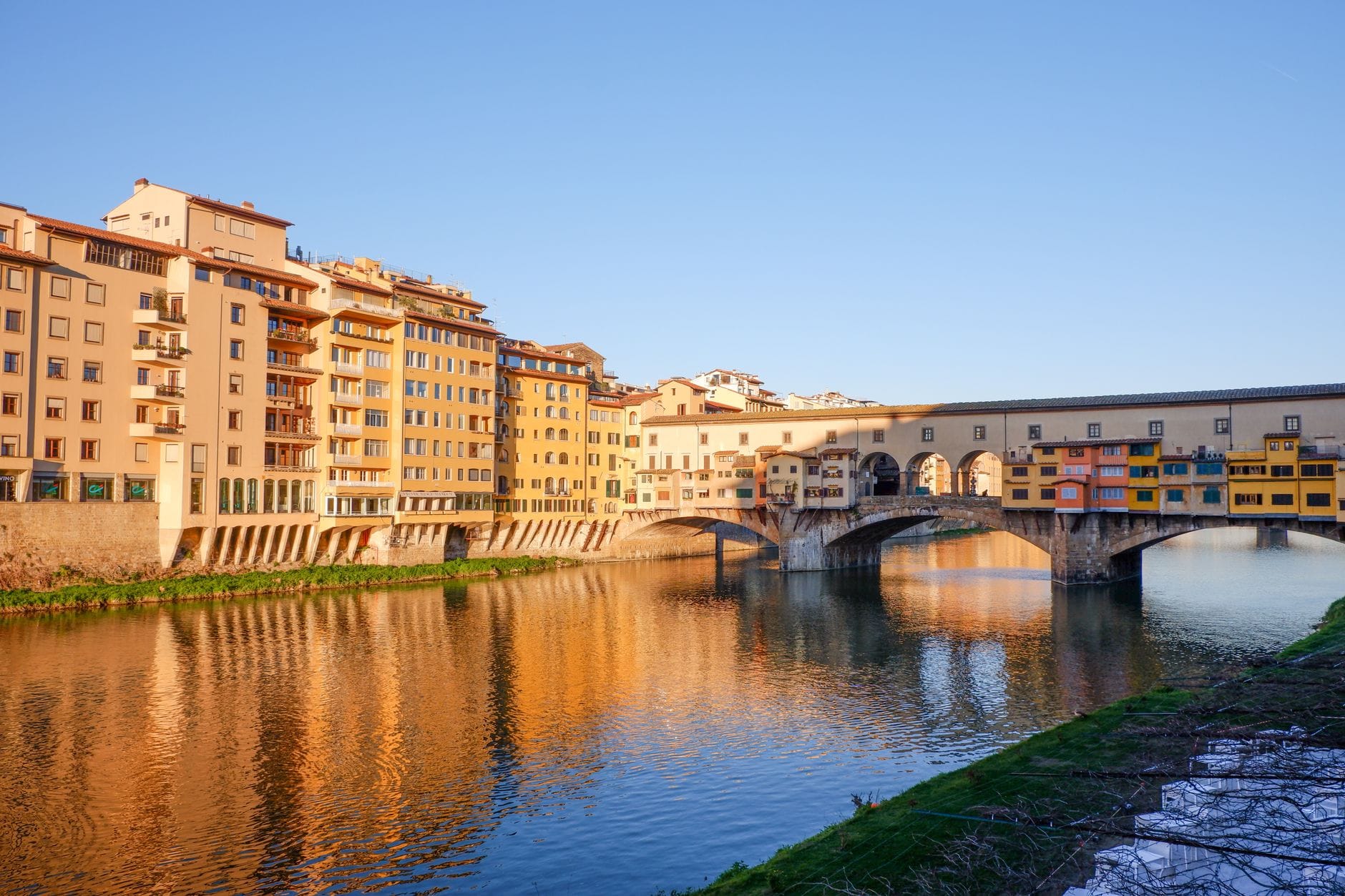
Early morning is the most underrated time to be here. Before 8am, the Lungarni belong almost entirely to locals: dog walkers, cyclists crossing toward the Oltrarno, delivery drivers, and the occasional jogger moving against the current of traffic. The light at this hour is low and angled, cutting across the stone parapets and catching the reflections off the water. The Ponte Vecchio, normally a shoulder-to-shoulder corridor of tourists by mid-morning, looks from the embankment like something out of a 15th-century painting rather than a postcard.
By late morning, the character shifts. Tour groups filter toward the river from the direction of the Uffizi and the Piazza della Signoria, and the pavements on the north bank grow more congested near the central bridges. This is not necessarily a reason to avoid the walk, but it does mean that the south bank (Oltrarno side) offers noticeably more breathing room during peak hours, particularly along Lungarno Guicciardini heading west away from the Ponte Vecchio.
Sunset draws a different crowd again. From around an hour before dusk, Florentines of all ages occupy every available section of parapet wall, sitting with aperitivo drinks or simply watching the sky turn over the hills. The western stretches of the Lungarni, particularly around Lungarno Corsini and Lungarno Vespucci, give views of the sun dropping behind the Oltrarno hills that are some of the finest in the city and require no admission fee, no timed entry, and no advance booking.
Tickets & tours
Live prices and dates from our booking partner. If you book, we may earn a commission at no extra cost to you.
Florence Sunset Gondola Tour on the Arno River
From 79 €Instant confirmationFree cancellationElectric golf cart experience along Arno River with audioguide
From 0 €Instant confirmationFree cancellationThe best of Florence walking tour
From 25 €Instant confirmationFree cancellationBest of Renaissance and Medieval Florence walking tour
From 20 €Instant confirmationFree cancellation
The Route: A Practical Walkthrough
Most visitors arrive at the Lungarni from the direction of the Ponte Vecchio, which makes it the natural starting point. From Ponte Vecchio, you have an immediate choice: cross to the Oltrarno side or stay on the north bank. Both directions offer strong stretches, and the most complete experience involves crossing at one bridge and returning on the other.
Walking east along the north bank from Ponte Vecchio takes you toward theMuseo Galileoand, further on, toward the Santa Croce neighborhood. The river views here look back west toward the Ponte Vecchio and frame it in a way that photographs rarely capture adequately. Walking west from Ponte Vecchio on the north bank, you move along Lungarno degli Acciaiuoli and Lungarno Corsini, passing handsome 16th- and 17th-century palazzo facades before the streets open out toward the Parco delle Cascine in the far west.
The south bank (Oltrarno side) is slightly quieter and in many ways more interesting for the details. From the southern end of Ponte Vecchio, Lungarno Guicciardini heads west past the entrance streets that lead up toward thePitti Palace and the Boboli Gardens. The buildings here lean against the hillside, and the streets narrow in a way that keeps the crowds thin. Continue west along Lungarno Soderini and you eventually reach the San Frediano area, one of the more low-key residential stretches of the Oltrarno.
💡 Local tip
For the most direct route from the train station: exit Santa Maria Novella, walk south through Piazza della Repubblica toward the Duomo, then continue to Piazza della Signoria and follow the signs to the river. The whole walk takes about 15–20 minutes at a comfortable pace.
What You're Actually Looking At: Bridges and Buildings
The Ponte Vecchio, Florence's only bridge to survive World War II intact, dominates the central stretch of the Lungarni visually. Its overhanging shops, originally occupied by butchers before the Medici ordered them replaced by goldsmiths in the late 16th century, give it a profile unlike any other bridge in Italy. From the embankment, you can see the enclosed Vasari Corridor running along the top of the eastern side, the private elevated passageway that once allowed the Medici to move between the Palazzo Vecchio and Pitti Palace without descending to street level.
Looking at the skyline from the embankments, several landmarks orient you within the city. The dome of the Cathedral of Santa Maria del Fiore appears behind the rooftops to the north, and from the right angles along the Lungarni, the profile of Brunelleschi's cupola lines up against the hills of Fiesole in a composition that has been painted and photographed for centuries. For the best elevated views over the whole scene,Piazzale Michelangelosits directly above the south bank and can be reached by a steep but manageable climb from Lungarno Serristori.
The buildings lining the north bank Lungarni include some of Florence's most significant private palaces, many of which are not open to the public but whose street facades reward careful attention. The rusticated stonework, the deeply set windows, and the ironwork lanterns are details that register differently here than they do in the cramped side streets of the historic centre, precisely because the open width of the river gives you room to step back and see them whole.
Photography, Weather, and Seasonal Conditions
For photography, the golden hours are reliable: the low morning light from the east catches the bridge arches and the water surface in a way that makes even a phone camera produce striking results. Sunset from the western Lungarni, particularly around the Ponte alla Carraia looking east, can produce intense orange and pink skies above the dome and the bell towers. The reflection on the Arno at this time is clearest when the wind is low, which is more common in spring and early autumn than in summer when afternoon thermal breezes stir the surface.
Weather matters significantly here. In July and August, the stone parapets and paved embankments absorb and radiate heat in a way that makes a midday walk genuinely uncomfortable. There is almost no shade on the central Lungarni. Spring (April to June) and early autumn (September to October) are the most pleasant seasons for the walk, with mild temperatures and clearer air. In October and November, the Arno can rise considerably after heavy rains; in historic flood events, notably 1966, the river famously inundated the city. Modern flood management systems have reduced that risk, but the river's power at high water is still visible and worth observing from the bridges.
⚠️ What to skip
In high summer, avoid the central Lungarni between noon and 3pm. The embankments offer almost no shade, and the heat reflected off the stone surfaces makes the walk significantly more draining than it appears. Bring water.
Practical Details: Accessibility, Nearby Stops, and Honest Limitations
The Lungarni are paved city streets and, along the main central stretches, generally manageable for wheelchair users and pushchairs. The surface is largely flat beside the river, which is one of the few genuinely level routes through the otherwise uneven topography of the historic centre. However, individual sections include cobblestones, and access to the lower riverbank levels (where they exist) typically requires descending stairs. Some of the older bridges have steps or narrow footpaths. If mobility is a concern, the north bank between the Ponte Vecchio and Ponte Santa Trinita offers the most consistently even surface.
The Lungarni work particularly well as a connecting route rather than a destination in isolation. They pass within easy walking distance of some of the city's key attractions: theUffizi Gallerysits directly on the north bank at Piazzale degli Uffizi, thePonte Vecchiois the walk's central landmark, and the streets leading south from the embankment take you into theOltrarnoneighborhood with its artisan workshops and quieter piazzas.
It is worth being honest about what the walk is not. It is not a groomed riverside park with benches, water fountains at regular intervals, or landscaped greenery. It is a working urban street that happens to run alongside one of Italy's most significant rivers. Traffic (mostly light, but present) shares the road on most stretches. The visual quality is high, but the comfort infrastructure is minimal. Travelers expecting a manicured promenade in the style of a purpose-built waterfront development will need to adjust their expectations.
For those who want more structure around their riverside time,guided walking tours of Florenceoften incorporate stretches of the Lungarni as part of a broader route through the historic centre, which can add historical depth to what you are seeing.
Insider Tips
- The best unobstructed photograph of the Ponte Vecchio from the river level is taken from the Ponte Santa Trinita, the bridge immediately to the west. Stand on its eastern parapet at golden hour and the Ponte Vecchio lines up perfectly against the hillside behind it.
- The lower riverbank ledges accessible at some points near Ponte alle Grazie are popular with young Florentines on warm evenings. They offer a water-level perspective on the city that the road-level Lungarni cannot provide, but require stepping down unrailed stairs.
- If the Lungarni are too crowded for your taste, the Borgo San Jacopo and Via dei Bardi streets on the Oltrarno side run parallel to Lungarno Guicciardini just one block back and carry a fraction of the foot traffic while still giving periodic river glimpses.
- Arno boat cruises operate from the city's embankments (prices typically around €15–€25; verify current operators and schedules on arrival). An hour on the water gives a completely different read of the Lungarni architecture and is particularly worthwhile at dusk.
- The stretch of Lungarno Serristori east of Ponte alle Grazie, heading toward San Niccolò, is one of the quietest sections of the entire walk and gives clear views back toward the dome with almost none of the tourist density of the central embankments.
Who Is Arno River Walk (Lungarni) For?
- Travelers who want Florence views without queuing for or paying entry to anything
- Early risers and late walkers who want to experience the city at its least crowded
- Photographers looking for wide-angle compositions of the Ponte Vecchio and the Duomo skyline
- Visitors using the walk as a practical, scenic connector between the historic centre and the Oltrarno
- Families with pushchairs who need a reliably flat route through the city centre
Nearby Attractions
Other things to see while in Centro Storico (Historic Center):
- Brunelleschi's Dome Climb
The climb inside Brunelleschi's Dome is one of the most physically rewarding experiences in Florence. 463 steps through narrow brick passages deliver you to a panoramic terrace above the city's rooftops, with views that no other vantage point in the historic centre can match. Here is everything a traveler needs to plan it well.
- Florence Baptistery
The Florence Baptistery, officially the Battistero di San Giovanni, is one of the oldest and most significant religious buildings in Italy. Standing directly in front of Florence Cathedral, it is famous for Ghiberti's gilded bronze 'Gates of Paradise' and a breathtaking interior ceiling covered in Byzantine mosaics. This guide covers what to expect, when to visit, and how to make the most of your time here.
- Florence Cathedral (Duomo di Firenze)
The Cattedrale Metropolitana di Santa Maria del Fiore is the geographic and spiritual heart of Florence. Free to enter, extraordinary to stand inside, and far more layered than its famous exterior suggests. Here is everything you need to plan a worthwhile visit.
- Florence Wine Windows (Buchette del Vino)
Scattered across Florence's historic center, the Buchette del Vino are tiny stone-framed wine hatches built into Renaissance palazzo walls in the 16th century. Free to explore, still active at select venues, and one of the city's most quietly fascinating street-level details.
Planning a trip? Discover personalized activities with the Nomado app.