Florence Wine Windows (Buchette del Vino): A Complete Visitor Guide
Scattered across Florence's historic center, the Buchette del Vino are tiny stone-framed wine hatches built into Renaissance palazzo walls in the 16th century. Free to explore, still active at select venues, and one of the city's most quietly fascinating street-level details.
Quick Facts
- Location
- Throughout Centro Storico, Florence — with notable clusters in the Santo Spirito district and streets in the historic center such as Via delle Belle Donne and Via Santo Spirito
- Getting There
- Walk from Santa Maria Novella station (10–15 min) or any central Florence hotel; no dedicated transit needed
- Time Needed
- 30–90 minutes to walk a self-guided route between active windows; longer if you stop for drinks
- Cost
- Free to view; drinks at active windows are paid per glass and vary by venue
- Best for
- History enthusiasts, casual walkers, and anyone who wants a genuinely local Florence experience
- Official website
- buchettedelvino.org/home%20eng/home%20page-2.html
What Are the Florence Wine Windows?
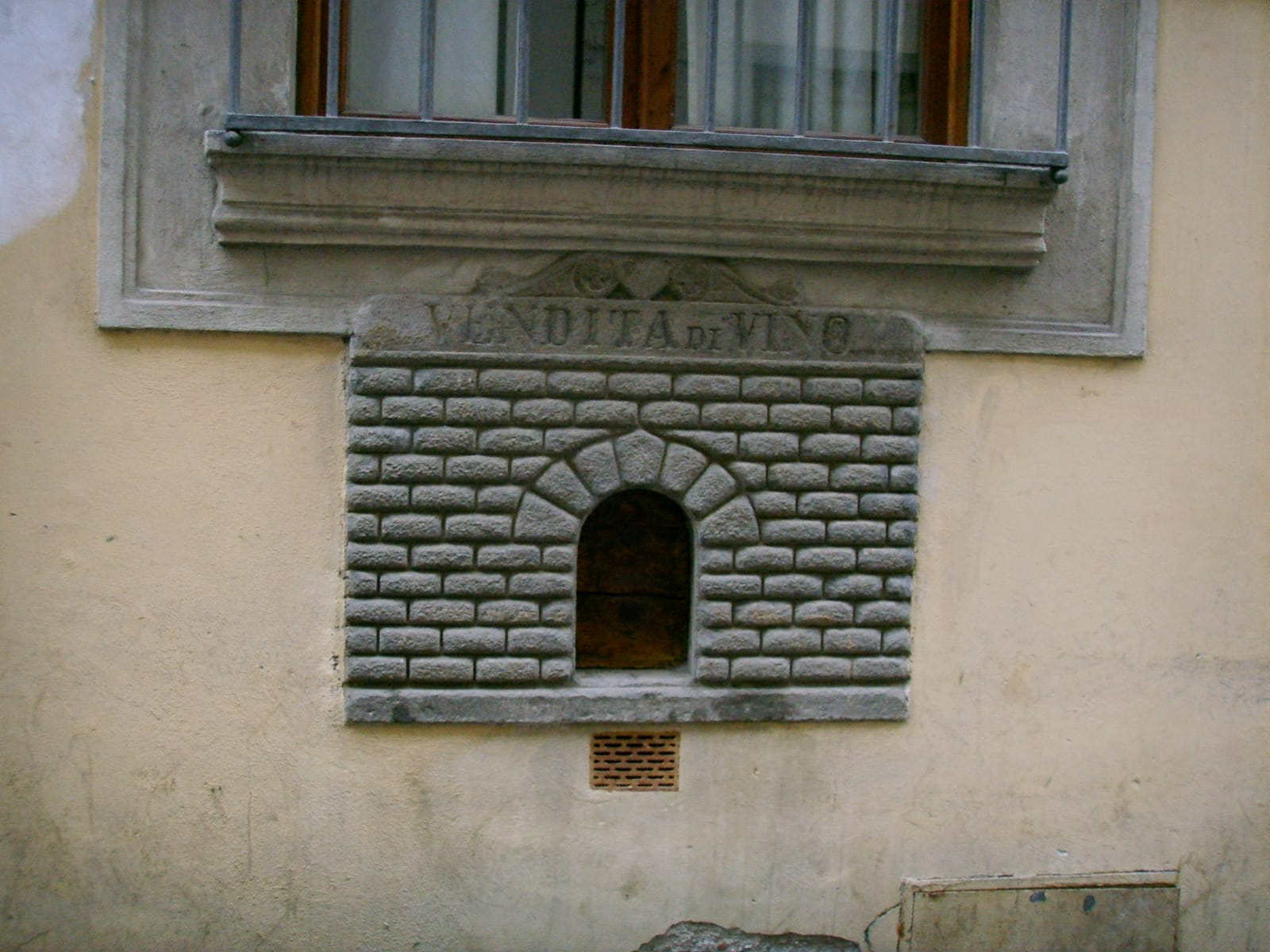
The Buchette del Vino, or Florence Wine Windows, are small stone-framed openings cut into the ground-floor walls of Renaissance-era palazzi across the city's historic center. Each one is roughly the height and width of a standard wine bottle, finished with a shallow stone arch and closed by a hinged wooden door or iron shutter. They look, at first glance, like architectural oddities or decorative flourishes. They are neither. They are functional remnants of a five-century-old retail system.
Modern surveys catalogued by the Buchette del Vino Association count around 180 wine windows still identifiable across Florence, in varying states of preservation. Some have been walled up, some are purely decorative, and a meaningful number are once again active, dispensing wine and other drinks to customers on the street.
ℹ️ Good to know
The Buchette del Vino Association maintains the most complete record of window locations in Florence. Their website lists catalogued examples by street address, which is useful before planning a self-guided walk.
A History Carved in Stone: Origins and Purpose
The wine windows date to the late 16th and early 17th centuries, emerging under Medici rule in Tuscany. Aristocratic families who owned vineyard estates in the surrounding hills faced a commercial problem: how to sell surplus wine in the city without paying full market taxes or operating an open tavern. The buchette offered an elegant solution. Families cut small hatches into the walls of their urban palazzi, allowing servants to pass out flasks or glasses directly to buyers on the pavement. Money exchanged hands, the empty vessel was returned through the same hole, and the transaction was complete. No entry, no tavern license, minimal tax exposure.
The names attached to many of these windows read like a roll call of Renaissance Florence's most powerful families: Antinori, Frescobaldi, Corsini. The Palazzo Antinori on Piazza degli Antinori, for example, still belongs to the wine dynasty of the same name. That continuity between ancient trading families and modern Tuscan wine production is one of the more remarkable threads you can trace while walking the streets of theCentro Storico.
The windows fell largely out of use through the 19th and 20th centuries as wine retail moved into shops and restaurants. Then, unexpectedly, the Covid-19 pandemic brought them back. In 2020, several Florentine bars and cafes reopened their wine windows as a contactless way to serve drinks to customers outside. The story attracted international attention, and the revival has continued, with a small but growing number of venues now using their buchette as a genuine point of service.
Tickets & tours
Live prices and dates from our booking partner. If you book, we may earn a commission at no extra cost to you.
Wine windows, legends and secret corners of Florence evening tour
From 35 €Instant confirmationFree cancellationChianti tour with two wine tastings from Florence
From 46 €Instant confirmationFree cancellationHomemade pasta and dessert cooking class in Florence's historic center
From 58 €Instant confirmationFree cancellationFlorence ancient market visit and cooking class with lunch
From 79 €Instant confirmationFree cancellation
What You Actually See on the Street
Up close, each wine window rewards careful looking. The stonework around the opening is typically pietra serena, the blue-grey sandstone that dominates Florentine interiors and exteriors alike. The frames are carved with simple molding; some carry an engraved plaque above the arch indicating traditional service hours, such as 9:00 to 14:00 and 17:00 to 20:00. These plaques reflect how the windows operated historically, not current schedules, but they add a layer of texture that a photograph rarely conveys.
The wooden shutters on active windows are small and solid, painted or weathered to dark tones. When a window is operating, you will likely hear the shutter click open before you see it. A hand appears, passes a glass or a small carafe, and withdraws. There is something genuinely medieval about the exchange, even when the drink being served is a Negroni.
At inactive windows, the door is simply latched shut. Many of these are easy to miss if you are not actively looking at wall level rather than at eye height. Children often spot them before adults do, precisely because they are scaled to a child's natural field of vision.
Planning Your Self-Guided Wine Window Walk
There is no official wine window tour route, which is both a limitation and a pleasure. The highest concentration of windows falls in the streets around Piazza degli Strozzi, Via delle Belle Donne, Via Santo Spirito, and the palazzi lining the routes between the Duomo and the Arno. A loose loop connecting these areas on foot takes 30 to 60 minutes at a comfortable pace, though stopping for a drink at an active window will naturally extend that.
The Buchette del Vino Association's online map is the most reliable starting point for planning. Cross-referencing this with a walk along theArno River walkmakes for a logical combination: you can pick up several windows en route between the Ponte Vecchio area and the Palazzo Strozzi neighbourhood, covering both riverfront and interior streets without significant backtracking.
💡 Local tip
Download or screenshot the Buchette del Vino Association's window map before heading out. Mobile data in narrow streets can be unreliable, and having an offline reference saves frustration.
If you are exploring the area aroundPalazzo Strozzi, note that several catalogued windows are within a few minutes' walk of the palazzo's exterior. The Strozzi family were among the noble dynasties associated with direct wine sales in the Renaissance period, which makes the pairing historically fitting rather than merely convenient.
Best Time to Visit and How Crowds Behave
Because the wine windows are embedded in ordinary street facades rather than enclosed in a site, there is no meaningful concept of crowds at the windows themselves. You might find a short queue of two or three people at an active window during early evening aperitivo hour, typically from around 18:00 onward, but this is part of the appeal rather than an inconvenience.
The best time to walk a window route is late afternoon, roughly 16:00 to 19:00. Light in the Centro Storico at this hour falls at a low angle that catches the carved stonework clearly, which matters for photography. The streets are active enough to feel alive but not so congested that you are constantly stopping to let tourist groups pass. Summer midday heat in Florence often climbs into the low to mid‑30s Celsius; the wine window walk requires sustained outdoor movement, so avoiding the hours between 12:00 and 15:00 in July and August is genuinely advisable.
Spring and early autumn remain the most comfortable seasons for any extended walk in Florence's historic center. For a broader perspective on seasonal timing, the guide to thebest time to visit Florencecovers temperature patterns and crowd cycles in detail.
Photography and Practical Details
Wine windows photograph best in natural light with the surrounding wall included for scale. Without a reference object, the hatch looks ambiguously sized in an image. Placing a hand near the opening or shooting from slightly below eye level emphasizes both the small scale and the architectural framing. A wide-angle lens is unnecessary; a standard smartphone camera works well in afternoon light.
Active windows are located on public streets and can be photographed freely. However, some are set into the walls of private palazzi with inhabited upper floors; it is worth being mindful of this. Shooting from the pavement at the window itself involves no access or permission issues.
Wear comfortable walking shoes. The pavements in the Centro Storico are predominantly cobblestone or irregular stone slabs, which can be slippery after rain. Accessibility for wheelchair users varies considerably by street: some lanes near the windows are narrow with uneven surfaces and no dropped kerbs. There is no centralized accessibility accommodation for the wine windows as a network, and conditions depend entirely on the specific street and any associated venue's entrance.
Honest Assessment: What This Is and Isn't
The Buchette del Vino are not a conventional attraction. There is no entrance, no exhibition, no commentary track, and no guarantee of an 'experience' in the packaged sense. If you walk the route expecting a curated museum-style encounter, you will likely find it underwhelming. Most windows are simply closed doors in walls, distinguished from ordinary architectural features only by their shape and placement.
What the wine windows offer instead is a particular kind of attentiveness: the practice of looking at a city's surfaces carefully and noticing what history has left at street level. For travelers who find that rewarding, the buchette are among the most quietly compelling things in Florence. For those who need an active programme or visible spectacle, they are better treated as a bonus detail during a walk to somewhere else.
Travelers who enjoy this kind of slow urban observation tend to get a great deal from Florence's less-announced details more broadly. The guide tohidden gems in Florencecovers comparable discoveries across the city, several of which sit close to wine window clusters.
Insider Tips
- Not all active windows are well-publicized: some operate only in the evening and have no external signage beyond the window itself. If you see a recently painted shutter or a small handwritten menu card tucked beside a buchetta, it is almost certainly active. Knock lightly.
- The window associated with the Palazzo Antinori area is one of the most historically significant given the Antinori family's centuries-long connection to Tuscan wine. The Cantinetta Antinori restaurant occupies the ground floor of the palazzo; check locally whether their window is active before your visit.
- Buying a drink through an active window means you drink standing on the pavement. Bring a sense of ease about this: it is the authentic format, not a workaround. The glass or cup is typically collected back through the hatch when you are done.
- Some wine windows have engraved plaques that are only legible in raking light. If you visit in flat overcast conditions, the carved lettering can be almost invisible. A small torch or your phone's flashlight makes the inscriptions readable.
- The Buchette del Vino Association periodically updates its catalogue as new windows are identified or restored. Checking their website shortly before a visit will flag any newly active locations you might otherwise miss.
Who Is Florence Wine Windows (Buchette del Vino) For?
- History and architecture enthusiasts who enjoy reading a city through its physical details
- Wine lovers looking for a drink with genuine historic context rather than a themed bar setting
- Slow travelers who prefer self-guided exploration over organized tours
- Photographers seeking unusual, low-traffic street-level subjects
- Families with older children interested in Florence's social and economic history
Nearby Attractions
Other things to see while in Centro Storico (Historic Center):
- Arno River Walk (Lungarni)
The Lungarni are the named embankment streets running along both banks of the Arno River through central Florence. Free to walk at any hour, they offer the city's best unmediated views of the Ponte Vecchio, the surrounding hills, and the slow rhythm of Florentine daily life. No ticket, no queue, no reservation required.
- Brunelleschi's Dome Climb
The climb inside Brunelleschi's Dome is one of the most physically rewarding experiences in Florence. 463 steps through narrow brick passages deliver you to a panoramic terrace above the city's rooftops, with views that no other vantage point in the historic centre can match. Here is everything a traveler needs to plan it well.
- Florence Baptistery
The Florence Baptistery, officially the Battistero di San Giovanni, is one of the oldest and most significant religious buildings in Italy. Standing directly in front of Florence Cathedral, it is famous for Ghiberti's gilded bronze 'Gates of Paradise' and a breathtaking interior ceiling covered in Byzantine mosaics. This guide covers what to expect, when to visit, and how to make the most of your time here.
- Florence Cathedral (Duomo di Firenze)
The Cattedrale Metropolitana di Santa Maria del Fiore is the geographic and spiritual heart of Florence. Free to enter, extraordinary to stand inside, and far more layered than its famous exterior suggests. Here is everything you need to plan a worthwhile visit.
Planning a trip? Discover personalized activities with the Nomado app.