Palazzo Strozzi: Florence's Renaissance Palace Turned World-Class Exhibition Space
Palazzo Strozzi is one of Florence's most striking architectural achievements and its most ambitious contemporary art venue. Built between 1489 and 1538eum circuit. in the heart of the historic centre now hosts internationally acclaimed exhibitions that draw visitors well beyond the usual museum circuit.
Quick Facts
- Location
- Piazza Strozzi, 50123 Florence (Centro Storico)
- Getting There
- 6-minute walk from Santa Maria Novella station via Via degli Strozzi; nearest tram stops are Alamanni – Stazione and Valfonda – Stazione
- Time Needed
- 1.5 to 2.5 hours depending on exhibition size
- Cost
- Paid admission; price varies by exhibition. Check the official site before visiting
- Best for
- Contemporary art lovers, architecture admirers, rainy-day culture seekers
- Official website
- www.palazzostrozzi.org/en
What Palazzo Strozzi Actually Is
Palazzo Strozzi is not a traditional Florentine museum in the sense of permanent collections. It operates as a high-profile exhibition space managed by the Fondazione Palazzo Strozzi, staging major temporary shows that rotate throughout the year. This is the place where you come to see a Ai Weiwei retrospective or a deep survey of Baroque masters, not to stand in front of a single famous painting on a fixed wall. If you are hoping for a permanent display, this is not it. If you want Florence's most culturally current venue housed in one of its most impressive Renaissance shells, this is exactly it.
The building sits at the centre of a tight triangle of streets betweenFlorence's historic core, bounded by Piazza Strozzi, Via Strozzi, and Via Tornabuoni. Its position is deliberate: Filippo Strozzi the Elder commissioned the palace specifically to outshine the Medici in scale and ambition, placing it on one of the city's most trafficked commercial axes. That power play still registers today. The building commands its piazza in a way few structures in Florence do.
💡 Local tip
Check the Fondazione Palazzo Strozzi website before visiting to confirm which exhibition is running and whether tickets require advance booking. The palace closes between major exhibitions and ticket prices change with each show.
The Architecture: What You See Before You Go Inside
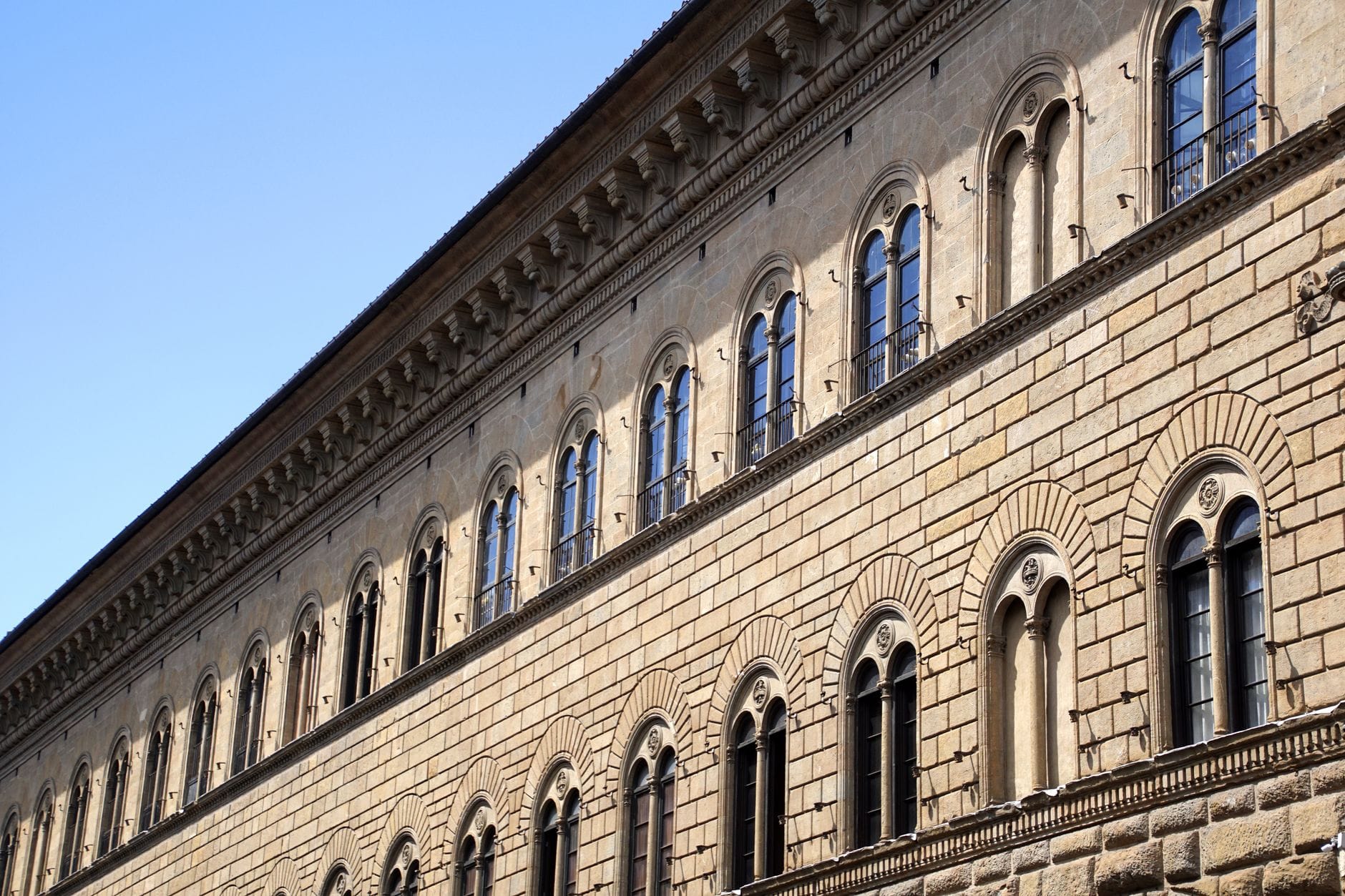
Construction of Palazzo Strozzi began in 1489 and was not completed until 1538entine Renaissance palace design: a massive rusticated stone facade with three almost identical levels, each separated by a strong horizontal cornice. The rustication is roughest at the base and gradually smooths toward the top, a technique that gives the building a sense of upward lightness despite its enormous bulk. The result is one of the purest examples of Florentine Renaissance palace design: a massive rusticated stone facade with three almost identical levels, each separated by a strong horizontal cornice. The rustication is roughest at the base and gradually smooths toward the top, a technique that gives the building a sense of upward lightness despite its enormous bulk.
Standing in Piazza Strozzi, the scale is the first thing you registerolders and lantern rings along the facade are original Renaissance ironwork, crafted by Niccolò Grosso, known as Caparra. These functional objects, designed to hold torches and tethering rings for horses, are now among the most photographed details on the building, a reminder that Renaissance grandeur was also ordinary urban infrastructure. and occupies an entire city block. The projecting iron torch holders and lantern rings along the facade are original Renaissance ironwork, crafted by Niccolò Grosso, known as Caparra. These functional objects, designed to hold torches and tethering rings for horses, are now among the most photographed details on the building, a reminder that Renaissance grandeur was also ordinary urban infrastructure.
Morning light hits the eastern facade directly, which makes the stone texture read more clearly before 11:00. By midday, the piazza fills with people sitting on the low stone seating that rings the building, many eating lunch. The stone itself emits a faint mineral warmth on sunny days, which makes Piazza Strozzi one of the more pleasant squares in the city for a brief pause.
Tickets & tours
Live prices and dates from our booking partner. If you book, we may earn a commission at no extra cost to you.
Medici series tour in Palazzo Medici Riccardi
From 90 €Instant confirmationFree cancellationPalazzo Vecchio secret passages tour with lunch or gelato tasting
From 47 €Instant confirmationFree cancellationPalazzo Vecchio and Salone dei Cinquecento guided tour
From 65 €Instant confirmationFree cancellationBest of Renaissance and Medieval Florence walking tour
From 20 €Instant confirmationFree cancellation
The Interior Courtyard: Free to Enter
The ground-floor cortile, the internal courtyardh knowing. The courtyard follows the same rusticated stone vocabulary as the exterior but introduces a more refined arcade at ground level. The proportions are precise to the point of feeling almost mathematical: equal bays, equal arches, a rhythm that does not vary. It reads as serious rather than decorative, which fits everything known about Filippo Strozzi's ambitions. This is worth knowing. The courtyard follows the same rusticated stone vocabulary as the exterior but introduces a more refined arcade at ground level. The proportions are precise to the point of feeling almost mathematical: equal bays, equal arches, a rhythm that does not vary. It reads as serious rather than decorative, which fits everything known about Filippo Strozzi's ambitions.
The courtyard is used for large-scale installation art during major exhibitions, and sometimes the works spill out here in ways that reframe the Renaissance architecture around them. The contrast between centuries-old stone and contemporary interventions can be jarring, but it is usually intentional and handled well by the foundation's curatorial team. Even without an active exhibition, the cortile is a quiet, shaded space that most people walking past on Via Strozzi never enter.
ℹ️ Good to know
The courtyard is generally accessible for free even if you are not attending an exhibition. It is a worthwhile stop on any walking route through the centro storico, particularly on hot afternoons when the shade is welcome.
The Exhibitions: What Palazzo Strozzi Shows and Why It Matters
The Fondazione Palazzo Strozzi has built a reputation for exhibitions that would be at home in major international art museums. Shows here have covered Renaissance masters, 20th-century modernists, and living contemporary artists with equal ambition. The programming tends to be thematic rather than purely chronological, which means even visitors familiar with the subject matter often encounter new framings. For context on how this fits into Florence's broader cultural landscape, see our overview of thebest museums in Florence.
The exhibition spaces run across multiple floors of the palace and are generally well lit, with enough room between works to avoid the shoulder-to-shoulder crowding that affects Florence's permanent collections in peak season. Wall text is typically available in both Italian and English, and the quality of the translations is reliably high. Audio guides are usually available for purchase or rental at the ticket desk.
Thursday evenings, when the palace stays open until 23:00rsday, this is the session to choose. The lower ambient light outside makes the interior galleries feel more focused, and the piazza afterward has a calmer energy than at midday. If you are in the city on a Thursday, this is the session to choose. The lower ambient light outside makes the interior galleries feel more focused, and the piazza afterward has a calmer energy than at midday.
Opening Hours and Practical Details
Palazzo Strozzi is open daily from 10:00 to 20:00, with extended hours on Thursdays until 23:00. The ticket office closes one hour before the palace does, so last entry is at 19:00 on standard days and 22:00 on Thursdays. The palace does close between exhibition runs, so checking the official website before your visit is essential, not optional.
Admission prices vary by exhibition and are not fixed year-rounduse there is no permanent collection. Tickets can usually be purchased on-site at the ticket desk or through the official website in advance. During blockbuster exhibitions, queues at the door can extend into the piazza on weekend afternoons; online booking eliminates this. There is no general-entry ticket for the permanent building because there is no permanent collection. Tickets can usually be purchased on-site at the ticket desk or through the official website in advance. During blockbuster exhibitions, queues at the door can extend into the piazza on weekend afternoons; online booking eliminates this.
⚠️ What to skip
Do not show up without checking whether an exhibition is currently running. The palace closes entirely between shows, and those gaps can last several weeks. The official website at palazzostrozzi.org lists current and upcoming exhibitions with exact dates.
Getting There and What to Bring
The most direct walking route from Firenze Santa Maria Novella station della Repubblica and you arrive directly into Piazza Strozzi. The route passes through the commercial heart of the city and is almost entirely flat, which matters in Florence where hills appear unexpectedly. For broader orientation on moving around the city, the guide to covers all transport options in detail. Walk east along Via degli Strozzi from Piazza della Repubblica and you arrive directly into Piazza Strozzi. The route passes through the commercial heart of the city and is almost entirely flat, which matters in Florence where hills appear unexpectedly. For broader orientation on moving around the city, the guide togetting around Florencecovers all transport options in detail.
There is no dedicated parking adjacent to the palace; the historic centre is a Limited Traffic Zone and private cars are restricted. Visitors arriving by car should use the park-and-ride facilities on the periphery and walk or use public transport for the last leg. Cyclists will find the piazza reasonably easy to reach, and bike racks exist in the surrounding streets.
Photography policies vary by exhibition and sometimes by the terms of individual artist loan agreements. Generally, photography without flash is permitted in the courtyard and in many gallery spaces, but tripods and selfie sticks are typically banned inside. Check the signage at each exhibition entrance
Context: The Strozzi Family and Their Palace
Filippo Strozzi the Elder was one of the wealthiest bankers in 15th-century Florence, operating financial networks across Europe while navigating a complicated political relationship with the Medici family. His decision to build on this scale, in this location, was a statement about rival power. The long construction period produced a building that became the standard reference for Florentine private palace architecture. producing a building that became the standard reference for Florentine private palace architecture.
The irony is that the family never fully enjoyed what they built favour with the ruling Medici. The palace passed through various institutional uses over the centuries before the Fondazione Palazzo Strozzi established its current exhibition model. Today the building functions better as a public cultural institution than it ever did as a private residence, which is perhaps the most Renaissance outcome possible. To understand the broader Medici context that shaped this rivalry, the guide to provides useful historical grounding. His descendants continued the project but eventually fell out of favour with the ruling Medici. The palace passed through various institutional uses over the centuries before the Fondazione Palazzo Strozzi established its current exhibition model. Today the building functions better as a public cultural institution than it ever did as a private residence, which is perhaps the most Renaissance outcome possible. To understand the broader Medici context that shaped this rivalry, the guide toMichelangelo in Florenceprovides useful historical grounding.
Who Should Think Twice Before Visiting
If you have very limited time and are prioritising Florence's permanent collections, Palazzo Strozzi may not be the right call. Visitors with only a day or two who want to see the David, the Uffizi, and the Duomo complex will likely not have time to add a full temporary exhibition on top. The palace also does not offer the sweep of historical narrative that the Uffizi or the Bargello provides; it is a focused, curated experience tied to one show at a time.
Families with very young children may find the exhibition format less engaging than Florence's more object-rich museums, though the courtyard is generally accessible and spacious enough for pushchairs. For family-specific planning, the guide toFlorence with kidscovers which venues work best for different age groups.
Insider Tips
- Thursday evening visits (open until 23:00) offer the best combination of lower crowds and a relaxed atmosphere. The piazza outside is pleasant after dark, making it easy to combine with dinner nearby on Via Tornabuoni or around Piazza della Repubblica.
- The inner courtyard is worth seeing even if you skip the exhibition. Step inside off Via Strozzi any time during opening hours to see the Renaissance arcade. Step inside off Via Strozzi any time during opening hours to see the Renaissance arcade without paying admission.
- Check whether the current exhibition requires timed-entry tickets. During high-profile shows, the foundation limits visitor numbers per hour, and walk-up tickets can sell out by early afternoon on weekends.
- The original iron torch holders and lantern rings on the exterior facade are by Renaissance smith Niccolò Grosso. The original iron torch holders and lantern rings on the exterior facade are by Renaissance smith Niccolò Grosso. They are easy to overlook but are notable surviving examples of Florentine Renaissance metalwork in public view.
- The palace sits one block from Via Tornabuoni, Florence's most concentrated stretch of high-end shopping. If you are combining a cultural visit with time on that street, plan Palazzo Strozzi first while your energy is highest.
Who Is Strozzi Palace (Palazzo Strozzi) For?
- Contemporary and modern art enthusiasts who want a world-class exhibition experience in a Renaissance setting
- Architecture admirers interested in the full-scale vocabulary of Florentine Renaissance palace design
- Repeat visitors to Florence who have already covered the permanent collections and want something current
- Travellers visiting on a Thursday, when the extended evening hours make for an unhurried, crowd-light visit
- Anyone caught in bad weather looking for a serious, well-presented cultural experience in the city centre
Nearby Attractions
Other things to see while in Centro Storico (Historic Center):
- Arno River Walk (Lungarni)
The Lungarni are the named embankment streets running along both banks of the Arno River through central Florence. Free to walk at any hour, they offer the city's best unmediated views of the Ponte Vecchio, the surrounding hills, and the slow rhythm of Florentine daily life. No ticket, no queue, no reservation required.
- Brunelleschi's Dome Climb
The climb inside Brunelleschi's Dome is one of the most physically rewarding experiences in Florence. 463 steps through narrow brick passages deliver you to a panoramic terrace above the city's rooftops, with views that no other vantage point in the historic centre can match. Here is everything a traveler needs to plan it well.
- Florence Baptistery
The Florence Baptistery, officially the Battistero di San Giovanni, is one of the oldest and most significant religious buildings in Italy. Standing directly in front of Florence Cathedral, it is famous for Ghiberti's gilded bronze 'Gates of Paradise' and a breathtaking interior ceiling covered in Byzantine mosaics. This guide covers what to expect, when to visit, and how to make the most of your time here.
- Florence Cathedral (Duomo di Firenze)
The Cattedrale Metropolitana di Santa Maria del Fiore is the geographic and spiritual heart of Florence. Free to enter, extraordinary to stand inside, and far more layered than its famous exterior suggests. Here is everything you need to plan a worthwhile visit.
Planning a trip? Discover personalized activities with the Nomado app.