Florence Cathedral (Duomo di Firenze): What to See, When to Go, and Why It Still Surprises
The Cattedrale Metropolitana di Santa Maria del Fiore is the geographic and spiritual heart of Florence. Free to enter, extraordinary to stand inside, and far more layered than its famous exterior suggests. Here is everything you need to plan a worthwhile visit.
Quick Facts
- Location
- Piazza del Duomo, 50122 Florence – Centro Storico
- Getting There
- 15-minute walk from Santa Maria Novella station; no direct tram stop – arrive on foot through the historic centre
- Time Needed
- 45–90 minutes for the cathedral interior; allow a half-day if combining with the Dome climb, Baptistery, and Opera del Duomo museum
- Cost
- Free entry to the cathedral interior; dome climb and Baptistery require a combined ticket – verify current prices at duomo.firenze.it
- Best for
- First-time visitors to Florence, architecture enthusiasts, Renaissance history, and anyone curious about Brunelleschi's engineering achievement
- Official website
- duomo.firenze.it/en
Why the Duomo Still Demands Your Attention
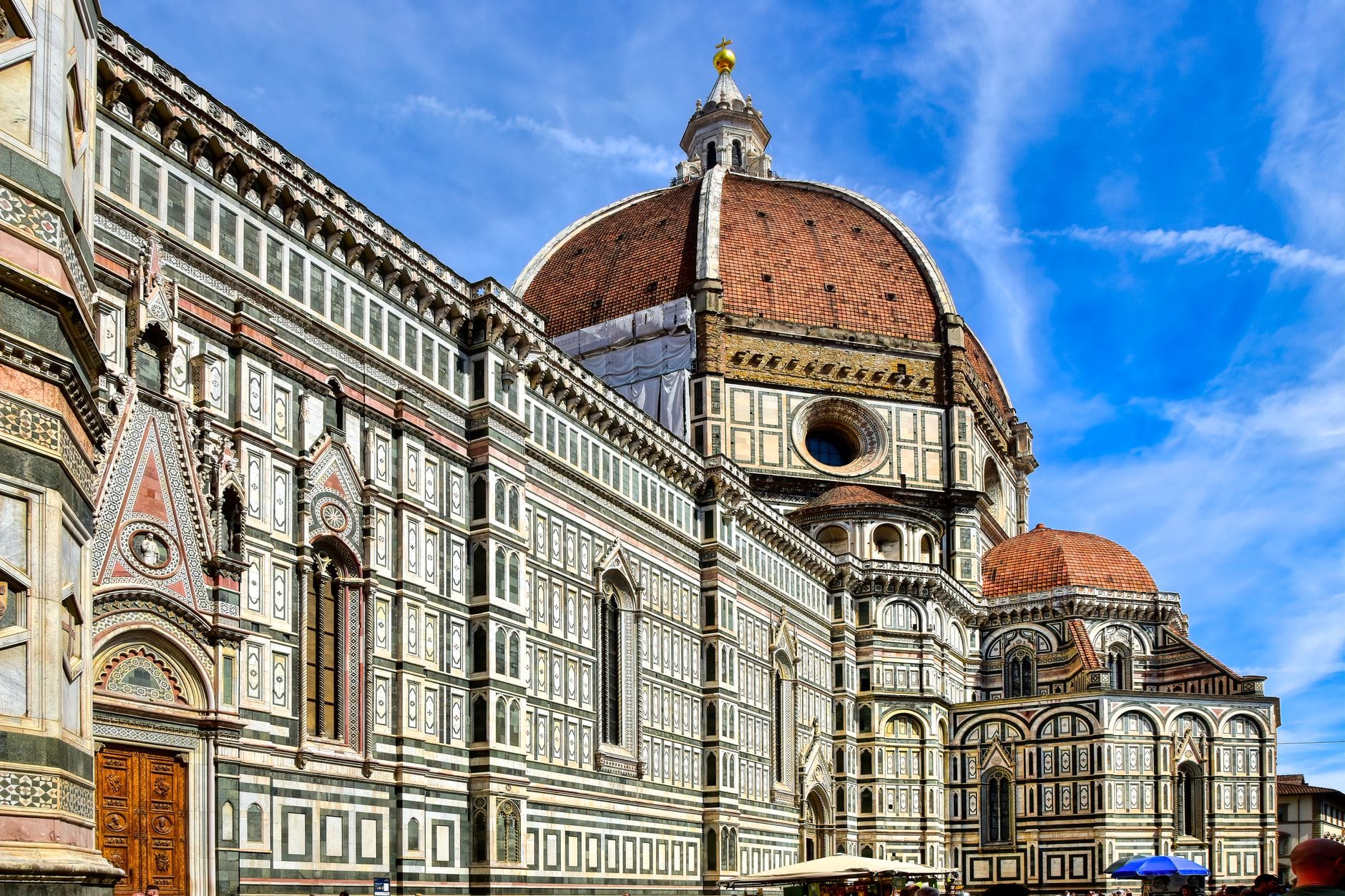
There is a moment, turning a corner in central Florence, when the Cattedrale Metropolitana di Santa Maria del Fiore simply stops you. The scale is not telegraphed from a distance the way it is in open cities. Florence's medieval street grid presses right up to the cathedral's flanks, and so the full facade arrives suddenly, like a curtain pulled back. What you see is approximately 153 metres of church clad in white, green, and pink marble from Carrara, Prato, and the Maremma, topped by a dome that has dominated the Florentine skyline since 1436.
The exterior is genuinely astonishing, but many visitors treat the Duomo as a photograph backdrop and never walk through the door. That is a significant mistake. The interior offers a wholly different experience from the jewel-box surfaces outside, and entry costs nothing.
ℹ️ Good to know
The cathedral interior is open to visitors Monday to Saturday, 10:15–15:45. It is closed to tourists on Sundays and during religious services. Dress code is enforced: covered shoulders and knees are required. Entry is free.
Inside the Cathedral: Scale, Restraint, and Frescoes
Step past the security check at the main entrance and the interior does something unexpected: it contracts emotionally even as it expands physically. The nave is vast – the building is around 90 metres wide at the transept – but the walls are relatively bare. This is not the gilded interior of St Peter's in Rome or the stained-glass kaleidoscope of Notre-Dame de Paris. The Gothic nave is cool, stone-grey, and deliberately austere compared to the exterior. Your eyes adjust slowly.
Once they do, the details accumulate. The clock on the interior facade above the entrance door is one of the oldest surviving examples of a liturgical clock in Italy, painted by Paolo Uccello in the mid-15th century. It runs counterclockwise and marks the 24-hour day in the medieval style, ending at sunset. Most visitors walk straight past it.
The fresco cycle covering the interior surface of Brunelleschi's dome is The Last Judgment, painted largely by Giorgio Vasari beginning in 1572 and completed by Federico Zuccari. It is visible from the nave floor, though a proper appreciation requires binoculars or the dome climb itself. The sheer area of painted ceiling – over 3,600 square metres – is difficult to comprehend from ground level. Two equestrian frescoes painted to resemble sculptures, one commemorating John Hawkwood by Uccello (1436) and one of Niccolò da Tolentino by Andrea del Castagno (1456), are painted on the left wall of the nave and represent early experiments in painted perspective illusionism.
💡 Local tip
Bring a small pair of pocket binoculars. The dome frescoes are best appreciated from directly beneath the crossing, and the detail is largely invisible to the naked eye from 90 metres below.
Tickets & tours
Live prices and dates from our booking partner. If you book, we may earn a commission at no extra cost to you.
A Building 140 Years in the Making
Construction of the cathedral began in 1296, when the city commissioned Arnolfo di Cambio to design a structure that would supersede all previous Florentine churches. By the time of Arnolfo's death around 1302, only the foundations and lower sections were complete. The project passed through several architects over the following century, with Francesco Talenti directing major construction phases in the mid-1300s.
The defining problem was the dome. The intended crossing was so wide – approximately 44 metres in diameter – that no Gothic centering (the wooden support scaffolding used to construct arches) could be built across it. The project stalled until Filippo Brunelleschi, a goldsmith-turned-architect with no formal training in large-scale construction, proposed an entirely new approach. He used a double-shell structure, herringbone brickwork to lock each course in place, and a series of horizontal stone rings to contain the outward thrust. Construction ran from 1420 to 1436, and the method has never been fully replicated. The cathedral was formally consecrated on March 25, 1436.
Brunelleschi's dome remains one of the great engineering achievements of European architecture. Thedome climb is a separate ticketed experience that takes you between the two shells and ultimately to the lantern, 463 steps above street level. If you are reasonably fit and not prone to claustrophobia, it is worth doing on the same visit.
The Duomo Complex: More Than One Building
The cathedral does not stand alone in the piazza. The complex includes three major structures that are best understood together. Immediately to the west of the cathedral facade stands the Baptistery of San Giovanni, an octagonal Romanesque building clad in the same white and green marble that significantly predates the cathedral. Its three pairs of bronze doors – particularly the Gates of Paradise on the north and east faces, designed by Lorenzo Ghiberti – are among the most studied works of early Renaissance sculpture in existence. What you see on site today are high-quality replicas; the originals are displayed in the Museo dell'Opera del Duomo.
The Florence Baptistery is a short walk across the piazza and merits at least 20–30 minutes separately. Its interior mosaic ceiling, completed in the 13th century, is among the finest Byzantine-influenced works in Tuscany.
Rising beside the cathedral's south flank is Giotto's Campanile, a free-standing bell tower begun by Giotto di Bondone in 1334 and completed by Francesco Talenti around 1359. The tower's hexagonal marble bas-relief panels at its base depict human arts, industries, and the planets. The climb to the top offers different sightlines across the city from the dome. For a comparison of both climbs, the dedicated page onGiotto's Campanile outlines the key differences in terms of difficulty, crowd levels, and views.
All three structures plus the dome climb are managed by the Opera di Santa Maria del Fiore. A combined ticket covers access to all paid elements of the complex; the cathedral interior itself is free. Verify the current combined ticket price directly at duomo.firenze.it before your visit, as pricing is updated periodically.
When to Visit and What to Expect at Different Hours
The piazza is crowded at almost every hour from around 9:00 onward through summer and spring. The volume peaks between 10:30 and 14:00, when large tour groups move through the square and the line for the cathedral entrance stretches toward the Campanile. If you arrive when the cathedral opens at 10:15 on a weekday, you will have perhaps 20 minutes in relative quiet before the first tour groups arrive.
Late afternoon is often calmer. The cathedral closes at 15:45, but from roughly 14:30 onward crowd pressure inside eases noticeably. Outside, the piazza takes on different qualities as afternoon light shifts across the marble surfaces. The south and east faces of the cathedral catch the best direct light in the morning; the main facade faces west and is most luminous near sunset, though the cathedral is of course closed by then. Evening in the piazza is a separate experience entirely: the crowds thin, the marble takes on a warm amber tone under the street lighting, and local residents reclaim the surrounding streets.
⚠️ What to skip
The cathedral is closed to visitors on Sundays and during all religious celebrations and special services. If you are visiting over Easter, Christmas, or on major feast days, check the official calendar at duomo.firenze.it to confirm access before building your itinerary.
Summer heat in Florence regularly reaches the mid-to-high 30s Celsius in July and August. The marble exterior radiates stored heat in the afternoon, and the piazza offers almost no shade. The interior stays noticeably cooler than the street, which is one practical argument for spending time inside rather than simply photographing the exterior and moving on. If you are visiting in summer, plan for the cathedral as a midday stop and keep the outdoor elements for morning.
Getting There and Practical Logistics
Piazza del Duomo sits at the geographic centre of the historic city. From Firenze Santa Maria Novella railway station, it is a straightforward 15-minute walk east through the pedestrianised core. There is no direct tram stop; the area is a traffic-limited zone and the most efficient approach is on foot. Taxis can drop off on streets bordering the restricted zone but cannot drive to the piazza itself.
For general orientation around the historic centre, including transport options and walking routes between major sites, the guide togetting around Florence covers the main options in practical detail.
Accessibility: visitors with mobility impairments can enter the cathedral via the Porta dei Canonici on the right side of the building. The cathedral floor is level once inside. The dome climb and Campanile are not accessible to wheelchair users due to narrow spiral staircases. Contact the Opera del Duomo directly via the official website for specific accessibility queries.
Photography is permitted inside the cathedral without flash. Tripods are generally not allowed inside the complex; selfie sticks are also typically prohibited. Bags larger than standard day-pack size may need to be checked before entry. Luggage storage is available at several points in the city, including near Santa Maria Novella station.
Honest Assessment: Is It Worth It?
For first-time visitors to Florence, the Duomo complex is the closest thing the city has to a non-negotiable stop. It is genuinely extraordinary in scale and historical significance, it is free to enter the cathedral itself, and it is central enough to work into virtually any itinerary. The surrounding complex, particularly the Museo dell'Opera del Duomo which houses Michelangelo's Pietà Bandini and the original Ghiberti door panels, arguably contains better and less-crowded art than the cathedral interior.
Repeat visitors and those primarily interested in painting rather than architecture may find their time better spent at theUffizi Gallery or the Galleria dell'Accademia. The Duomo rewards genuine curiosity about engineering and medieval urbanism more than it rewards passive sightseeing.
Those who dislike crowds and have visited Florence before might consider structuring a morning around the Baptistery interior, the Opera del Duomo museum, and the view from Giotto's Campanile rather than spending time in the cathedral nave itself. That combination offers less company and arguably more concentrated artistic content per hour.
Insider Tips
- The Museo dell'Opera del Duomo, immediately behind the cathedral's apse, is included in the combined Duomo ticket and is significantly less crowded than the cathedral or dome. It houses Donatello's Mary Magdalene and the original Ghiberti Gates of Paradise panels – do not skip it.
- For the exterior marble to photograph well without harsh shadows, aim for an overcast morning. Clear-sky direct sun creates extreme contrast on the white, green, and pink marble that is difficult to expose correctly with a phone camera.
- The cathedral's acoustic quality is remarkable when the space is relatively empty. If you arrive early in the opening window and the tour groups have not yet entered, stand beneath the dome crossing and you will understand why this space was used for major civic ceremonies as well as religious ones.
- Queue time for the dome climb can exceed an hour during peak summer days. Book a timed entry slot via the official Opera del Duomo website before your visit rather than purchasing on site.
- The piazza has restrictions on eating, sitting on steps, and certain other activities that are enforced by municipal wardens. Check current local ordinances if you plan to linger in the square, as fines apply.
Who Is Florence Cathedral (Duomo di Firenze) For?
- First-time visitors to Florence who want to understand the city's physical and historical core
- Architecture and engineering enthusiasts, particularly those interested in Renaissance structural innovation
- Visitors who want a significant free attraction in the historic centre
- Travellers combining the cathedral with the Baptistery, Campanile, and Opera del Duomo museum as a half-day complex visit
- History-focused travellers tracing the arc from medieval Gothic construction to early Renaissance design
Nearby Attractions
Other things to see while in Centro Storico (Historic Center):
- Arno River Walk (Lungarni)
The Lungarni are the named embankment streets running along both banks of the Arno River through central Florence. Free to walk at any hour, they offer the city's best unmediated views of the Ponte Vecchio, the surrounding hills, and the slow rhythm of Florentine daily life. No ticket, no queue, no reservation required.
- Brunelleschi's Dome Climb
The climb inside Brunelleschi's Dome is one of the most physically rewarding experiences in Florence. 463 steps through narrow brick passages deliver you to a panoramic terrace above the city's rooftops, with views that no other vantage point in the historic centre can match. Here is everything a traveler needs to plan it well.
- Florence Baptistery
The Florence Baptistery, officially the Battistero di San Giovanni, is one of the oldest and most significant religious buildings in Italy. Standing directly in front of Florence Cathedral, it is famous for Ghiberti's gilded bronze 'Gates of Paradise' and a breathtaking interior ceiling covered in Byzantine mosaics. This guide covers what to expect, when to visit, and how to make the most of your time here.
- Florence Wine Windows (Buchette del Vino)
Scattered across Florence's historic center, the Buchette del Vino are tiny stone-framed wine hatches built into Renaissance palazzo walls in the 16th century. Free to explore, still active at select venues, and one of the city's most quietly fascinating street-level details.
Planning a trip? Discover personalized activities with the Nomado app.