Giotto's Campanile: Florence's Bell Tower and What It's Like to Climb It
Standing 84.7 metres above Piazza del Duomo, Giotto's Campanile iserious visitors with a rare, close-level view of Brunelleschi's dome that no other viewpoint in Florence can match. The climb rewards serious visitors with a rare, close-level view of Brunelleschi's dome that no other viewpoint in Florence can match.
Quick Facts
- Location
- Piazza del Duomo, 50122 Florence (Centro Storico)
- Getting There
- Bus lines C1, C2, 14, 23 to Duomo; Tram T1 to Alamanni then a 10-minute walk
- Time Needed
- 45–75 minutes including the climb
- Cost
- Tickets via Opera del Duomo; verify current pricing at duomo.firenze.it
- Best for
- Architecture lovers, photographers, anyone who wants the Duomo dome in their frame
- Official website
- duomo.firenze.it/en/discover/giotto-s-bell-tower
What Giotto's Campanile Actually Is
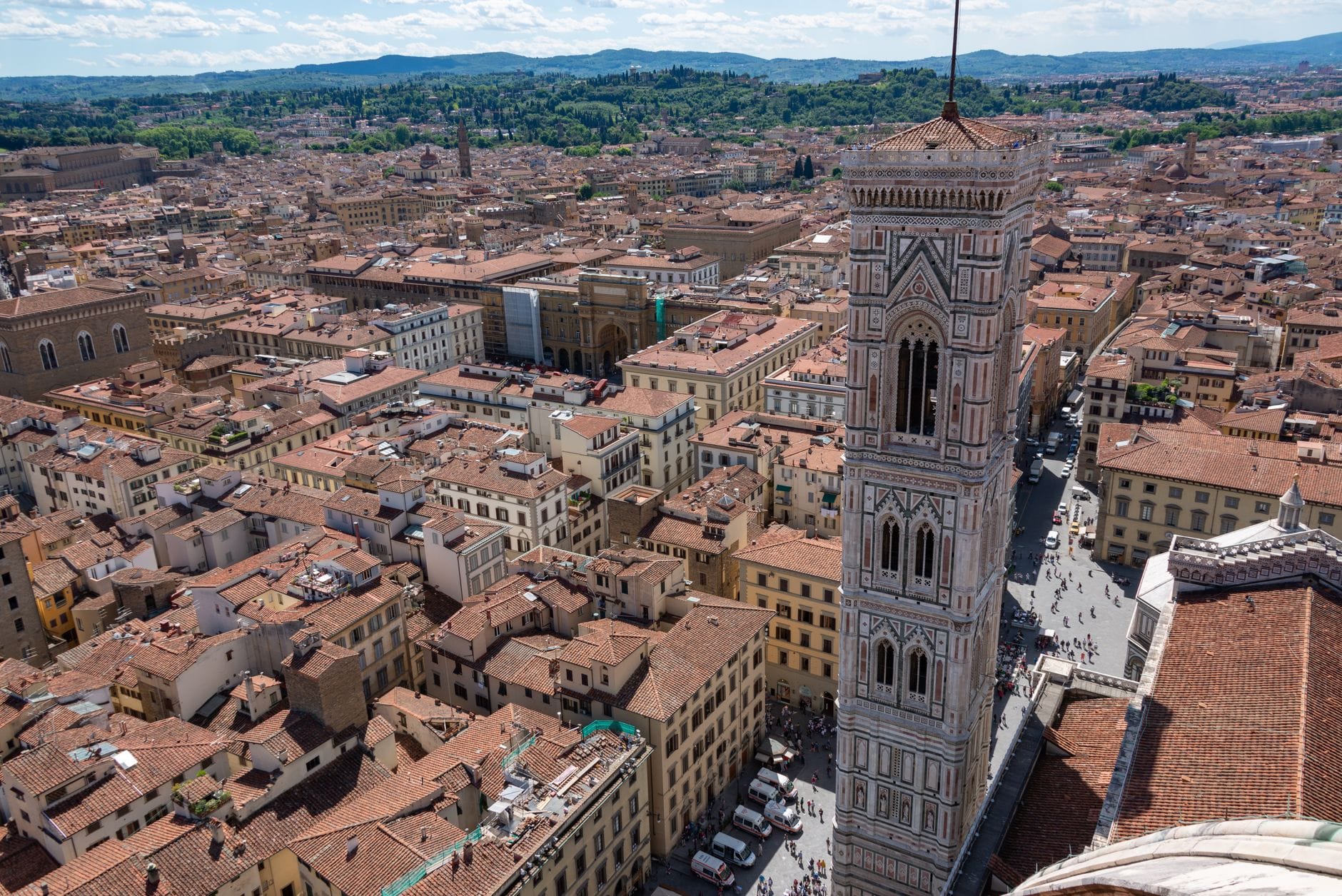
Giotto's Campanile (Campanile di Giotto) is the freestanding bell tower of Florence Cathedral, rising 84.7 metres from the marble pavement of Piazza del Duomo. It stands immediately south of the cathedral nave and west of the Baptistery, making the three structures a single architectural ensemble that has defined the skyline of central Florence for nearly seven centuries.
Unlike the Brunelleschi Dome, which most visitors treat as Florence's signature climb, the Campanile offers something genuinely different: a straight-on view of the dome itself. From the top, you are level with the drum of the dome rather than looking down from above it. This detail matters enormously for photographs and for understanding the cathedral's scale.
The tower is administered by the Opera di Santa Maria del Fiore and accessed on a time-slot ticket, either as a standalone entry or as part of a combined pass covering theFlorence Baptistery and the Museo dell'Opera del Duomo. Booking in advance is strongly recommended, especially between April and October.
💡 Local tip
Book your time slot on the Opera del Duomo website before you arrive. Walk-up tickets are sometimes available at the ticket office in Piazza del Duomo, but selling out is common during peak season, and queues can add 30–40 minutes even when tickets remain.
A Brief History: Three Architects, One Tower
Construction began in 1334 under the direction of Giotto di Bondone, then the most celebrated painter in Italy and newly appointed as Capomaestro of the cathedral works. Giotto laid out the tower's square planral facade., and established the decorative program of polychrome marble cladding in white Carrara, green Prato serpentine, and pink Maremma marble — the same palette used on the cathedral facade.
Giotto died in 1337 with the tower barely above its foundations. Andrea Pisano continued the work, completing the lower two registers of programmes of 14th-century Italy. The originals have been moved to the Museo dell'Opera del Duomo for conservation; the reliefs on the tower today are high-quality casts., which depict the arts, sciences, planets, virtues, and sacraments. These carvings are among the most important sculptural programmes of 14th-century Italy. The originals have been moved to the Museo dell'Opera del Duomo for conservation; the reliefs on the tower today are high-quality casts.
Francesco Talenti completed the towerys with their large biforate and triforate windows and crowning the structure with a projecting cornice. Talenti's decision to open up the upper storeys with progressively larger windows gives the tower its characteristic visual rhythm — solid and sculptural at the base, increasingly transparent as it rises., adding the three upper storeys with their large biforate and triforate windows and crowning the structure with a projecting cornice. Talenti's decision to open up the upper storeys with progressively larger windows gives the tower its characteristic visual rhythm — solid and sculptural at the base, increasingly transparent as it rises.
Tickets & tours
Live prices and dates from our booking partner. If you book, we may earn a commission at no extra cost to you.
Giotto's Bell Tower and Duomo of Florence Square highlights with audio app
From 0 €Instant confirmationPerfume masterclass: a sensory experience in Florence
From 70 €Instant confirmationFree cancellationFlorence cathedral complex and Brunelleschi's dome tickets
From 59 €Instant confirmationMedici series tour in Palazzo Medici Riccardi
From 90 €Instant confirmationFree cancellation
The Climb: What to Expect on the Way Up
There is no lift. There is no lift. The ascent requires 414 steps, divided across several internal flights of stairs that grow progressively narrower as you approach the summit. The stairwells are dim and enclosed, with stone walls worn smooth by centuries of use. If you are prone to claustrophobia or have mobility issues, this is important to factor in. The tower is not wheelchair accessible
At several levels, narrow windows offer framed views over the rooftops of the Centro Storico, giving you natural resting points. The temperature inside the tower stays noticeably cooler than street level in summer, which makes the climb bearable even on hot afternoons. By the time you reach the top, your legs will know about it — 414 steps at altitude is not a casual stroll.
The summit terrace is open-air and protected by iron grilles. It is relatively compact, and when busy, movement around the perimeter requires patience. Early morning slotsy visits in July and August can feel overcrowded on the terrace and uncomfortably hot., mean significantly fewer people at the top and soft, directional light that catches the dome's orange terracotta beautifully. Midday visits in July and August can feel overcrowded on the terrace and uncomfortably hot.
⚠️ What to skip
Wear rubber-soled shoes. The marble steps inside the tower are polished and can be slippery, particularly in wet weather when visitors track moisture inside. Flip-flops and leather soles are genuinely risky on the descent.
The View from the Top: What You Actually See
The view from Giotto's Campanile is one of the most technically interesting in Florence precisely because of its relationship to the dome. From Piazzale Michelangelo or the hillside viewpoints to the south, you see Florence spread below you. From the Campanile, you are inside the city, surrounded by it, looking across at Brunelleschi's engineering at close range. The dome fills a large portion of the northern view, and you can study the lantern, the white marble ribs, and the scale of the drum in a way that no postcard can convey.
To the south, the Arno River is visible as a silver ribbon cutting through the city. On clear days, the hills of Fiesole to the northeast and the Chianti ridgeline to the south are both identifiable. ThePonte Vecchioand the towers of Palazzo Vecchio anchor the view toward the historic city core. In the foreground directly below, the octagonal Baptistery roof and its bronze doors are laid out in a near-aerial perspective.
Photography note: a wide-angle lens (or the equivalent on a phone) is far more useful here than a zoom. The dome is close enough that telephoto compression flattens its depth. The iron grilles around the terrace will appear in shots unless you press the lens close to the metal — which is possible in most sections but requires some maneuvering.
When to Visit and How to Time It
The Campanile opens at 08:15. The first hour is noticeably quieter than anything from 10:00 onward, and the light at this time is low and warm, coming from the southeast and catching the dome's ribbed structure with strong shadow contrast. For photographers, this is the window worth planning around.
Late afternoon, between roughly 16:30 and 18:00, offers a second quality light period and is less crowded than the tourist peak of 11:00 to 14:00fore closing gives enough time for the climb and a comfortable period at the top. Arriving 90 minutes before closing gives enough time for the climb and a comfortable period at the top.
Seasonal timing matters. April through June and September through October are widely considered the most comfortable months to visit Florence for climate and crowd reasons. Summer (July and August) brings extreme heat and the city's highest visitor volumes. For broader planning, thebest time to visit Florenceguide covers the full seasonal breakdown.
ℹ️ Good to know
The Campanile entry is timed and ticketed separately from the Brunelleschi Dome climb. If you plan to do both on the same day, book them in adjacent time slots and allow at least 90 minutes between entries. Both can be included in the Opera del Duomo
The Marble Facade: Architecture at Ground Level
Many visitors walk past the Campanile in a hurry to reach the ticket office and miss what is one of the most instructive architectural surfaces in Italy. Before you enter, spend five minutes reading the exterior from the base upward. The lowest register, at roughly eye level, contains the surviving or replicated bas-relief hexagons attributed to Giotto and Andrea Pisano, depicting human industry and the liberal arts: the ploughman, the shepherd, the weaver, the astronomer. Above them run diamond-shaped reliefs representing the planets, virtues, and sacraments.
The polychrome marble bands transition from dense sculptural cladding at the base to the clean geometric marble inlay of the middle storeys, then to the large mullioned windows of the upper levels. This progression from opaque to transparent, from relief-heavy to smooth, is deliberate Italian Gothic design logic. The tower was meant to be read upward, just as you read the pages of a manuscript.
The facade detailing connects to the broader conversation about Florentine Gothic architecture that you will encounter at theBasilica di Santa Croce and the Basilica di Santa Maria Novella, both of which share the same appetite for polychrome marble cladding that distinguishes Florentine Gothic from its northern European counterparts.
Practical Notes: Getting There and Staying Comfortable
The Campanile is at Piazza del Duomo, 50122 Florence, in the pedestrianised heart of the Centro Storico. The area is not accessible by private car, and the nearest parking is several blocks away. Most central hotels are within a 10 to 20 minute walk. Bus lines C1 and C2 serve the area; the T1 tram's nearest stop is Alamanni (at Santa Maria Novella station), from which the Piazza del Duomo is roughly a 10-minute walk through the historic centre.
Wear layers in cooler months. The interior of the tower is cool even in spring, and the open summit terrace is exposed to wind year-round. In summer, bring water — there are no refreshment facilities inside the tower, and you will want to hydrate before and after the climb. Church dress codes do not formally apply here as they would inside the cathedral, but respectful attire is appropriate given the religious complex context.
Visitors with mobility limitations, a fear of heights, or heart or respiratory conditions should assess the 414-step climb carefully before booking. The Opera del Duomo offers free admission for a person with documented disabilities, arranged via email or at the ticket desk, but the physical climb itself has no accessible alternative.
Insider Tips
- Book the first available morning slot (08:15) to reach the summit before tour groups arrive. The difference in crowd density between 08:30 and 10:30 at the top is considerable.
- The bas-relief panels on the lower exterior are best examined before your climb, in the 10 minutes while you wait at the entrance. They are easy to overlook, but they represent some of the finest 14th-century sculptural work in the city — or high-quality casts of it.
- If you plan to visit the Museo dell'Opera del Duomo on the same trip, do so after the Campanile climb: the museum holds the original marble reliefs by Giotto and Pisano, and seeing the casts on the tower first gives the originals far more meaning.
- The northwest corner of the summit terrace gives the clearest unobstructed angle on the dome, with the Baptistery visible directly below. This is the composition most photographers are looking for, and it fills quickly on busy mornings.
- A combined Opera del Duomo pass covering multiple Duomo complex sites typically offers better value than single entries if you intend to visit more than one component. Check the current pass structure on the official Opera del Duomo website before booking individual tickets.
Who Is Giotto's Campanile For?
- Architecture and art history enthusiasts who want to study the Campanile's sculptural programme and Gothic marble facade up close
- Photographers seeking the only central Florence viewpoint that places Brunelleschi's dome in the frame at eye level
- Visitors who have already done the Brunelleschi Dome climb and want a different, complementary perspective on the city
- Travellers with a full day in the Centro Storico who want to combine the Campanile with the Baptistery and Museo dell'Opera del Duomo in a single morning
- Anyone willing to commit to 414 steps in exchange for one of the most architecturally rich views in Italy
Nearby Attractions
Other things to see while in Centro Storico (Historic Center):
- Arno River Walk (Lungarni)
The Lungarni are the named embankment streets running along both banks of the Arno River through central Florence. Free to walk at any hour, they offer the city's best unmediated views of the Ponte Vecchio, the surrounding hills, and the slow rhythm of Florentine daily life. No ticket, no queue, no reservation required.
- Brunelleschi's Dome Climb
The climb inside Brunelleschi's Dome is one of the most physically rewarding experiences in Florence. 463 steps through narrow brick passages deliver you to a panoramic terrace above the city's rooftops, with views that no other vantage point in the historic centre can match. Here is everything a traveler needs to plan it well.
- Florence Baptistery
The Florence Baptistery, officially the Battistero di San Giovanni, is one of the oldest and most significant religious buildings in Italy. Standing directly in front of Florence Cathedral, it is famous for Ghiberti's gilded bronze 'Gates of Paradise' and a breathtaking interior ceiling covered in Byzantine mosaics. This guide covers what to expect, when to visit, and how to make the most of your time here.
- Florence Cathedral (Duomo di Firenze)
The Cattedrale Metropolitana di Santa Maria del Fiore is the geographic and spiritual heart of Florence. Free to enter, extraordinary to stand inside, and far more layered than its famous exterior suggests. Here is everything you need to plan a worthwhile visit.
Planning a trip? Discover personalized activities with the Nomado app.