Basilica di Santa Croce: Florence's Pantheon of Great Italians
The Basilica di Santa Croce is one of the largest Franciscan churches in the world and the final resting place of Michelangelo, Galileo, and Machiavelli. Set on one of Florence's most atmospheric piazzas, it combines monumental Gothic architecture with extraordinary Renaissance art and nearly eight centuries of Italian history.
Quick Facts
- Location
- Piazza Santa Croce 16, Santa Croce neighborhood, Florence. Visitor entrance and ticket office on the north side in Largo Bargellini.
- Getting There
- About 10 minutes on foot east of Piazza della Signoria. City buses serve the area; no tram stop directly outside. Taxi drop-off at Piazza Santa Croce.
- Time Needed
- 1.5 to 2.5 hours for the basilica, museum, and cloister. Budget extra time to linger in the piazza.
- Cost
- Tickets available at the Largo Bargellini ticket office or online via the official site. Verify current prices before visiting, as they are subject to change.
- Best for
- History enthusiasts, art lovers, architecture fans, and anyone interested in the Italian Renaissance and its key figures.
- Official website
- www.santacroceopera.it/en/organise-your-visit
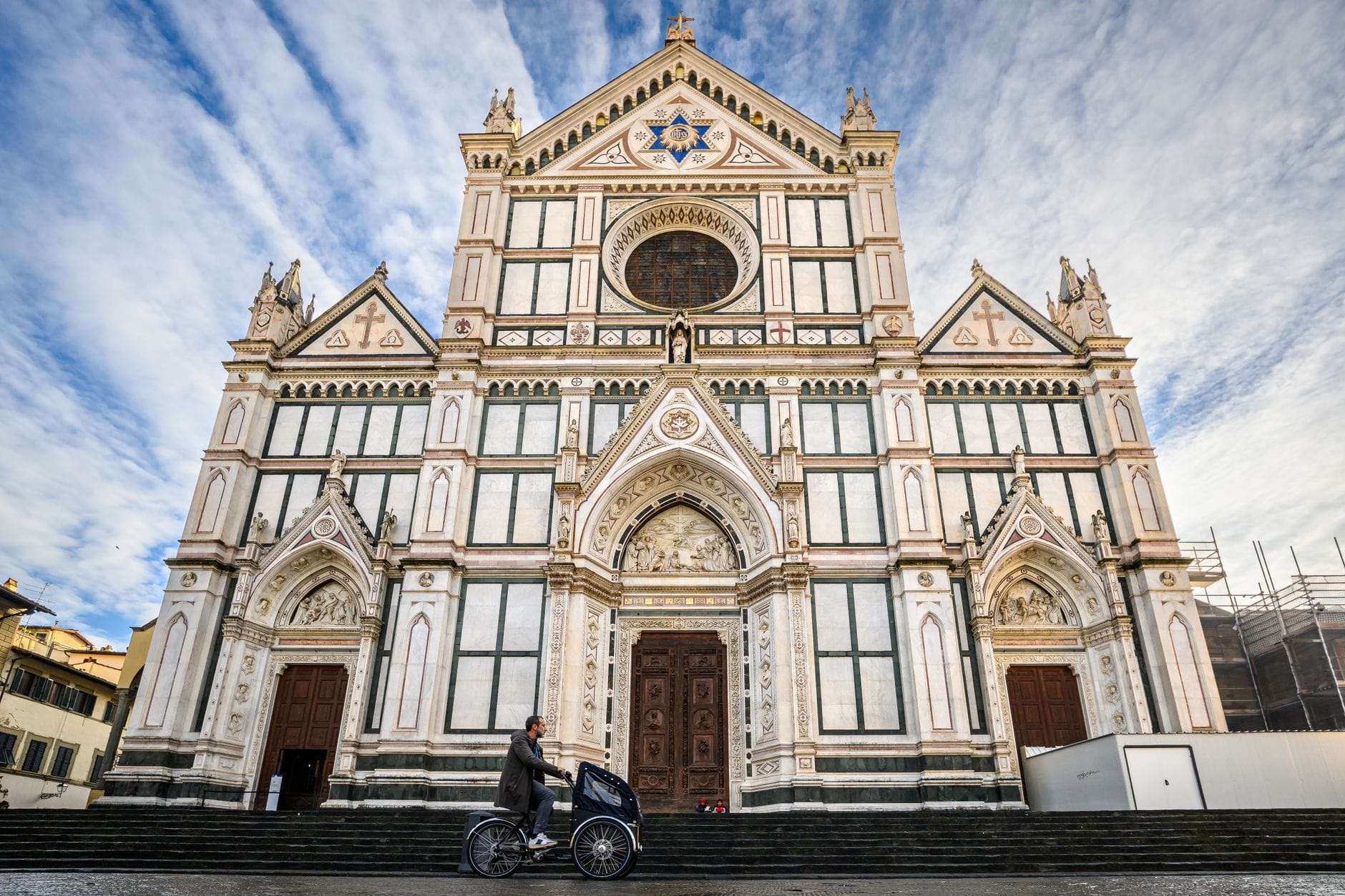
What the Basilica di Santa Croce Actually Is
The Basilica di Santa Croce, officially the Basilica of the Holy Cross, is the principal Franciscan church of Florence and one of the largest Gothic churches in Italy, measuring approximately 115 meters long and 39 meters wide. Construction of the present building began in 1294, though a smaller church occupied the site before that. The result is a building of serious dimensions: a vast, stone-flagged nave flooded with thin light, walls lined with funerary monuments, and chapels decorated by the greatest painters of the early Renaissance.
What distinguishes Santa Croce from other great Florentine churches is the sheer concentration of historic significance inside. Michelangelo is buried here. So is Galileo Galilei, Niccolò Machiavelli, and the composer Luigi Cherubini. The poet Dante Alighieri, who was exiled from Florence and died in Ravenna, has a cenotaph inside, though not his remains. The 19th-century writer Ugo Foscolo famously called Santa Croce the temple of Italian glories, and the label has stuck. For visitors with any interest in Italian history, this is one of the most genuinely moving interiors in the country.
💡 Local tip
Buy tickets online in advance through the official website to avoid queues, especially in spring and early autumn when the piazza fills quickly. The ticket office is on the north side of the building in Largo Bargellini, not on the main piazza facade.
The Piazza First: Arriving at Santa Croce
Piazza Santa Croce is one of the more rewarding open spaces in Florence, partly because it still functions as a genuine neighborhood square rather than a purely touristic one. The white-and-green marble facade of the basilica, completed in the 19th century in a Neo-Gothic style funded by an English benefactor, rises at the far end of the rectangular piazza. In front of it stands a statue of Dante, looking slightly severe. Local residents cut across the square on foot; street vendors set up near the edges; and in summer, the piazza hosts events including the Calcio Storico, a brutal historical football game played in 16th-century costume.
In the early morning, before the tour groups arrive, the piazza has a quiet, residential character. The surrounding buildings are painted in the amber and ochre tones typical of the Santa Croce neighborhood, and the basilica's facade catches the light differently at almost every hour. If you are arriving for a morning opening, take a moment to look at the building from across the square before heading to the ticket office. The scale of the nave only becomes clear once you are inside, but the exterior already signals that this is something substantial.
Tickets & tours
Live prices and dates from our booking partner. If you book, we may earn a commission at no extra cost to you.
Inside the Basilica: The Nave, the Tombs, and the Art
Stepping inside, the first impression is of unusual width and openness. Unlike many Italian Gothic churches, the nave of Santa Croce has no blind triforium obscuring the upper walls, and the wooden trussed ceiling sits at a height that feels expansive rather than oppressive. The floor is entirely paved with funerary slabs, many of them worn smooth by centuries of foot traffic. Walking across them, you are literally stepping over the dead, a fact that the church does not downplay.
The most-visited spot is Michelangelo's tomb on the right aisle, designed by Giorgio Vasari and featuring allegorical figures of Painting, Sculpture, and Architecture. A few steps further is the cenotaph of Dante, and beyond that, the tomb of Machiavelli. These monuments are worth studying slowly rather than photographing in passing. The Latin inscriptions, the quality of the carving, and the way each monument reflects the aesthetic of its period tell a layered story about how Italy chose to remember its most influential figures.
At the far end of the right transept are the Bardi and Peruzzi Chapels, decorated with fresco cycles by Giotto di Bondone, painted in the early 14th century. These are among the most important surviving works of pre-Renaissance Italian painting. Giotto's narrative scenes, particularly the scenes from the life of St. Francis in the Bardi Chapel, show a command of spatial depth and human emotion that was genuinely revolutionary for their time. They look nothing like the flat, gold-ground icons that preceded them. If you are visiting theGalleria dell'Accademia or the Uffizi Galleryon the same trip, seeing these frescoes first gives useful context for understanding how Italian painting developed.
ℹ️ Good to know
Photography without flash is generally permitted in the basilica, but tripods are typically prohibited. Check current rules at the ticket office, as restrictions can change. Keep voices low near the chapels, which remain active consecrated spaces.
The Pazzi Chapel and the First Cloister
The ticket to Santa Croce includes access to the First Cloister and the Pazzi Chapel at its far end, and this part of the visit is frequently underestimated by visitors who spend all their time inside the basilica. The First Cloister is a calm, arcaded courtyard with a well at its center. After the sensory density of the nave, it offers genuine quiet. The paving stones are uneven, the cypress trees in the adjacent areas cast long shadows in the afternoon, and the whole space has a contemplative atmosphere that is quite different from the tourist-facing interior.
At the end of the cloister stands the Pazzi Chapel, commissioned by Andrea de' Pazzi and designed by Filippo Brunelleschi, begun around 1442. It is considered one of the purest expressions of early Renaissance architecture, a masterclass in geometric proportion, controlled light, and restrained ornament. The circular terracotta medallions of the Apostles by Luca della Robbia, set into the grey pietra serena walls, are among the most elegant decorative details in all of Florence. The chapel is small enough that you can absorb its proportions from a single point in the center of the room. Stand there for a moment and look up at the dome.
If Brunelleschi's structural thinking interests you, the Pazzi Chapel is a compelling companion piece to hisdome at the Florence Cathedral. The same principles of geometry and harmonious proportion are at work, but on a human, intimate scale rather than a civic-monumental one.
The Museo dell'Opera di Santa Croce
The museum occupying the former refectory of the Franciscan convent holds several significant works, most notably Cimabue's Crucifix, a large painted cross from the 13th century that was severely damaged in the catastrophic 1966 Arno flood. The flood reached over five meters inside the church, destroying or damaging artworks throughout. The restored Crucifix, with its visible areas of loss, is kept in the museum as a document of both Cimabue's genius and the disaster that nearly erased it.
The refectory space itself is worth seeing for its proportions and the remnants of Taddeo Gaddi's fresco of the Last Supper on the end wall. The museum is rarely as crowded as the basilica, and the relative quiet makes it easier to spend time with individual works rather than working against the current of a tour group.
Practical Walkthrough: Hours, Dress Code, and When to Go
The basilica is open Monday through Saturday from 9:30 to 17:30, and on Sundays and religious holidays generally from 14:00 to 17:45. It is closed on Christmas Day. Visitors should note that Sunday morning hours are restricted because the basilica holds Mass, so morning visits on Sundays are not possible. Confirm current hours on the official website before your visit, as schedules can shift for feast days and special events.
Dress code is enforced: covered shoulders and knees are required for entry, as at all major Florentine churches. This is not a soft suggestion. Staff at the entrance will ask visitors who are not appropriately dressed to cover up or, in some cases, deny entry. Lightweight scarves or a cardigan carried in a bag solve the problem easily. The stone floor can be cold in winter, even when the outdoor temperature is mild, so closed shoes are more comfortable than sandals during the cooler months.
The best time to visit is early on a weekday morning, when the building is quietest and the light through the high windows is still directional and relatively soft. By mid-morning in spring and autumn, the piazza and nave fill considerably. If you are planning a wider day in the Santa Croce neighborhood, theMuseo del Bargellois a short walk northwest and pairs well with a Santa Croce visit for a day focused on Florentine sculpture and Renaissance history.
⚠️ What to skip
Summer visits (June to August) come with significant heat and crowd pressure. The stone interior stays cooler than the piazza, but the basilica can feel congested by late morning. If you are visiting in summer, arrive at or just after opening time. Winters are cold and occasionally foggy, but crowds are much thinner and the atmosphere inside the nave is particularly atmospheric.
Who Might Not Enjoy This Visit
Santa Croce is not an ideal choice for visitors who find funerary art uncomfortable or who are primarily seeking colorful, decorative interiors. The nave is deliberately austere in character, and much of the art is sepulchral. Young children can find the atmosphere difficult to engage with, and the visit requires sustained quiet and a willingness to move slowly. If your priority is a single, concentrated artistic experience rather than a broad historical survey, the focused collections at the Uffizi or Accademia may serve you better in limited time.
Visitors with limited mobility should be aware that the interior floor is uneven in places due to the funerary slabs, and some areas of the cloisters have cobblestone surfaces. The official website notes visitor access arrangements; check current accessibility information directly with the site before your visit. For a broader sense of what the Santa Croce neighborhood offers beyond the basilica, the area around the church includes some of the city's more authentic daily life, including theSant'Ambrogio marketa short walk north, worth combining into a morning itinerary.
Insider Tips
- The ticket office is in Largo Bargellini on the north flank of the building, not on the main piazza. Many visitors circle the piazza looking for an entrance before finding it. Give yourself a couple of extra minutes if you arrive without knowing this.
- Galileo's tomb is on the left aisle, directly opposite Michelangelo's on the right. Most visitors crowd around Michelangelo and walk past Galileo with barely a glance. His monument is simpler but worth the stop: Galileo was only given a proper tomb in 1737, nearly a century after his death, once the Church had softened its position toward him.
- The Pazzi Chapel receives the best light in the mid-afternoon, when the soft Tuscan sun enters from the west-facing door and illuminates the della Robbia medallions. If you have flexibility in your timing, this is the optimal moment to see it.
- The museum section housing Cimabue's Crucifix is included in the standard ticket but is easy to skip if you follow the crowd flow. Go against the grain: visit the museum before the basilica while energy is high, then finish in the quieter cloister.
- Sunday afternoon (14:00 onwards) is one of the less-visited windows in summer, because many tourists assume religious sites are closed or have limited access all day. In fact, the basilica opens specifically at 14:00 on Sundays, and the early afternoon crowd is often lighter than a busy weekday morning.
Who Is Basilica di Santa Croce For?
- Travelers interested in the Italian Renaissance and the figures who shaped it, from Michelangelo to Machiavelli
- Architecture enthusiasts who want to compare Gothic scale with Brunelleschi's early Renaissance rationalism side by side
- Art historians and students of medieval and early Renaissance painting, particularly Giotto's fresco cycles
- Visitors seeking depth over breadth: a single, layered site that rewards careful attention rather than rapid movement
- Repeat visitors to Florence who already know the Uffizi and Accademia and want to explore the city's less-photographed interiors
Nearby Attractions
Other things to see while in Santa Croce:
- Leather School of Florence
Founded in 1950 inside the monastery of the Basilica di Santa Croce, the Scuola del Cuoio is one of the few places in Florence where visitors can watch skilled artisans craft leather goods by hand, browse the workshop, and shop directly from the makers, all without paying an entrance fee.
- Museo del Bargello
Housed in Florence's oldest public building, the Bargello National Museum contains one of the world's finest collections of Renaissance sculpture, including landmark works by Donatello, Michelangelo, and Verrocchio. It draws far fewer crowds than the Uffizi, making it one of the most rewarding museum visits in the city.
- Sant'Ambrogio Market
The Mercato di Sant'Ambrogio has been feeding Florence's eastern neighborhoods since its cast-iron hall opened in 1873. Open Monday through Saturday mornings, it draws local shoppers, chefs, and a handful of savvy visitors for fresh produce, cheese, meat, and cheap hot lunches. Entry is free.
Planning a trip? Discover personalized activities with the Nomado app.