Scuola del Cuoio: Inside Florence's Historic Leather School
Founded in 1950 inside the monastery of the Basilica di Santa Croce, the Scuola del Cuoio is one of the few places in Florence where visitors can watch skilled artisans craft leather goods by hand, browse the workshop, and shop directly from the makers, all without paying an entrance fee.
Quick Facts
- Location
- Via San Giuseppe 5R, 50122 Florence (inside the Santa Croce monastery complex)
- Getting There
- Walk 15 min east from Piazza della Signoria via Borgo dei Greci, or take city bus to Piazza Santa Croce
- Time Needed
- 45–90 minutes
- Cost
- Free entry; no ticket required (separate ticket needed only for the Basilica di Santa Croce itself)
- Best for
- Craft enthusiasts, shoppers seeking authentic Florentine leather, history lovers
- Official website
- scuoladelcuoio.it
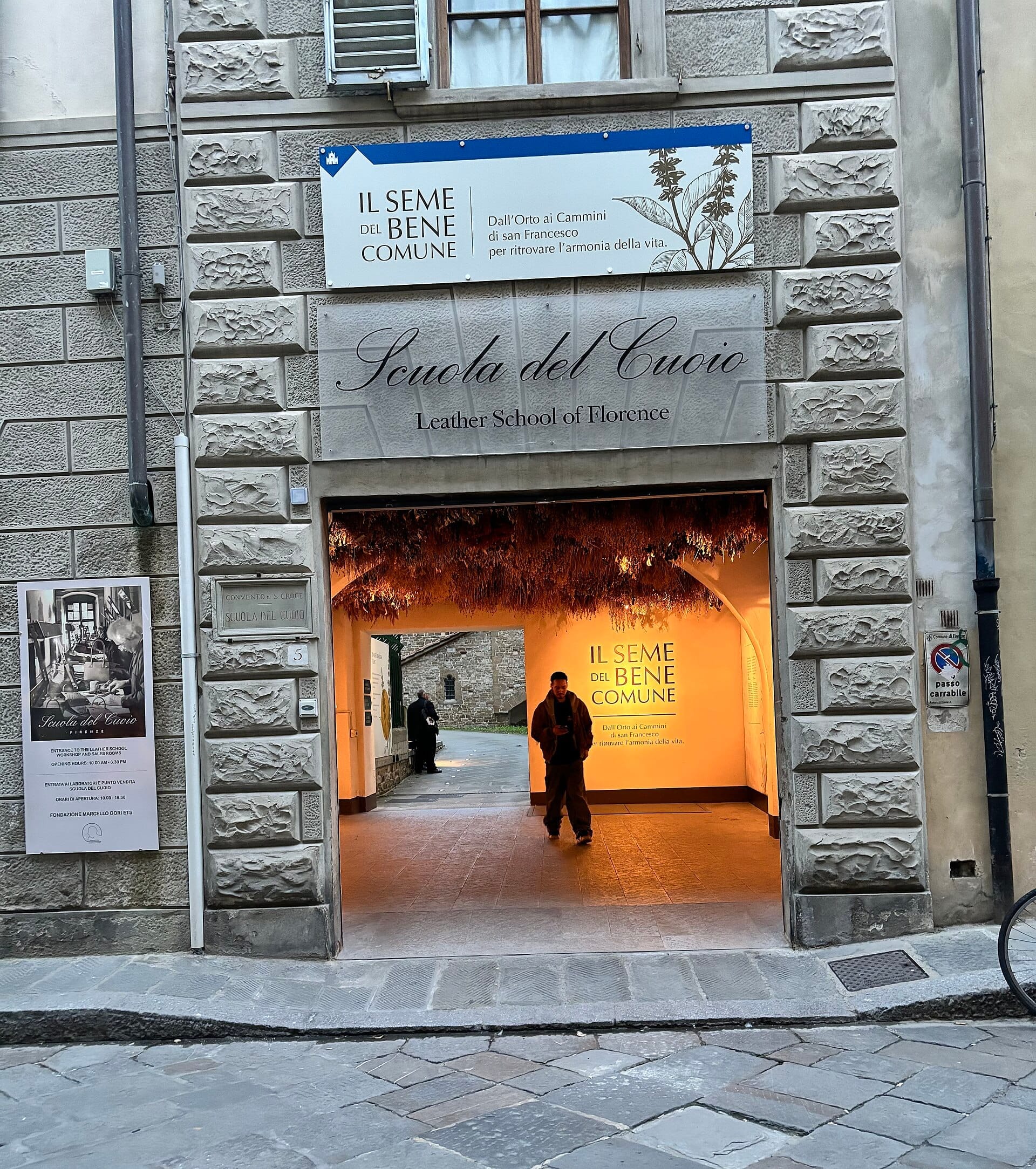
What the Scuola del Cuoio Actually Is
The Scuola del Cuoio, known in English as the Florence Leather School, is not a museum, and it is not a boutique. It occupies a genuinely unusual position: a working artisan school and production workshop that is also open to the public, set inside the centuries-old monastery attached to the Basilica di Santa Croce. You enter through a courtyard, climb a short flight of stairs, and find yourself in rooms where leather workers are cutting, stitching, dyeing, and finishing bags, belts, wallets, and jackets with the same manual techniques that have defined Florentine leatherwork for generations.
Florence has long been regarded as one of Europe's foremost centres for leather craftsmanship, a reputation rooted in centuries of guild tradition and the availability of fine Tuscan hides. The Scuola del Cuoio exists at the serious end of that tradition. Unlike the stalls of theSan Lorenzo Market, where mass-produced goods frequently mingle with handmade ones, everything sold at the Scuola is produced on-site by trained artisans. That distinction matters enormously when you are deciding where to spend money on leather in Florence.
ℹ️ Good to know
Entry to the Scuola del Cuoio workshop and shop is free. You do not need a ticket for the Basilica di Santa Croce to enter the school: it has its own entrance on Via San Giuseppe 5R, to the left of the church facade, and can also be accessed through the garden around the apse.
The History Behind the Walls
The school was founded in 1950 by leather artisans Silvano Casini and Marcello Gori, working in collaboration with the Franciscan friars of the Santa Croce monastery. The context matters: post-war Florence had a significant population of orphaned children with no professional training and limited prospects. The school was conceived as a practical solution, teaching leatherworking as a skilled trade that could give young people a sustainable livelihood. The partnership with the Franciscans provided the physical space within the monastery, and a craft tradition that had existed in the city for centuries provided the curriculum.
More than seven decades later, the school remains family-run, still occupying the same monastic rooms, and still oriented around the transmission of technical skill. The founding families' descendants continue to lead the operation. This continuity is not a marketing narrative so much as a structural reality that shapes what you actually see when you visit: a working environment where learning and production happen in the same space.
The physical setting adds a layer of context that you will not find in any conventional leather shop. The monastery of Santa Croce is one of the great Franciscan complexes in Italy, and theBasilica di Santa Croceitself, where Michelangelo, Galileo, and Machiavelli are buried, stands immediately adjacent. Walking from the piazza into the monastery courtyard and then up to the school feels like moving through layers of the city's history rather than simply entering a shop.
Tickets & tours
Live prices and dates from our booking partner. If you book, we may earn a commission at no extra cost to you.
Perfume masterclass: a sensory experience in Florence
From 70 €Instant confirmationFree cancellationFlorence cathedral complex and Brunelleschi's dome tickets
From 59 €Instant confirmationFlorence Cooking Class Making Pizza and Gelato
From 69 €Instant confirmationFree cancellationChianti tour with two wine tastings from Florence
From 46 €Instant confirmationFree cancellation
Finding the Entrance: A Practical Walkthrough
The entrance requires a small amount of navigation that most visitors miss on their first attempt. Standing in Piazza Santa Croce facing the basilica, walk to the left side of the church. Continue roughly 50 feet along Via San Giuseppe and look for the school's signage. Follow it around the back of the church into the monastery courtyard, then up one flight of stairs to reach the main workshop and shop area.
If you are coming from Piazza della Signoria, the most direct route on foot is east along Via dei Gondi, which becomes Borgo dei Greci as it approaches Piazza Santa Croce. Cross the piazza along the left side of the basilica and continue onto Via San Giuseppe. The walk takes approximately 15 minutes at a relaxed pace and passes through some of the most historically dense streets in Florence.
⚠️ What to skip
Accessibility note: reaching the main workshop involves crossing cobblestone courtyard surfaces and climbing one flight of stairs. There is no formal step-free route described by the school, so visitors with mobility limitations should contact the school in advance via scuoladelcuoio.it.
What You See Inside, and When to Go
The workshop rooms smell strongly of tanned leather and the mild chemical sharpness of dyes, a combination that becomes immediately recognizable as specific to this kind of craft environment. Workbenches run along the walls and across the center of the rooms. Depending on the time of day, you may see artisans cutting patterns from large hides spread across flat surfaces, stitching by hand or machine, applying gilt tooling, or finishing edges with bone folders and wax. The sounds are quiet: the thud of a cutting tool, the rhythm of a sewing machine, an occasional exchange in Italian.
Artisans are typically present and working Monday through Friday, roughly between 10:00 and 18:00. This is the window when the school genuinely functions as a working workshop rather than simply a retail space. Visiting on a weekday morning gives you the best chance of watching several stages of production at once, when light from the courtyard-facing windows falls across the workbenches and the rooms are relatively uncrowded. Afternoon visits on weekdays are also good, though by mid-afternoon some workstations may be winding down.
The shop section displays the finished range: bags, wallets, belts, key rings, notebook covers, gloves, and jackets. Prices reflect the hand production process and the quality of the materials used, so this is not the place to look for bargain leather goods. What you are paying for is verifiable provenance and craft, and the ability to ask the people who made the item questions about how it was produced.
💡 Local tip
Photography inside the workshop is generally permitted, but ask before photographing individual artisans at close range. A respectful approach tends to result in more engaging interaction, and the craftspeople are often willing to briefly explain what they are working on.
Opening Hours and When to Avoid
The Scuola del Cuoio is open daily from 10:00 to 18:00, with one important seasonal note: from November through March it is normally open Monday through Saturday, while from April through October it is open every day, including Sundays. If you are visiting in winter and planning a Sunday itinerary in the Santa Croce area, factor this in.
Midday in summer, roughly between 12:30 and 14:00, tends to bring a concentration of tour groups, particularly those connecting the school with a visit to the basilica. The rooms are relatively small and can feel crowded when a group arrives. Early opening, just after 10:00, is consistently the quietest period across most days of the week. If your priority is watching artisans work without crowd interference, a weekday morning visit is the clear choice.
For visitors planning a broader itinerary in the area, theSanta Croce neighborhoodrewards a longer half-day exploration. The piazza itself, the basilica complex, and the surrounding streets offer a concentration of Florentine history at a slightly lower tourist density than the Duomo area.
Is It Worth Your Time? An Honest Assessment
The Scuola del Cuoio is genuinely one of the more coherent craft experiences available in Florence without advance booking or an entrance fee. The combination of a working workshop, a historically significant location, and a retail operation run by the makers themselves is uncommon. For anyone with an interest in artisan production, the history of Florentine craft, or simply buying a leather object with documented provenance, it represents good use of an hour.
However, it is worth being clear about what it is not. It is not a museum with interpretive panels or guided explanations of leather history. It is not interactive in the sense that visitors participate in making anything. If you are primarily looking for the cheapest leather goods in Florence, this is not the right destination. For that kind of shopping, the stalls around theMercato Centraleoffer a wider range of price points, though the provenance of goods varies considerably.
Visitors who arrive expecting a dramatic artisan spectacle may also find the experience quieter and more understated than anticipated. The workshop is a place of focused, skilled labor, not a performance. The value lies in the authenticity of what you observe, not in any theatrical presentation of it.
Practical Details at a Glance
- Address: Via San Giuseppe 5R, 50122 Florence
- Hours: Generally 10:00–18:00; typically Monday–Saturday from November through March, and daily (including Sundays) from April through October
- Artisan working hours: approximately Monday–Friday 10:00–18:00
- Admission: Free
- No reservation required to visit the workshop or shop
- Currency: Euro (EUR)
- Language: Italian; English spoken by shop staff
If you are planning a broader Florence itinerary and want to understand the full arc of Florentine craft and artistic heritage, thecomplete Florence guidecovers the city's major cultural sites alongside lesser-known workshops and artisan traditions.
Insider Tips
- Visit on a Tuesday or Wednesday morning for the best balance of active workshop production and manageable visitor numbers. Mondays can be slightly unsettled as the week begins, and Fridays see more afternoon visitors.
- The school produces items in a range of colors and finishes that are not always displayed on the shelves. If you have a specific preference in mind, ask a member of staff directly: custom or non-displayed stock is sometimes available.
- Combining the Scuola del Cuoio with a visit to the Basilica di Santa Croce in the same morning works efficiently, but note that the basilica requires a separate ticket and has its own entry queue. Enter the school first, when crowds are thinnest, then join the basilica queue.
- The school entrance on Via San Giuseppe is easy to walk past. Look for a small, low-key sign near the junction, not a shopfront. The approach through the monastery courtyard is part of the experience.
- If you are buying a significant piece, ask for a certificate of authenticity or a receipt that specifies the item as handmade at the Scuola del Cuoio. This is standard practice at the school and useful both for customs documentation and personal assurance.
Who Is Leather School of Florence For?
- Travelers who want to buy quality Florentine leather goods directly from the artisans who made them
- Craft and design enthusiasts interested in observing traditional hand production techniques
- History-focused visitors exploring the Santa Croce monastery complex and its layered past
- Shoppers who want verified provenance rather than the lowest possible price
- Anyone building a half-day itinerary in the Santa Croce neighborhood alongside the basilica
Nearby Attractions
Other things to see while in Santa Croce:
- Basilica di Santa Croce
The Basilica di Santa Croce is one of the largest Franciscan churches in the world and the final resting place of Michelangelo, Galileo, and Machiavelli. Set on one of Florence's most atmospheric piazzas, it combines monumental Gothic architecture with extraordinary Renaissance art and nearly eight centuries of Italian history.
- Museo del Bargello
Housed in Florence's oldest public building, the Bargello National Museum contains one of the world's finest collections of Renaissance sculpture, including landmark works by Donatello, Michelangelo, and Verrocchio. It draws far fewer crowds than the Uffizi, making it one of the most rewarding museum visits in the city.
- Sant'Ambrogio Market
The Mercato di Sant'Ambrogio has been feeding Florence's eastern neighborhoods since its cast-iron hall opened in 1873. Open Monday through Saturday mornings, it draws local shoppers, chefs, and a handful of savvy visitors for fresh produce, cheese, meat, and cheap hot lunches. Entry is free.
Planning a trip? Discover personalized activities with the Nomado app.