Museo Nazionale del Bargello: Florence's Greatest Sculpture Museum
Housed in Florence's oldest public building, the Bargello National Museum contains one of the world's finest collections of Renaissance sculpture, including landmark works by Donatello, Michelangelo, and Verrocchio. It draws far fewer crowds than the Uffizi, making it one of the most rewarding museum visits in the city.
Quick Facts
- Location
- Via del Proconsolo 4, Santa Croce district, Florence
- Getting There
- 10-minute walk from the Duomo; city buses serve surrounding streets in the historic centre
- Time Needed
- 1.5 to 2.5 hours
- Cost
- €12 full price; €26 combined 48hr ticket with Galleria dell'Accademia; €4 optional reservation fee. Verify before visiting.
- Best for
- Renaissance art lovers, architecture enthusiasts, visitors seeking a quieter alternative to the Uffizi
- Official website
- bargellomusei.it/en/museum/museo-nazionale-del-bargello
What Is the Bargello?
The Museo Nazionale del Bargello, officially housed at Via del Proconsolo 4, is Italy's preeminent museum of Renaissance sculpture and decorative arts. Established by royal decree in 1865, it was Italy's first national museum. The building predates the collection by six centuries: this is the Palazzo del Podestà, begun in 1255, making it the oldest surviving civic palace in Florence, older even than the Palazzo Vecchio.
The museum's name comes from the bargello, the chief of police who used the building as headquarters in later centuries, after it had served as the seat of the Capitano del Popolo and the city's council of justice. For a period it also functioned as a prison. That history is present in the architecture: thick stone walls, a crenellated tower, barred windows at street level. Walking through the entrance on Via del Proconsolo feels like entering a fortress rather than a gallery, which is precisely what it once was.
💡 Local tip
The Bargello is open Monday, and Wednesday through Saturday, 08:15 to 18:50 (Sunday 08:15 to 13:50; last admission 50 minutes before closing) and is closed on Tuesdays. Check the official site for special openings and occasional evening hours before you visit.
The Collection: What You'll Actually See
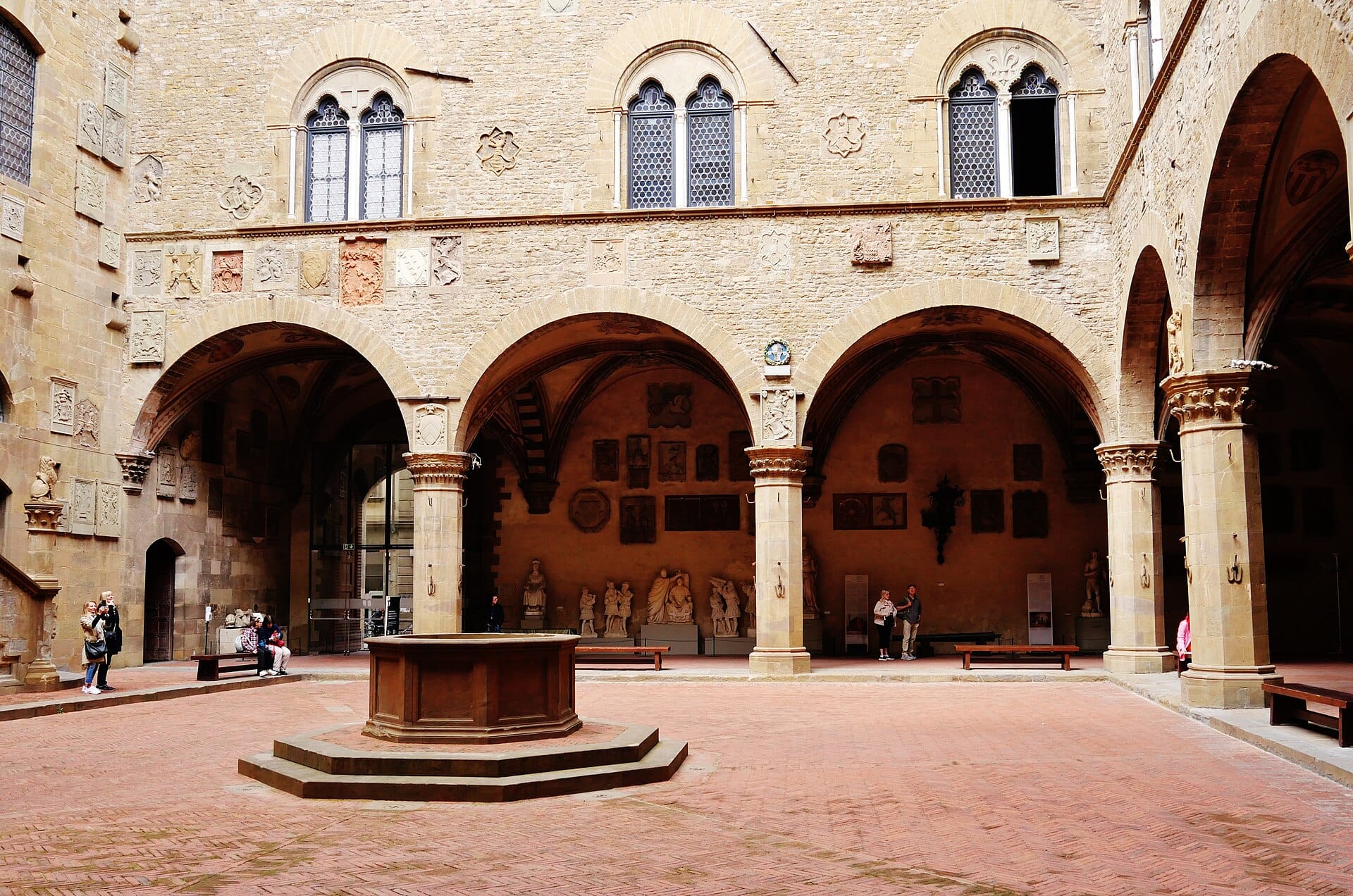
The ground floor opens into a large interior courtyard, one of the most atmospheric spaces in Florence. Stone coats of arms line the walls — the emblems of past magistrates — and a broad external staircase climbs to the upper loggia. The courtyard alone rewards slow attention before you enter any gallery.
The first-floor Donatello Room is the reason many serious art travellers come. Donatello's bronze David, cast in the 1440s, is the centrepiece: the first free-standing nude male sculpture created in the Western world since antiquity. It is smaller and stranger than reproductions suggest — the figure has an unsettling adolescent elegance, the helmet of Goliath at his feet decorated with a laurel feather that reaches improbably up the inside of David's thigh. Nearby stands Donatello's earlier marble David, a more conventional but equally important work, alongside his Saint George, originally made for Orsanmichele.
Michelangelo's Bacchus occupies the ground-floor Michelangelo Room, and it repays careful looking. Carved between 1496 and 1497, it was one of his earliest large sculptures, made when he was in his early twenties. The god of wine sways very slightly, his expression blurred with intoxication, the surface of the marble worked to suggest soft flesh rather than the heroic musculature of his later work. Also in this room: his Tondo Pitti, an unfinished relief of the Madonna, and a small bronze bust of Brutus, his only portrait bust.
The collection extends to Benvenuto Cellini, Giambologna, Verrocchio, and Luca della Robbia, whose glazed terracotta reliefs appear throughout the upper floors in vivid blues and whites. For those interested in tracing the full arc of Florentine sculptural achievement, this museum is the logical companion to theGalleria dell'Accademia, which focuses on Michelangelo's late career.
Tickets & tours
Live prices and dates from our booking partner. If you book, we may earn a commission at no extra cost to you.
Private Guided Tour to Bargello National Museum in Florence
From 0 €Instant confirmationFree cancellationPrivate Guided Tour to Bargello National Museum in Florence
From 0 €Instant confirmationFree cancellationPrivate Guided Tour to Bargello National Museum in Florence
From 0 €Instant confirmationFree cancellationPrivate Guided Tour to Bargello National Museum in Florence
From 0 €Instant confirmationFree cancellation
The Building as Attraction
The Bargello's architecture is not incidental backdrop. The palazzo was built when Florence was an independent commune governed by elected magistrates, and the building's scale was intended to project civic authority. The tower, the crenellations, the thick rusticated stone: these are the markers of 13th-century communal power, the same visual language used for the Palazzo Vecchio built a generation later.
The upper loggia running along the courtyard's first floor is itself a small sculpture gallery, with works arranged along the open arcade. On a clear morning, light enters the courtyard from above and the loggia fills with a clean, even brightness that makes it unusually good for examining three-dimensional form. This is not an accident: sculptors and patrons understood northern light, and the museum's curators have preserved natural lighting conditions in several rooms rather than relying entirely on artificial illumination.
The building sits in theSanta Croce neighbourhood, a short walk east of the Piazza della Signoria and roughly equidistant between the Duomo and the Basilica di Santa Croce. The surrounding streets are part of Florence's medieval street grid, narrow and mostly free of tourist retail, which gives the approach to the museum an unpolished, working-city quality you don't always find near the major sites.
When to Go and How Crowds Behave
The Bargello attracts a fraction of the visitors who queue for the Uffizi or the Accademia. On a typical mid-morning in peak season, you might share the Donatello Room with twenty people rather than two hundred. This matters enormously for how you experience the sculpture: you can walk around individual pieces, crouch to examine a base or a hand, step back for a long view. The intimacy is not available at the blockbuster venues.
Arriving at opening time (08:15) gives you the courtyard almost entirely to yourself. By 10:30, guided groups begin arriving. Late afternoon, from about 16:00 onward, crowds thin again as visitors return to hotels before dinner. Avoid Saturday mornings in July and August if you want quieter rooms, though even then the museum rarely feels overwhelming.
⚠️ What to skip
The Bargello is a 13th-century fortress with staircases throughout and no escalators. Visitors with mobility limitations should contact the museum in advance at +39 055 0649440 or by email at mn-bar@cultura.gov.it to confirm access arrangements.
Photography and Practical Walkthrough
Photography without flash is generally permitted throughout the museum. The courtyard, with its stone coats of arms and external staircase, is the single most photogenic space, particularly in the morning when light enters from the open sky above. The Donatello Room's narrow floor plan can make wide shots difficult; a 35mm equivalent lens works better here than anything wider, which tends to introduce distortion on the sculptures.
The museum's layout follows a roughly chronological path across multiple floors. Allow at least 90 minutes if you plan to cover the main highlights; two to two-and-a-half hours if you want to spend time with the decorative arts collections on the upper floors, which include medieval ivories, enamels, and arms and armour. The rooms are well labelled in both Italian and English.
Tickets can be purchased on-site or online through the official Bargello Museums website. An optional reservation fee of €3 applies for advance booking. A 48-hour combined ticket (€26) covers the Bargello and theGalleria dell'Accademia; a 72-hour ticket (€38) covers all museums in the Bargello Museums group. Verify current prices on the official site before visiting, as admission fees are subject to change.
Honest Assessment: Is It Worth Your Time?
For visitors whose primary interest is painting, the Bargello may feel peripheral. The collection is almost exclusively three-dimensional: sculpture, bronze, ivory, majolica, and metalwork. If you are on a short trip and your one museum day is going to the Uffizi, you will not have missed something obviously equivalent.
For anyone with genuine interest in the history of sculpture, or in understanding what Florence actually produced during the 15th century before painting became the dominant medium of the Renaissance, the Bargello is not a secondary option. It is the correct starting point. Donatello's David in particular is a work whose significance is difficult to overstate: it changed what sculpture could be. Seeing it in a small, relatively uncrowded room rather than through a crowd barrier is an experience the larger museums rarely offer.
The museum pairs naturally with nearby sites. ThePalazzo Vecchiois a five-minute walk west and shares the Bargello's civic, communal-era character. TheBasilica di Santa Croce, with its own sculptural programme and the tombs of Michelangelo and Galileo, is a ten-minute walk east. Building a half-day route around all three is a reasonable and coherent itinerary.
ℹ️ Good to know
The Bargello has secondary entrances and exits on Via Ghibellina, Via dell'Acqua, and Via della Vigna Vecchia, which can be useful for navigating the surrounding streets after your visit.
Insider Tips
- Spend time in the courtyard before entering any gallery. The stone coats of arms and the open staircase are often overlooked by visitors moving straight to the sculpture rooms, but the space is architecturally significant and far less crowded than the galleries above.
- Donatello's bronze David is displayed on a plinth in the centre of its room, allowing you to walk a full circle around it. Do this slowly. The sculpture changes dramatically from each angle, particularly the view from behind, which most visitors never take.
- The upper-floor rooms containing medieval and early Renaissance decorative arts, including ivory carvings, enamels, and small bronzes, are almost always empty. If you want to photograph objects without other visitors in frame, these rooms offer the best opportunity in the entire museum.
- The 72-hour Bargello Museums combined ticket covers all museums managed by the Bargello Museums group. If you plan to visit multiple museums over three days, it represents better value than purchasing individual tickets.
- Morning light in the courtyard is best between 09:00 and 11:00. If photography matters to you, plan your visit to start in the courtyard at opening time and move to the interior galleries as the light rises.
Who Is Museo del Bargello For?
- Travellers with a serious interest in Renaissance sculpture who want to see Donatello and early Michelangelo without large crowds
- Architecture enthusiasts interested in 13th-century Florentine civic buildings
- Visitors on a second or third trip to Florence who have already covered the Uffizi and Accademia
- Anyone building a half-day itinerary in the Santa Croce and Piazza della Signoria area
- Photographers looking for well-lit, uncrowded interiors with strong three-dimensional subjects
Nearby Attractions
Other things to see while in Santa Croce:
- Basilica di Santa Croce
The Basilica di Santa Croce is one of the largest Franciscan churches in the world and the final resting place of Michelangelo, Galileo, and Machiavelli. Set on one of Florence's most atmospheric piazzas, it combines monumental Gothic architecture with extraordinary Renaissance art and nearly eight centuries of Italian history.
- Leather School of Florence
Founded in 1950 inside the monastery of the Basilica di Santa Croce, the Scuola del Cuoio is one of the few places in Florence where visitors can watch skilled artisans craft leather goods by hand, browse the workshop, and shop directly from the makers, all without paying an entrance fee.
- Sant'Ambrogio Market
The Mercato di Sant'Ambrogio has been feeding Florence's eastern neighborhoods since its cast-iron hall opened in 1873. Open Monday through Saturday mornings, it draws local shoppers, chefs, and a handful of savvy visitors for fresh produce, cheese, meat, and cheap hot lunches. Entry is free.
Planning a trip? Discover personalized activities with the Nomado app.