Palazzo Vecchio: Florence's Fortress-Palace at the Heart of the City
Palazzo Vecchio has stood at the center of Florentine civic life since 1299, functioning simultaneously as a working city hall and one of the city's most important museums. From the frescoed Salone dei Cinquecento to the 94-meter Arnolfo Tower, it rewards visitors who go beyond the famous square outside.
Quick Facts
- Location
- Piazza della Signoria, 50122 Florence (Centro Storico)
- Getting There
- 10–15 min walk from Santa Maria Novella station; city buses stop near Piazza della Signoria
- Time Needed
- 1.5–3 hours for the museum; add 30–45 min for the Arnolfo Tower
- Cost
- Museum approx. €12–15 full price; separate ticket for Arnolfo Tower; verify current prices before visiting
- Best for
- History enthusiasts, architecture lovers, anyone wanting to understand how Florence was actually governed
- Official website
- musefirenze.it/en/museum/museo-di-palazzo-vecchio
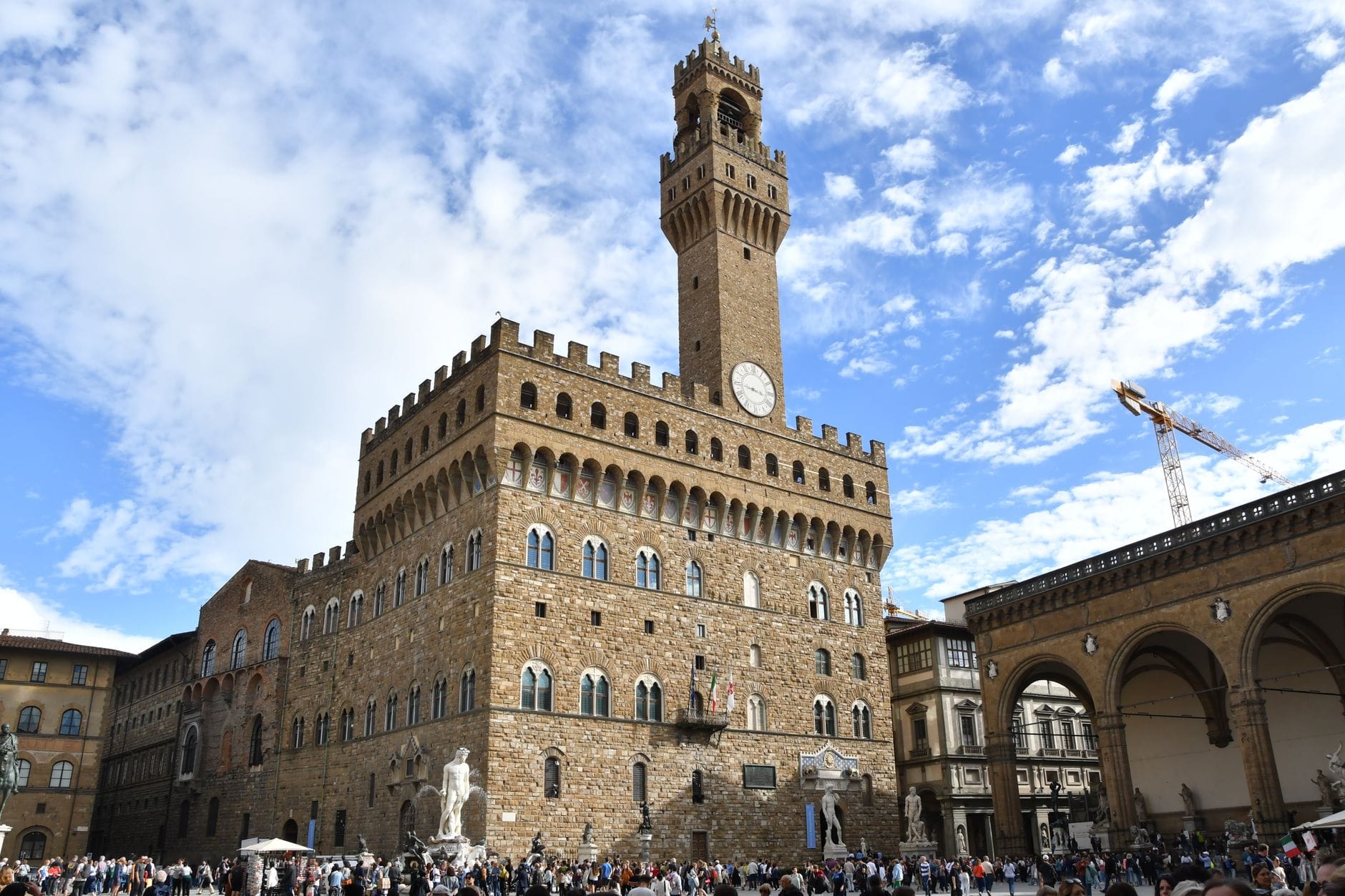
What Palazzo Vecchio Actually Is
Palazzo Vecchio is not merely a backdrop for photographs. Built beginning in 1299 and largely complete by around 1310, this fortress-palace has served as the seat of Florentine government almost continuously for over seven centuries. Today it functions simultaneously as Florence's working city hall and as the Museo di Palazzo Vecchio, a civic museum run under the Musei Civici Fiorentini network. That dual status matters: parts of the building are genuinely off-limits because elected officials work there, which gives the whole place a different atmosphere from the purpose-built palaces that became pure museums elsewhere in Europe.
Originally called the Palazzo della Signoria after the governing body that occupied it, it acquired the name Palazzo Vecchio, meaning Old Palace, only in the mid-16th century, when Cosimo I de' Medici relocated the ducal court across the river to Palazzo Pitti. The name stuck, and so did the building's authority as Florence's civic nucleus.
Architecturally, the palace sits at the edge ofPiazza della Signoria, Florence's open-air civic stage. The asymmetric facade, built from rough pietra forte stone, gives it a deliberately martial look, reinforced by crenellated battlements and the 94-meter Arnolfo Tower rising from the left side of the building rather than the center. That off-center placement has puzzled visitors for centuries; it was dictated by the need to preserve a pre-existing tower belonging to the Foraboschi family on the site.
The Piazza Before You Go In
Before entering, it is worth spending a few minutes in Piazza della Signoria at different hours if you can. Early morning, around 8:00–8:30, the square is relatively quiet and the pale stone of the palace catches low light in a way that midday sun completely flattens. The bronze copy of Michelangelo's David stands at the palace entrance (the original is at the Galleria dell'Accademia), alongside Baccio Bandinelli's Hercules and Cacus and Benvenuto Cellini's Perseus under the open Loggia dei Lanzi. The Loggia itself is free and unenclosed, accessible at any hour.
By mid-morning the square fills with tour groups and street performers. By noon in summer it is genuinely crowded and uncomfortably hot. If your plan includes both the exterior and the museum interior, arrive close to opening time at 9:00 to see the square without its full daytime complement and then move inside before the main crowds arrive.
💡 Local tip
Book museum tickets in advance through the official Musei Civici Fiorentini portal to avoid queuing at the door, especially April through October. The ticket desk and the online booking queue are separate entrances.
Tickets & tours
Live prices and dates from our booking partner. If you book, we may earn a commission at no extra cost to you.
Inside the Museum: What to Prioritize
The ground floor entry leads quickly to the Salone dei Cinquecento, the Hall of the Five Hundred, which Cosimo I commissioned Giorgio Vasari to redecorate in the 1560s. The room is immense, measuring roughly 54 by 23 meters, and the ceiling is a dense arrangement of 39 painted panels celebrating Florentine military victories. The scale is genuinely overwhelming the first time you stand in it. Vasari's wall frescoes depicting battles against Pisa and Siena were painted directly over earlier works, and there has been ongoing debate among art historians about whether Leonardo da Vinci's Battle of Anghiari lies hidden beneath the eastern wall, though no definitive evidence has yet been made public.
The Studiolo di Francesco I, directly off the Salone, is one of the most unusual rooms in any Italian palace. Designed in 1570 by Vasari and decorated by over 30 artists, it is a small, windowless cabinet lined floor to ceiling with allegorical paintings and bronze statuettes, organized around the four elements. It served as Francesco de' Medici's private study and alchemical retreat. It is easy to walk past the entrance without noticing it; look for the low doorway on the right side of the Salone.
Upper floors contain the Quartieri Monumentali, the suite of ceremonial apartments decorated for the Medici family, including the Quartiere degli Elementi and the Quartiere di Eleonora di Toledo, named for Cosimo I's Spanish wife. The ceiling of the Sala dei Gigli on this level, painted by Francesco di Giovanni (known as Francesco del Botticino) in the 1480s, is among the more restrained and elegant rooms in the palace. It also contains Donatello's original Judith and Holofernes bronze, brought inside from the piazza for conservation reasons.
The Arnolfo Tower Climb
The Arnolfo Tower offers one of the better elevated views of Florence's roofline, with direct sightlines across to Brunelleschi's dome and south toward the Arno. The climb is narrow and involves a series of staircases without lifts, so it is not accessible to visitors with mobility limitations. The tower has shorter operating hours than the main museum and is subject to closure in poor weather, particularly high winds. Check the official site on the morning of your visit to confirm it is open.
The view from the top provides useful orientation for understanding Florence's compact core. From here you can see clearly why thedome of Santa Maria del Fioredominates the skyline from every angle: it rises roughly 115 meters, 20 meters higher than the Arnolfo Tower itself. Photographers using a standard wide-angle lens will find the tower platform relatively cramped; a 24mm or wider equivalent is recommended for capturing the dome and roofline together.
⚠️ What to skip
The Arnolfo Tower requires a separate ticket from the main museum admission. Hours are shorter and weather-dependent. Do not assume it is open simply because the museum is open.
Opening Hours, Tickets, and Getting There
The museum generally operates daily from 9:00 to 19:00, closing at 14:00 on Thursdays; on certain dates in the warmer months it offers extended evening openings that can run as late as 23:00, so check the official calendar for your exact travel days. The extended summer evening hours are genuinely useful: arriving around 19:00 in June or July means the peak afternoon crowds have thinned while full light still comes through the upper windows of the Salone.
Full museum admission is approximately €12–15, with reduced rates for students and young visitors; children below a certain age enter free. These figures should be verified at the official booking portal before your visit, as civic museum pricing is reviewed periodically. A combined ticket including special routes such as secret passages or the Roman Theatre excavations beneath the palace may be available at an additional cost.
Palazzo Vecchio sits in the pedestrianized historic center, roughly a 10 to 15-minute walk from Firenze Santa Maria Novella station via Via de' Tornabuoni or the more direct route along Via dei Cerretani and Via dei Calzaiuoli. Several city bus lines stop near the square, though access by private vehicle is restricted by the ZTL limited traffic zone that covers the center. Taxis can drop off at the nearest permitted point, which is typically a few minutes on foot from the piazza.
For visitors with reduced mobility, the main museum routes have been adapted with elevators and accessible pathways where the building's medieval structure permits. Many sections, including the tower, remain inaccessible. The museum recommends contacting them in advance at info.museicivici@comune.fi.it or by phone at +39 055 276 8325 to plan a visit with specific needs.
Context: Why This Building Matters
Florence's historic center is a UNESCO World Heritage Site, inscribed in 1982, and Palazzo Vecchio is among its defining structures. To understand the palace is to understand how Florence governed itself through competing merchant families, guild politics, and eventually Medici consolidation of power. Machiavelli worked in this building as a government official. Savonarola was tried and hanged in the piazza directly in front of it. The palace is not decorative civic architecture; it is the physical record of how one of Europe's most consequential cities made decisions. Pairing a visit here with a walk through theCentro Storicogives that broader context a geography.
Visitors with a particular interest in Medici history may want to follow this with theMedici Chapelsnear San Lorenzo, where the dynasty's funerary monuments offer a different register of the same power that shaped these painted halls. Those interested in how Florence's medieval civic culture expressed itself through public space should also consider spending time at theMuseo del Bargello, just a few minutes walk to the northeast, which houses the city's foremost collection of Renaissance sculpture in another repurposed seat of government.
Honest Assessment: Is It Worth It?
The exterior and the piazza can be experienced entirely for free, and for many visitors that will be sufficient. The interior rewards those who are genuinely curious about Florentine political history or Renaissance decorative programs. It does not reward visitors hoping for a single knockout artwork in the manner of the Uffizi or the Accademia. The Salone dei Cinquecento impresses through sheer scale, and the Studiolo di Francesco I is one of the most atmospheric rooms in the city, but these are not headline paintings in the way Botticelli's Primavera or Michelangelo's David are.
If your time in Florence is limited to one day, this palace competes directly with theUffizi Gallerynext door and the Accademia across the city. The Uffizi will likely take priority for first-time visitors focused on painting. For anyone on a second or third trip, or for those specifically interested in how Renaissance political power was visually staged, Palazzo Vecchio becomes one of the more substantive experiences in Florence.
ℹ️ Good to know
The palace remains Florence's working city hall. On weekdays you may encounter municipal employees and administrative activity alongside tourists, which is an oddly grounding reminder that this is not a preserved artifact but a living institution.
Insider Tips
- The Thursday early-closure (14:00 year-round) catches many visitors off guard. Build your itinerary around any other day of the week if you want the full hours.
- The Studiolo di Francesco I is easy to overlook because the entrance is small and unmarked. It is off the right side of the Salone dei Cinquecento; make a point of finding it before leaving that floor.
- On selected dates in summer, evening hours until 23:00 are genuinely useful. Arriving at 19:00–20:00 in June or July means you share the Salone with far fewer people, and the light through the upper windows at that hour is better for photography than the flat afternoon glare.
- The Roman Theatre excavations beneath the palace, which reveal ancient Roman-era remains discovered during 20th-century works, require a separate ticket but add meaningful historical depth. They are rarely crowded even when the main museum is busy.
- If you want a view of the palace itself rather than from it, walk to the south end of Piazza della Signoria near the Neptune Fountain at dusk. The tower is lit and the crowds have partially cleared by then.
Who Is Palazzo Vecchio For?
- Travelers on a second or third visit to Florence who want to go beyond the major painting collections
- History and political history enthusiasts interested in how Renaissance Florence actually governed itself
- Architecture and design visitors drawn to Vasari's decorative programs and Donatello's original bronzes
- Those with a full day in the centro storico who want to understand the civic counterpart to the Uffizi's artistic one
- Visitors taking advantage of summer evening hours, looking for a significant indoor attraction after the worst of the afternoon heat has passed
Nearby Attractions
Other things to see while in Centro Storico (Historic Center):
- Arno River Walk (Lungarni)
The Lungarni are the named embankment streets running along both banks of the Arno River through central Florence. Free to walk at any hour, they offer the city's best unmediated views of the Ponte Vecchio, the surrounding hills, and the slow rhythm of Florentine daily life. No ticket, no queue, no reservation required.
- Brunelleschi's Dome Climb
The climb inside Brunelleschi's Dome is one of the most physically rewarding experiences in Florence. 463 steps through narrow brick passages deliver you to a panoramic terrace above the city's rooftops, with views that no other vantage point in the historic centre can match. Here is everything a traveler needs to plan it well.
- Florence Baptistery
The Florence Baptistery, officially the Battistero di San Giovanni, is one of the oldest and most significant religious buildings in Italy. Standing directly in front of Florence Cathedral, it is famous for Ghiberti's gilded bronze 'Gates of Paradise' and a breathtaking interior ceiling covered in Byzantine mosaics. This guide covers what to expect, when to visit, and how to make the most of your time here.
- Florence Cathedral (Duomo di Firenze)
The Cattedrale Metropolitana di Santa Maria del Fiore is the geographic and spiritual heart of Florence. Free to enter, extraordinary to stand inside, and far more layered than its famous exterior suggests. Here is everything you need to plan a worthwhile visit.
Planning a trip? Discover personalized activities with the Nomado app.