Uffizi Gallery: Florence's Greatest Collection, Honestly Assessed
The Galleria degli Uffizi holds one of the world's most important collections of Renaissance painting, from Botticelli's Birth of Venus to Caravaggio's Medusa. Knowing how to navigate it makes the difference between an exhausting shuffle and a genuinely moving experience.
Quick Facts
- Location
- Piazzale degli Uffizi 6, 50122 Florence — adjacent to Piazza della Signoria
- Getting There
- Walk from Santa Maria Novella station (~15 min) or take a city bus to Piazza della Signoria; no direct metro in Florence
- Time Needed
- 2–4 hours for a focused visit; allow a full morning or afternoon for a thorough one
- Cost
- Prices vary by season and visitor type; check tickets.uffizi.it for current rates. Advance booking strongly recommended.
- Best for
- Art lovers, history enthusiasts, first-time Florence visitors, and anyone serious about the Italian Renaissance
- Official website
- www.uffizi.it/en
What the Uffizi Actually Is — and Why It Matters
The Galleria degli Uffizi is not simply a museum. It is the physical record of one of the most consequential periods in Western art history, assembled largely by a single family: the Medici. Spread across two floors of a Mannerist palace that Giorgio Vasari designed between 1560 and 1580 for Cosimo I de' Medici, the collection spans the 13th to the 18th century and runs to roughly 20,000 works, of which about 1,700 are on permanent display at any given time.
The gallery was formally established in 1581, making it one of the oldest purpose-built public museums in Europe. That detail matters: this was not a royal treasury grudgingly opened to the public after a revolution. Francesco I de' Medici converted the top floor of the Uffizi building into a gallery space and invited scholars and artists to view the collection. The idea that art should be accessible, rather than hoarded, is woven into the institution's DNA.
The museum sits at the southern end of thePiazza della Signoria, the civic heart of Florence, and forms part of the dense cluster of monuments that makes theCentro Storico a UNESCO World Heritage Site. You can walk here from virtually anywhere in the historic core in under fifteen minutes.
⚠️ What to skip
The Uffizi is one of the most visited museums in the world. Arriving without a pre-booked ticket in high season (April through October) almost guarantees a long queue — sometimes exceeding two hours. Book online at tickets.uffizi.it before your trip, not the morning of.
The Building Before the Paintings
Before you see a single canvas, the building itself rewards attention. Vasari's design is a long, U-shaped palazzo with an internal courtyard open toward the Arno. Walking through that corridor toward the river, you pass between two colonnaded wings and catch a framed view of the Ponte Vecchio and the water below — a sight that has barely changed in four centuries. In the morning, the low light catches the pale stone and turns the courtyard into something closer to a stage set than a public street.
The courtyard itself is often overlooked by visitors rushing to the entrance. Street artists and portrait painters set up along the outer edges in the warmer months. There is a smell of stone and river damp here, especially in autumn and early spring, that gives way immediately to climate-controlled air the moment you step through the doors. The contrast is part of the experience.
Tickets & tours
Live prices and dates from our booking partner. If you book, we may earn a commission at no extra cost to you.
Navigating the Collection: What to Prioritize
The permanent collection is organized roughly chronologically, beginning with medieval Tuscan art on the second floor and moving through the Renaissance into Baroque and later work on the first floor. Most visitors come specifically for the rooms containing Botticelli, and that concentration is justified. Rooms 10 through 14 — the Botticelli rooms — hold both the Birth of Venus and Primavera, two of the most analyzed paintings in existence. Even if you know the reproductions well, the scale and surface of the originals require adjustment. Primavera in particular is larger than most people expect, and the condition of the paint repays close, slow looking.
Beyond Botticelli, the gallery contains Leonardo da Vinci's Annunciation and Adoration of the Magi, Michelangelo's Doni Tondo (his only completed panel painting), Raphael's portraits of Leo X and of Elisabetta Gonzaga, Titian's Venus of Urbino, and Caravaggio's Medusa and Sacrifice of Isaac. The collection of Flemish and Dutch work is less celebrated but substantial, and the corridor connecting the two wings offers a long, glass-enclosed view over the Arno that is worth stopping for.
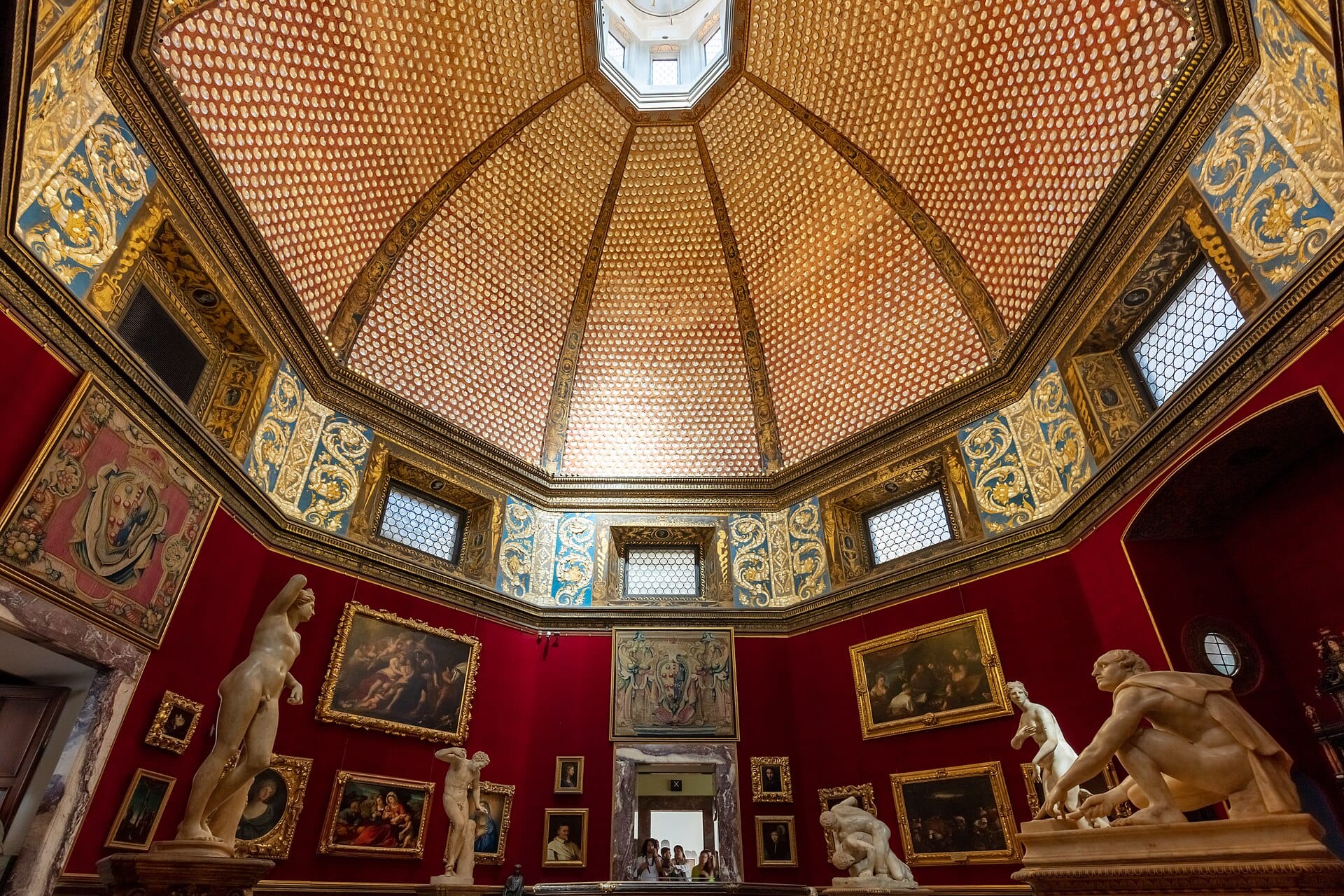
If your time in Florence is limited — say, you are working from aone-day itinerary— concentrate on the second floor's early Renaissance rooms and the Botticelli rooms, then finish at the Tribuna, the octagonal room that Buontalenti designed in 1584 to display the Medici's most prized objects. Budget at least ninety minutes for this route alone.
💡 Local tip
The museum provides a free floor plan at the entrance. Pick one up before heading upstairs — the room numbering is not always intuitive, and the layout involves occasional doubling back. Audio guides and guided tours are available for hire at the entrance, and the official app includes a navigation function.
Crowds, Timing, and When to Come
The Uffizi is open Tuesday through Sunday, 08:15 to 18:30. The ticket office closes at 17:30. It is closed on Mondays, on 1 January, and on 25 December. Those closure details matter: many visitors assume major museums are open every day and arrive to find locked doors.
The first entry slot of the day — around 08:15 to 09:00 — is consistently the least crowded. The Botticelli rooms in particular are transformed at this hour: quieter, cooler, with better light and space to stand in front of the paintings without being jostled. By 10:30, tour groups fill the corridors, and the queue for the Botticelli rooms can back up noticeably. If you have flexibility, a Tuesday or Wednesday morning arrival is the most comfortable combination.
Late afternoon, from about 16:00 onward, sees another relative dip in density as some guided groups leave and day-trippers head for dinner. The trade-off is less time before closing. For context on when Florence as a whole is most and least overrun with visitors, thebest time to visit Florence guide covers seasonal patterns across all the major sites.
Summer — roughly June through August — is the peak of both heat and crowds. The galleries are air-conditioned, which makes the museum a genuine refuge from the outdoor temperatures that regularly push into the high 30s Celsius. This creates a specific crowd pattern: people treat the museum partly as shelter, which adds to congestion in the mid-afternoon. Spring (April to early June) and early autumn (September to October) offer the most balanced conditions.
Practical Walkthrough: Entrance to Exit
The main entrance is on Piazzale degli Uffizi, the long pedestrian corridor between the two wings of the building. With a pre-booked ticket, you join the separate online-ticket queue and then proceed as directed to the entrance. Security screening is thorough — bags go through an X-ray machine and you pass through a body scanner, similar to an airport. Large bags and backpacks need to be stored in a cloakroom near the entrance; the cloakroom is free. Tripods and selfie sticks are not permitted. Food and open drinks other than water are not allowed in the galleries.
The main galleries are on the second floor, reached by stairs or elevator. The ground-level and first-floor spaces hold smaller rooms and the Contini Bonacossi collection. Toilets are located on each floor and at the entrance level. There is a cafe and bookshop at the exit level. The bookshop carries serious art-history publications, including scholarly Uffizi catalogues, alongside the expected postcards.
Accessibility: the building has elevators connecting all floors. Visitors with specific mobility needs are advised to contact the museum in advance via the official website to confirm current arrangements.
Photography in the Galleries
Photography without flash is permitted in most permanent collection rooms. Flash photography, tripods, and selfie sticks are prohibited throughout the museum. In practice, the lighting in many rooms is dim enough that phone cameras struggle without flash — this is part of the conservation approach, and it is worth accepting rather than fighting. The Leonardo rooms and the Botticelli rooms are bright enough for decent handheld shots. The Tribuna, with its deep red walls and concentrated lighting, photographs well in the late morning when natural light supplements the internal fixtures.
Some temporary exhibition spaces have their own photography rules, which are posted at each entrance. When in doubt, follow posted signs rather than assuming the general rule applies.
The Honest Assessment: Who Should and Should Not Visit
The Uffizi is not overhyped in terms of collection quality — the works here are genuinely among the most important in existence. What is sometimes overstated is how easy the experience is. The museum is large, the floors are hard stone, and moving through it carefully takes significant time and physical energy. Visitors who are not engaged by painting and drawing specifically — those who find the idea of looking closely at panel paintings and canvases for two or more hours unrewarding — will likely find the experience tiring rather than enriching. There is almost nothing interactive or multimedia-driven here: this is a museum of objects, presented with scholarship rather than entertainment.
Families with young children should factor in that the galleries are quiet and movement is restricted — it is a poor fit for small children who need to move around, though older children with a specific interest in art or history often do well. For family-specific planning across Florence, theFlorence with kids guide covers which museums and sites tend to hold younger visitors' attention.
For visitors who want to deepen their understanding of how the Uffizi collection connects to the rest of Florence's art landscape, thebest museums in Florence guide provides context on the full range of options, from the Bargello's sculpture collection to the frescoes at the Convent of San Marco.
Insider Tips
- Book the first entry slot of the day (08:15). The Botticelli rooms have space to breathe before 09:30 in a way they simply do not at any other time.
- The long corridor connecting the two wings has windows overlooking the Arno and the Ponte Vecchio — most visitors walk past without stopping. Pause here for one of the better views in the building, and one of the quietest spots in the museum.
- Combined tickets that include Palazzo Pitti and the Boboli Gardens exist and can offer better value if you plan to visit both. Check the current combined ticket options at tickets.uffizi.it before purchasing a single-entry ticket.
- The Vasari Corridor — the elevated passageway connecting the Uffizi to Palazzo Pitti across the Ponte Vecchio — is part of the Uffizi complex and opens for limited visits. Availability is restricted and booking fills quickly; check the official site well in advance if this interests you.
- Wear comfortable, flat-soled shoes. The floors throughout are original stone — beautiful, historically significant, and unforgiving on feet after two hours of standing and walking.
Who Is Uffizi Gallery For?
- Art lovers and anyone with a serious interest in Renaissance and early modern painting
- First-time Florence visitors who want to understand the city's cultural foundations
- History enthusiasts interested in Medici patronage and the development of European museum culture
- Photographers and design-focused visitors drawn to the architecture as much as the art
- Travelers on a 3-day Florence itinerary who want to anchor one full morning to a world-class collection
Nearby Attractions
Other things to see while in Centro Storico (Historic Center):
- Arno River Walk (Lungarni)
The Lungarni are the named embankment streets running along both banks of the Arno River through central Florence. Free to walk at any hour, they offer the city's best unmediated views of the Ponte Vecchio, the surrounding hills, and the slow rhythm of Florentine daily life. No ticket, no queue, no reservation required.
- Brunelleschi's Dome Climb
The climb inside Brunelleschi's Dome is one of the most physically rewarding experiences in Florence. 463 steps through narrow brick passages deliver you to a panoramic terrace above the city's rooftops, with views that no other vantage point in the historic centre can match. Here is everything a traveler needs to plan it well.
- Florence Baptistery
The Florence Baptistery, officially the Battistero di San Giovanni, is one of the oldest and most significant religious buildings in Italy. Standing directly in front of Florence Cathedral, it is famous for Ghiberti's gilded bronze 'Gates of Paradise' and a breathtaking interior ceiling covered in Byzantine mosaics. This guide covers what to expect, when to visit, and how to make the most of your time here.
- Florence Cathedral (Duomo di Firenze)
The Cattedrale Metropolitana di Santa Maria del Fiore is the geographic and spiritual heart of Florence. Free to enter, extraordinary to stand inside, and far more layered than its famous exterior suggests. Here is everything you need to plan a worthwhile visit.
Planning a trip? Discover personalized activities with the Nomado app.