Florence Baptistery (Battistero di San Giovanni): A Complete Visitor Guide
The Florence Baptistery, officially the Battistero di San Giovanni, is one of the oldest and most significant religious buildings in Italy. Standing directly in front of Florence Cathedral, it is famous for Ghiberti's gilded bronze 'Gates of Paradise' and a breathtaking interior ceiling covered in Byzantine mosaics. This guide covers what to expect, when to visit, and how to make the most of your time here.
Quick Facts
- Location
- Piazza San Giovanni, 50123 Florence (Centro Storico)
- Getting There
- Bus lines 6, 11, 14, 23, C1, C2, and 71 stop near Piazza del Duomo
- Time Needed
- 45–75 minutes
- Cost
- Included in the Opera di Santa Maria del Fiore combined ticket; verify current pricing at duomo.firenze.it
- Best for
- Medieval architecture, Byzantine art, Renaissance sculpture history
- Official website
- duomo.firenze.it/en/discover/baptistry
What the Florence Baptistery Actually Is
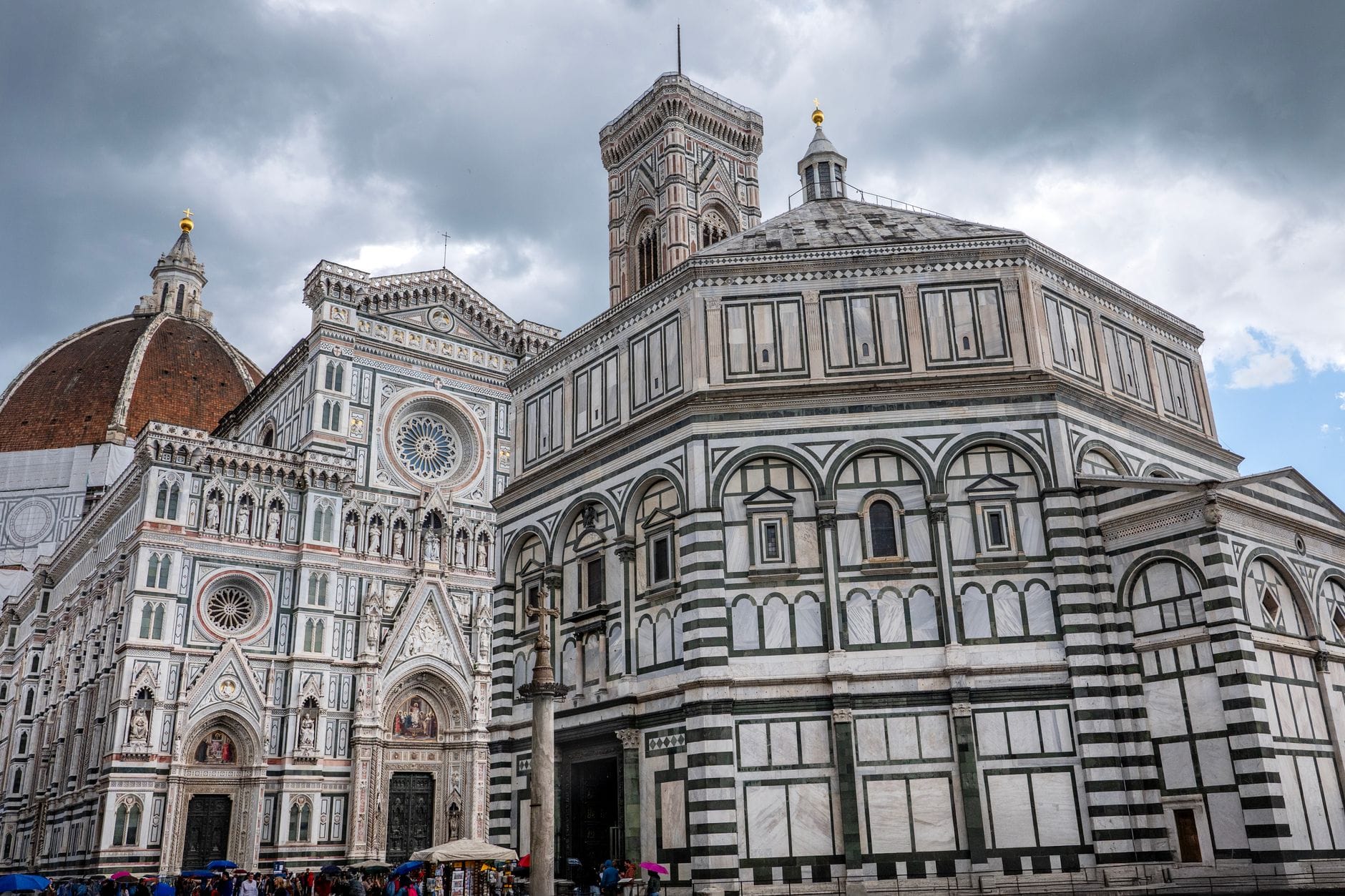
The Battistero di San Giovanni stands at the geographic and spiritual heart of Florence, separated from the Cathedral of Santa Maria del Fiore by just a narrow strip of paving stones. For centuries, every Florentine citizen was baptized here, from ordinary families to Dante Alighieri, who referred to it as his 'bel San Giovanni' in the Divine Comedy. That personal, civic weight is part of what makes this octagonal Romanesque building feel different from other monuments in the city.
Architecturally, it is one of the oldest structures in Florence. The current building was consecrated in 1059 by Pope Nicholas II, most likely as a substantial enlargement of an even earlier 4th-century baptistery on the same site. Construction and embellishment continued through the 11th and 12th centuries. The exterior is clad in alternating white Carrara marble and green Prato marble, a geometric precision that influenced Florentine architecture for generations and can be spotted echoed in the facades of churches across Tuscany.
ℹ️ Good to know
Opening hours: daily 8:30–19:30, with early closure on the first Sunday of each month (typically around 13:30–14:00). Special schedules apply on June 24 and during Easter. The Baptistery is closed on January 1, Easter Sunday, September 8, Christmas Eve, and Christmas Day. Always confirm at duomo.firenze.it before your visit.
The Gates of Paradise: What You're Actually Looking At
The Baptistery has three sets of bronze doors, and each one is a landmark in the history of Western art. The south doors, completed by Andrea Pisano around 1336, depict scenes from the life of John the Baptist in 28 Gothic quatrefoil panels. They are sober and precise, in keeping with 14th-century Florentine taste. The north doors, cast by Lorenzo Ghiberti between 1403 and 1424, mark the transition from Gothic to Renaissance narrative style. Ghiberti won the commission for the north doors in a famous public competition in 1401, beating out Filippo Brunelleschi, among others.
The east doors, facing the Cathedral, are what most visitors come specifically to see. Michelangelo reportedly called them the 'Gates of Paradise,' a phrase that has stuck for 500 years. Ghiberti spent roughly 27 years completing them, between 1425 and 1452, and they represent a quantum leap: ten large gilded bronze panels depicting Old Testament scenes with extraordinary depth, landscape, and anatomical realism. The detail in panels like 'Joseph and His Brothers' or 'The Story of Moses' is stunning even from a few meters away.
An important practical note: the doors you see on the exterior are high-quality replicas installed to protect the originals. The original panels from the Gates of Paradise, restored over decades following the 1966 Arno flood, are displayed in the Museo dell'Opera del Duomo a short walk away. If you are seriously interested in the craftsmanship, the originals at the museum reward close inspection in ways the outdoor replicas cannot.
The Museo dell'Opera del Duomo is included in the combined Duomo complex ticket and is well worth pairing with your Baptistery visit. Read more about the complex in our guide toMuseo dell'Opera del Duomoor get broader context from our overview of theFlorence Cathedral and Duomo complex.
Tickets & tours
Live prices and dates from our booking partner. If you book, we may earn a commission at no extra cost to you.
Florence Baptistery and Opera Museum audio tour with live expert guide
From 55 €Instant confirmationFree cancellationFlorence Baptistery, Cathedral and Museum ticket with audio guide
From 29 €Instant confirmationFree cancellationPerfume masterclass: a sensory experience in Florence
From 70 €Instant confirmationFree cancellationFlorence cathedral complex and Brunelleschi's dome tickets
From 59 €Instant confirmation
The Interior: Mosaics, Marble, and Medieval Grandeur
Most visitors spend the majority of their time outside examining the doors, which means the interior is often less congested than you might expect given the building's fame. Walking inside feels like entering a different century entirely. The floor is inlaid with intricate geometric marble patterns and zodiac signs, some of which date to the 13th century. The walls are lined with classical Roman columns, almost certainly sourced from ancient structures that once stood on or near this site.
The ceiling is the main event inside. The entire interior of the dome is covered in Byzantine-style mosaics begun in the late 12th century and completed over roughly a hundred years, with contributions from multiple Florentine workshops. The iconographic program is vast: Christ in Majesty dominates the largest panel, surrounded by scenes from the Last Judgment, the life of John the Baptist, the life of the Virgin, and the story of Joseph. The gold tesserae catch light differently depending on the hour and the angle of entry, shifting the warm amber tones across the vaulted surface.
Cimabue, the great proto-Renaissance Florentine painter, is traditionally credited with designing portions of the mosaics, though attribution within the program remains a subject of scholarly discussion. What is not disputed is the scale and coherence of the achievement: standing at the center of the octagon and looking up, the effect is enveloping in a way that photographs consistently fail to capture.
💡 Local tip
Bring or rent a small pair of binoculars if you own them. The upper registers of the mosaic ceiling contain detail that is genuinely difficult to appreciate with the naked eye from ground level.
How the Experience Changes by Time of Day
The square outside the Baptistery, Piazza San Giovanni, is one of the most congested spots in Florence from mid-morning through late afternoon. Tour groups cluster around the east doors, and the combination of audio guides, umbrella-toting guides, and selfie-stick maneuvers can make standing in front of the Gates of Paradise feel more like navigating a corridor than experiencing art. If you are visiting the exterior doors, arriving before 10:00 or after 17:00 makes a significant difference.
The interior hours begin later (11:15 on most days), which creates an interesting dynamic: the first slot of the day sees visitors who have specifically planned to enter early, and it is noticeably calmer than the midday rush. Sunday mornings, when the Baptistery opens at 8:30, offer an unusually quiet window before the tourist wave builds. The light inside is relatively constant since there are no large windows, but morning light entering through the main door does illuminate the floor mosaics in a particularly striking way.
Winter visits carry a particular atmospheric quality that summer cannot replicate. The square is emptier, the air carries the faint smell of roasting chestnuts from nearby vendors, and the white and green marble facade seems almost to glow against grey skies. Crowds thin dramatically from November through February, though you should account for the earlier sunset when planning late-afternoon visits.
Practical Walkthrough: Getting There and Getting In
The Baptistery is in the Centro Storico, Florence's UNESCO-listed historic core, roughly a 10–12 minute walk from Firenze Santa Maria Novella station. Several city bus lines (6, 11, 14, 23, C1, C2, and 71) stop at or near Piazza del Duomo. Most visitors approach on foot through the historic center, typically arriving via Via dei Calzaiuoli from Piazza della Signoria or through the network of medieval streets from the train station.
The Baptistery is physically adjacent to the Cathedral, Giotto's Campanile, and the Museo dell'Opera del Duomo. All four are included in the combined Opera di Santa Maria del Fiore ticket, which represents considerably better value than buying the Baptistery alone if you plan to visit more than one component. Theclimb to the top of Brunelleschi's Dome and the Giotto's Campanileare both worth building into the same half-day, since they share the same ticket and are steps from the Baptistery.
Tickets can be purchased on-site at the Piazza San Giovanni ticket office or in advance online via the Opera del Duomo website. Pre-booking is strongly recommended in spring and summer, as the combined complex sells out. Check duomo.firenze.it for current pricing before your visit, as ticket structures are periodically updated.
⚠️ What to skip
Dress code is enforced. Covered shoulders and knees are required to enter. Sleeveless tops and short shorts will result in denied entry. Lightweight scarves are sold by vendors outside but bringing your own is faster and cheaper.
The Baptistery is confirmed accessible for visitors with mobility difficulties. Free admission for visitors with disabilities is available by speaking with staff at the ticket desk in Piazza San Giovanni 7, with appropriate certification.
How the Baptistery Fits into the Larger Florentine Story
Florence is widely regarded by historians and scholars as the cradle of the Italian Renaissance, and the Baptistery sits at the very beginning of that story. The 1401 competition for the north doors commission is often cited as the moment when Renaissance artistic ambition first broke into the open, with multiple sculptors submitting panels interpreting the Sacrifice of Isaac according to criteria that explicitly valued classical technique alongside religious narrative. Ghiberti's winning panel and Brunelleschi's rejected entry both survive and are displayed in the Bargello, making this one of those rare cases where you can stand in front of the actual competing works.
That broader Renaissance geography, connecting the Baptistery, the Bargello, the Duomo, and sites across the city, is worth understanding before you visit. Our guide toMichelangelo in Florencetraces another thread of this story, and theMuseo del Bargellois where you can see Ghiberti's competition panel in person.
The Baptistery's civic function matters as much as its artistic content. For roughly nine centuries, Florentine children were brought here for baptism, making it the shared ritual origin point for the city's entire population, including its most famous sons. That continuity between daily life and monumental art is something Florence achieves better than almost any other city in the world, and the Baptistery is one of the clearest expressions of it.
Who Should Skip It (and Why)
Travelers on extremely tight schedules who have already allocated their Duomo complex time to the dome climb and the Campanile may find that adding the Baptistery interior stretches the day uncomfortably. The exterior doors are freely visible from the square at any time, and if you are visiting the Museo dell'Opera del Duomo (which is included in the same combined ticket), you will see the original Gates of Paradise panels there in far better lighting and detail than on the building itself.
Visitors with young children who struggle with low-stimulation environments may find the interior less engaging than the Campanile climb or the dome. The mosaics are extraordinary but require time and stillness to appreciate, which is not always compatible with traveling with small kids. That said, the floor mosaics with their zodiac symbols tend to catch children's attention in ways the ceiling does not.
If you are trying to build a broader picture of the Centro Storico in a single day, ourone-day Florence itineraryshows how to combine the Baptistery with the Duomo complex, Piazza della Signoria, and the Uffizi without feeling rushed.
Insider Tips
- On the first Sunday of each month, the Baptistery opens at 8:30 but closes early (around 13:30–14:00), which can be an excellent way to see the interior without the midday crowd.
- The Gates of Paradise replicas on the exterior are excellent, but if you want to see the originals up close, head to the Museo dell'Opera del Duomo, included in the same combined ticket. The restored panels are displayed at eye level in a purpose-built room.
- Photography inside is generally permitted without flash. The mosaic ceiling is the obvious subject, but the geometric marble floor patterns, especially the zodiac roundels near the center, are worth photographing and often ignored by other visitors.
- The Baptistery stands between two squares: Piazza del Duomo and Piazza San Giovanni. The north and south doors are significantly less photographed than the east (Gates of Paradise) doors and worth examining closely without fighting for space.
- If you are visiting in June, note that the Baptistery has special hours and programming around June 24, the feast of Saint John the Baptist and Florence's patron saint day. This is the city's most significant civic-religious celebration, and the atmosphere around the Baptistery is unlike any other day of the year.
Who Is Florence Baptistery For?
- Art history enthusiasts who want to trace the origins of Renaissance sculpture in the physical spaces where it happened
- Architecture travelers drawn to Romanesque design and its influence on later Italian styles
- Visitors with a combined Duomo complex ticket who want to understand all four components of the site
- Travelers interested in Byzantine mosaic art, particularly those who have already visited Ravenna or Venice's San Marco
- Anyone with even a passing connection to Dante, whose baptism here gives the building a strong literary resonance
Nearby Attractions
Other things to see while in Centro Storico (Historic Center):
- Arno River Walk (Lungarni)
The Lungarni are the named embankment streets running along both banks of the Arno River through central Florence. Free to walk at any hour, they offer the city's best unmediated views of the Ponte Vecchio, the surrounding hills, and the slow rhythm of Florentine daily life. No ticket, no queue, no reservation required.
- Brunelleschi's Dome Climb
The climb inside Brunelleschi's Dome is one of the most physically rewarding experiences in Florence. 463 steps through narrow brick passages deliver you to a panoramic terrace above the city's rooftops, with views that no other vantage point in the historic centre can match. Here is everything a traveler needs to plan it well.
- Florence Cathedral (Duomo di Firenze)
The Cattedrale Metropolitana di Santa Maria del Fiore is the geographic and spiritual heart of Florence. Free to enter, extraordinary to stand inside, and far more layered than its famous exterior suggests. Here is everything you need to plan a worthwhile visit.
- Florence Wine Windows (Buchette del Vino)
Scattered across Florence's historic center, the Buchette del Vino are tiny stone-framed wine hatches built into Renaissance palazzo walls in the 16th century. Free to explore, still active at select venues, and one of the city's most quietly fascinating street-level details.
Planning a trip? Discover personalized activities with the Nomado app.