Museo dell'Opera del Duomo: Florence's Most Underrated Cathedral Museum
The Museo dell'Opera del Duomo holds the original sculptures, reliefs, and tools behind Florence's Duomo complex, including Ghiberti's Gates of Paradise and Michelangelo's unfinished Pietà. Reopened after a major 2015 renovation, it is a major and highly significant cathedral museum, yet consistently less crowded than the Uffizi or Accademia.
Quick Facts
- Location
- Piazza del Duomo 9, Centro Storico, Florence (northeast side of the cathedral square)
- Getting There
- 10–15 min walk from Santa Maria Novella railway station through the mostly pedestrianized historic centre. No tram stop directly at the Duomo; walking is the practical option.
- Time Needed
- 2–3 hours for a thorough visit; 90 minutes if focused on highlights
- Cost
- Included in the Giotto Pass (€30, valid 3 days, covers Bell Tower, Baptistery, Opera del Duomo Museum, and Santa Reparata crypt). Free for disabled visitors and one carer upon advance reservation and availability. Verify current prices at the official site before visiting.
- Best for
- Renaissance sculpture enthusiasts, art history students, Duomo complex visitors, anyone who wants to see the originals behind the copies outside
- Official website
- duomo.firenze.it/en/discover/opera-duomo-museum
What the Museo dell'Opera del Duomo Actually Is
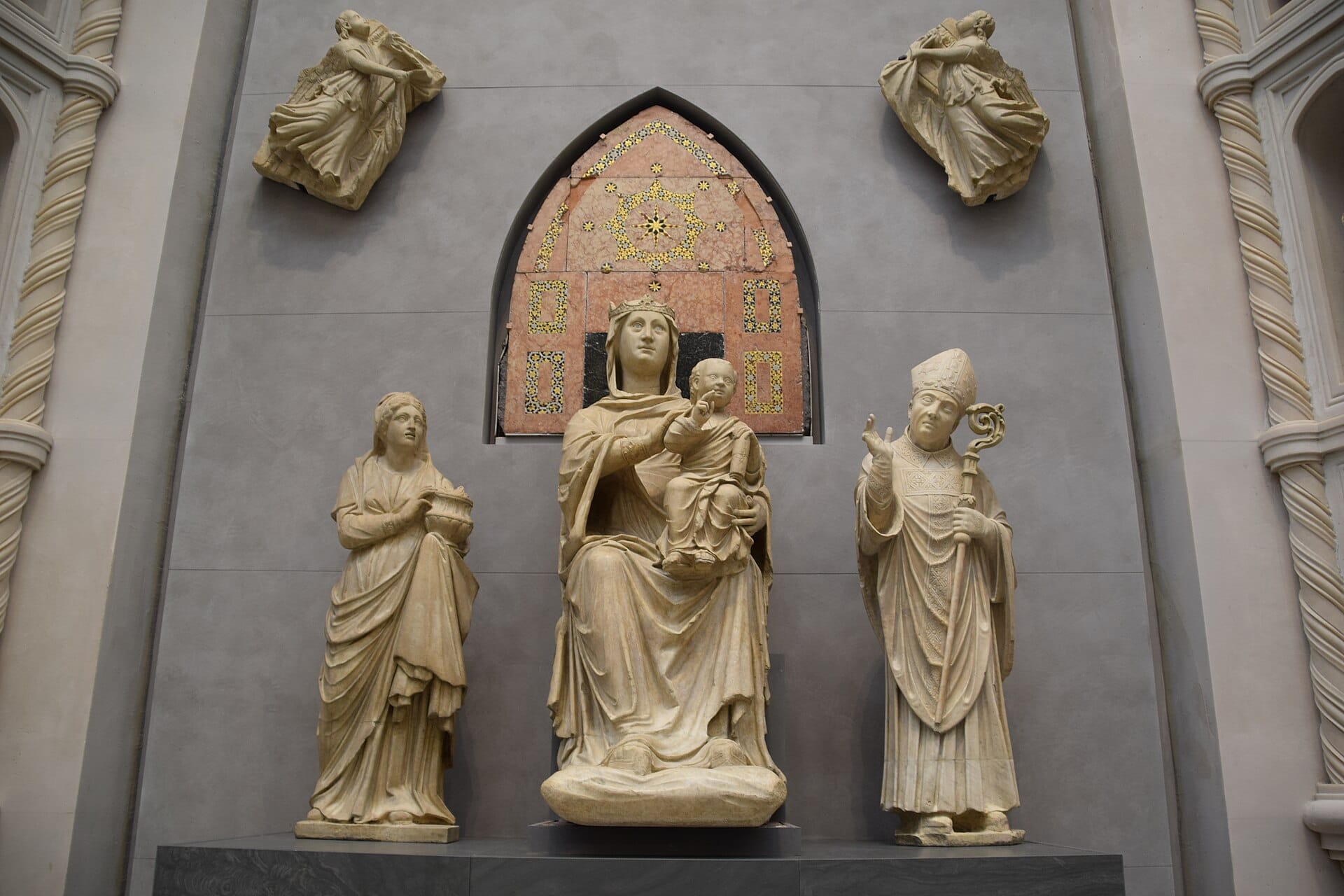
Most visitors walk past the Museo dell'Opera del Duomo without a second glance, distracted by the cathedral facade thirty metres away. That is a significant oversight. The museum, officially the Museo dell'Opera del Duomo di Firenze, exists specifically to house the original sculptures, reliefs, tools, and archival records that were removed from the Duomo, Baptistery, and Giotto's Bell Tower over the centuries, as weather, pollution, and structural fragility made outdoor display impossible. What you see on the exteriors of those buildings today are, in almost every significant case, high-quality replicas. The originals are in here.
The Opera del Duomo, the cathedral works commission that manages and maintains the Duomo complex, was founded in 1296, the same year construction on the cathedral began. The museum itself was formally established in 1891 to consolidate and display the growing collection of displaced masterworks. After a major renovation completed in 2015, the building expanded significantly, greatly increasing its exhibition space and creating a major cathedral museum. The experience today is a complete reimagining of what a museum about a building can be.
💡 Local tip
The museum is closed on the first Tuesday of every month for maintenance. It otherwise opens daily at 8:30 and closes at 19:00, except that it does not open on that first Tuesday. Arrive early on weekdays for the calmest experience. Hours can vary on Italian public holidays, so check the official Opera di Santa Maria del Fiore website before your visit.
The Collection: What You Will Actually See
The collection covers roughly seven centuries of artistic production tied to Florence's cathedral complex, spanning from medieval stonework through High Renaissance masterpieces. The organisation is broadly chronological, though themed rooms draw connections across periods. Three works in particular justify the visit on their own terms.
Lorenzo Ghiberti's Gates of Paradise, the gilded bronze doors originally installed on the east facade of the Baptistery, anchor the museum's central hall. The name was coined by Michelangelo himself, according to Vasari, and the doors took Ghiberti over twenty years to complete. Ten large panels depict Old Testament scenes with a spatial complexity, using gilded bronze relief, that was genuinely revolutionary for the early 15th century. Seeing them at eye level, under controlled lighting, at a pace you choose, is a fundamentally different experience from peering at the replica on the Baptistery facade from behind a crowd.
Michelangelo's Bandini Pietà, sometimes called the Florentine Pietà, is a late, unfinished work that the sculptor reportedly intended for his own tomb before abandoning and partially mutilating it in frustration. A student completed some sections afterward. The result is a strangely raw object: polished marble transitions into rough-hewn stone, finished faces share the composition with figures barely emerged from the block. It communicates something about artistic process that no finished masterwork can.
Donatello's Mary Magdalene, carved in painted wood, dates from around 1455 and is one of the most unsettling devotional images of the Renaissance. Where other artists rendered the Magdalene as beautiful and penitent, Donatello carved her emaciated, gaunt, clearly aged by desert years of asceticism. It is simultaneously technically masterful and deeply uncomfortable to stand in front of, which is precisely the point.
Tickets & tours
Live prices and dates from our booking partner. If you book, we may earn a commission at no extra cost to you.
Florence Duomo guided tour and main city's museums pass
From 29 €Instant confirmationFree cancellationDuomo Cathedral skip-the-line entry and express tour
From 20 €Instant confirmationFree cancellationGuided Tour of Florence's Duomo Complex
From 55 €Instant confirmationFree cancellationFlorence Duomo and Brunelleschi's Dome entrance with audio app
From 59 €Instant confirmationFree cancellation
The Brunelleschi Room and Architectural Context
One full section of the museum is devoted to the construction of the dome itself, including original tools, models, and the death mask of Filippo Brunelleschi. This section functions almost as a separate exhibit on engineering history. The herringbone brick pattern Brunelleschi invented to construct the dome without a traditional wooden centering frame is explained through scale models, and you can see the bricks and iron chains used in the actual construction.
If you plan to climb the dome, visiting this section first gives the ascent a completely different dimension. You understand what you are walking through. TheBrunelleschi dome climbis covered by the same Giotto Pass that includes the museum, so many visitors combine both in a single day. That said, do the museum first while your legs are fresh.
How the Experience Changes Through the Day
The museum opens at 8:30, and the first hour is consistently the quietest. The central hall containing the Gates of Paradise, which can feel overwhelmed with groups mid-morning, is almost meditative at this hour. Natural light through the skylights of the main hall shifts through the morning, altering the way the gilded panels catch and reflect it. By 10:30, school groups and guided tours begin arriving in volume.
Midday brings the densest crowds, particularly around the most famous works. This is when the Ghiberti panels and Michelangelo's Pietà attract the longest standing-room situations. The museum's layout does allow you to reverse the standard flow and start at the upper floors or side galleries, effectively moving against the crowd's direction and finding more space.
Late afternoon, roughly 17:00 onward, sees a marked drop in visitors as tour groups depart for dinner. The light quality changes in the main hall, becoming warmer and more angled. If your schedule allows, this window rewards unhurried looking.
ℹ️ Good to know
Photography is permitted in most areas of the museum without flash. Tripods are generally prohibited. The main hall with the Gates of Paradise can be dimly lit in some sections; phone cameras handle it adequately, but a dedicated camera with a wide aperture lens produces noticeably better results.
Practical Walkthrough: Layout and Navigation
The museum entrance is on the northeast side of Piazza del Duomo at number 9, set back slightly from the main cathedral facade and easy to miss if you are focused on the dome. The entrance is at street level. The building is fully accessible, with elevators serving all three floors and the terrace, and free admission can be extended to disabled visitors and one accompanying carer upon reservation and subject to availability. For accessibility inquiries or advance arrangements, the official contact is accessibilita@duomo.firenze.it.
The ground floor contains the medieval and early Renaissance collection, including original statuary from the Duomo's exterior, a room dedicated to Arnolfo di Cambio's work, and the extraordinary architectural models. The central hall, a double-height space specifically designed in the 2015 renovation, reproduces the facade of the Baptistery at scale, allowing the Gates of Paradise to be displayed in near-contextual relation to their original home. The upper floors continue through the 15th and 16th centuries, with the Donatello and Luca della Robbia cantorie (choir lofts) suspended for viewing from multiple angles.
The museum is located within theCentro Storico, Florence's historic core, and you can realistically walk to major landmarks from here within ten minutes in any direction. The Baptistery andFlorence Baptisteryare directly across the square, whileGiotto's Campanilestands immediately adjacent to the cathedral facade.
Honest Assessment: Limitations and Who Might Skip This
The museum is not a casual drop-in. Without some prior familiarity with the Duomo complex, the medieval stonework rooms can feel like an undifferentiated sequence of damaged sculptures and architectural fragments. Audio guides and the museum's printed materials help, but they require active engagement. Visitors expecting the visual drama of the Uffizi's paintings, or the single-icon clarity of the Accademia's David, may find the experience demanding.
Young children may struggle with the pacing and the density of the collection. If you are traveling with kids and want a more interactive cultural experience nearby, consider theFlorence with kids guidefor alternatives better suited to shorter attention spans.
The museum is also not free as a standalone ticket. Access is bundled within the Giotto Pass, officially priced at €20 (valid 3 calendar days, subject to change), which covers the Bell Tower, Baptistery, Opera del Duomo Museum, and Santa Reparata crypt. If you are not planning to visit other components of the Duomo complex, the pass still represents reasonable value given what the museum contains, but confirm current pricing on the official Opera di Santa Maria del Fiore website before you buy.
⚠️ What to skip
The museum is closed on the first Tuesday of every month. If your Florence visit falls on that day, plan accordingly. Church dress code standards apply in the religious sections of the Duomo complex, but the museum itself has no specific dress requirement beyond general decency.
Combining This Visit with the Duomo Complex
The Giotto Pass covers the museum, the Bell Tower, the Baptistery, and the Santa Reparata crypt beneath the cathedral floor (the dome climb requires the Brunelleschi Pass). Doing all of these in one day is possible but tiring, particularly if you add the dome climb's 463 steps and the Bell Tower's 414 steps. A more common approach is to spread the complex across two days: museum and Baptistery on day one, dome and Bell Tower on day two. For a full overview of how to sequence the Duomo complex within a broader itinerary, theone day in Florence guidecovers realistic pacing. TheFlorence Cathedral (Duomo)itself is free to enter, though timed entry is required for the interior.
Insider Tips
- Buy your Giotto Pass online in advance through the official Opera di Santa Maria del Fiore website. Ticket queues at the piazza can be long in peak season, while the museum entrance itself is often calm. Buying online eliminates the queue entirely.
- The room displaying the two cantorie (marble choir lofts) by Donatello and Luca della Robbia is often overlooked by visitors moving quickly toward the major single works. Both cantorie are installed at eye level after the 2015 renovation, finally visible in detail rather than mounted high in situ. The della Robbia cantoria in particular rewards slow looking.
- The terrace accessible by elevator offers a view toward the cathedral apse and the surrounding roofline of the centro storico. It is rarely crowded and provides a different perspective on the dome than the more famous views from Piazzale Michelangelo.
- If you want to understand the cathedral's medieval original facade, the reconstruction in the main hall is the only place you can see it. Arnolfo di Cambio's unfinished facade was demolished in 1587, and the current facade dates from the 19th century. The museum presents the salvaged original sculptures alongside documentation of what was lost.
- The museum shop, located near the exit, stocks academic catalogues on the collection that are difficult to find elsewhere, including detailed studies of the Ghiberti panels and the Donatello works. These are genuinely useful for anyone continuing to other Renaissance sites in Florence.
Who Is Museo dell'Opera del Duomo For?
- Art history enthusiasts who want to see the original Renaissance sculptures behind the Duomo complex replicas
- Visitors already purchasing the Giotto Pass for the dome climb or Baptistery, who should treat this museum as the essential companion
- Architecture and engineering-focused travelers interested in Brunelleschi's dome construction methods
- Anyone who finds the Uffizi overwhelming and prefers a more focused collection with a coherent historical narrative
- Repeat visitors to Florence who have covered the major galleries and want to go deeper into the city's medieval and Renaissance craft history
Nearby Attractions
Other things to see while in Centro Storico (Historic Center):
- Arno River Walk (Lungarni)
The Lungarni are the named embankment streets running along both banks of the Arno River through central Florence. Free to walk at any hour, they offer the city's best unmediated views of the Ponte Vecchio, the surrounding hills, and the slow rhythm of Florentine daily life. No ticket, no queue, no reservation required.
- Brunelleschi's Dome Climb
The climb inside Brunelleschi's Dome is one of the most physically rewarding experiences in Florence. 463 steps through narrow brick passages deliver you to a panoramic terrace above the city's rooftops, with views that no other vantage point in the historic centre can match. Here is everything a traveler needs to plan it well.
- Florence Baptistery
The Florence Baptistery, officially the Battistero di San Giovanni, is one of the oldest and most significant religious buildings in Italy. Standing directly in front of Florence Cathedral, it is famous for Ghiberti's gilded bronze 'Gates of Paradise' and a breathtaking interior ceiling covered in Byzantine mosaics. This guide covers what to expect, when to visit, and how to make the most of your time here.
- Florence Cathedral (Duomo di Firenze)
The Cattedrale Metropolitana di Santa Maria del Fiore is the geographic and spiritual heart of Florence. Free to enter, extraordinary to stand inside, and far more layered than its famous exterior suggests. Here is everything you need to plan a worthwhile visit.
Planning a trip? Discover personalized activities with the Nomado app.