Climbing Brunelleschi's Dome: What to Expect at the Top of Florence
The climb inside Brunelleschi's Dome is one of the most physically rewarding experiences in Florence. 463 steps through narrow brick passages deliver you to a panoramic terrace above the city's rooftops, with views that no other vantage point in the historic centre can match. Here is everything a traveler needs to plan it well.
Quick Facts
- Location
- Piazza del Duomo, Centro Storico, Florence — entrance at Porta della Mandorla on the north side of the cathedral
- Getting There
- 10–15 minute walk from Firenze Santa Maria Novella station; the historic centre is pedestrianized — no bus stops directly at the Duomo
- Time Needed
- 45–60 minutes including the queue, climb, and time at the top
- Cost
- Included in the Brunelleschi Pass (Duomo complex ticket); guided dome tour via Opera di Santa Maria del Fiore: timed reservation required. Timed entry required — no walk-ups.
- Best for
- Architecture lovers, panoramic views, Renaissance history, active travelers comfortable with confined spaces
- Official website
- duomo.firenze.it/en
What the Dome Climb Actually Is
Brunelleschi's Dome, formally known as the Cupola di Santa Maria del Fiore, crowns Florence Cathedral and remains the largest masonry dome ever built. Construction began on 7 August 1420 under architect Filippo Brunelleschi and the dome was consecrated in 1436. More than six centuries later, visitors still climb the same double-shell brick structure Brunelleschi engineered without a supporting wooden centering frame, a feat that engineers still study today.
The climb covers 463 steps. These are not straightforward stairs. The route winds between the dome's inner and outer shells through passages that narrow at points, with the brick curving overhead and the stone steps worn smooth by millions of feet. The physical reality is part of the experience: you feel the scale of the structure from inside it.
⚠️ What to skip
The climb is not suitable for people with claustrophobia or vertigo. There is no elevator and no exit midway through the route. The Opera di Santa Maria del Fiore explicitly advises against attempting the climb if these apply.
The dome forms part of a broader complex of monuments managed by the Opera di Santa Maria del Fiore. If you are planning a full morning around this area, also consider theMuseo dell'Opera del Duomo and Giotto's Campanile, both included in the same complex ticket. Together, these three sites form the most concentrated architecture experience in Florence's historic centre.
The Climb Step by Step
The entrance to the dome climb is at the Porta della Mandorla on the north side of the cathedral. This is not the main façade entrance used for the church nave, and first-time visitors frequently miss it. Look for the marble relief of the Virgin above the door and the queue management barriers outside.
The first section of the climb is a tight spiral staircase through the cathedral walls. After a short passage, you reach the first significant stop: the interior walkway that circles the base of the dome, directly above the nave. From here you look straight down at Giorgio Vasari's fresco of the Last Judgment covering the interior of the dome. Take a moment here. The perspective — standing on a narrow ledge at significant height, with the painted surface curving above and below you — is genuinely disorienting in the best way.
The final section of the climb between the inner and outer shells is the most physically demanding. The passage follows the curve of the dome itself, meaning the floor and walls both tilt inward as you rise. Handrails are provided. Ventilation is limited on warm days, and the brick radiates heat in summer. Moving slowly and steadily is the practical approach.
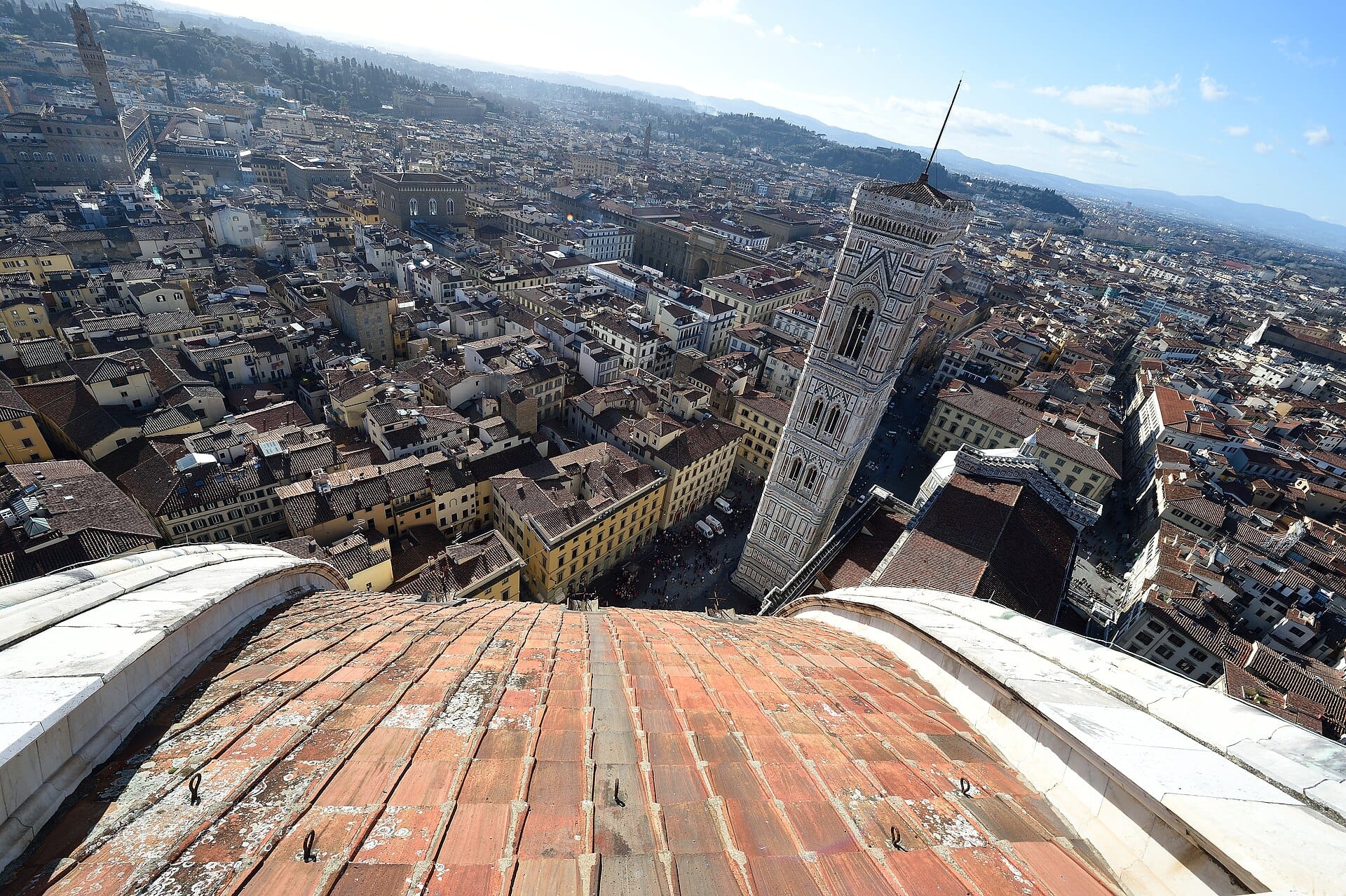
At the top, the terrace wraps around the base of the lantern. The view covers the full bowl of the city: the Arno River cutting through the valley, the orange tile rooflines of the Centro Storico, the Oltrarno hills rising to the south, and on clear days the Tuscan countryside stretching to the horizon. Few other points in the historic centre offer an unobstructed 360-degree view at this height.
Tickets & tours
Live prices and dates from our booking partner. If you book, we may earn a commission at no extra cost to you.
How the Experience Changes by Time of Day
Early morning entry, close to the 08:15 opening on weekdays, is the most effective way to avoid crowds inside the passages. The narrow corridors between the shells mean that even a moderate queue of visitors ahead of you creates a slow, stop-start ascent. In high season from June through August, the wait at the entrance can add time to the total visit even with a timed ticket.
The quality of light at the top terrace changes considerably across the day. Morning light comes from the east and illuminates the Oltrarno hills and the Arno valley, giving the clearest photographic visibility before midday haze settles over the city in summer. Late afternoon shifts the warm light toward the cathedral's west façade and the streets leading toward Santa Maria Novella, which can be visually striking but also means shooting into the sun from certain angles.
💡 Local tip
Sunday hours are shorter — 12:45 to 16:30 — which compresses visitor numbers into a smaller window. Saturday afternoons are similarly crowded. Weekday mornings in April, May, or October give you the best combination of light, temperature, and manageable crowds.
In winter the terrace can be genuinely cold and windy. The Arno valley creates a natural wind corridor, and the exposed position at the top of the dome means temperatures at the summit feel several degrees colder than at street level. A layer in your bag is worth the inconvenience even if it seems excessive in the piazza below.
The Architecture and Why It Matters
The dome's double-shell construction was Brunelleschi's core innovation. The inner shell carries the structural load; the outer shell provides weatherproofing and visual impact. Between them runs the staircase you walk up. Brunelleschi used a herringbone brick pattern — called a spina pesce layout — to distribute stress across the dome without mortar fully curing before the next layer was added, eliminating the need for the temporary wooden frameworks that had been assumed necessary for any dome of this diameter.
The dome's external diameter is 45.52 meters, and the total height from the floor of the cathedral to the top of the lantern is approximately 114.5 meters. These numbers were considered impossible when the commission was first put out in 1418. Brunelleschi submitted his proposal, famously refused to reveal his method to competitors, and then demonstrated it by actually building the thing. The dome was finished within his lifetime, though Brunelleschi died in 1446, and the lantern was completed later by others following his design.
For deeper context on Brunelleschi's influence across Florence's built environment, the guide toRenaissance art in Florencecovers how the dome anchored the visual and symbolic identity of the city for generations of artists who followed.
Tickets, Booking, and Practical Details
Access to the dome requires a timed-entry ticket booked in advance. Walk-up entry is not available. The dome climb is included in the Brunelleschi Pass, which covers the cathedral interior, the dome climb, Giotto's Campanile, the Baptistery, the Crypt, and the Museo dell'Opera del Duomo. This is the standard ticket for most visitors. The Opera di Santa Maria del Fiore also offers a dedicated guided tour of the dome, which includes the entrance fee and a guide through the interior passages.
Opening hours for the dome climb on a typical weekday are 08:15 to 18:45, with last admission about 45 minutes before closing. Saturday hours end at 16:30 and Sunday hours run from 12:45 to 16:30. Hours are reduced or suspended on major religious holidays. Always verify current hours directly on the Opera di Santa Maria del Fiore website before visiting, as these schedules shift seasonally and around the liturgical calendar.
ℹ️ Good to know
Book tickets through the official Opera di Santa Maria del Fiore website (duomo.firenze.it). Third-party resellers charge significant markups. Timed slots for the dome fill weeks in advance during summer and Easter week. For spring travel, booking 2–3 weeks ahead is a reliable buffer.
Dress code applies to the cathedral itself — covered shoulders and knees are required for entry. These rules apply at the nave entrance; the dome climb entrance via Porta della Mandorla is technically a separate access point, but the same standards are enforced. Bring water for the climb, particularly in summer.
Photography on the Climb
The interior walkway above the nave is the most photogenic stop before the summit. Shooting the Vasari fresco from above requires a wide angle and steady hands — there is no tripod space and movement is constant as other visitors pass. A phone camera or compact camera is more practical than a DSLR with a large lens inside the passages, both for space and for protecting your equipment from contact with the walls.
At the exterior terrace, the dome's terracotta tiles are immediately behind you, which provides context shots for scale. The Florence Cathedral facade directly below, the Baptistery's octagonal form, and the grid of streets radiating into the Centro Storico all read clearly from this height. The view toward the Oltrarno and the hills beyond makes for the most compelling wide-angle shots, especially with the Arno visible in the middle distance.
For comparison of the city's best panoramic vantage points, the guide tothe best views in Florencecovers how the dome terrace compares to Piazzale Michelangelo, Forte di Belvedere, and other elevated lookouts.
Who Should Think Twice
The dome climb is worth every step for the right traveler. But it is worth being direct about who might not enjoy it. If tight enclosed passages cause anxiety, the section between the shells will be genuinely uncomfortable, not just mildly challenging. The passages are not pitch dark, but they are narrow, the ceiling is low in places, and passing other visitors coming down requires pressing against the wall. There is no exit until you complete the full circuit.
Visitors primarily interested in painting or Renaissance art as a category may find the Museo dell'Opera del Duomo, which houses major sculpture and devotional works, a more satisfying use of time. The dome itself is architectural and experiential rather than object-based. In summer heat, the effort is real: lightweight clothing, good walking shoes, and hydration make the difference between an uncomfortable slog and a memorable climb.
If you are building a full day around the Duomo complex and the surrounding streets, theone-day Florence itinerarysuggests a practical sequence for covering the major sites in theCentro Storicowithout backtracking.
Insider Tips
- Book the first available timed slot of the day on a weekday. The passages are emptiest before 09:30, and the morning light from the terrace is cooler and cleaner for photography than midday sun.
- The Porta della Mandorla entrance on the north side of the cathedral is easy to miss. It is not marked with large signage and is set apart from the main tourist flow around the west façade. Navigate specifically to the north side before joining any queue.
- If you are visiting multiple parts of the Duomo complex on the same day, save the dome climb for early in your visit. After a full morning at the Museo dell'Opera del Duomo or Baptistery, the physical demand of the climb feels considerably heavier.
- The narrow spiral staircases inside the walls amplify sound. The noise of other visitors' footsteps and conversations echoes continuously. If you find this disorienting, visiting on a quiet weekday morning reduces both the crowd and the noise to a manageable level.
- Wear rubber-soled shoes with grip. The stone steps are worn smooth from centuries of foot traffic and can be slippery, particularly in cooler months or if you are descending while others are still climbing up behind you.
Who Is Brunelleschi's Dome Climb For?
- Architecture enthusiasts who want to understand the dome's engineering from inside the structure itself
- First-time visitors to Florence wanting the city's defining panoramic view
- Travelers with a full day in the historic centre who can combine the climb with the Museo dell'Opera and the Baptistery under one pass
- Photographers looking for an elevated, unobstructed view across the Centro Storico rooflines
- History-focused visitors interested in Renaissance engineering and the mechanics of how the dome was actually built
Nearby Attractions
Other things to see while in Centro Storico (Historic Center):
- Arno River Walk (Lungarni)
The Lungarni are the named embankment streets running along both banks of the Arno River through central Florence. Free to walk at any hour, they offer the city's best unmediated views of the Ponte Vecchio, the surrounding hills, and the slow rhythm of Florentine daily life. No ticket, no queue, no reservation required.
- Florence Baptistery
The Florence Baptistery, officially the Battistero di San Giovanni, is one of the oldest and most significant religious buildings in Italy. Standing directly in front of Florence Cathedral, it is famous for Ghiberti's gilded bronze 'Gates of Paradise' and a breathtaking interior ceiling covered in Byzantine mosaics. This guide covers what to expect, when to visit, and how to make the most of your time here.
- Florence Cathedral (Duomo di Firenze)
The Cattedrale Metropolitana di Santa Maria del Fiore is the geographic and spiritual heart of Florence. Free to enter, extraordinary to stand inside, and far more layered than its famous exterior suggests. Here is everything you need to plan a worthwhile visit.
- Florence Wine Windows (Buchette del Vino)
Scattered across Florence's historic center, the Buchette del Vino are tiny stone-framed wine hatches built into Renaissance palazzo walls in the 16th century. Free to explore, still active at select venues, and one of the city's most quietly fascinating street-level details.
Planning a trip? Discover personalized activities with the Nomado app.