Piazza della Signoria: Florence's Civic Heart and Open-Air Sculpture Hall
Piazza della Signoria is the historic political centre of Florence, an L-shaped square that has witnessed the rise of the Medici, the burning of Savonarola, and the Republic's finest hours. Flanked by Palazzo Vecchio and the Loggia dei Lanzi, it holds some of the most significant Renaissance sculpture in the world, all under open sky and free to enter.
Quick Facts
- Location
- P.za della Signoria, 50122 Firenze FI — Centro Storico, between the Duomo and the Arno
- Getting There
- 15-minute walk from Stazione di Santa Maria Novella; no tram stop directly at the square — the historic centre is best reached on foot
- Time Needed
- 30–60 minutes for the square itself; allow extra time if visiting Palazzo Vecchio or the Uffizi
- Cost
- Free — the piazza is a public space open 24 hours. Fees apply separately to Palazzo Vecchio and the Uffizi Gallery
- Best for
- History enthusiasts, sculpture lovers, first-time Florence visitors, evening strollers
- Official website
- www.italia.it/en/tuscany/florence/piazza-della-signoria
What Is Piazza della Signoria?
Piazza della Signoria is Florence's principal civic square and, for many visitors, the emotional centre of the city. It is an L-shaped stone-paved space that sits roughly halfway between the Duomo and the Arno River, anchored on one side by the crenellated bulk of Palazzo Vecchio and on another by the open arches of the Loggia dei Lanzi. To stand here is to stand at the intersection of everything Florence once was: a republic that produced extraordinary art while tearing itself apart with faction and ambition.
Unlike most European squares of comparable prestige, Piazza della Signoria charges no entry fee and closes for no one. It is part of theCentro Storico, Florence's UNESCO-inscribed historic core, and functions as a natural crossroads for visitors moving between theUffizi Galleryand the cathedral complex. But it is not merely a transit point. Arrive at the right hour and it earns your full attention.
Historical Context: Two Thousand Years of Civic Power
The ground beneath the square's grey stone pavers has a layered history that stretches back to ancient Florentia. The piazza was built over the site of Roman-era thermal baths, abandoned at the start of the Middle Ages, and the square in its current configuration took shape during the 13th century. Its paving was laid at the end of the 14th century, making those stones, however worn, among the oldest urban surfaces in continuous public use in Italy.
From the era of the Florentine Republic through the 16th century, this was where Florence governed itself, celebrated, punished, and revolted. Palazzo Vecchio — then called the Palazzo della Signoria — housed the city's elected governing body, the Signoria. Major political decisions were announced from its windows. Citizens were summoned here by the ringing of the great bell. In 1498, the Dominican friar Girolamo Savonarola, who had briefly turned Florence into a theocratic state and ordered the burning of artworks, books, and mirrors in his 'Bonfire of the Vanities' on this very square, was himself burned alive here in front of a large crowd. A small disc set into the pavement near the fountain of Neptune marks the approximate spot.
The Medici used the square as a stage for dynastic display. Sculptures were placed here not merely as decoration but as political statements: Donatello's Judith and Holofernes was moved to the piazza's entrance as a symbol of civic virtue over tyranny. Michelangelo's David originally stood here — where a copy stands today — placed so that its gaze fell toward Rome, a deliberate political gesture.
ℹ️ Good to know
The original Michelangelo's David was moved to the Galleria dell'Accademia in 1873 to protect it from weathering. The marble statue in the piazza is a 19th-century copy. If seeing the original is a priority, book Accademia tickets well in advance.
Tickets & tours
Live prices and dates from our booking partner. If you book, we may earn a commission at no extra cost to you.
E-bike night tour of Florence with stunning view from Piazzale Michelangelo
From 55 €Instant confirmationFree cancellationE-bike tour of Florence and Piazzale Michelangelo with surprise tasting
From 29 €Instant confirmationFree cancellationTicket entrance to Galleria dell'Accademia and open bus Florence tour
From 57 €Instant confirmationFree cancellationPerfume masterclass: a sensory experience in Florence
From 70 €Instant confirmationFree cancellation
The Sculptures: An Open-Air Gallery
What makes Piazza della Signoria genuinely extraordinary is the concentration of significant sculpture accessible for free and at any hour. The Loggia dei Lanzi, a three-arched covered gallery on the square's south side, was built between 1376 and 1382 and originally served as a ceremonial space for public functions. Today it shelters some of the most important Renaissance and Mannerist sculpture in Florence, fully open to the public and completely unguarded by ticket booths.
Benvenuto Cellini's bronze Perseus with the Head of Medusa (1554) is the centrepiece: a technically dazzling work cast in a single pour, with the writhing snakes of Medusa's severed head and the hero's lifted arm creating a composition that rewards slow looking from multiple angles. Giambologna's Rape of the Sabine Women (1582), carved from a single block of marble, spirals upward in a triple-figure torsion that was unprecedented at the time. These are not reproductions. They are the originals, exposed to weather, pigeons, and the hands of passing tourists, which is both remarkable and, depending on your temperament, alarming.
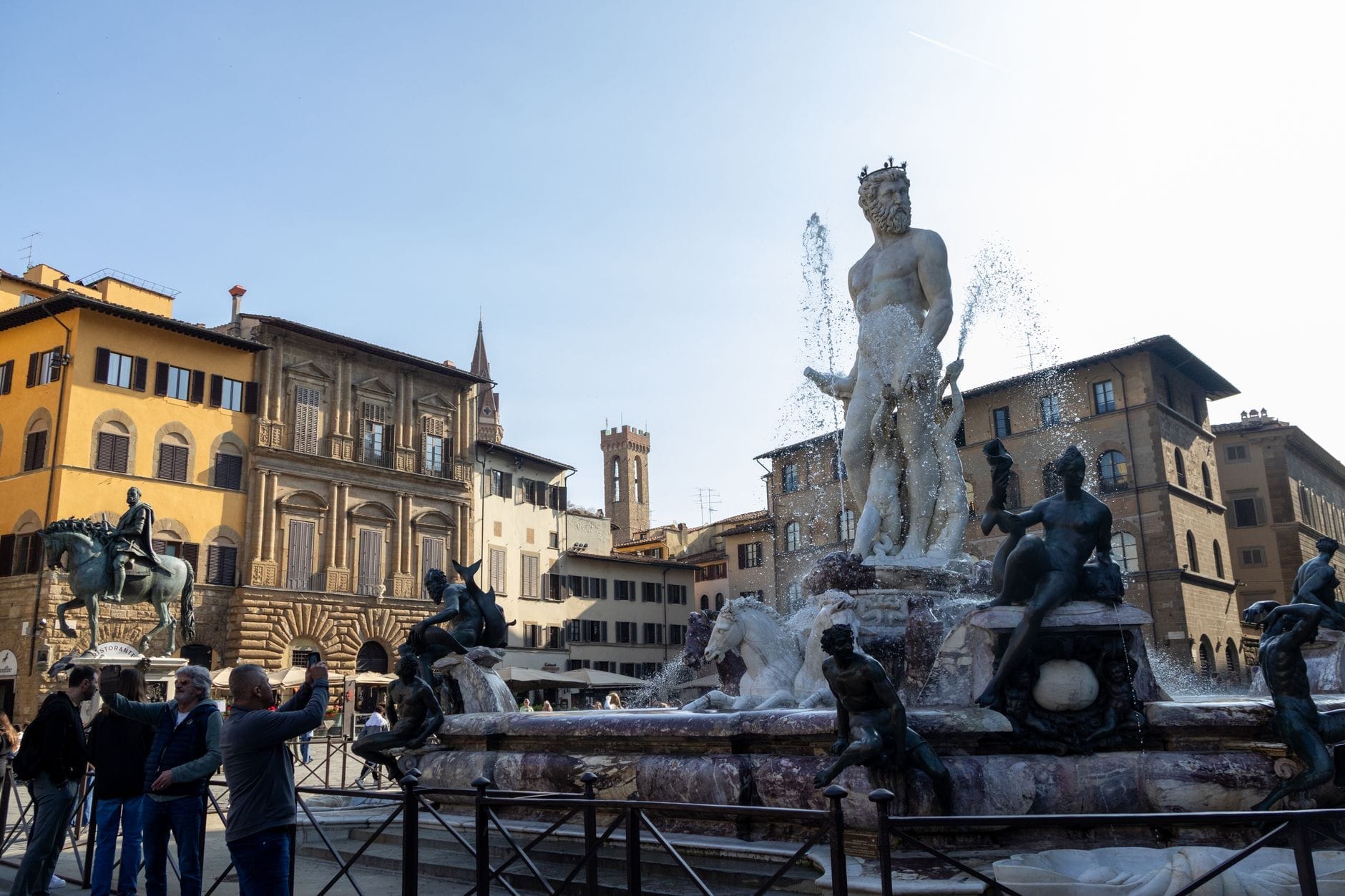
In the open square, Bartolomeo Ammanati's Neptune Fountain (1565) stands at one end, its enormous white Neptune — nicknamed 'Il Biancone' (the big white one) by Florentines who were not particularly impressed — surrounded by bronze sea creatures and satyrs of far higher quality. The equestrian statue of Cosimo I de' Medici by Giambologna (1594) closes the opposite end, a landmark bronze equestrian monument that continues Florence’s Renaissance revival of such statues.
The Square at Different Hours
The experience of Piazza della Signoria shifts considerably depending on when you arrive. Early morning, before 8 a.m., the square belongs to pigeons and municipal workers hosing the paving stones. The travertine and grey sandstone of Palazzo Vecchio's facade picks up a warm amber in the low eastern light, and you can study the Loggia dei Lanzi sculptures in something approaching silence. This is the hour for photography without crowds in the frame, and for reading the detail on Cellini's Perseus base, which contains additional small bronze figures often overlooked at busier times.
By mid-morning the square fills rapidly. Tour groups form around flag-carrying guides, outdoor cafe tables fill on the square's perimeter, and the smell of espresso mixes with sunscreen and the faint mineral scent of old stone. At peak summer hours, the density of visitors can make contemplative looking difficult. The square's L-shape means some relief is possible: the shorter arm, closer to the Uffizi colonnade, is consistently less crowded than the main stretch in front of the Loggia.
Evening brings a different quality entirely. After about 7 p.m., the tour buses have gone and the light turns deep gold before fading through orange to blue. Palazzo Vecchio's tower is illuminated against the darkening sky, and the bronze of Cellini's Perseus gleams differently under artificial light than in daylight. The square fills again with Florentines and independent travelers rather than organized groups, and the outdoor tables serve aperitivo. It is, genuinely, one of the better ways to end an afternoon in Florence.
💡 Local tip
For photography: come before 8 a.m. for empty frames and warm light, or at blue hour (around 30 minutes after sunset) for illuminated Palazzo Vecchio against a darkening sky. Midday light is flat and crowds are at their peak.
Practical Walkthrough: What to See and How to Move
Enter the square from the north, via Via dei Calzaiuoli, the pedestrian street connecting it to the Duomo. This is the direction most visitors approach from, and it gives you the full frontal view of Palazzo Vecchio's asymmetric facade and tower as you arrive. The tower, the Torre d'Arnolfo, rises 94 metres and is climbable for a panoramic view over the city's rooftops.
Turn immediately left on entering the square and spend time at the Loggia dei Lanzi before the day heats up. Move through it slowly — the back wall holds Giambologna's three intertwined figures of the Rape of the Sabine Women standing in the loggia, often overlooked by visitors focused on the standing works. After the Loggia, walk toward the Neptune Fountain and then scan the copy of Michelangelo's David positioned near the entrance of Palazzo Vecchio. ThePalazzo Vecchioitself is worth entering for its frescoed halls and rooftop views — tickets are sold separately at the building's entrance.
The Uffizi Galleryruns along the piazza's southern edge and connects via the Vasari Corridor to the Ponte Vecchio. Even if you are not visiting the Uffizi on this trip, the long colonnaded facade of the Uffizi building frames the view toward the Arno and is worth pausing at. From the far end of the Uffizi colonnade, you can look back toward Palazzo Vecchio for one of the most photographed views in Florence.
Accessibility, Regulations, and Practical Notes
The piazza is largely flat and has no steps at its main entrances, making it broadly accessible for wheelchair users and visitors with strollers. However, the historic stone paving is uneven in places, with gaps between cobbles that can be challenging for wheeled mobility aids. The square is a pedestrian-priority zone with limited vehicle access.
Florence's municipal authorities have periodically introduced regulations restricting certain behaviors in the historic centre, including restrictions on eating, sitting on monument steps, and related activities in specific squares. Rules can change seasonally and are enforced by local police. Check current municipal guidelines before visiting if this is a concern, particularly in summer when enforcement tends to be stricter.
Temperatures in the square during July and August can feel considerably hotter than the ambient air temperature due to the open stone surface and lack of shade. If visiting in summer, early morning or evening visits are strongly advisable. For broader context on timing, thebest time to visit Florenceguide covers seasonal crowd and weather patterns across the city in detail.
⚠️ What to skip
Piazza della Signoria has no public seating inside the square itself. The perimeter cafes have outdoor tables, but these charge significantly above average Florence cafe prices due to location. Bring water in summer — stone surfaces radiate heat and the square is largely unshaded.
Who Should Manage Their Expectations
Visitors expecting a quiet, contemplative experience should approach with realistic expectations. At peak tourist season (June through August), this is one of the most heavily trafficked squares in Europe. If solitude and unhurried looking are priorities, consider pairing an early visit to the piazza with less-visited sculpture sites nearby — theMuseo del Bargelloa short walk away holds original works by Donatello, Cellini, and Michelangelo in a medieval palace that draws a fraction of the Uffizi's crowds.
Travelers primarily interested in paintings rather than sculpture may find the piazza itself less compelling than its immediate neighbor the Uffizi. And those hoping to understand the sculptures in depth will benefit from some preparation: the works are labeled but not extensively interpreted on-site, and the historical significance of their placement is not self-evident without context.
Insider Tips
- The small bronze disc set into the paving near the Neptune Fountain marks the approximate site of Savonarola's execution in 1498. Most visitors walk over it without noticing. Look for it roughly between the fountain and Palazzo Vecchio's main entrance.
- The base of Cellini's Perseus contains four small bronze niches with additional figures, including a self-portrait of Cellini himself. They are at ankle height and almost universally missed in the crowd. Crouch down and look.
- Palazzo Vecchio's courtyard (the first interior courtyard) can sometimes be viewed for free or at a minimal charge depending on current access rules — it contains a delicate fountain by Verrocchio and is dramatically cooler than the square in summer heat.
- The Uffizi colonnade facing the piazza is a good shaded spot to observe the square at midday without being in the thick of the crowd. Buskers and informal guides frequently set up here, but the framed view of Palazzo Vecchio from inside the colonnade is also excellent for photography.
- If you want to see the full ensemble of Loggia dei Lanzi sculptures without other visitors in frame, arrive by 7:30 a.m. in summer. In low season (November to February), even 9 a.m. can be quiet enough.
Who Is Piazza della Signoria For?
- First-time Florence visitors building their orientation to the city
- Sculpture enthusiasts who want direct access to original Renaissance bronzes without museum queues
- Evening walkers and aperitivo seekers who want atmosphere alongside history
- History-focused travelers interested in the Florentine Republic and Medici power politics
- Photographers working in early morning or blue-hour light
Nearby Attractions
Other things to see while in Centro Storico (Historic Center):
- Arno River Walk (Lungarni)
The Lungarni are the named embankment streets running along both banks of the Arno River through central Florence. Free to walk at any hour, they offer the city's best unmediated views of the Ponte Vecchio, the surrounding hills, and the slow rhythm of Florentine daily life. No ticket, no queue, no reservation required.
- Brunelleschi's Dome Climb
The climb inside Brunelleschi's Dome is one of the most physically rewarding experiences in Florence. 463 steps through narrow brick passages deliver you to a panoramic terrace above the city's rooftops, with views that no other vantage point in the historic centre can match. Here is everything a traveler needs to plan it well.
- Florence Baptistery
The Florence Baptistery, officially the Battistero di San Giovanni, is one of the oldest and most significant religious buildings in Italy. Standing directly in front of Florence Cathedral, it is famous for Ghiberti's gilded bronze 'Gates of Paradise' and a breathtaking interior ceiling covered in Byzantine mosaics. This guide covers what to expect, when to visit, and how to make the most of your time here.
- Florence Cathedral (Duomo di Firenze)
The Cattedrale Metropolitana di Santa Maria del Fiore is the geographic and spiritual heart of Florence. Free to enter, extraordinary to stand inside, and far more layered than its famous exterior suggests. Here is everything you need to plan a worthwhile visit.
Planning a trip? Discover personalized activities with the Nomado app.