Galleria dell'Accademia: Florence's Most Famous Museum, Honestly Assessed
The Galleria dell'Accademia in Florence holds Michelangelo's original David alongside a remarkable collection of Renaissance paintings and unfinished sculptures. This guide tells you exactly what to expect, when to go, and whether the experience lives up to the queue outside.
Quick Facts
- Location
- Via Ricasoli 58/60, San Marco, Florence
- Getting There
- 10-minute walk from Florence Duomo; buses serve Piazza San Marco nearby
- Time Needed
- 1.5 to 2.5 hours
- Cost
- €16 standard; €2 reduced (EU citizens 18–25); free first Sunday of each month (2026)
- Best for
- Renaissance art lovers, first-time Florence visitors, sculpture enthusiasts
- Official website
- www.galleriaaccademiafirenze.it/en
What the Galleria dell'Accademia Actually Is
The Galleria dell'Accademia di Firenze sits on Via Ricasoli, a straight, narrow street connecting the Florence Duomo with Piazza San Marco. From the outside, it gives little away: a pale facade, a modest entrance, and, for most of the year, a line of visitors stretching down the pavement. Inside is one of the most disarming moments in European art, the full-scale encounter with Michelangelo's David in person.
Founded in 1784 by Grand Duke Pietro Leopoldo as a teaching resource for the newly established Academy of Fine Arts, the museum was built into the former Hospital of San Matteo and the Convent of San Niccolò di Cafaggio. The David arrived in 1873, moved from Piazza della Signoria to protect it from weather damage. That transfer defined the museum's identity for the next 150 years.
It would be misleading, though, to call this a one-sculpture museum. The Accademia holds an important collection of Florentine panel paintings from the 13th to the 16th centuries, a significant group of Russian icons, a collection of historical musical instruments, and, perhaps most compellingly, Michelangelo's four unfinished Prisoners (also called the Slaves), which line the corridor leading to the David and offer a more intellectually revealing encounter than the famous figure at the end.
💡 Local tip
Book your ticket in advance. Walk-in queues can exceed 90 minutes during peak season (April to October). The optional booking fee is €4 via Firenze Musei’s booking service — worth every cent. Timed entry slots move quickly for popular morning windows.
The Prisoners: What Most Visitors Walk Past Too Quickly
Before you reach the David, you pass through the Tribune of the Slaves, a long vaulted hall lined with Michelangelo's four unfinished marble figures: Atlas, the Young Slave, the Awakening Slave, and the Bearded Slave. These were originally intended for the tomb of Pope Julius II and were never completed. That incompleteness is the point.
Standing beside them, you can trace with your eye exactly where the chisel stopped. The figures appear to be emerging from the raw stone, or possibly receding back into it. The rougher sections retain the texture of the original block: slightly grainy, unpolished, cool to the visual touch in a way the finished surfaces are not. Whether this incompleteness was intentional or circumstantial is still debated, but the effect is extraordinary and widely overlooked by visitors moving quickly toward the David.
Give these figures ten minutes. Look at the transition zones between carved and uncarved marble. Look at the Atlas figure, whose head is still partly enclosed in stone. This is where the museum earns its hours for a visitor with any interest in the mechanics of Renaissance sculpture.
Tickets & tours
Live prices and dates from our booking partner. If you book, we may earn a commission at no extra cost to you.
The David: Managing Expectations and the Real Experience
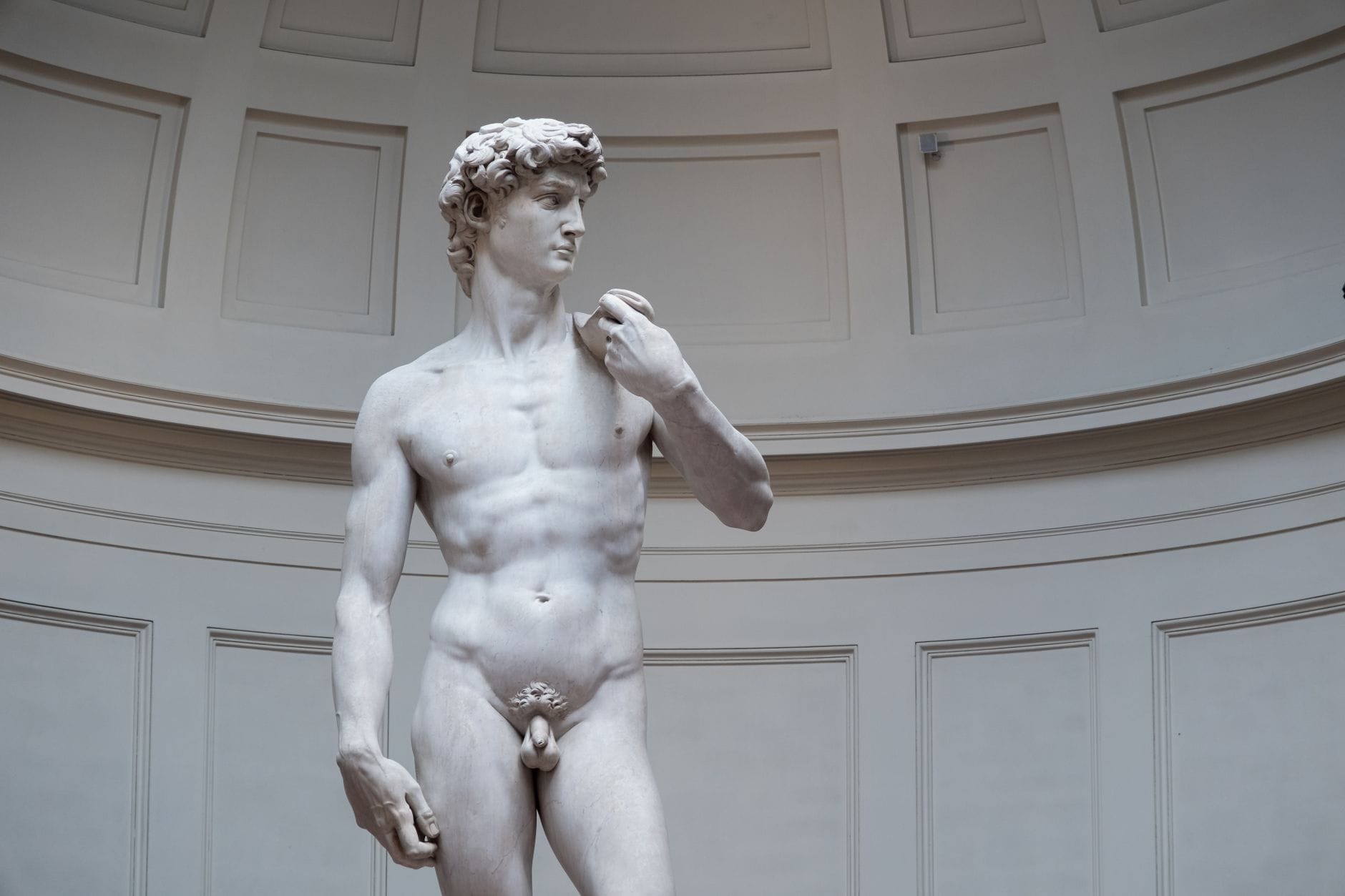
Nothing fully prepares a first-time visitor for the scale of the David. At 5.17 metres tall, the statue fills the domed Tribune at the end of the hall in a way that photographs, however good, cannot communicate. The proportions that seem slightly exaggerated in images, particularly the large hands and oversized head, were deliberate: the statue was originally designed to be seen from below at a distance. Up close, the effect is different, more confrontational than monumental.
The figure represents David before his confrontation with Goliath, not after. The tension is in the pose: the sling over his shoulder, the weight shifted, the gaze turned slightly to his left. Michelangelo carved this between 1501 and 1504 from a single block of Carrara marble that had been abandoned for decades after two earlier sculptors failed to work it. The technical achievement alone is staggering.
The lighting in the Tribune is good but not perfect. Direct flash photography is not permitted, and the dome above provides a diffused natural quality to the light that shifts slightly depending on the time of day and season. Morning visits, particularly in spring and autumn, offer a cleaner, less yellow-toned light than late afternoon. If photography matters to you, arrive in the first hour after opening.
ℹ️ Good to know
The museum is fully accessible for wheelchair users, with accessible entrance and ticket office at street number 60 on Via Ricasoli. Check the official website for detailed accessibility resources before your visit.
The Rest of the Collection: Genuinely Worth Your Time
The side galleries branching off the main Tribune contain Florentine panel paintings spanning roughly 1300 to 1550. The collection is not as comprehensive as the Uffizi, and that is actually an advantage: there is no fatigue here, no sense of being overwhelmed by room after room. The works are grouped thematically and chronologically, with pieces by Botticelli, Filippino Lippi, Domenico Ghirlandaio, and Perugino represented alongside lesser-known workshop pieces that give useful context for how Florentine painting evolved.
The collection of Russian icons, while unexpected in this context, reflects the museum's 18th-century origins as a broad pedagogical collection rather than a curated art gallery. It sits separately enough not to interrupt the Renaissance focus. The musical instruments section is equally specialised, housing a collection of historic instruments including Stradivari pieces, and while it is likely to interest only some visitors, it occupies its own space without intruding on the main flow. If you are planning a full day of museum-hopping, note that the nearbyConvent of San Marco is a five-minute walk away and offers an entirely different kind of experience: Fra Angelico's frescoes in the monks' cells, intimate and quiet in a way that no major gallery can replicate.
When to Visit and How Crowds Behave
The Galleria dell'Accademia is open Tuesday through Sunday, 08:15 to 18:50, with last admission at 18:20. It is closed on Mondays, January 1, and December 25. In 2026, free admission days include April 25, June 2, November 4, and the first Sunday of each month; on these days the booking service is not active and you simply wait your turn at the entrance. On free Sundays, the queue forms well before opening time and can be substantial by 09:00.
The single quietest window is the first 45 minutes after opening on weekday mornings, particularly Tuesday through Thursday in the shoulder months of March, early November, and February. By 10:30 on any day from April to September, the Tribune with the David becomes crowded enough that quiet contemplation is difficult. Midweek afternoons between 15:00 and 17:00 are a reasonable second choice, though the school group traffic can be unpredictable.
Summer visits (June through August) present a heat problem as much as a crowd problem. The streets outside are hot and the queue, if you arrive without a booking, is in direct sun for much of the morning. The museum interior is cooler, but not air-conditioned to the degree of larger institutions. Lightweight clothing and a water bottle are practical necessities in summer, not optional comforts.
⚠️ What to skip
Tripods and selfie sticks are not permitted inside the museum. Large bags may need to be deposited at the cloakroom near the entrance. Plan for a brief bag check process when you arrive.
Getting There and Practical Navigation
The museum's address is Via Ricasoli 58/60. From the Florence Duomo, it is a straightforward 10-minute walk north along Via Ricasoli. From Piazza San Marco, it takes under five minutes. TheFlorence Cathedral complex is close enough that it makes sense to plan both on the same half-day, though combining them back-to-back requires stamina. The Duomo complex involves considerable time and queuing of its own.
City buses serve Piazza San Marco regularly, connecting it to the Santa Maria Novella train station area and other parts of the city. If you are staying in theSan Marco neighborhood, the gallery is within easy walking distance of most accommodation in the area. Taxis and rideshare drop-offs work best on the wider roads around Piazza San Marco rather than Via Ricasoli itself, which is narrow and often pedestrian-heavy.
The combined ticket options advertised by some resellers may bundle the Galleria dell'Accademia with the Museo del Bargello or the broader Musei del Bargello system, but availability, inclusions, and prices vary by provider and date, so check current details carefully before purchase. The Bargello's collection of Donatello bronzes and Renaissance sculpture makes it a natural companion to this visit.
EU citizens aged 18 to 25 pay a reduced rate of €2, making this one of the most accessible major museums in Italy for that age group. If you are building a broader itinerary,Florence's best museums range from free to €25 depending on the site and season, and planning the sequence matters for managing both crowds and energy.
Is It Worth the Visit?
For a first-time visitor to Florence, yes, unconditionally. The David in person is one of the few cases where reality exceeds expectation, and the Prisoners corridor adds genuine intellectual weight to the experience. The museum is compact enough to cover thoroughly without exhaustion.
For return visitors who have already seen the David, the case is more nuanced. The painting collection, while strong, does not rival the Uffizi, and the musical instruments section appeals to a specialist audience. Those returning visitors might find more reward in sites like theMuseo del Bargello or the Cappella Brancacci, which are less visited and offer depth for someone already familiar with the Renaissance canon.
The museum is not suitable for visitors who struggle with crowded interiors, have very limited mobility on uneven flooring in older gallery sections, or are primarily interested in ancient or medieval art. It is also not the right choice for very young children unless they have demonstrated sustained interest in art contexts: the experience is predominantly static and requires patience in the queue.
Insider Tips
- Book online and select the earliest available time slot, ideally 08:15. The Tribune with the David is noticeably quieter in the first 30 minutes, before group tours arrive in volume. The atmosphere is completely different from midday.
- Stand at the far end of the Tribune and look back down the hall toward the Prisoners, with the David behind you. The spatial relationship between the unfinished and finished works, seen together in one long view, is something most visitors miss by only looking forward.
- Check the official website before your visit for the current first-Sunday free admission dates. If your travel dates include one of these Sundays, arrive before the museum opens: free admission days draw long queues by 09:00.
- The €4 booking fee via Firenze Musei is significantly less than the time cost of queuing without a reservation. In July and August, walk-in waits of 60 to 90 minutes are common even on weekday mornings.
- If you are combining the Accademia with the Convent of San Marco on the same morning, visit San Marco first when it opens, then walk the five minutes to the Accademia for your timed slot. San Marco's Fra Angelico frescoes reward the quiet of early morning particularly well.
Who Is Galleria dell'Accademia For?
- First-time visitors to Florence who want to see Michelangelo's David in its original museum setting
- Sculpture enthusiasts interested in Renaissance technique, particularly the unfinished Prisoners series
- Visitors with a half-day to spend who want a focused, manageable museum experience without the scale of the Uffizi
- EU students and young adults aged 18 to 25, who qualify for the €2 reduced admission rate
- Travellers combining the San Marco neighborhood's cluster of sites: the Accademia, the Convent of San Marco, and the Piazza della Santissima Annunziata are all within a 10-minute walk
Nearby Attractions
Other things to see while in San Marco:
- Convent of San Marco
The Convent of San Marco is one of Florence's most unusual museums: a 15th-century Dominican convent where every monk's cell was frescoed by Fra Angelico. Built for Cosimo de' Medici between 1437 and 1443, it later sheltered the firebrand preacher Savonarola. The collection is intimate, serious, and unlike anything else in the city.
- Ospedale degli Innocenti
Built in 1419 by Filippo Brunelleschi, the Ospedale degli Innocenti is widely considered the first purpose-built Renaissance structure in Europe. Today it houses the Innocenti Museum, displaying art collected over centuries to benefit the children who once lived here, all overlooking one of Florence's most harmonious squares.
- Piazza della Santissima Annunziata
Piazza della Santissima Annunziata is the closest Florence comes to a complete, unaltered Renaissance urban space. Flanked by arcaded loggias, anchored by a bronze Medici horseman, and overlooked by Europe's oldest orphanage, it rewards visitors who take the time to read its layers carefully. Entry is free, and while the piazza is generally accessible as a public square, official city hours are 8:00–18:00 Monday to Friday and 8:00–14:00 on Saturday.
Planning a trip? Discover personalized activities with the Nomado app.