Convent of San Marco: Florence's Most Contemplative Museum
The Convent of San Marco is one of Florence's most unusual museums: a 15th-century Dominican convent where every monk's cell was frescoed by Fra Angelico. Built for Cosimo de' Medici between 1437 and 1443, it later sheltered the firebrand preacher Savonarola. The collection is intimate, serious, and unlike anything else in the city.
Quick Facts
- Location
- Piazza San Marco 3, 50121 Florence — northern edge of the historic centre
- Getting There
- Multiple urban bus lines stop at Piazza San Marco; the square is about a 15-minute walk from the Duomo
- Time Needed
- 1.5 to 2.5 hours
- Cost
- State museum admission in euros; as of the latest update, full tickets cost €11 and reduced tickets €2 for EU citizens aged 18–25, with free admission for visitors under 18. Verify current prices at the official site before visiting
- Best for
- Art history lovers, Renaissance devotees, anyone wanting a quieter alternative to the Uffizi
What the Convent of San Marco Actually Is
The Museo Nazionale di San Marco occupies a working Dominican convent that was rebuilt between 1437 and 1443 by the architect Michelozzo, under commission from Cosimo de' Medici. It is not a gallery in the conventional sense. You are walking through dormitory corridors, chapter houses, a refectory, and individual monk cells. The art was made for the monks who lived there, not for public display, and that intention is still legible in the silence of the building.
The collection is dominated by the work of Fra Angelico (Giovanni da Fiesole), a Dominican friar who decorated the convent's cells with frescoes during the 1440s and 1450s. The museum also holds a large collection of Fra Angelico panel paintings gathered from other Florentine churches. Beyond the art, the convent was home to two figures who shaped Florentine history in very different ways: the philosopher and humanist Giovanni Pico della Mirandola lived here briefly, and the cell of Girolamo Savonarola, the charismatic and eventually executed preacher, is preserved as it was.
ℹ️ Good to know
The museum is closed on Mondays and on the 5th Sunday of the month. Typical opening hours run from 08:30 to 13:50, with last admission around 12:45. Hours are subject to change, especially on public holidays. Confirm current hours on the official Museo di San Marco website before visiting.
The Architecture: Michelozzo's Cloister and Library
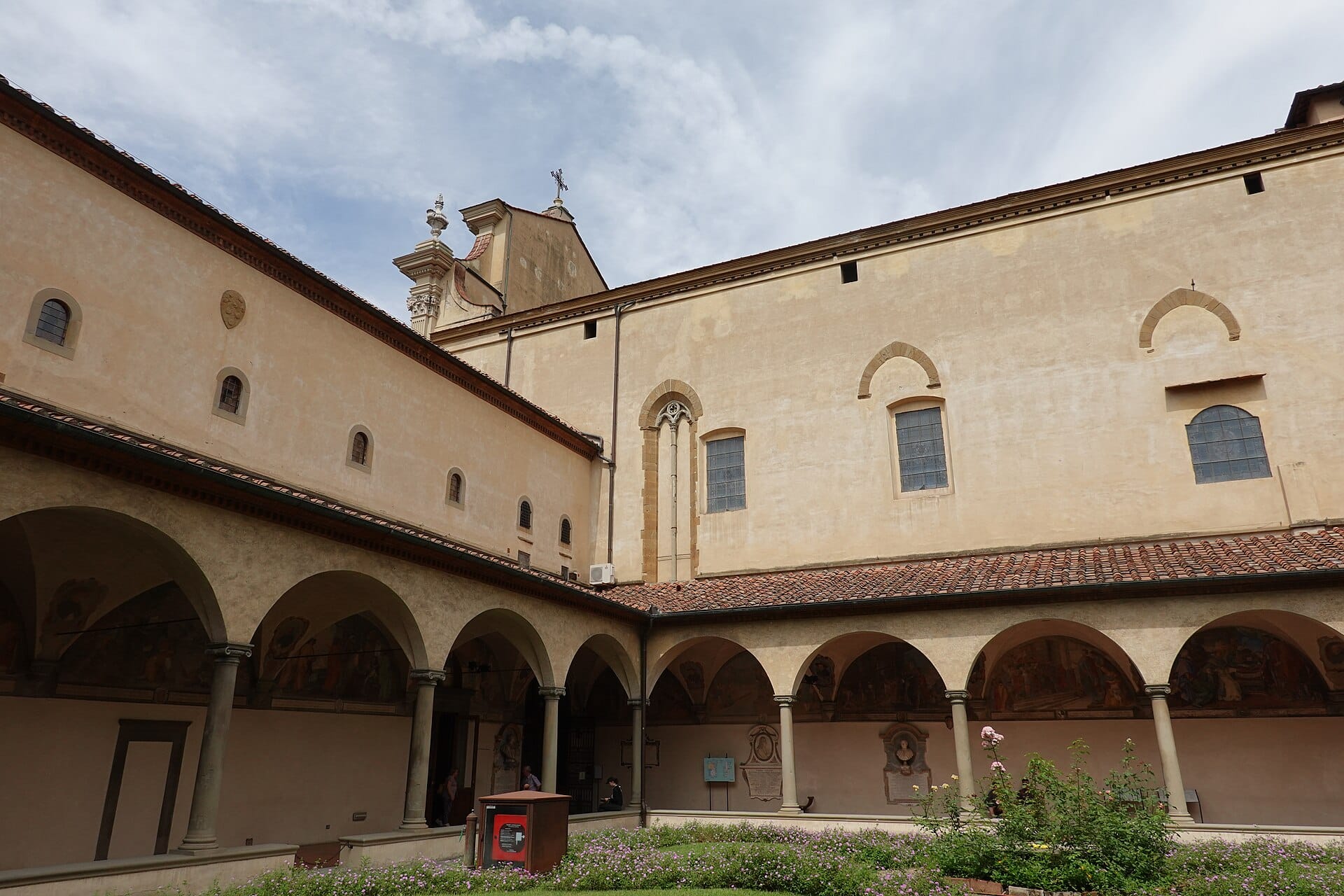
You enter through the Chiostro di Sant'Antonino, a covered cloister with a garden courtyard at its centre. Michelozzo designed the space with clean, arched porticos that feel measured and calm after the noise of Piazza San Marco outside. The stone is pale, the proportions are modest by Florentine palace standards, and the overall effect is one of deliberate restraint. This is Medici patronage filtered through Dominican austerity.
Upstairs, the library designed by Michelozzo for Cosimo de' Medici is one of the most architecturally significant rooms in Florence. Cosimo endowed it with manuscripts and opened it to scholars, making it one of the earliest public libraries in Europe. The barrel-vaulted reading room runs the full length of the upper floor in a long, luminous nave of columns. It is easy to overlook because it contains no famous painting, but the space itself is the exhibit.
Visitors with mobility limitations should be aware that reaching the monk cells requires climbing a staircase. The upper floor is accessed from the corridor above the cloister, and there is no lift. Contact the museum directly for current accessibility arrangements.
Tickets & tours
Live prices and dates from our booking partner. If you book, we may earn a commission at no extra cost to you.
Visit to Tenuta Bossi dei Marchesi Gondi with 3 wine tastings
From 21 €Instant confirmationFree cancellationPerfume masterclass: a sensory experience in Florence
From 70 €Instant confirmationFree cancellationFlorence cathedral complex and Brunelleschi's dome tickets
From 59 €Instant confirmationMedici series tour in Palazzo Medici Riccardi
From 90 €Instant confirmationFree cancellation
Fra Angelico: The Annunciation and the Cells
The painting that stops people at the top of the stairs is the Annunciation, a large fresco Fra Angelico placed at the entrance to the dormitory corridor. The Angel Gabriel and the Virgin Mary face each other in a vaulted portico that echoes the architecture of the convent itself. The colours are muted gold, rose, and pale blue. There is no dramatic gesture; the scene is quiet in a way that reads less like religious narrative and more like private devotion made visible.
The 44 individual cells lining the dormitory corridor each contain a small fresco, most of them by Fra Angelico and his workshop. Each image was designed to give a monk a single subject for meditation: the Noli me Tangere, the Transfiguration, the Coronation of the Virgin. The cells are tiny, perhaps 10 square meters, with a small window and bare stone walls. Seeing the frescoes inside them makes clear that these were functional devotional tools, not decorations. This context is something no gallery reproduction can convey. For a broader picture of the painter's influence in Florence, theguide to Florence's best museumsplaces San Marco alongside the city's other major collections.
💡 Local tip
Photography is generally permitted without flash in the cells, but check current museum rules on arrival. Avoid visiting on a weekday afternoon when school groups sometimes move through the corridor in numbers that make quiet viewing difficult.
Savonarola's Cell and the Weight of History
Near the end of the dormitory corridor, two cells are associated with Girolamo Savonarola, the Dominican friar who became Prior of San Marco and launched his famous campaign against Florentine excess in the 1490s. His cell is preserved with period objects: a simple wooden crucifix, a desk, a hard narrow bed. A portrait of Savonarola by Fra Bartolommeo hangs nearby, showing the tight, angular face that appears in virtually every surviving image of him.
Savonarola organised the Bonfire of the Vanities in 1497, in which Florentines burned mirrors, wigs, paintings, books, and playing cards in Piazza della Signoria. He was excommunicated the following year, and in 1498 he was hanged and burned in the same piazza where his bonfire had stood. His cell at San Marco is the quietest place in the building, and also the one where most visitors spend the most time reading the wall panels explaining what happened.
When to Visit and How the Experience Shifts
San Marco opens early, around 08:30, and the morning hours are noticeably calmer than the period approaching midday. The convent sits on a large, open piazza that receives morning light on the facade, and the cloister interior holds a cool, slightly damp air in the early hours that feels appropriate to the building. By late morning, tour groups from larger itineraries sometimes arrive, but the museum remains quieter than the Uffizi or the Accademia on most days.
The museum closes in the early afternoon, which means it fits naturally as a morning stop before lunch or before continuing to nearby sites. TheGalleria dell'Accademiais a short walk south, and thePalazzo Medici Riccardiis reachable on foot in under ten minutes. Combining San Marco with one of these in a single morning makes for a coherent route through the northern part of the historic centre.
Spring and autumn are the most comfortable seasons for visiting. Summer heat concentrates in the upper floor corridor, which is not air-conditioned, and the experience of slowly moving from cell to cell in August heat can be fatiguing. Winter visits are perfectly viable and crowd levels are lower, though verify holiday closures carefully as the museum observes several public-holiday closures.
Practical Details for the Visit
The entrance is directly off Piazza San Marco at number 3. The square itself functions as a bus interchange, and several AT bus lines from the Santa Maria Novella train station area stop here. From the Duomo, the walk north along Via Cavour takes roughly 12 to 15 minutes. There is no dedicated parking adjacent to the piazza.
Dress code applies as with all church and convent buildings in Florence: covered shoulders and knees are required. Bags may be checked at the entrance. The convent has a small bookshop near the exit. For context on how San Marco fits into the wider neighbourhood, theSan Marco neighbourhood guidecovers the surrounding streets and other points of interest in the area.
⚠️ What to skip
San Marco is closed every Monday and on the 5th Sunday of the month. Arriving on one of these closed days is a common mistake, especially for visitors who have already booked nearby accommodation and assume the museum will be open every day like most commercial attractions.
The museum's limited opening hours, currently closing around 13:50 with last admission around 12:45, mean it is not suitable as an afternoon activity. Plan for a morning visit and build the rest of your day around it. Tickets are sold at the door and through the official booking channel; pre-booking is advisable during peak season though not always obligatory.
Is San Marco Worth Your Time?
For anyone interested in early Renaissance painting, Florentine religious history, or simply wanting to understand what a 15th-century monastic life looked like, San Marco is one of the strongest experiences in the city. It is not a showpiece museum engineered for crowds. The cells are small, the frescoes are worn in places, and the institutional quiet of the building is not for everyone. But that quiet is precisely why it works as an experience.
Visitors who prefer large-scale spectacle, who find religious art repetitive, or who are short on time and prioritising the Uffizi or the Duomo complex should probably skip it. But for a traveler who has already covered the headline attractions and wants to understand Florence at a different register, San Marco is where the city becomes legible in a different way. See also theguide to Michelangelo in Florencefor further context on the artistic world that produced these works, and considerFlorence's overlooked attractionsif you are building a deeper itinerary.
Insider Tips
- Arrive within the first 30 minutes of opening. The cloister in early morning light, before tour groups arrive, has a quality of stillness that the building genuinely earns.
- Cell 7 contains one of the most compositionally striking of the Fra Angelico frescoes, the Mocking of Christ, in which the tormentors are rendered as disembodied hands and a floating head. Many visitors walk past it quickly. Pause here.
- The library on the upper floor is often treated as a passageway to the cells. Walk through it slowly and look at the column spacing and barrel vault. It is one of the earliest purpose-built public reading rooms in European history.
- Savonarola's cells are at the far end of the corridor, cells 12 and 13. Many visitors turn back before reaching them. Don't.
- The museum shop near the exit stocks scholarly catalogues on Fra Angelico that are difficult to find at standard tourist bookshops. Worth a look if you want to continue the subject at home.
Who Is Convent of San Marco For?
- Art history and early Renaissance enthusiasts who want to see Fra Angelico's frescoes in the architectural context for which they were created
- Travelers building a deeper Florence itinerary beyond the Uffizi and Accademia
- History readers interested in Savonarola, the Medici, and 15th-century Florentine religious life
- Visitors who find large, crowded museums exhausting and want a quieter, slower experience
- Architecture-focused travelers interested in Michelozzo's design and the history of Renaissance civic patronage
Nearby Attractions
Other things to see while in San Marco:
- Galleria dell'Accademia
The Galleria dell'Accademia in Florence holds Michelangelo's original David alongside a remarkable collection of Renaissance paintings and unfinished sculptures. This guide tells you exactly what to expect, when to go, and whether the experience lives up to the queue outside.
- Ospedale degli Innocenti
Built in 1419 by Filippo Brunelleschi, the Ospedale degli Innocenti is widely considered the first purpose-built Renaissance structure in Europe. Today it houses the Innocenti Museum, displaying art collected over centuries to benefit the children who once lived here, all overlooking one of Florence's most harmonious squares.
- Piazza della Santissima Annunziata
Piazza della Santissima Annunziata is the closest Florence comes to a complete, unaltered Renaissance urban space. Flanked by arcaded loggias, anchored by a bronze Medici horseman, and overlooked by Europe's oldest orphanage, it rewards visitors who take the time to read its layers carefully. Entry is free, and while the piazza is generally accessible as a public square, official city hours are 8:00–18:00 Monday to Friday and 8:00–14:00 on Saturday.
Planning a trip? Discover personalized activities with the Nomado app.