Palazzo Medici Riccardi: Inside Florence's Original Medici Palace
Built for Cosimo de' Medici in 1444, Palazzo Medici Riccardi is where the Renaissance was quietly administered. The chapel frescoes alone justify the visit. Here is what to know before you go.
Quick Facts
- Location
- Via Camillo Cavour 3, San Lorenzo, Florence
- Getting There
- 10-minute walk from Santa Maria Novella station; a few steps from San Lorenzo church and the Duomo
- Time Needed
- 1 to 1.5 hours
- Cost
- €10 (Nov–Feb) / €15 (Mar–Oct); reduced €7. Closed Wednesdays.
- Best for
- Renaissance art, Medici history, fresco lovers, architecture enthusiasts
- Official website
- www.palazzomediciriccardi.it/en
What Is Palazzo Medici Riccardi?
Palazzo Medici Riccardi is the former private palace of the Medici family, begun in 1444 on the orders of Cosimo de' Medici and completed in the late 15th century. It stands on Via Camillo Cavour, one block north of the Duomo, in the San Lorenzo quarter. For more than two centuries it was the nerve centre of Medici power: a working family home, diplomatic reception hall, art repository, and the place where political decisions rippled outward to reshape Europe. Lorenzo the Magnificent grew up here. Piero de' Medici died here. For a building that anchored a dynasty, it sees surprisingly few visitors compared to the Uffizi or the Accademia.
In 1659 the palace was sold to Marchese Gabriello Riccardi, who enlarged it substantially, which is how it acquired the hyphenated name it carries today. The building now serves a dual purpose: one half houses the museum open to visitors, the other houses the administrative offices of the Metropolitan City of Florence. The coexistence of daily bureaucracy and 15th-century frescoes is oddly appropriate for a place that never entirely left public life.
Visitors who want to understand the Medici family before arriving will find useful context in our guide tothe Medici Chapelsand in the broaderMichelangelo in Florenceguide, which traces how Medici patronage shaped a generation of artists.
The Architecture: What You See from the Street
The palace's exterior was revolutionary when it was completed. Architect Michelozzo di Bartolomeo designed a three-storey rusticated facade using progressively smoother stonework as the eye moves upward: rough-cut blocks at street level, flatter stones in the middle, and smooth ashlar at the top. The effect is one of graduated refinement rather than raw display of wealth. It became a template for Florentine Renaissance palace architecture that you can trace across the city.
The ground floor originally had open arched loggias at the corner of what is now Via de' Gori, but Michelangelo himself, working for the Medici in the 16th century, closed them with the distinctive kneeling windows (finestre inginocchiate) you see today. Look for them at the corner of the building: they are among the few surviving examples of Michelangelo's architectural interventions in secular buildings. The change was partly practical, partly aesthetic, and the windows became influential in their own right.
💡 Local tip
Photograph the facade from across Via Cavour in the morning, when the sun falls directly on the stonework. By midday the street is in shadow and the texture of the rustication is much harder to read.
Tickets & tours
Live prices and dates from our booking partner. If you book, we may earn a commission at no extra cost to you.
Medici series tour in Palazzo Medici Riccardi
From 90 €Instant confirmationFree cancellationPalazzo Vecchio secret passages tour with lunch or gelato tasting
From 47 €Instant confirmationFree cancellationPitti Palace tour: the magnificence of the Medici dynasty
From 59 €Instant confirmationFree cancellationPalazzo Vecchio and Salone dei Cinquecento guided tour
From 65 €Instant confirmationFree cancellation
Inside the Palace: Courtyard, Chapel, and Gallery
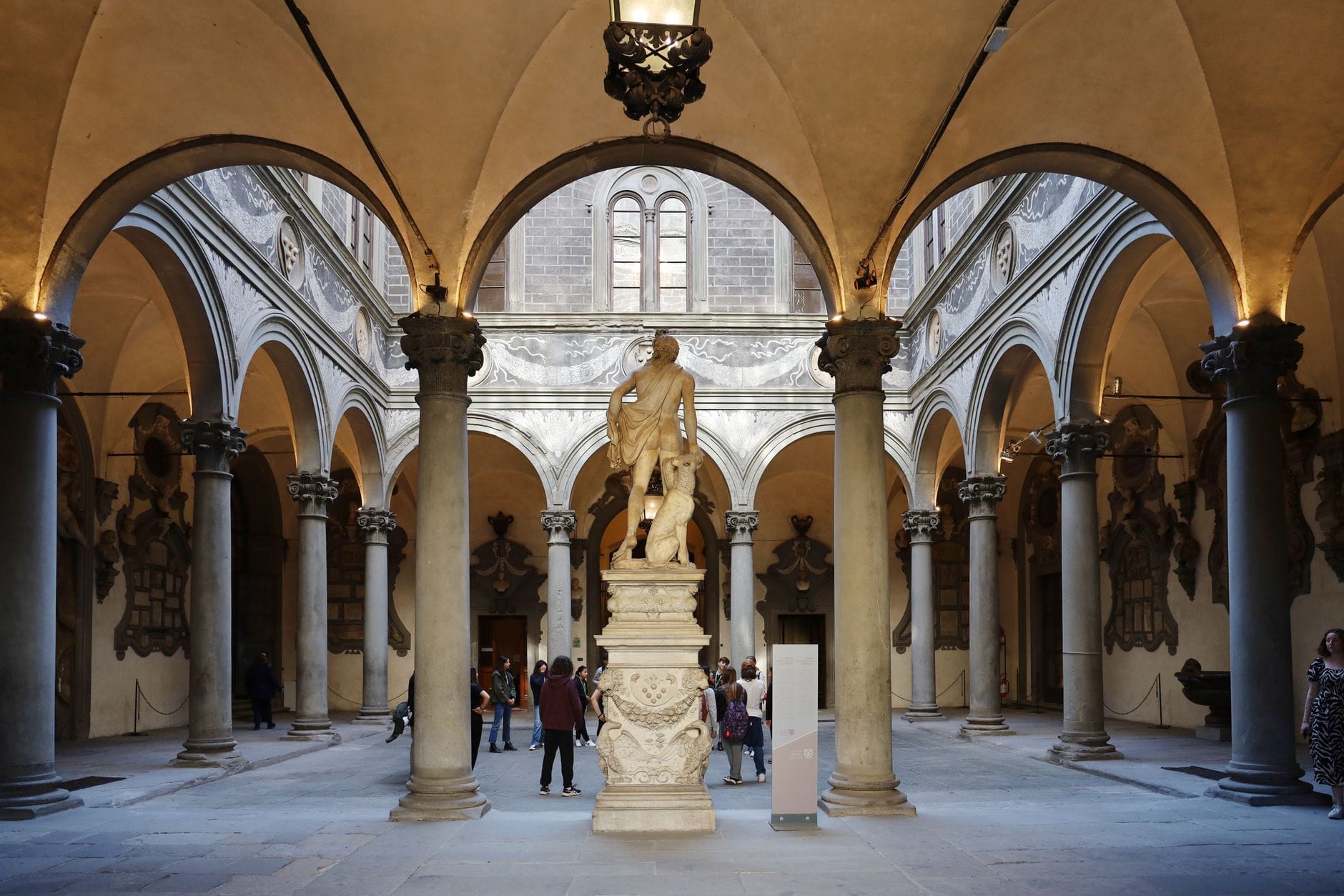
Entering through the main gate you step into a colonnaded courtyard that is calm, proportioned, and almost always quieter than the street outside. Michelozzo designed it as a classical space, with round arches supported on Corinthian columns and decorative roundels in the spandrels. Several of the roundels are copies of antique gems from the Medici collection. The originals have long since been dispersed, but the courtyard retains the sense of a space designed to impress cultivated visitors, not to overwhelm them.
The main draws are on the upper floor. The Cappella dei Magi, the private chapel of the Medici family, contains a fresco cycle painted by Benozzo Gozzoli between 1459 and 1461. The subject is the Journey of the Magi, but it doubles as a portrait of Medici Florence: Cosimo de' Medici, Lorenzo (depicted as a young man on a white horse), and members of the Byzantine imperial delegation who visited Florence in 1439 are all recognisable in the procession. The walls are covered floor to ceiling, and the detail is extraordinary. Gold leaf catches the light. The landscape behind the procession is a lyrical, almost invented version of the Tuscan hills. The chapel is small enough that visitors are rotated in groups to protect the frescoes, which means you will have a time limit inside. Use it.
The second highlight is the Sala di Luca Giordano, a long baroque gallery added by the Riccardi family in the late 17th century. The ceiling fresco by the Neapolitan painter Luca Giordano is an Apotheosis of the Medici, painted in 1683, decades after the Medici had actually sold the palace. The irony of the Riccardi commissioning a glorification of their predecessors is either generous or calculated, depending on how you read it. The room itself is high and luminous. The contrast between the intimate Renaissance chapel and this extravagant baroque gallery, in the same building, tells you a great deal about how tastes changed across two centuries.
For context on how other great Florentine palaces were designed and used, thePalazzo Vecchio and the Palazzo Strozziare both worth comparing.
When to Visit and How Long to Allow
The palace opens Monday, Tuesday, Thursday, Friday, Saturday, and Sunday from 09:00 to 19:00 (ticket office and bookshop close at 18:00). It is closed on Wednesdays. On 1 January, hours are reduced (14:00 to 19:00 in 2026, though this may change year to year). Check the official website before visiting on any public holiday.
Ticket prices vary by season: from January through February and from November through December, the full price is €10. From March through October it rises to €15. A reduced rate of €7 applies to eligible visitors; conditions are specified at the ticket office and on the official site. Booking in advance online is possible and recommended during peak months (April through June and September through October) when the chapel can reach capacity quickly.
One hour is enough to see everything thoroughly. Budget ninety minutes if you want to sit in the courtyard, read the interpretive panels in the museum rooms on the ground and upper floors, and browse the bookshop. The palace does not require the kind of marathon stamina that the Uffizi does, which is part of its appeal.
⚠️ What to skip
The Cappella dei Magi has limited capacity and visits are time-controlled. If crowds are high, you may wait outside the chapel before entering. The wait is rarely more than 10 to 15 minutes, but factor this into your timing.
The Surrounding Area: San Lorenzo
The palace sits in theSan Lorenzodistrict, which is one of the most historically layered parts of Florence. Directly behind the palace is the Basilica di San Lorenzo, the parish church of the Medici and the site of their family tombs. The outdoor market that fills the surrounding streets, selling leather goods and clothing, has been here in some form since the Middle Ages.
The street-level reality of San Lorenzo is noisier and more commercial than the palace interiors suggest. Vendors call out from stalls, tour groups cluster at the church entrance, and the smells of leather and grilled food mix together by midmorning. The palace itself functions as a retreat from this texture, which the courtyard amplifies. If you are visiting the Medici Chapels or the Basilica di San Lorenzo on the same trip, Palazzo Medici Riccardi slots naturally into a half-day loop around the neighborhood.
The Mercato Centraleis a five-minute walk away and makes a practical lunch stop before or after the palace visit.
Photography, Accessibility, and Practical Notes
Photography is generally permitted in the public areas of the palace without flash. The Cappella dei Magi may have specific restrictions on photography that change periodically; follow the instructions given by staff on the day. The baroque gallery is well lit and photogenic, though its proportions make wide-angle shots challenging in a modest crowd.
The palace is a 15th-century building and accessibility is limited in places. The museum staff can advise on the most accessible routes, and the official site recommends contacting the museum directly before visiting if you have mobility requirements. The courtyard is on the ground level and accessible, but some upper-floor areas involve stairs. Do not assume full step-free access without checking in advance.
ℹ️ Good to know
The palace gets noticeably cooler inside than the summer streets of Florence. In July and August this is welcome. In winter, the stone walls and high ceilings make it feel cold. Bring a light layer regardless of season.
Visitors who find straightforward narrative-style museums more engaging than art-heavy collections may find the palace modest in scale. It is not a spectacle in the way the Uffizi is, and if Gozzoli's frescoes or Renaissance civil architecture are not subjects that hold your attention, the visit may feel brief. That said, for anyone with genuine interest in the Medici, in early Renaissance painting, or in how power was expressed through domestic architecture, Palazzo Medici Riccardi rewards careful attention in a way that few more famous sites in Florence do.
Insider Tips
- Arrive when the palace opens at 09:00. The chapel is least crowded in the first hour, groups have not yet arrived from nearby hotels, and the morning light through the chapel's small windows gives the gold leaf in Gozzoli's frescoes a warmth it loses later in the day.
- The museum rooms on the upper floor beyond the baroque gallery are often skipped by visitors in a hurry. They contain decorative arts, coins, and documentation of the palace's history that adds useful context, and they are almost always empty.
- The bookshop at Palazzo Medici Riccardi has a better-than-average selection of titles on the Medici, Renaissance Florence, and Gozzoli specifically. If you are buying art books during your trip, this is a good stop.
- The courtyard is occasionally used for events and may be partially closed to casual visitors during setup. Check the official website or call ahead if your visit falls on a weekend.
- Combine your visit with the Basilica di San Lorenzo directly behind the palace, but note that the basilica and the Medici Chapels have separate tickets and separate opening hours. Budget accordingly if you plan to see all three in one morning.
Who Is Palazzo Medici Riccardi For?
- Medici history enthusiasts who want to see where the family actually lived rather than where they were commemorated
- Renaissance art lovers focused on fresco painting, particularly those interested in Benozzo Gozzoli's detailed narrative style
- Architecture students and travellers interested in how the Renaissance palazzo form evolved
- Anyone who finds the major museums exhausting and prefers a focused, manageable visit to a single significant building
- Photographers interested in the contrast between rough rusticated stonework and the ornate interiors just a few steps away
Nearby Attractions
Other things to see while in San Lorenzo:
- Basilica di San Lorenzo
The Basilica di San Lorenzo is Florence's oldest major church and the burial ground of the Medici dynasty. Built to Brunelleschi's design in the 15th century, it holds some of the finest Renaissance architecture and art in Italy, plus the separate Medici Chapels complex. This guide covers what to expect inside, how long to spend, and how to visit without wasting time.
- Medici Chapels
The Medici Chapels are the official mausoleum of the Medici dynasty, housing Michelangelo's most powerful funerary sculptures inside one of Florence's most underestimated museum spaces. Two distinct chapels, two entirely different moods, and one of the most concentrated displays of Renaissance genius in Europe.
- Mercato Centrale
Mercato Centrale is Florence's largest and most celebrated covered market, housed in a cast-iron and glass hall dating to 1874. The ground floor runs as a traditional food market Monday through Saturday mornings, while the upper level operates as a modern food hall open daily until midnight. Entry is free.
- San Lorenzo Market
San Lorenzo Market combines a working 19th-century iron-and-glass food hall, a buzzing upper-floor food court open until midnight, and a sprawling street market selling leather goods and textiles. Free to enter, central to navigate, and genuinely useful whether you're buying lunch or a wallet.
Planning a trip? Discover personalized activities with the Nomado app.