Basilica di San Lorenzo: The Medici Church That Shaped the Renaissance
The Basilica di San Lorenzo is Florence's oldest major church and the burial ground of the Medici dynasty. Built to Brunelleschi's design in the 15th century, it holds some of the finest Renaissance architecture and art in Italy, plus the separate Medici Chapels complex. This guide covers what to expect inside, how long to spend, and how to visit without wasting time.
Quick Facts
- Location
- Piazza di San Lorenzo 9, 50123 Florence — San Lorenzo neighborhood, a short walk north of the Duomo
- Getting There
- 10-15 min walk from Firenze Santa Maria Novella station; several city bus lines stop near the Duomo/San Lorenzo area
- Time Needed
- 45–90 minutes for the basilica and cloisters; add 45–60 minutes if visiting the Medici Chapels separately
- Cost
- Separate tickets for the basilica/cloisters and the Medici Chapels (Cappelle Medicee); check current prices at sanlorenzofirenze.it before visiting
- Best for
- History enthusiasts, Renaissance architecture lovers, Medici-focused itineraries, and travelers who want depth over crowds
- Official website
- www.sanlorenzofirenze.it
Why San Lorenzo Matters
The Basilica di San Lorenzo is not a secondary church. It stands on one of Florence's oldest Christian church sites, with a first church traditionally dated to 393 AD, and for roughly three centuries it served as the private parish and burial ground of the most powerful family in Renaissance Italy: the Medici. That combination of extreme antiquity and extreme Medici patronage makes San Lorenzo something the Duomo, for all its fame, cannot quite replicate. This is where Florence's ruling dynasty actually worshipped, commissioned, and was buried.
The current Renaissance structure was built to a design by Filippo Brunelleschi, the same architect responsible for the cathedral dome visible from almost everywhere in the city. Work began around 1421 and was completed in 1461 by Antonio Manetti after Brunelleschi's death. The result is one of the earliest and most disciplined applications of Renaissance architectural principles in Florence: rational proportions, grey pietra serena stone ribs against white plaster, and a calm, mathematical order that feels almost startling after the ornamented Gothic churches elsewhere in the city.
ℹ️ Good to know
The Medici Chapels (Cappelle Medicee) are technically a separate complex entered from a different door on Piazza Madonna degli Aldobrandini, around the back of the basilica. They require a different ticket and house Michelangelo's famous Sagrestia Nuova sculptures. Budget time and money for both if you want the full picture.
What the Basilica Looks Like Inside
Stepping through the entrance, the first thing you notice is the restraint. San Lorenzo does not hit you with gilded excess. The nave is wide, cool, and organized into three aisles separated by columns of grey stone. The floor is inlaid with geometric patterns in dark and pale marble. The ceiling above the central nave is a deep coffered wood, painted in alternating squares. Everything is measured and deliberate, and after a few minutes the proportions start to feel genuinely satisfying in a way that is hard to describe but easy to feel.
The two most celebrated spaces within the basilica proper are the Old Sacristy and the library cloister access, though the library itself (the Biblioteca Medicea Laurenziana, entered from the cloister) is an independent experience with its own character. The Old Sacristy, built by Brunelleschi between 1421 and 1428 and one of the first pure Renaissance interior spaces anywhere, is a small domed cube of extraordinary precision. Donatello contributed the bronze doors and terracotta roundels inside. The Medici tombs here, including that of Giovanni di Bicci de' Medici, the dynasty's founder, are modest by later Medici standards, which makes them feel all the more serious.
Other works throughout the basilica include Donatello's two bronze pulpits, completed late in his life and considered among his most powerful work. Filippino Lippi's Annunciation hangs in a side chapel. Rosso Fiorentino's Marriage of the Virgin is vivid and slightly unsettling in the best way. None of these pieces are famous in the way the Uffizi's paintings are famous, which means you can spend real time in front of them without anyone nudging past.
Tickets & tours
Live prices and dates from our booking partner. If you book, we may earn a commission at no extra cost to you.
Santa Croce guided experience
From 40 €Instant confirmationFree cancellationPrivate walking tour in Florence
From 0 €Instant confirmationPrivate walking tour in Florence
From 0 €Instant confirmationPrivate walking tour in Florence
From 0 €Instant confirmation
The Medici Chapels: A Separate Visit Worth Making
The Cappelle Medicee are administered separately from the basilica and entered from a different street. Inside, the Cappella dei Principi is extraordinary for the sheer ambition of its decoration: walls and floors covered floor to ceiling in pietra dura, a form of stone inlay using semi-precious materials, with enormous effort concentrated on the tombs of the later Medici grand dukes. It is overwhelming and slightly bizarre, which is arguably the point. The scale of the room is palatial rather than ecclesiastical. For more context on the broader Medici legacy across Florence, see the guide toMedici Chapels.
The more important space artistically is the Sagrestia Nuova, designed by Michelangelo and one of the few architectural interiors he completed. The marble sculptures on the tombs of Lorenzo de' Medici (Duke of Urbino) and Giuliano de' Medici (Duke of Nemours), accompanied by allegorical figures of Dawn, Dusk, Day, and Night, are among his greatest works in any medium. These are not reproductions. You stand within a few meters of marble he carved in the 1520s and 1530s. The experience is quieter and more concentrated than the Accademia, where crowds form around the David.
Time of Day and Crowd Patterns
San Lorenzo sits in the middle of a busy market area. The Piazza San Lorenzo and surrounding streets fill with leather stalls and souvenir vendors from mid-morning onward, and by midday the area around the entrance can feel chaotic despite the church itself being relatively calm inside. The contrast between the busy square and the hushed interior is sharp.
💡 Local tip
Arrive when the basilica opens, or go in the late afternoon after the tour groups have moved on. Midday brings the largest concentrations of visitors, and the market noise outside becomes more intrusive when the piazza is crowded.
In the cooler morning light, the pietra serena columns take on a silvery quality and the coffered ceiling is easier to study without crowds blocking sight lines. The cloister, which you pass through to reach the staircase to the Laurentian Library, is a particularly good place to pause on a warm afternoon: cool, shaded, and usually quiet. The cloister garden is small but gives the only real greenery in the complex. On overcast days, the white plaster walls inside glow gently from windows rather than direct sunlight, which is actually a fine condition for looking at the Donatello bronzes.
The Medici Chapels next door tend to run slightly cooler than the basilica in summer and draw a different crowd pattern since they require a separate queue. Spring and autumn are the most comfortable seasons for a thorough visit. For general advice on navigating Florence's main churches, thebest churches in Florence guidecovers the tradeoffs between the major sites.
The Laurentian Library: Do Not Skip It
Accessed from the cloister and up a staircase Michelangelo designed (and that took centuries to complete to his specifications), the Biblioteca Medicea Laurenziana is one of the most unusual spaces in Florence. The vestibule staircase alone is worth the detour: the steps seem to pour downward in three interlocking flows, and the walls have blind niches, pilasters, and corbels that break every Renaissance rule that Brunelleschi established. Michelangelo was apparently doing this deliberately.
The reading room itself is long, narrow, and lit by a row of windows along each side. Original reading desks line the center, and rotating exhibitions show manuscripts from the Medici collection, which includes some of the most important classical and humanist texts in existence. The library holds tens of thousands of manuscripts and rare books. Whether the current exhibition aligns with your interests is unpredictable, but the room itself rewards ten minutes regardless.
Practical Information for Your Visit
The basilica entrance is on Piazza San Lorenzo. The Medici Chapels are entered from Piazza Madonna degli Aldobrandini, around the left side of the building when facing the facade. Dress codes apply: covered shoulders and knees are required, as in all active Catholic churches in Florence. The basilica closes during religious services, which can occur at irregular times, so check the schedule on the official site before planning a very short visit.
From Firenze Santa Maria Novella station, walk east along Via Nazionale or Via degli Arazzieri toward the market area; the walk takes roughly 10 to 15 minutes. The San Lorenzo neighborhood is also the location of theMercato Centrale, Florence's main food market, which occupies a 19th-century iron hall two minutes from the basilica entrance. Combining the two makes for a logical morning.
Photography inside is generally permitted without flash, though tripods and selfie sticks may not be allowed in certain areas. Verify current rules at the ticket desk on arrival. If you are planning a wider Renaissance circuit, theMichelangelo in Florence guidemaps out how San Lorenzo fits into the full picture of his work across the city, including the Accademia and the New Sacristy.
⚠️ What to skip
Opening hours, ticket prices, and access rules for both the basilica and the Medici Chapels change seasonally and occasionally for restoration work. Always verify at sanlorenzofirenze.it before you visit. Do not rely on third-party sites for current prices.
Accessibility information for historic buildings in Florence is variable. San Lorenzo has multiple levels and historic stone surfaces. Contact the basilica directly or check the official site for step-free routes, lift availability, and accessible toilets before visiting. For broader planning advice, thegetting around Florence guidecovers transport and mobility options across the city.
Who Should Think Twice
San Lorenzo asks you to slow down. If your priority is a single headline work, the way the Accademia has the David or the Uffizi has Botticelli, this is not that kind of experience. The value here is cumulative: the Brunelleschi interior plus the Donatello bronzes plus the Old Sacristy plus the library plus the Medici Chapels add up to something substantial, but none of it works as a quick selfie stop. Travelers on a single-day itinerary who have not yet seen the Duomo, the Uffizi, or Piazza della Signoria should probably prioritize those first.
Very young children may find the interior less engaging without strong narrative hooks, though the Medici Chapels' decorated surfaces do provoke questions. Families visiting Florence with children might want to cross-reference theFlorence with kids guideto decide how much time to allocate here versus more interactive sites.
Insider Tips
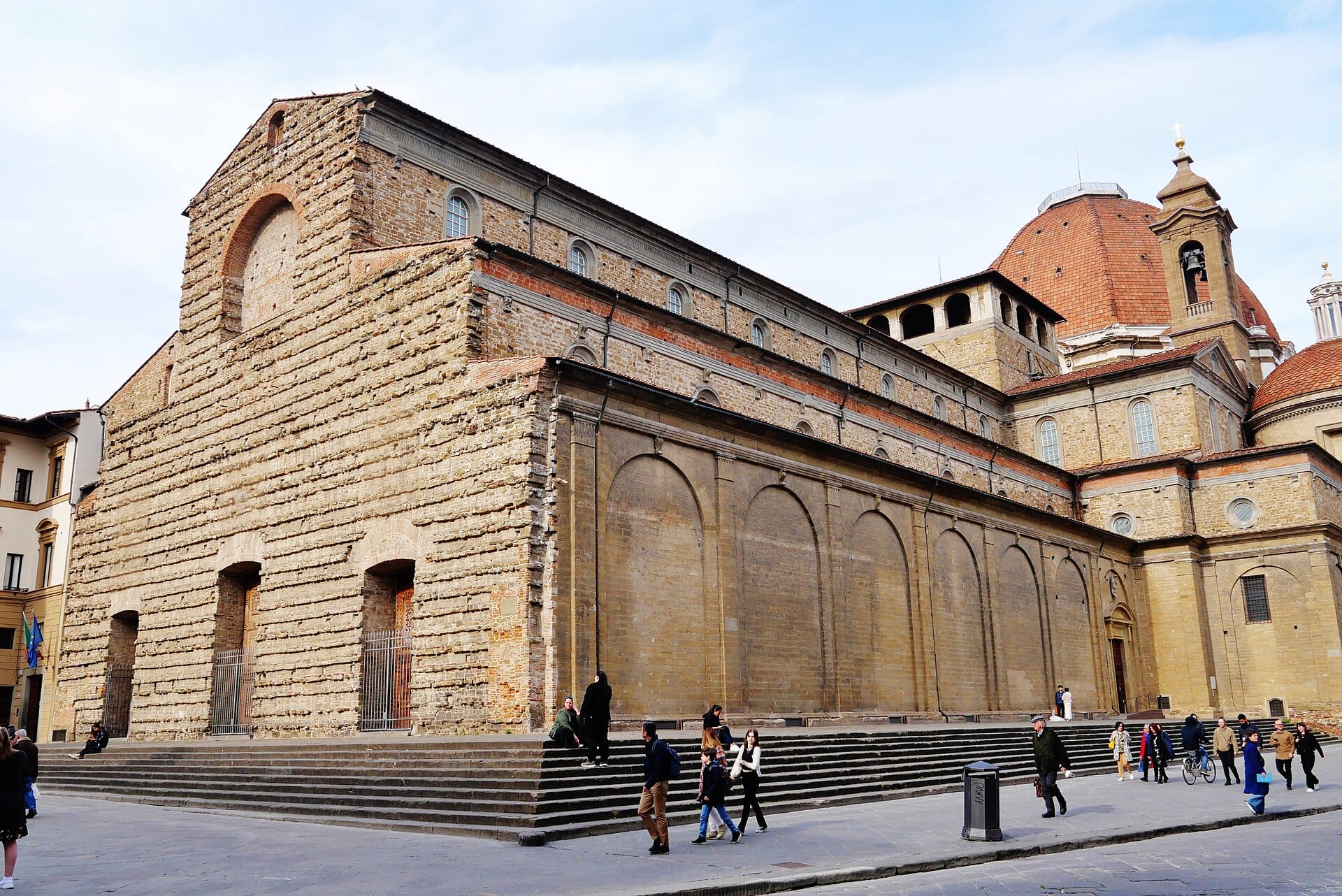
- The exterior facade of the basilica was never completed. Michelangelo designed a marble facade in the early 16th century but the project was abandoned, leaving the rough brick front you see today. That context makes the interior's refinement even more striking.
- The Medici Chapels are managed by the Uffizi Galleries group and can be booked through their reservation system in advance. The basilica itself is separate and may not always require advance booking, but checking availability before arriving in peak season saves frustration.
- The leather goods market on Piazza San Lorenzo and surrounding streets is persistent and loud. Vendors outside the entrance are aggressive by Florentine standards. Budget a few minutes to navigate politely if you arrive during market hours (roughly mid-morning to early evening).
- Donatello's two bronze pulpits near the crossing are often overlooked by visitors rushing to the sacristy. They were unfinished at Donatello's death in 1466 and represent his final major works. Stand directly beneath them and look up at the narrative reliefs for the intended viewing angle.
- The cloister garden is accessible as part of the basilica visit and is usually very quiet even when the church itself is moderately busy. If you need five minutes of calm in the middle of a crowded Florence day, this is a reliable place to find it.
Who Is Basilica di San Lorenzo For?
- Renaissance architecture enthusiasts who want to understand Brunelleschi's spatial logic firsthand
- Medici history followers tracing the family's patronage, power, and burial traditions across Florence
- Art lovers interested in Donatello and Michelangelo beyond their most-photographed works
- Travelers on a second or third visit to Florence who want depth beyond the headline sites
- Anyone pairing a morning food market visit to the Mercato Centrale with a cultural stop
Nearby Attractions
Other things to see while in San Lorenzo:
- Medici Chapels
The Medici Chapels are the official mausoleum of the Medici dynasty, housing Michelangelo's most powerful funerary sculptures inside one of Florence's most underestimated museum spaces. Two distinct chapels, two entirely different moods, and one of the most concentrated displays of Renaissance genius in Europe.
- Mercato Centrale
Mercato Centrale is Florence's largest and most celebrated covered market, housed in a cast-iron and glass hall dating to 1874. The ground floor runs as a traditional food market Monday through Saturday mornings, while the upper level operates as a modern food hall open daily until midnight. Entry is free.
- Palazzo Medici Riccardi
Built for Cosimo de' Medici in 1444, Palazzo Medici Riccardi is where the Renaissance was quietly administered. The chapel frescoes alone justify the visit. Here is what to know before you go.
- San Lorenzo Market
San Lorenzo Market combines a working 19th-century iron-and-glass food hall, a buzzing upper-floor food court open until midnight, and a sprawling street market selling leather goods and textiles. Free to enter, central to navigate, and genuinely useful whether you're buying lunch or a wallet.
Planning a trip? Discover personalized activities with the Nomado app.