Piazza della Santissima Annunziata: Florence's Most Perfectly Composed Square
Piazza della Santissima Annunziata is the closest Florence comes to a complete, unaltered Renaissance urban space. Flanked by arcaded loggias, anchored by a bronze Medici horseman, and overlooked by Europe's oldest orphanage, it rewards visitors who take the time to read its layers carefully. Entry is free, and while the piazza is generally accessible as a public square, official city hours are 8:00–18:00 Monday to Friday and 8:00–14:00 on Saturday.
Quick Facts
- Location
- Piazza della Santissima Annunziata, 50122 Firenze — San Marco neighborhood, northeast of the Duomo
- Getting There
- On foot from Piazza del Duomo: walk north along Via dei Servi for roughly 500–750 m (about 9 minutes). City buses serve the wider San Marco area, including nearby stops.
- Time Needed
- 20–40 minutes for the square itself; allow 1.5–2 hours if visiting the Ospedale degli Innocenti museum
- Cost
- Free to enter the piazza. The Ospedale degli Innocenti museum has its own admission fee (verify current price before visiting).
- Best for
- Architecture enthusiasts, Renaissance history, photography, uncrowded mornings, families with cultural interests
Why This Square Stands Apart
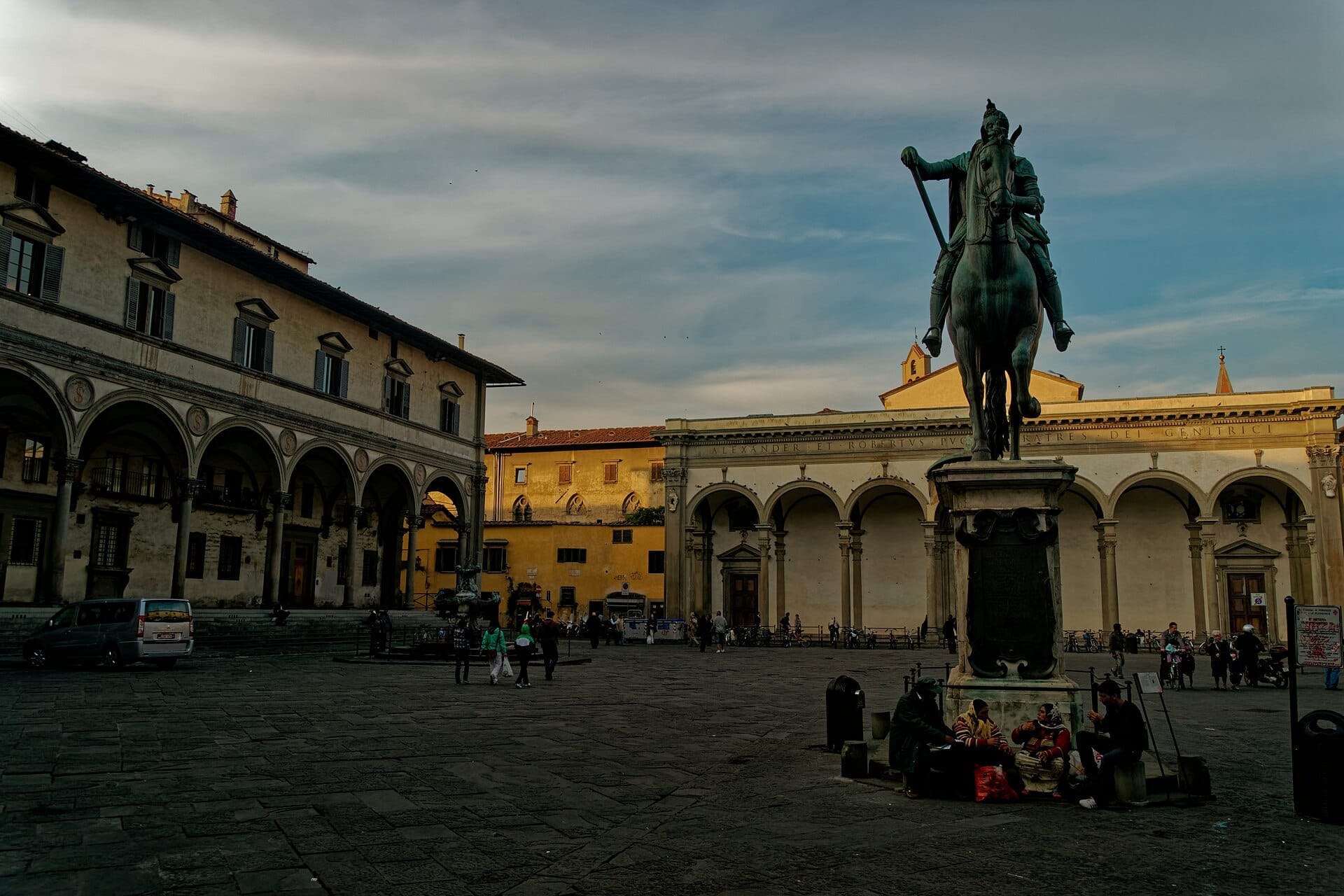
Most visitors to Florence spend their square-time at Piazza della Signoria or Piazza del Duomo, both of which are spectacular but perpetually overwhelmed. Piazza della Santissima Annunziata offers something rarer: architectural coherence. Three of its four sides are defined by arcaded loggias built across different centuries but designed to rhyme with one another, creating the impression of a unified Renaissance stage set. The effect is not accidental. It reflects deliberate civic planning during one of the most architecturally self-conscious periods in European history.
The square is named after the Basilica della Santissima Annunziata, a Servite church with roots going back to 1250. Over the centuries, the piazza grew up around it, accumulating buildings, sculptures, and symbolic weight until it became what you see today: a rectangle of stone and loggia that functions simultaneously as a religious forecourt, a civic space, and an open-air gallery of High Renaissance and Mannerist design.
💡 Local tip
The square is free and generally accessible during the day. Visit before 9 a.m. to see it at its quietest, when the stone paving catches the low morning light and the arcades throw long, clean shadows.
The Architecture: Reading the Square's Three Faces
The east side of the piazza is dominated by the Spedale degli Innocenti, or Foundling Hospital, designed by Filippo Brunelleschi and begun in 1419. It is widely regarded as Europe's oldest surviving orphanage and one of the first purpose-built expressions of Early Renaissance architecture anywhere. Brunelleschi's loggia is the thing to study: nine semicircular arches carried on slender Corinthian columns, each arch framing a terracotta medallion by Andrea della Robbia depicting a swaddled infant in blue and white glazed ceramic. The medallions are both decorative and explanatory, advertising the building's function to a largely illiterate population. The proportions Brunelleschi used here, the relationship of column height to arch span to bay width, became a template that architects across Tuscany would study and imitate for generations.
To match Brunelleschi's loggia visually, the Confraternity of the Servants of Mary constructed a corresponding loggia on the west side of the square in the late fifteenth and early sixteenth centuries, deliberately mirroring the spacing and rhythm of the original. The basilica itself closes the northern end of the piazza behind its own portico. Stand in the center of the square and turn slowly: the result is a space that feels enclosed without being claustrophobic, formal without being cold. For a deeper dive into how this fits into Florence's broader Renaissance streetscape, theOspedale degli Innocentinow houses a museum whose upper floor gives a rare elevated view across the square's roofline.
Tickets & tours
Live prices and dates from our booking partner. If you book, we may earn a commission at no extra cost to you.
E-bike night tour of Florence with stunning view from Piazzale Michelangelo
From 55 €Instant confirmationFree cancellationE-bike tour of Florence and Piazzale Michelangelo with surprise tasting
From 29 €Instant confirmationFree cancellationTicket entrance to Galleria dell'Accademia and open bus Florence tour
From 57 €Instant confirmationFree cancellationPerfume masterclass: a sensory experience in Florence
From 70 €Instant confirmationFree cancellation
At the Center: Ferdinando I and the Sea-Monster Fountains
The square's focal point is the large bronze equestrian statue of Ferdinando I de' Medici, the Grand Duke of Tuscany who ruled from 1587 to 1609. The statue was created by Giambologna, the Flemish-born sculptor who spent most of his working life in Florence and whose influence on late Renaissance bronze-casting is impossible to overstate. Giambologna died before casting the work, which was completed by his pupil Pietro Tacca in 1608.
Tacca also created the two Mannerist fountains that flank the statue, known as the Fontane dei mostri marini, or Sea-Monster Fountains. Cast in bronze and dated to around 1629, they are strange, unsettling objects: hybrid marine creatures with fish-scale bodies and open mouths spilling water into shallow basins. Up close, the surfaces are extraordinary in their detail, with barnacled flanks and coiled tails that catch light differently depending on the time of day. Most visitors photograph the equestrian statue and walk past the fountains without stopping, which means you can often study them at leisure even when the rest of the square is occupied.
How the Square Changes Through the Day
Early morning is when Piazza della Santissima Annunziata belongs to residents. Delivery vehicles come and go along the side streets. A handful of people cross the square on their way to work. The loggia of the Spedale degli Innocenti is empty and you can walk its full length under the arches without weaving between anyone. The light at this hour is soft and directional, coming from the east, and it rakes across the terracotta medallions in a way that emphasizes their modeled depth.
By mid-morning, school groups and tour parties begin to arrive, often pausing in the square before or after visiting the Ospedale degli Innocenti museum. By early afternoon on busy days in spring and autumn, the piazza holds a moderate crowd but rarely approaches the density of the Duomo complex ten minutes' walk south. Late afternoon brings a different quality of light, warm and amber, particularly flattering on the pale stone facades. If you are here to photograph the architecture, the ninety minutes before sunset in spring or summer is the most rewarding window.
Evening transforms the square again. The loggia arcades are lit softly from below, the equestrian statue turns green-black against the sky, and the square becomes a gathering point for students from the nearby university buildings and locals walking between the San Marco and Sant'Ambrogio neighborhoods. There is no nightlife here in any commercial sense, but the atmosphere at dusk is genuinely pleasant, quieter and more residential in feeling than the historic core further south.
ℹ️ Good to know
Every year on 7 September, the Feast of the Nativity of the Virgin Mary is preceded by the Festa della Rificolona, a traditional Florentine lantern festival in which children and adults parade with paper lanterns. It is one of the city's oldest popular celebrations and draws large crowds to this normally quiet piazza.
The Basilica and What to Know Before You Enter
The Basilica della Santissima Annunziata closes the northern end of the piazza behind its portico. The Servite order founded the original structure in 1250, though the current building reflects substantial reconstruction during the fifteenth century, with later Baroque additions to the interior. The church is particularly significant to Florentines.
The interior holds several important fresco cycles, including works attributed to Andrea del Sarto in the atrium. Opening hours are set by the Servite friars and can vary seasonally; check locally before planning a specific visit. Dress expectations may apply: shoulders and knees should be covered. The church is free to enter but is a working religious space, so timed visits around services are recommended.
Practical Walkthrough: Getting Here and Making the Most of It
The most direct walking route from the Duomo complex is along Via dei Servi, a straight, relatively quiet street that runs due north from behind the cathedral apse. The walk takes under ten minutes and passes through theSan Marco neighborhood, one of Florence's less touristically saturated central districts. The same route connects the piazza to the Convent and Museum of San Marco, which houses Fra Angelico's famous frescoes and is a short detour to the northwest.
Because the piazza sits at the meeting point of several itineraries, it works well as a midpoint rather than a dedicated destination. A logical circuit from here would combine the Ospedale degli Innocenti museum, theConvent of San Marcoto the west, and the Galleria dell'Accademia to the south, all within comfortable walking distance. The nearbyMercato Centralein the San Lorenzo area makes a practical lunch stop before or after.
Accessibility is generally good. The piazza's paving is broad and level, and the Comune di Firenze notes that the site meets visitability standards for people with reduced mobility. The Ospedale degli Innocenti museum has lift access to its upper floors; confirm current accessibility arrangements directly with the museum before visiting.
⚠️ What to skip
Photography of the square's architecture is unrestricted from public areas. However, the Basilica della Santissima Annunziata's interior may have its own photography rules, which can change. Check posted notices at the entrance before shooting inside.
Who Will Get the Most From This Square, and Who Might Not
Travelers with a genuine interest in Renaissance architecture, civic history, or urban planning will find Piazza della Santissima Annunziata disproportionately rewarding relative to how little it costs and how few people seem to know to come here. It pairs well with a broader itinerary focused on Florentine monuments: combine it with theFlorence Cathedral and Galleria dell'Accademiafor a half-day that covers the city's northern historic core thoroughly.
Families with children will find the square a comfortable, open space with room to move, and the Ospedale degli Innocenti museum has made efforts to engage younger visitors. That said, the square itself offers no interactive elements; it is fundamentally a space for looking and thinking. Travelers who find architectural tourism unrewarding and are focused on shopping, food markets, or nightlife will not find much to hold them here beyond a brief pause.
If this is your first day in Florence and you are working through the major sites, you might consider bookmarking this piazza for a slower morning later in the trip, when you are less driven by a checklist. For a structured approach to fitting it into a broader schedule, the3 days in Florence itineraryplaces it effectively within a San Marco half-day.
Insider Tips
- The della Robbia medallions on the Spedale degli Innocenti loggia are best examined in the morning light, when direct sun from the east catches their modeled relief. By afternoon they flatten in diffuse light and lose much of their sculptural detail.
- Pietro Tacca's Sea-Monster Fountains are almost always photographed as background scenery behind the equestrian statue. Approach them directly and crouch to shoot upward: the bronze casting at close range is among the most technically accomplished metalwork in any Florentine public space.
- Via dei Servi, the street connecting this piazza to the Duomo, passes several small workshops and a few family-run trattorie that cater almost entirely to residents and students. Lunch prices here are noticeably lower than in the streets immediately around the Duomo.
- The loggia on the west side of the square, mirroring Brunelleschi's original, is often used as a shelter from sudden rain and is usually empty enough to let you walk its full length in peace, examining the columns and capitals at your own pace.
- If you visit around 7 September for the Festa della Rificolona, arrive by early evening before the main procession begins. The square fills quickly and the surrounding streets become packed; positioning yourself under the Spedale degli Innocenti loggia gives you an elevated view of the parade without being in the thick of the crowd.
Who Is Piazza della Santissima Annunziata For?
- Architecture and Renaissance history enthusiasts who want depth over spectacle
- Photographers seeking strong geometric compositions and morning loggia light
- Travelers combining a San Marco half-day with the Accademia and Convent of San Marco
- Families looking for an open, uncrowded space with a nearby museum geared to all ages
- Visitors who want to understand how Florence planned its civic spaces, not just what it built
Nearby Attractions
Other things to see while in San Marco:
- Convent of San Marco
The Convent of San Marco is one of Florence's most unusual museums: a 15th-century Dominican convent where every monk's cell was frescoed by Fra Angelico. Built for Cosimo de' Medici between 1437 and 1443, it later sheltered the firebrand preacher Savonarola. The collection is intimate, serious, and unlike anything else in the city.
- Galleria dell'Accademia
The Galleria dell'Accademia in Florence holds Michelangelo's original David alongside a remarkable collection of Renaissance paintings and unfinished sculptures. This guide tells you exactly what to expect, when to go, and whether the experience lives up to the queue outside.
- Ospedale degli Innocenti
Built in 1419 by Filippo Brunelleschi, the Ospedale degli Innocenti is widely considered the first purpose-built Renaissance structure in Europe. Today it houses the Innocenti Museum, displaying art collected over centuries to benefit the children who once lived here, all overlooking one of Florence's most harmonious squares.
Planning a trip? Discover personalized activities with the Nomado app.