Ospedale degli Innocenti: Florence's First Renaissance Building and Its Remarkable Museum
Built in 1419 by Filippo Brunelleschi, the Ospedale degli Innocenti is widely considered the first purpose-built Renaissance structure in Europe. Today it houses the Innocenti Museum, displaying art collected over centuries to benefit the children who once lived here, all overlooking one of Florence's most harmonious squares.
Quick Facts
- Location
- Piazza della Santissima Annunziata 13, 50122 Florence
- Getting There
- Walk from Firenze Santa Maria Novella station (approx. 15 min)
- Time Needed
- 1.5 to 2.5 hours
- Cost
- Ticketed entry; check the official Innocenti Museum website for current prices and booking
- Best for
- Architecture lovers, Renaissance art, history of childhood and social welfare, photography of Renaissance civic space
- Official website
- www.istitutodeglinnocenti.it
What the Ospedale degli Innocenti Actually Is
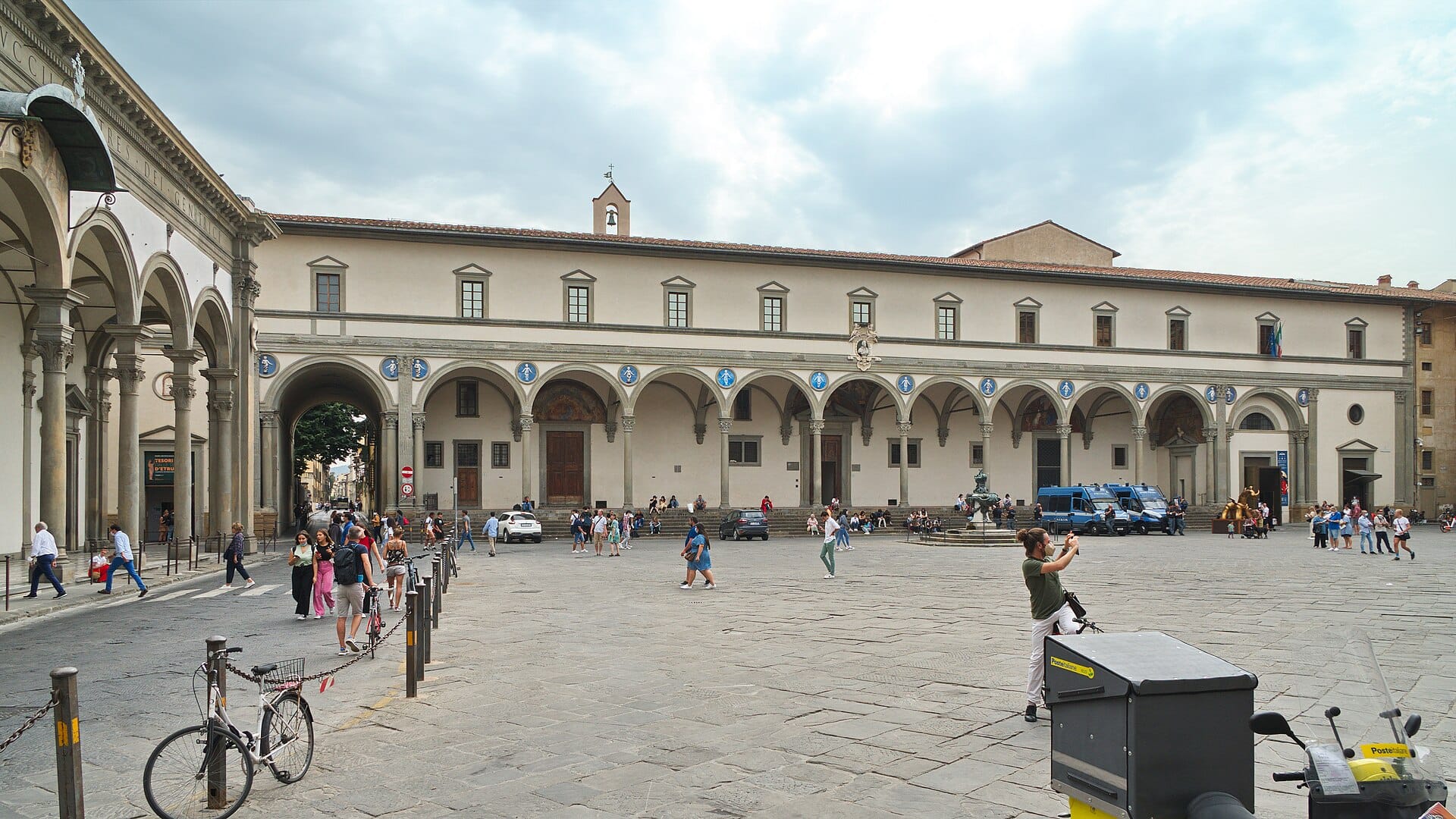
The Ospedale degli Innocenti is not a hospital in any modern sense. Founded in 1419 as an orphanage and foundling home for abandoned children, it was commissioned by the powerful Arte della Seta (Silk Guild) of Florence and designed by Filippo Brunelleschi, the architect who would later raise the Duomo's dome. The building is considered among the earliest consciously Renaissance structures ever constructed anywhere in Europe, predating many of the landmarks that made Florence synonymous with that movement.
Remarkably, the institution it housed continued operating in some form for centuries, caring for children across more than five hundred years of Florentine history. The Istituto degli Innocenti still functions today as a research and social welfare organization. What visitors access is the Innocenti Museum, which occupies a substantial portion of the building and tells both the architectural and the deeply human story of the children raised within these loggia-flanked walls.
ℹ️ Good to know
The Innocenti Museum is open 09:00 to 18:00, last entry 60 minutes before closing. It is closed on 15 August, 25 December, and 1 January. Verify current ticket prices and any booking requirements at istitutodeglinnocenti.it before your visit.
The Loggia and the Piazza: What You See Before You Enter
Your experience begins before you reach the ticket desk. Approaching the building across Piazza della Santissima Annunziata, you encounter a loggia of nine arched bays supported by slender Corinthian columns. The proportions are exact: Brunelleschi designed each intercolumnar space as a perfect cube, producing a rhythm of light and shadow that feels modern even six centuries later. The grey pietra serena stone of the columns against the white plaster is a color palette that would come to define Florentine Renaissance interiors.
Beneath the arches, ten terracotta roundels by Andrea della Robbia depict swaddled infants in glazed blue and white. These were added in the 1480s and have become one of Florence's most reproduced images. Up close, they are smaller than most visitors expect, perhaps 60 centimeters across, but the detail in each infant's expression rewards a slow look. The loggia itself smells faintly of old stone on cool mornings, and the acoustic quality is unusual: traffic noise from surrounding streets cuts out almost entirely once you step beneath the arches.
The piazza as a whole is worth pausing over. The Basilica della Santissima Annunziata closes the north end, with a matching loggia designed to mirror Brunelleschi's. The result is one of the most formally coherent civic squares in Italy, less visited than Piazza della Signoria and easier to read as a unified composition.
For a broader look at the squares and monuments that define Florence's public life, thePiazza della Santissima Annunziatadeserves its own dedicated time, either before or after your museum visit.
Tickets & tours
Live prices and dates from our booking partner. If you book, we may earn a commission at no extra cost to you.
Perfume masterclass: a sensory experience in Florence
From 70 €Instant confirmationFree cancellationFlorence cathedral complex and Brunelleschi's dome tickets
From 59 €Instant confirmationMedici series tour in Palazzo Medici Riccardi
From 90 €Instant confirmationFree cancellationPalazzo Vecchio secret passages tour with lunch or gelato tasting
From 47 €Instant confirmationFree cancellation
Inside the Museum: Art, Architecture, and Social History
The Innocenti Museum reflects careful curatorial thinking. The ground floor moves you through the building's original spaces: the vestibule, the men's loggia, and rooms where the institution's daily life unfolded. Display panels and physical objects document the foundling wheel, the ruota degli innocenti, the slot in the exterior wall through which anonymous parents once left newborns. The actual wheel is preserved here, a quiet, unsettling artifact
The art collection on the upper floors exists because wealthy Florentines donated works specifically to benefit the institution. This gives the collection an unusual coherence: everything here was meant to honor or support these childrenhe collection is not large, but the quality is high and the context adds weight. It is displayed in a dedicated space on the piano nobile and reads differently knowing it was made for a room full of orphans rather than a private patron's chapel. Luca della Robbia's glazed terracotta works appear throughout, as does a small Botticelli Madonna. The collection is not large, but the quality is high and the context adds weight.
The upper loggia, accessed from inside the museum, offers a view across the piazza rooftops that most visitors miss entirely. Morning light comes from the east and illuminates the terracotta tiles in a way that photographs well without a tripod. There are no ropes or barriers up here; you walk directly onto the corridor and lean against the original stone parapet. This is one of the more memorable architectural experiences in Florence precisely because it is so undramatic.
💡 Local tip
The upper loggia is accessed from inside the museum. If you visit in the afternoon, the light falls differently and the shadows on the piazza become more pronounced after 15:00. Both times are worth experiencing if you can stay long enough
How the Atmosphere Changes Through the Day
At opening time, around 09:00, the piazza is quiet enough that you can hear pigeons on the loggia tiles foundling wheel and the early rooms, arriving at 09:00 sharp is genuinely worthwhile. and the ground floor vestibule can become congested during this window. If you want unhurried time with the foundling wheel and the early rooms, arriving at 09:00 sharp is genuinely worthwhile.
Midday brings the opposite problem: the museum's interior is calm while the piazza outside becomes crowded with lunch-hour foot traffic from the university buildings nearby. This is actually a good time to visit the upper floors and the art collection, which see fewer visitors regardless of hour.
Late afternoon, from around 16:30 onward, the piazza empties considerably and the light on the loggia becomes warm and lowf you have already seen the building's exterior earlier in the day. Summer evenings can be pleasantly cool under the arches after a hot afternoon in the city. gives enough time for a focused visit to the museum's highlights if you have already seen the building's exterior earlier in the day. Summer evenings can be pleasantly cool under the arches after a hot afternoon in the city.
Getting There and Practical Logistics
The Ospedale degli Innocenti sits at the northern edge of central Florence, a roughly 15-minute walk from Firenze Santa Maria Novella railway station heading northeast through the city. The route passes through the San Marco neighborhood and can easily be combined with visits to nearby sites. The address is Piazza della Santissima Annunziata 13.
Several city bus lines stop within a short walk; the area around Via dei Servi and Via Cesare Battisti is the closest stop cluster. If you are combining this visit with theConvent of San Marco or the Galleria dell'Accademia, all three are within a five-minute walk of each other, making this corner of Florence one of the most efficient areas for cultural visits in the city.
The museum entrance is under the loggia and clearly marked. Admission requires a ticket; check the official Innocenti Museum website for current pricing, any concession rates, and whether advance booking is needed, particularly in peak months from April through October. The museum does not appear in most mass-market tour packages, which means queues are rarely a serious problem even in high season.
⚠️ What to skip
The museum is open daily according to the current official hours. If your Florence itinerary is tight, check the official website for seasonal changes or special closures before you go.
Accessibility information is not detailed on the official museum page; contact the museum directly before visiting if step-free access is a requirement.
Historical and Architectural Context Worth Knowing
Understanding why this building matters requires a brief note on what came before it. Medieval Florentine architecture was dominated by massive rusticated stone facades, Gothic tracery, and vertical drama. Brunelleschi's loggia here introduced something entirely different: mathematical proportion derived from classical Roman sources, light columns in place of heavy piers, and a horizontal reading of space that felt almost shockingly calm by comparison. The date, 1419, places this at the very beginning of what historians and art historians have long described as the Italian Renaissance, a period of intellectual and artistic transformation with Florence at its center.
For travelers interested in tracing Brunelleschi's work across the city, theBrunelleschi Dome climb and the Basilica di San Lorenzooffer different aspects of the same architectural vision. The Ospedale degli Innocenti is arguably the purest expression of his early civic thinking because it was designed to serve people without resources, not a powerful private patron or the Church.
The social history dimension is equally significant. The institution accepted abandoned infants regardless of origin, a progressive policy for its era. Records kept over the centuries are now a resource for genealogical researchers and social historians studying pre-modern childhood in Italy. The museum presents this material accessibly, without turning it into a bleak experience. The tone is respectful and informative rather than sensationalist.
Who This Attraction Suits and Who Might Find It Underwhelming
Visitors who arrive primarily for the art collection and treat the building as a container may feel the museum is smaller and less spectacular than the Uffizi or the Accademia. The collection is genuinely excellent but not exhaustive. If you have one day in Florence and are prioritizing art over architectural history, this may sit lower on your list.
Travelers who respond to buildings as much as paintings, anyone with an interest in social history, and those wanting a serious cultural experience without the mass-tourism atmosphere of the major galleries will find the Ospedale degli Innocenti one of the most rewarding hours they spend in Florence. It pairs naturally with a broader exploration of theSan Marco neighborhood, which remains one of the least overrun parts of the historic center.
Families with children old enough to engage with history, roughly eight and above, often find the story of the foundling home genuinely affecting and memorable. Very young children may find the museum's pacing slow. The loggia and piazza, however, are good spaces for children at any age.
Insider Tips
- The exterior roundels by Andrea della Robbia on the loggia are original to the 1480s. Each one is slightly different if you look carefully at the infants' faces and the folds of their swaddling. Most visitors walk past without stopping.
- The piano nobile, the upper floor where the Ghirlandaio Adoration of the Magi hangs, is accessed by a stone staircase inside the museum. It sees fewer visitors than the ground floor exhibits and is worth taking slowly.
- Piazza della Santissima Annunziata is one of the few major Renaissance squares in Florence where you can sit on stone benches without being moved on. The view from the center of the piazza back toward the loggia, with both flanking arcades visible, is the defining photograph of Brunelleschi's civic planning.
- The museum shop stocks scholarly publications on the institution's history that are not widely available elsewhere, including research on the foundlings' records. For anyone interested in genealogy or Renaissance social history, these are worth browsing.
- If you visit on a weekday morning outside July and August, you may have the upper loggia almost entirely to yourself for 15 to 20 minutes. This is the best spot in the building to understand the proportional logic Brunelleschi was working with.
Who Is Ospedale degli Innocenti For?
- Architecture enthusiasts wanting to understand the origins of Renaissance design
- Travelers interested in social history and the history of childhood in Renaissance Italy
- Photographers looking for clean, unpopulated architectural compositions
- Visitors combining multiple San Marco-area museums into a single half-day
- Anyone wanting a serious, unhurried cultural experience away from the city's most crowded sites
Nearby Attractions
Other things to see while in San Marco:
- Convent of San Marco
The Convent of San Marco is one of Florence's most unusual museums: a 15th-century Dominican convent where every monk's cell was frescoed by Fra Angelico. Built for Cosimo de' Medici between 1437 and 1443, it later sheltered the firebrand preacher Savonarola. The collection is intimate, serious, and unlike anything else in the city.
- Galleria dell'Accademia
The Galleria dell'Accademia in Florence holds Michelangelo's original David alongside a remarkable collection of Renaissance paintings and unfinished sculptures. This guide tells you exactly what to expect, when to go, and whether the experience lives up to the queue outside.
- Piazza della Santissima Annunziata
Piazza della Santissima Annunziata is the closest Florence comes to a complete, unaltered Renaissance urban space. Flanked by arcaded loggias, anchored by a bronze Medici horseman, and overlooked by Europe's oldest orphanage, it rewards visitors who take the time to read its layers carefully. Entry is free, and while the piazza is generally accessible as a public square, official city hours are 8:00–18:00 Monday to Friday and 8:00–14:00 on Saturday.
Planning a trip? Discover personalized activities with the Nomado app.