Cappella Brancacci: Masaccio's Masterpiece in Florence's Oltrarno
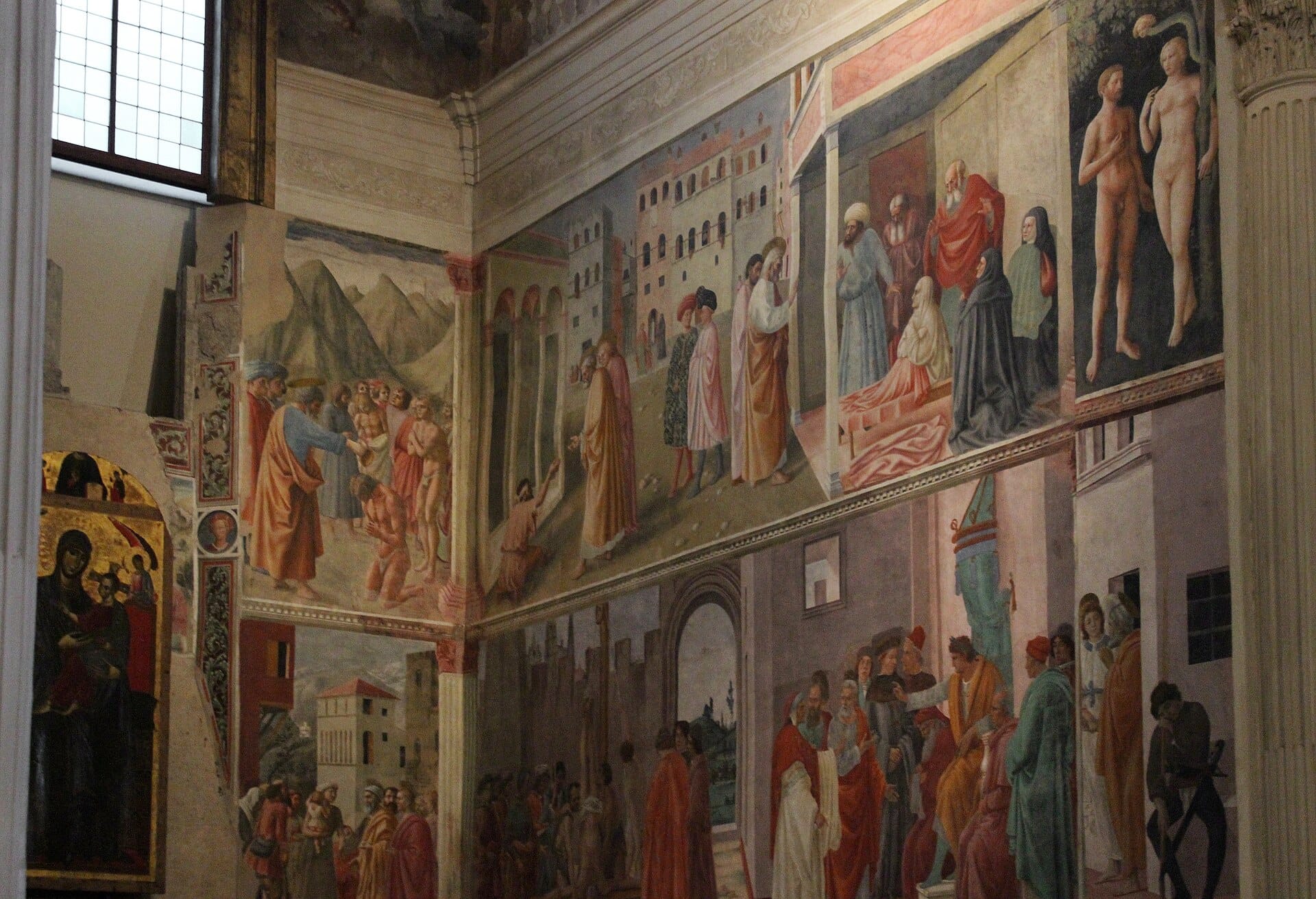
The Brancacci Chapel inside Santa Maria del Carmine holds one of the most significant fresco cycles in Western art. Painted by Masolino, Masaccio, and Filippino Lippi between 1424 and 1481, these images of St Peter's life transformed how painters understood light, space, and the human figure. Visits are intimate by design, capped at 30 people for 30 minutes, making advance booking essential.
Quick Facts
- Location
- Piazza del Carmine 14, Oltrarno, Florence (inside Santa Maria del Carmine)
- Getting There
- City bus to Piazza del Carmine; roughly 15-minute walk from the Ponte Vecchio across the Arno
- Time Needed
- 15–30 minutes inside the chapel depending on current slot rules; allow 60–90 minutes total including the walk and queue
- Cost
- Full €10, reduced €7; free under 18 and for disabled visitors; +€1 online booking fee. Prices may have changed — confirm before visiting.
- Best for
- Art history lovers, Renaissance painting enthusiasts, slow travellers who prefer depth over volume
- Official website
- musefirenze.it/en/museum/cappella-brancacci
What the Brancacci Chapel Actually Is
The Cappella Brancacci is a small chapel in the right transept of the Church of Santa Maria del Carmine, tucked into a quiet corner of Florence's Oltrarno district on the south bank of the Arno. From the outside, the church is an unassuming, cream-coloured facade on Piazza del Carmine, giving almost no indication of what lies inside. You do not enter through the nave. Access is through the neighbouring convent, where staff manage timed group entries.
What fills the chapel is a fresco cycle depicting the life of St Peter, begun in 1424 by Masolino da Panicale and Masaccio, and completed around 1481 by Filippino Lippi after a long interruption. The commission originated in the mid-1420s under Felice Brancacci, a wealthy Florentine silk merchant. The chapel itself dates back to a foundation in 1366 by Piero di Piuvichese Brancacci, though the decoration that made it famous came decades later.
For most visitors, the chapel is not a long visit in the conventional sense. It is a concentrated one. You have 30 minutes in a room with perhaps 29 other people, standing close to paintings that art historians have studied for six centuries. That structure is either a feature or a frustration depending on the kind of traveler you are.
Why Masaccio Matters Here
Most visitors arrive knowing Masaccio's name but not quite why it matters. The short answer: before Masaccio, European painting largely depicted figures as flat, symbolic, and frontally arranged. In the Brancacci Chapel, specifically in his sections of the fresco cycle painted between about 1424 and 1427, figures have weight, shadow falls consistently from a single light source, faces show psychological individuality, and architectural space recedes with something approaching geometric perspective.
The Tribute Money is the panel most art historians point to first. Christ and the apostles stand in a semicircle; the composition uses continuous narrative, meaning three moments of the story appear simultaneously in one frame. Look at the apostle Peter's posture as he reaches into the water for the coin: the body bends, the fabric pulls, the legs carry actual weight. This was radical in the mid-1420s. Botticelli studied here. Leonardo is said to have come. Michelangelo came as a student and was reportedly punched in the nose by a fellow apprentice he had mocked for his drawings in the chapel.
Filippino Lippi's completion of the cycle around 1481 is identifiable by a slightly different palette and more decorative figure handling, but the seam between artists is subtler than you might expect. The full cycle, and its place in Florentine painting history, is covered in depth in theMichelangelo in Florence guide, which traces the lineage from Masaccio through to the Sistine Chapel ceiling.
💡 Local tip
Bring a pocket torch or use your phone's flashlight discreetly. The chapel is relatively dim and some details in the lower register frescoes reward a closer look than the ambient lighting provides.
Tickets & tours
Live prices and dates from our booking partner. If you book, we may earn a commission at no extra cost to you.
Perfume masterclass: a sensory experience in Florence
From 70 €Instant confirmationFree cancellationFlorence cathedral complex and Brunelleschi's dome tickets
From 59 €Instant confirmationMedici series tour in Palazzo Medici Riccardi
From 90 €Instant confirmationFree cancellationPalazzo Vecchio secret passages tour with lunch or gelato tasting
From 47 €Instant confirmationFree cancellation
The Visit: What to Expect on the Ground
The chapel is open Monday, Wednesday, Thursday, Friday, and Saturday from 10:00 to 17:00, and on Sundays from 13:00 to 17:00. It is closed on Tuesdays. Last admission is 45 minutes before closing according to the civic museums information. Groups are limited to 30 people with visits organized in 30-minute slots, but the maximum stay inside the chapel is currently 15 minutes.
That 30-minute limit sounds restrictive but works out reasonably well if you prepare. There are four walls of frescoes to cover and most guided audio descriptions run about 20–22 minutes at a measured pace. What the format discourages is the slow, absorptive looking that this kind of painting actually rewards. If you want to stand in front of The Expulsion of Adam and Eve for ten minutes, you may find it difficult in a group context.
Tickets generally must be reserved in advance through the civic museums system, and same-day access without a prior booking is only possible if there are unsold slots. Online booking through the civic museums system includes an additional €1 booking fee and is strongly recommended between March and October. The entrance is through the convent corridor adjoining the church, and staff will ask you to leave bags larger than a small backpack in lockers near the entrance. There is no coat check fee.
⚠️ What to skip
Do not confuse the entrance with the main church door on Piazza del Carmine. The chapel access is through the convent on the left side of the building. Signs are present but easy to miss if you are not looking for them.
The Oltrarno Setting: Context That Matters
Santa Maria del Carmine stands on Piazza del Carmine, a large, low-key square that local families use as a neighbourhood gathering point. It does not attract the same foot traffic as the area around the Uffizi or the Duomo. This is part of what makes the Oltrarno worth exploring: theOltrarno districtstill feels like a working neighbourhood despite increasing tourist interest, with artisan workshops, independent wine bars, and markets occupying the same streets as centuries-old palaces.
The walk to the chapel from the north bank of the Arno takes you across any of several bridges, then through streets that gradually widen as you move west from thePonte Vecchiotoward Santo Spirito and Piazza del Carmine. In the morning, the streets smell of bread and coffee. By midday the piazza fills with students and residents eating lunch on benches. By late afternoon the light comes in low and warm from the west. The walk itself is part of the experience, not just the transit.
If you are planning a full Oltrarno afternoon, theBasilica di Santo Spiritois a 10-minute walk east and provides a striking architectural contrast: Brunelleschi's rational, mathematical interior against the emotionally charged figurative painting of the Brancacci Chapel.
Best Time to Visit and How Weather Affects the Experience
Because the chapel is entirely indoors, weather has less impact here than at most Florence attractions. The chapel maintains a controlled environment partly for conservation reasons, which means it can feel noticeably cooler than the street on a summer afternoon, a genuine relief in July or August when temperatures regularly reach into the low-to-mid 30s Celsius.
Peak season (June through August) brings larger numbers to Florence overall, but the Brancacci Chapel is less overwhelmed than the Uffizi or the Accademia because the group-size cap naturally limits entry. The real problem in high season is availability: slots fill faster, and showing up without a booking risks being turned away. In October and November, or in March, the chapel is easier to access on the day, and the Oltrarno neighbourhood feels more like itself.
For a broader view of when to visit Florence overall, including seasonal tradeoffs on crowds, prices, and weather, thebest time to visit Florence guidecovers the full picture in detail.
ℹ️ Good to know
Weekday mornings (Wednesday to Friday, 10:00–12:00) consistently offer the quietest experience at the Brancacci Chapel. Sunday afternoons after 13:00 are reliably busier.
Photography, Accessibility, and Practical Notes
Photography without flash is often permitted inside the chapel, though this can vary by group and guide; confirm at the entrance. Tripods are not permitted. Given the 30-minute time limit, you will need to prioritise: shooting while also absorbing the frescoes properly is a genuine tension. Most experienced visitors recommend one pass of looking, then a second pass for photographs if time allows.
On accessibility: the civic museums provide free entry for disabled visitors and one accompanying companion. Specific details on physical access, including ramp and lift availability within the convent entrance, should be confirmed directly with the museum ahead of visit, as the convent corridors involve some level changes. Visitors should wear covered shoulders and knees when entering the church premises, in line with standard Italian church etiquette.
The Brancacci Chapel is part of the Florentine civic museums system. If you are planning multiple museum visits, check whether the Firenze Card currently applies to this site, as it covers the ticket cost here even though you still need to make the mandatory reservation separately. For a full map of Florence's civic and state museums, thebest museums in Florence guidegives an honest ranking with context on what each institution does best.
Who Will Love This, and Who Should Look Elsewhere
The Brancacci Chapel rewards visitors who arrive with some preparation. If you know what to look for in Masaccio's technique, the 30 minutes feels insufficient. If you arrive with no context, it can feel like a small, dimly lit room with old paintings. The difference between these two experiences is about 20 minutes of reading beforehand.
Families with young children may find the format challenging. There is no interactive element, no space to move around freely, and the 30-minute limit with a capped group size means little flexibility if a child needs to leave. The format is calm and controlled, which suits adults and older teenagers with an interest in art history considerably more than it suits younger children seeking engagement.
Travelers on a single day in Florence will need to weigh this against the major state museums. The Brancacci Chapel requires crossing the Arno and managing a specific timed entry, which adds logistical complexity to an already full day. Theone-day Florence itineraryaddresses how to sequence Oltrarno visits alongside the major sites on the north bank.
Insider Tips
- Read at least a short summary of the Tribute Money and the Expulsion of Adam and Eve before you arrive. Even five minutes of context transforms what you see in the room. The Expulsion in particular, on the left of the entrance arch, is one of the most emotionally immediate images in Renaissance art and easy to underestimate without preparation.
- Book online even if you are visiting in low season. The €1 booking fee buys certainty, and the chapel does occasionally close for conservation work or private events without advance notice on all channels.
- Visit the rest of Santa Maria del Carmine after your chapel slot. The church interior is free and largely overlooked by visitors who come only for the Brancacci frescoes. The scale and Baroque decoration offer a useful counterpoint to the chapel's contained intensity.
- Time your visit to coincide with an Oltrarno walk: the neighbourhood around Piazza del Carmine and Piazza Santo Spirito has independent bookshops, wine bars, and small restaurants that reward lingering. The chapel itself ends abruptly; give yourself somewhere to decompress afterward.
- The chapel is cool relative to the street in summer. If you are visiting in July or August, slot the chapel into the hottest part of the afternoon (13:00–15:00) and use it as a natural break before continuing your day.
Who Is Cappella Brancacci For?
- Art history enthusiasts who want to understand where Renaissance painting changed direction
- Slow travelers who prefer one profound experience over a list of checked boxes
- Visitors spending two or more days in Florence who have already covered the primary state museums
- Anyone building an Oltrarno afternoon around Santo Spirito, Palazzo Pitti, or the Boboli Gardens
- Adults and older teenagers with some prior interest in Italian Renaissance painting
Nearby Attractions
Other things to see while in Oltrarno:
- Bardini Garden
Tucked into the hillside above the Oltrarno neighborhood, the Giardino Bardini is a 4-hectare historic garden offering panoramic views over Florence, a famous wisteria pergola, and a far more intimate atmosphere than its famous neighbor, the Boboli Gardens. Open daily (except the first and last Monday of each month) from April 1 through September 30, it rewards visitors who time their arrival carefully.
- Basilica di Santo Spirito
On the south side of the Arno, away from the crowds of the Duomo district, the Basilica di Santo Spirito stands as one of Florence's most complete Renaissance interiors. Designed by Filippo Brunelleschi in the late 1430s, it offers serene architecture, a Michelangelo crucifix, and a surrounding piazza that feels more Florentine than touristic.
- Boboli Gardens
Spread across 30 hectares behind Palazzo Pitti in the Oltrarno, the Boboli Gardens are one of Italy's finest examples of Italian Renaissance and Baroque garden design. Laid out from the mid-16th century as a private Medici retreat, the grounds combine terraced lawns, shaded groves, monumental fountains, and open-air sculpture across a hillside with sweeping views over Florence.
- Forte di Belvedere
Perched on the Boboli hill above Palazzo Pitti, Forte di Belvedere is a 16th-century Medici fortress offering some of the most expansive views over Florence's rooftops and hills. Open seasonally for outdoor exhibitions and panoramic walks, it rewards the uphill effort with a perspective on the city that few tourists bother to find.
Planning a trip? Discover personalized activities with the Nomado app.