Boboli Gardens (Giardino di Boboli): Florence's Grand Medici Landscape
Spread across 30 hectares behind Palazzo Pitti in the Oltrarno, the Boboli Gardens are one of Italy's finest examples of Italian Renaissance and Baroque garden design. Laid out from the mid-16th century as a private Medici retreat, the grounds combine terraced lawns, shaded groves, monumental fountains, and open-air sculpture across a hillside with sweeping views over Florence.
Quick Facts
- Location
- Piazza de' Pitti 1, Oltrarno, Florence (behind Palazzo Pitti, southwest of Ponte Vecchio)
- Getting There
- 15-minute walk from Ponte Vecchio; local buses serve Piazza de' Pitti. No tram stop at the gate.
- Time Needed
- 2 to 3 hours for a thorough visit; allow more in summer heat
- Cost
- €7 gardens only; €22 combined with Palazzo Pitti. Reduced €3. Optional booking fee €3. Verify current prices at uffizi.it.
- Best for
- History lovers, garden enthusiasts, photographers, travellers needing a break from indoor museums
- Official website
- www.uffizi.it/en/boboli-garden
What the Boboli Gardens Actually Are
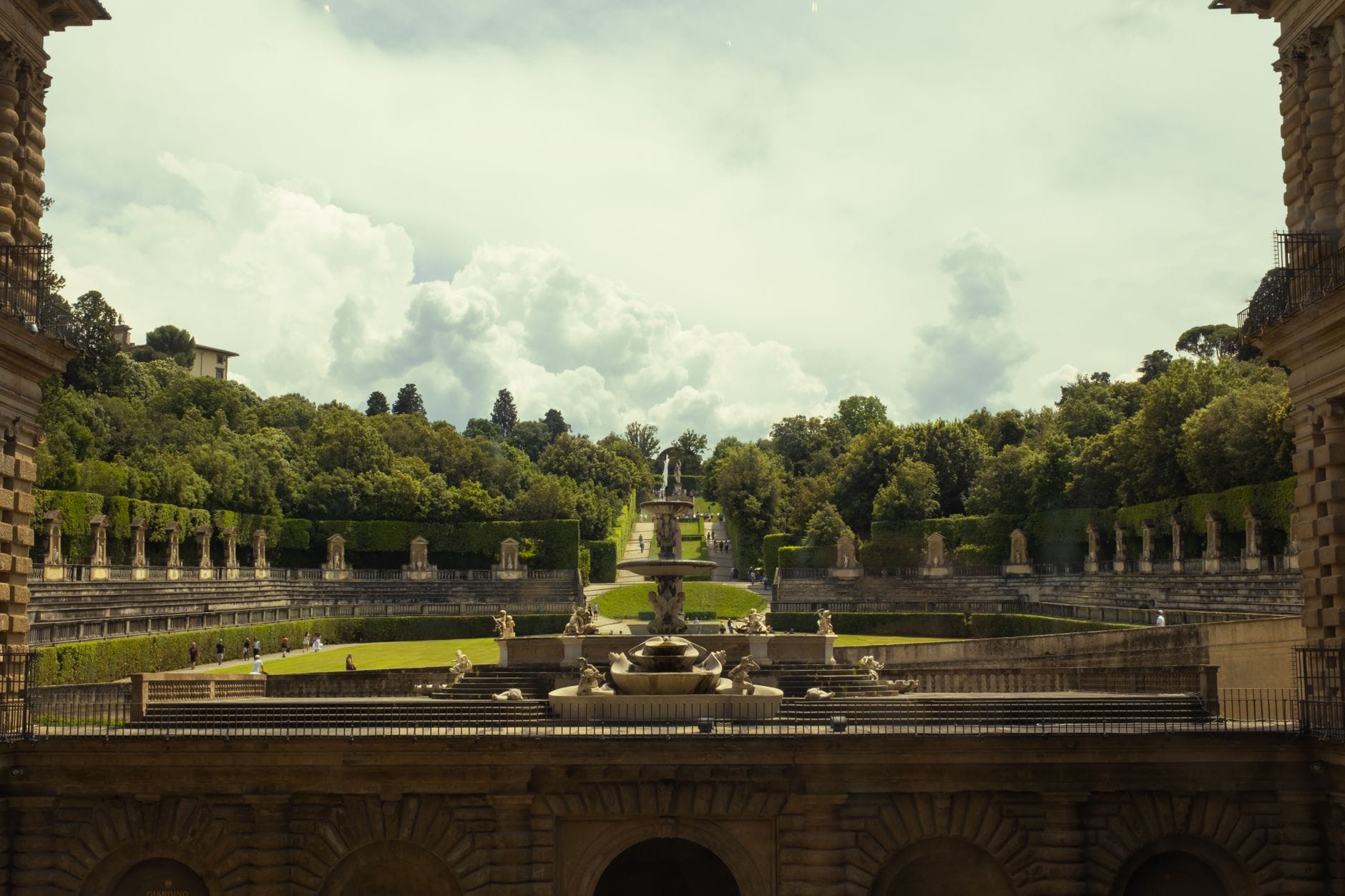
The Boboli Gardens, known in Italian as the Giardino di Boboli, are a historic park of around 30 hectares climbing the hillside directly behind Palazzo Pitti in Florence's Oltrarno district. They are not a conventional public park with lawns and benches. They are a designed landscape: a sequence of axes, terraces, fountains, grottos, and nearly 200 pieces of sculpture, many dating to the 16th and 17th centuries. The overall effect is closer to an open-air museum than a botanical garden, though the seasonal planting, cypress avenues, and oak groves give the space genuine natural weight.
For a traveller deciding how to allocate time in Florence, that distinction matters. If you want a quiet shaded walk with incidental beauty, the Boboli delivers that. If you want to understand Italian garden theory at a monumental scale, it delivers that too. What it does not offer is the informal ease of a city park: the terrain is hilly, the paths are largely unshaded in the central amphitheatre and on the upper terraces, and the distances between key features require real walking.
ℹ️ Good to know
Opening hours change by season. The gardens open at 08:15 and close at 16:30 in January, February, November and December; at 17:30 in March and October (standard time); at 18:30 in March (daylight saving time), April, May, September and October (daylight saving time); and at 19:10 in June, July and August. Last entry is one hour before closing. The gardens are also closed on the first and last Monday of each month and on 25 December. Check uffizi.it before you go.
Historical and Cultural Context
The gardens were laid out from the mid-16th century for the Medici family, who purchased Palazzo Pitti in 1549 and immediately commissioned a landscape garden to complement it. The project drew on then-emerging Italian Renaissance garden principles: geometric order, symbolic allusion to antiquity, and the integration of architecture with nature. Niccolò Tribolo is credited with the initial design, followed by Bartolomeo Ammannati and Bernardo Buontalenti, whose grotto work near the palace entrance remains one of the most visited features.
When the Medici ceded the palace to the city of Florence in 1919, the gardens passed into public ownership alongside the palace collections. The entire Pitti complex, including the Boboli, is now managed under the Uffizi Galleries administration. The gardens are also part of the Medici Villas and Gardens network, inscribed as a UNESCO World Heritage Site in 2013 as part of the broader recognition of Medici-era landscape architecture across Tuscany.
Visitors with particular interest in the Medici story will find the gardens work best in combination with the palace itself. ThePitti Palacehouses several museums, including the Palatine Gallery, and a combined ticket (€22) covers both. It is worth deciding before you arrive whether you want the gardens as your primary experience or as an add-on to the palace collections.
Tickets & tours
Live prices and dates from our booking partner. If you book, we may earn a commission at no extra cost to you.
The Layout: What You Actually Walk Through
Entering from Palazzo Pitti, you step into a large amphitheatre, an open oval basin originally used for Medici entertainments and spectacles. This is the geometric heart of the lower garden: the ground falls away to the palace behind you and rises steeply ahead. An Egyptian obelisk from Luxor, brought to Florence in the 19th century, stands at the centre. On hot days, the amphitheatre can feel exposed and reflective; early morning arrivals or visits in shoulder season are noticeably more comfortable.
From the amphitheatre, the main axis ascends through cypress-lined paths toward the Viottolone, a long double avenue of cypresses and ilex oaks running diagonally across the lower garden. This avenue, planted in the early 17th century, is one of the most visually arresting features: the trees form a dense canopy, the light changes as you pass under them, and the proportions give a sense of scale that photographs rarely capture accurately. The ground here is gravel, slightly uneven, and notably cooler than the open terraces.
At the upper level, the Kaffehaus, a small rococo pavilion built in the 18th century, marks the highest accessible viewpoint in the gardens. From here, on a clear day, you can see across the Oltrarno rooftops to the Duomo, with the hills of Fiesole visible to the north. The view is less crowded than Piazzale Michelangelo and requires more effort to reach, which tends to keep the terrace pleasantly uncrowded even during peak season.
The Isolotto, a large oval pond with an island at the garden's lower western end, is worth the detour. An ocean fountain by Giambologna and Stoldo Lorenzi sits at its centre, accessible by a small bridge. It is one of the few places in the Boboli where visitors tend to slow down and linger. If the upper views are what draws you, the nearbyForte di Belvedere(accessible via a gate from the upper garden when open) extends the hilltop experience considerably.
Time of Day and Seasonal Experience
Arrival at opening (08:15) gives you the lower garden in near-solitude. The early light is angled and warm, particularly flattering in the cypress avenue and around the Buontalenti Grotto near the palace entrance. By 10:30, group tours begin to arrive at the amphitheatre and the Neptune Fountain. By midday in summer, the upper terraces can be genuinely hot with little shade, and the gravel paths radiate heat. The gardens do not have easily accessible water refill points at all sections, so carry water.
The most comfortable visiting windows are mid-April through May and September through October. In spring, the wisteria and rose plantings near the lower terraces are in flower, and the garden's combination of green growth and pale stone reads at its best. In October, the ilex oaks and plane trees shift colour, the crowds thin substantially, and the late afternoon light across the Isolotto pond becomes genuinely striking.
Winter visits are underrated. The garden is far from empty, but crowds are minimal compared to summer, the skeletal form of the cypress avenues and the sculptural programme become more legible without dense foliage, and the low winter light is excellent for photography. The trade-off is early closing (16:30 from November through February), which makes a morning arrival even more important.
💡 Local tip
Photography tip: The Buontalenti Grotto, just inside the main Pitti entrance, is dimly lit and features Michelangelo's unfinished Prisoners in facsimile form within a stalactite-encrusted interior. A wide-aperture lens or a camera with good low-light performance will produce far better results than a smartphone in auto mode. Tripods are not permitted.
Practical Walkthrough: Getting There and Getting Around
The Boboli Gardens sit in the Oltrarno, Florence's south-bank neighbourhood. The main entrance is at Piazza de' Pitti 1, directly behind the palace facade. On foot from the historic centre, cross thePonte Vecchioand continue south along Via Guicciardini for roughly 10 minutes. From Santa Maria Novella station, the walk takes around 25 to 30 minutes through the centre. Local buses serve the Oltrarno and stop near Piazza de' Pitti; check current route information from Autolinee Toscane before relying on a specific number.
Additional access points exist via Via Romana to the south (Annalena entrance) and Forte di Belvedere and Porta Romana to the east and south (when open), but the Pitti entrance is the most practical for first-time visitors. Tickets can be purchased on-site or booked in advance online with a €3 reservation fee. Advance booking is advisable in high season (June through August) and around Italian public holidays, as visitor numbers at the palace and gardens peak sharply.
Accessibility is officially described as partial. The gardens are on a hillside: the lower areas around the amphitheatre are manageable on firm paths, but the upper terraces involve significant gradients and gravel surfaces. Wheelchair users and visitors with mobility limitations should review the accessibility notes on the official Uffizi website before visiting, as the experience differs considerably from the flat historic centre.
⚠️ What to skip
The gardens are closed on the first and last Monday of each month. This catches many visitors off-guard, particularly those combining a Pitti Palace visit on what they assume is a standard museum day. Confirm the calendar at uffizi.it before travelling to the Oltrarno for this specific attraction.
Honest Assessment: Is It Worth Your Time?
For travellers who have already seen the headline indoor museums, the Boboli Gardens offer something genuinely different: scale, air, and a slower pace. The garden does not reward a hurried 45-minute loop. The Isolotto, the Viottolone, and the upper viewpoints are spread across a large hill, and the sculpture programme requires some navigation to appreciate. Visitors who approach it as a tick-box stop on the way between the Pitti and thePiazzale Michelangelotend to leave underwhelmed. Those who give it two full hours and a map come away with one of the more memorable experiences in Florence.
Families with young children may find the hilly terrain tiring for smaller visitors, though the open amphitheatre and the Isolotto pond provide space to roam. For a more contained garden experience in the Oltrarno, theBardini Gardennearby offers a smaller, less crowded alternative with notable spring wisteria and good city views. Those primarily seeking panoramic vistas should note that Piazzale Michelangelo is a shorter and more direct walk from the Oltrarno and delivers a wider panorama with less physical effort.
The gardens fit naturally into a broader Oltrarno day. The neighbourhood itself repays slow exploration: theBasilica di Santo Spirito and the Cappella Brancacciare both within a 15-minute walk and represent some of Florence's most significant Renaissance interiors. Combining the gardens with one or both of these makes for a full and varied day on the south bank without crossing the Arno until the evening.
Insider Tips
- Enter at opening (08:15) and head directly to the Buontalenti Grotto before any tour groups arrive. It is one of the most extraordinary spaces in Florence, but it fills up quickly and the experience degrades sharply with crowds.
- The Kaffehaus pavilion at the upper garden level offers one of the highest accessible viewpoints in the Boboli. It is not a full restaurant, and any seasonal refreshment service is limited, but the shaded terrace with views that most visitors never reach makes it one of the quieter spots in the entire Oltrarno.
- If you are visiting in spring (late April through May), seek out the rose garden section on the lower eastern slope. It is less formally signposted than the main axes but holds some of the best floral colour in the garden at that time of year.
- The combined Pitti Palace ticket (€16) covers the palace museums as well as the Boboli. If you plan to spend any time inside the palace's Palatine Gallery, the combined ticket is significantly better value than buying the gardens alone and then a separate palace entry.
- The garden slopes mean that routes downhill from the Kaffehaus back toward the Isolotto and Viottolone are substantially easier on the legs than the reverse. Plan your circuit to go up early while you have energy and return via the lower western section.
Who Is Boboli Gardens For?
- Travellers on a second or third Florence visit who have covered the headline indoor museums
- Garden design and landscape history enthusiasts with an interest in Italian Renaissance and Baroque planning
- Photographers looking for monumental sculpture, architectural framing, and city views with fewer crowds than Piazzale Michelangelo
- Anyone needing outdoor time and open space after concentrated days of church and museum visits
- Visitors combining a full Oltrarno day with Pitti Palace, Santo Spirito, or the Brancacci Chapel
Nearby Attractions
Other things to see while in Oltrarno:
- Bardini Garden
Tucked into the hillside above the Oltrarno neighborhood, the Giardino Bardini is a 4-hectare historic garden offering panoramic views over Florence, a famous wisteria pergola, and a far more intimate atmosphere than its famous neighbor, the Boboli Gardens. Open daily (except the first and last Monday of each month) from April 1 through September 30, it rewards visitors who time their arrival carefully.
- Basilica di Santo Spirito
On the south side of the Arno, away from the crowds of the Duomo district, the Basilica di Santo Spirito stands as one of Florence's most complete Renaissance interiors. Designed by Filippo Brunelleschi in the late 1430s, it offers serene architecture, a Michelangelo crucifix, and a surrounding piazza that feels more Florentine than touristic.
- Cappella Brancacci
The Brancacci Chapel inside Santa Maria del Carmine holds one of the most significant fresco cycles in Western art. Painted by Masolino, Masaccio, and Filippino Lippi between 1424 and 1481, these images of St Peter's life transformed how painters understood light, space, and the human figure. Visits are intimate by design, capped at 30 people for 30 minutes, making advance booking essential.
- Forte di Belvedere
Perched on the Boboli hill above Palazzo Pitti, Forte di Belvedere is a 16th-century Medici fortress offering some of the most expansive views over Florence's rooftops and hills. Open seasonally for outdoor exhibitions and panoramic walks, it rewards the uphill effort with a perspective on the city that few tourists bother to find.
Planning a trip? Discover personalized activities with the Nomado app.