Piazzale Michelangelo: Florence's Panoramic Terrace Above the Arno
Perched on the hills south of the Arno, Piazzale Michelangelo is a 19th-century public terrace that frames the entire Florence skyline in a single glance. Admission is free and the square never closes, but timing your visit makes all the difference between a crowd-free revelation and a tourist scrum.
Quick Facts
- Location
- Piazzale Michelangelo, 50120 Florence (Oltrarno hillside, south of the Arno)
- Getting There
- Bus lines 12 or 13 from the city centre; about a 20-25 min walk uphill via the Rampe del Poggi from the river (near Piazza Giuseppe Poggi)
- Time Needed
- 30-60 minutes at the terrace; longer if walking up and exploring the hillside
- Cost
- Free. No ticket required. Standard city bus fare applies if using public transport.
- Best for
- Sunrise and sunset panoramas, photography, romantic evenings, first-day orientation
- Official website
- www.comune.firenze.it
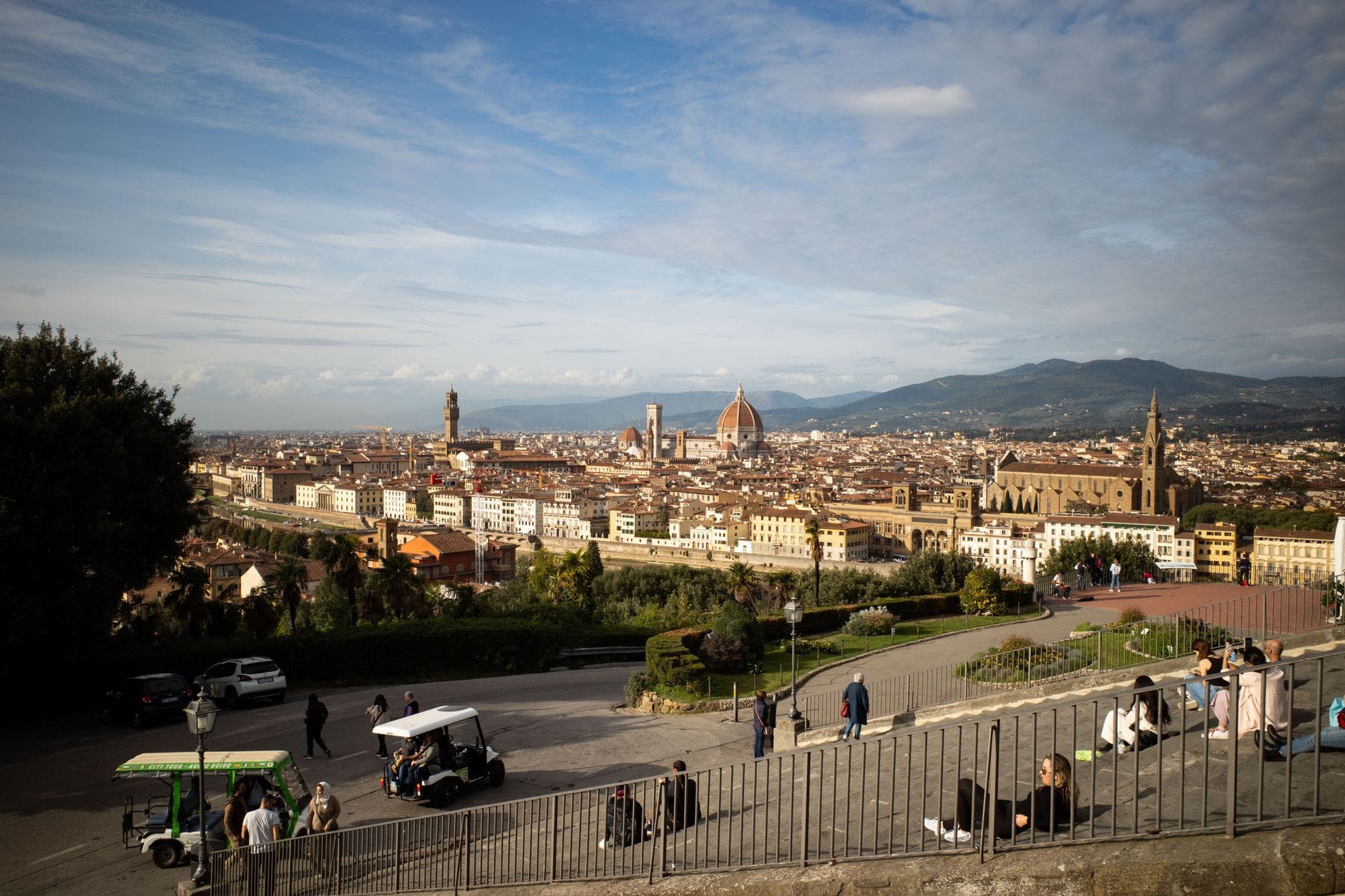
What Piazzale Michelangelo Actually Is
Piazzale Michelangelo is a large public terrace set into the hillside of the Oltrarno area, roughly 100 metres above the city centre. It was designed by Florentine architect Giuseppe Poggi and constructed around 1869, during the period when Florence served as the temporary capital of the unified Kingdom of Italy from 1865 to 1871. Poggi's brief was to modernise the city, and part of that project involved creating a grand viale, a tree-lined boulevard climbing the southern hills to connect the historic centre with a new panoramic piazza. The result is a terrace that frames the Florence skyline almost theatrically: the Duomo, Giotto's Campanile, the tower of Palazzo Vecchio, the arches of Ponte Vecchio, and the pale green band of the Arno all slot into view at once.
At the centre of the square stands a bronze copy of Michelangelo's David, installed around the time the square was inaugurated and accompanied by bronze copies of the four allegorical figures from the Medici tombs in the Basilica di San Lorenzo. These are not token decorations: they were placed here deliberately, a tribute to the artist whose name the square bears. The originals, of course, sit in climate-controlled museum rooms across the city, but seeing these dark bronze casts against an open Tuscan sky gives them a different kind of weight.
💡 Local tip
Piazzale Michelangelo is an open public terrace that is effectively accessible 24 hours a day, 365 days a year, and entry is completely free. No reservation, no queue, no ticket office. The only cost is getting there.
The View: What You Will Actually See
The panorama stretches roughly 180 degrees, taking in the full breadth of Florence from east to west. On clear days, the terrace gives an almost cartographic perspective: you can trace the line of the Arno as it bends through the city, spot the rust-orange dome of Santa Maria del Fiore rising above the medieval roofline, and pick out the crenellated towers of Palazzo Vecchio against the blue-grey hills of Fiesole in the distance. In the foreground, the tiled rooftops of the Oltrarno neighbourhood roll out directly below.
What photographs rarely convey is the sound layer. Traffic noise from the city drifts up faintly, but up here the dominant sounds are wind through the umbrella pines, pigeons, and the low hum of other visitors. On summer evenings, street musicians sometimes set up near the terrace walls. The stone balustrade is warm to the touch in afternoon sun and cool and slightly damp before dawn. These textures are part of the experience the view alone does not tell you about.
For a broader selection of Florence panoramas ranked by accessibility and quality, see our guide to thebest views in Florence. If you want to combine your visit with a climb inside the cathedral dome itself, theBrunelleschi Dome climboffers a close-up view in the opposite direction.
Tickets & tours
Live prices and dates from our booking partner. If you book, we may earn a commission at no extra cost to you.
E-bike night tour of Florence with stunning view from Piazzale Michelangelo
From 55 €Instant confirmationFree cancellationE-bike tour of Florence and Piazzale Michelangelo with surprise tasting
From 29 €Instant confirmationFree cancellationUffizi Gallery, Michelangelo's David and Accademia guided tour
From 119 €Instant confirmationFree cancellationAccademia skip-the-line tour of Michelangelo's David and highlights
From 47 €Instant confirmationFree cancellation
How the Terrace Changes Through the Day
The experience at Piazzale Michelangelo is not static. It shifts significantly depending on when you arrive, and that timing is the single most important practical decision you will make about this visit.
Sunrise (roughly 5:30-7:00am in summer, later in winter)
This is when the terrace is at its most atmospheric and least crowded. The city below is quiet, the light is soft and horizontal, and the dome of the Duomo catches the first orange glow before anything else. You may share the space with a handful of joggers, a few photographers with tripods, and the occasional dog walker. The air is noticeably cooler than midday, so carry a layer regardless of the season. In winter, mist sometimes settles in the Arno valley, leaving only the tower tops visible above a grey blanket, which is extraordinary if the sky above is clear.
Midday (10:00am-4:00pm)
This is the peak tourist window. Tour buses park along the road below the terrace, and the square fills with groups, selfie sticks, and souvenir vendors. The light is harsh for photography. In July and August, temperatures on the exposed terrace can be fierce, with no shade except near the loggia of the small bar-restaurant at the back of the square. If midday is your only option, the bar serves drinks and light food and has shaded outdoor seating, which makes the stop more bearable.
Sunset (golden hour to dusk)
Sunset draws the second-largest crowd but the quality of light justifies it. The western sky above the city turns pink and amber, the dome goes copper, and the Arno reflects whatever colour the sky is doing. Arrive at least 30 minutes before sunset to secure a spot along the balustrade. After dark, the city lights come on gradually and the terrace takes on a different, quieter character. Couples and small groups tend to stay well past sunset, sharing wine or snacks on the low walls.
⚠️ What to skip
Weekends from late spring through early autumn are significantly more crowded than weekdays, especially in the hour before and after sunset. If possible, visit on a Tuesday or Wednesday morning for the most peaceful experience.
Getting There: Your Options Compared
The most rewarding route is on foot via the Rampe del Poggi, a series of wide stone ramps and staircases designed by Poggi himself as the original ceremonial approach to the square. Starting near Piazza Giuseppe Poggi on the south bank of the Arno, the walk takes roughly 20 to 25 minutes at a steady pace. The path winds through cypress and pine, past the giardino delle rose below (worth a detour in May when the roses are in bloom), and up through the broader gardens. It is steep in sections and includes stairs, so it is not suitable for visitors with limited mobility or anyone pushing a stroller.
If the walk is not practical, ATAF city bus lines 12 and 13 run from the historic centre up to Piazzale Michelangelo, with other routes (such as 23, 23B, 370A and C4) passing nearby. A standard city bus ticket is required. Taxis and ride services can drop you at the square itself, which has a small parking area. For a broader picture of moving around Florence without a car, the guide togetting around Florencecovers all the main options.
Once you are on the terrace, the surface is flat, wide, and paved, making it comfortable for wheelchairs and easy to navigate. The challenge is purely the ascent. If accessibility matters, the bus is the practical solution.
Photography: Making the Most of the Light
The standard shot from Piazzale Michelangelo, the wide panorama with the Duomo centred and the Arno in the foreground, is one of the most reproduced images of Florence. That does not make it less worth taking, but it does mean the real photographic challenge here is finding a frame that is not already on ten thousand postcards.
Early morning gives you the best light and the cleanest foreground without crowds blocking the balustrade. Golden hour before sunset produces warmer tones and stronger shadow definition across the rooftops. For telephoto work, the dome and campanile compress beautifully against the Fiesole hills behind them. Wide-angle shots work best when you can include the bronze David in the foreground with the city behind, creating a sense of depth. Note that some museums in Florence restrict tripods indoors, but there are no such restrictions on this open public terrace.
💡 Local tip
Walk to the far east end of the terrace, away from the main crowd, for a slightly different angle on the city that includes more of the Oltrarno hillside and the church of San Miniato al Monte above you to the left.
The Neighbourhood Around the Terrace
Piazzale Michelangelo sits within the broaderOltrarnodistrict, the characterful south-bank neighbourhood that contains some of Florence's quieter pleasures. Directly above the terrace, a short further climb brings you to the Romanesque church of San Miniato al Monte, one of the oldest and most beautiful churches in the city, with a geometric marble facade and a hillside cemetery worth exploring. Below the square, the Giardino delle Rose, a public rose garden, opens seasonally and is free to enter.
Heading back downhill toward the river, the neighbourhood of San Niccolò unfolds with a string of local bars, trattorias, and artisan studios that are considerably less touristy than the historic centre. ThePonte Vecchiois a 20-minute walk north once you descend, making it straightforward to combine the two in a single afternoon or evening loop.
Who Should Reconsider This Visit
Piazzale Michelangelo is not for everyone. Visitors who have limited time and want maximum museum content per hour will find the terrace a slow investment: you spend time getting there and standing around rather than moving through exhibition rooms. Those who struggle with steep inclines will find the walking route punishing, and while the bus solves that, the journey itself is less interesting.
If you have already seen Florence from the Brunelleschi Dome or from the top of Giotto's Campanile, the Piazzale view, while wider, covers familiar ground. On overcast days when the hills disappear and the light is flat, the payoff is notably reduced. And anyone expecting a quiet, contemplative space at midday in July will be disappointed.
Insider Tips
- Come at sunrise on a weekday. The terrace is nearly empty, the light is spectacular, and you will have the balustrade entirely to yourself for stretches of ten minutes at a time. Bring a jacket even in summer.
- The small bar-restaurant at the back of the terrace (inside a loggia) serves espresso, aperitivo drinks, and snacks. It is unremarkable as a restaurant but genuinely useful as a rest stop, especially in midday heat when shade is scarce on the exposed terrace.
- Walk up via the Rampe del Poggi rather than taking the bus. The ramp route passes through landscaped gardens, gives you views that build gradually rather than appearing all at once, and is far more interesting than arriving by road. Allow 30 minutes to enjoy the walk properly.
- Immediately above Piazzale Michelangelo, the church of San Miniato al Monte is a 10-minute walk further uphill. It is one of Florence's finest Romanesque buildings and is much less visited than the sites in the centre. The afternoon light inside is extraordinary, especially in the lower crypt.
- The bronze David at the centre of the square is often ignored in favour of the view, but it rewards a close look. The patina varies dramatically across the surface depending on weathering and handling, and the surrounding Medici tomb copies are fine works in their own right.
Who Is Piazzale Michelangelo For?
- First-time visitors who want to understand Florence's geography before diving into the museums
- Photographers looking for the classic Florence skyline in optimal light conditions
- Couples seeking a sunset or evening atmosphere without paying for a rooftop bar
- Families with older children who can manage the uphill walk and enjoy an outdoor reward at the top
- Anyone on a tight budget who wants a genuinely memorable Florence experience at zero cost
Nearby Attractions
Other things to see while in Oltrarno:
- Bardini Garden
Tucked into the hillside above the Oltrarno neighborhood, the Giardino Bardini is a 4-hectare historic garden offering panoramic views over Florence, a famous wisteria pergola, and a far more intimate atmosphere than its famous neighbor, the Boboli Gardens. Open daily (except the first and last Monday of each month) from April 1 through September 30, it rewards visitors who time their arrival carefully.
- Basilica di Santo Spirito
On the south side of the Arno, away from the crowds of the Duomo district, the Basilica di Santo Spirito stands as one of Florence's most complete Renaissance interiors. Designed by Filippo Brunelleschi in the late 1430s, it offers serene architecture, a Michelangelo crucifix, and a surrounding piazza that feels more Florentine than touristic.
- Boboli Gardens
Spread across 30 hectares behind Palazzo Pitti in the Oltrarno, the Boboli Gardens are one of Italy's finest examples of Italian Renaissance and Baroque garden design. Laid out from the mid-16th century as a private Medici retreat, the grounds combine terraced lawns, shaded groves, monumental fountains, and open-air sculpture across a hillside with sweeping views over Florence.
- Cappella Brancacci
The Brancacci Chapel inside Santa Maria del Carmine holds one of the most significant fresco cycles in Western art. Painted by Masolino, Masaccio, and Filippino Lippi between 1424 and 1481, these images of St Peter's life transformed how painters understood light, space, and the human figure. Visits are intimate by design, capped at 30 people for 30 minutes, making advance booking essential.
Planning a trip? Discover personalized activities with the Nomado app.